

P1451 on 2009-2010 Dodge Ram 2500 6.7L Cummins: DPF System Performance Causes and Fixes
On a 2009-2010 Ram 6.7L Cummins, P1451 means the Diesel Particulate Filter (DPF) is overloaded with soot. The most common fix is inspecting and cleaning or replacing the DPF pressure sensor hoses, which often crack or clog with soot. This is a cheap fix, costing around $20-$50 for new hoses. Also, ensure the metal ports the hoses connect to are clear, as they are a major chokepoint.
- P1451 specifically means 'Diesel Particulate Filter System Performance' on a Dodge Ram with a Cummins engine; it is not an EVAP code.
- Before buying any parts, check the simple things: ensure your driving habits allow for DPF regeneration (sustained highway driving) and thoroughly inspect the DPF pressure sensor hoses for cracks, melting, or clogs.
- This code is a warning. Ignoring it can lead to a fully clogged DPF, putting the truck in limp mode and risking a very expensive repair.
- Do not immediately assume the DPF itself is bad. The problem is almost always a much cheaper component like a hose or sensor.
What's Unique About the 2009-2010 Dodge Ram 2500
On the 6.7L Cummins engine, the DPF system is highly sensitive to driving cycles. This platform was among the first to incorporate DPFs on a wide scale for consumer trucks, and the control logic can be sensitive. Frequent short trips, prolonged idling, or light-load driving often prevent the exhaust from reaching the high temperatures needed for automatic regeneration, leading to soot buildup and the P1451 code. The most common failure points are not the expensive DPF itself, but the simple rubber hoses and sensors that monitor it. Forum users on 'cumminsforum.com' and 'hdrams.com' frequently report success after simply cleaning or replacing these inexpensive parts.
Generation note: The 2009 model year is the end of the 3rd Generation Ram, while 2010 marks the beginning of the 4th Generation. While both use the 6.7L Cummins with a DPF system and the meaning of P1451 is the same, there may be slight differences in the location and part numbers of components like the DPF pressure sensor and its hoses. The DPF pressure sensor is typically located on a bracket on the transmission.
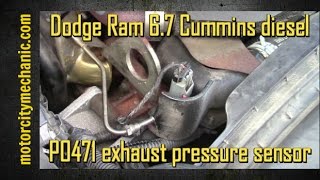
🎬 Watch: Locating and replacing the exhaust pressure sensor.Symptoms You May Notice
- Message on the Electronic Vehicle Information Center (EVIC), such as "CATALYST FULL" or "Exhaust Filter Full See Dealer".
- Engine power is reduced (limp mode) if the problem is ignored.
- Active DPF regeneration cycles may be disabled by the PCM.
- Check Engine Light may eventually illuminate if the condition persists, though P1451 often appears first without a light.
- Replacing the entire Diesel Particulate Filter (DPF) assembly. The DPF is very expensive and is rarely the root cause of this code. It is usually a symptom of a problem with a much cheaper component, like a sensor hose or the sensor itself.
- Replacing the DPF pressure sensor without first thoroughly cleaning both the rubber hoses and, critically, the metal connection ports on the DPF housing. 🎬 See this guide on cleaning soot and ash from ports.
Most Likely Causes
- Cracked, Melted, or Clogged DPF Pressure Sensor Hoses 🔴 High Probability The rubber hoses are exposed to high heat from the exhaust system, causing them to become brittle, crack, or melt over time. Soot can also build up and clog the hoses or the metal ports they connect to, which is a very common and often overlooked blockage point.
How to confirm: Visually inspect the two rubber hoses running from the DPF to the differential pressure sensor. Remove them and check for cracks, holes, or soft/melted spots. Try blowing compressed air through them to check for blockages. Crucially, use a small wire or a 1/8" drill bit (turned by hand) to clean the metal ports on the DPF housing, as they are a major chokepoint for hard carbon buildup.
Typical fix: Replace the damaged or clogged hoses with high-temperature silicone replacements. Clean the metal ports on the DPF housing thoroughly. The downstream hose is a very common replacement.
Est. part cost: $20-$50 - Driving Habits Preventing DPF Regeneration 🔴 High Probability The DPF requires sustained highway speeds (typically over 50 mph for 20-30 minutes) to generate enough heat to burn off trapped soot. Trucks used for frequent short trips, city driving, or that idle excessively may never complete a regeneration cycle, triggering the 'CATALYST FULL' message.
How to confirm: Review the vehicle's recent usage. If it has been primarily driven for short distances or idled for long periods, this is a likely cause. A scan tool like AlfaOBD can show the DPF soot load percentage.
Typical fix: Drive the vehicle at sustained highway speeds for an extended period (30-45 minutes) to allow a full regeneration cycle to complete. If the DPF is too clogged, a forced stationary regeneration may need to be initiated with a diagnostic scan tool.
Est. part cost: $0 - Failed DPF Differential Pressure Sensor 🟡 Medium Probability The sensor operates in a harsh environment and can fail electronically over time, sending incorrect pressure readings to the PCM. It is mounted on the transmission, away from the DPF itself, but is still subject to heat and vibration.
How to confirm: After confirming the hoses and ports are clear, use a scan tool to monitor the DPF pressure sensor voltage or pressure reading with the key on, engine off (KOEO). It should read at or very near zero (0.0 PSI). If it shows a significant pressure reading, or the voltage is stuck, the sensor is likely faulty.
Typical fix: Replace the DPF differential pressure sensor. It is typically mounted on a bracket on the transmission.
Est. part cost: $50-$150
Rare But Worth Checking
- Underlying Engine Issue Causing Excessive Soot: If the DPF clogs up again quickly after being cleaned, it may be a symptom of a larger problem. Check for issues like leaking fuel injectors, a stuck-open EGR valve, or a failing turbocharger that can cause the engine to produce excessive black smoke (soot).
- Faulty Thermostat: A thermostat that is stuck open can prevent the engine from reaching the operating temperature required for DPF regeneration, especially in colder climates. This may also set a P0128 code, and forum users have noted a connection between P0128 and P1451 in cold weather.
- Chafed Wiring Harness: There is a known failure point where the DPF sensor wiring harness can rub against a metal grounding strap on the transmission bell housing, causing a short in the signal wire. This may set other codes like P2454 but can be a root cause.
Diagnosis Steps
- Check Driving Habits: First, consider if the truck's recent driving patterns (short trips, long idle times) have prevented a DPF regeneration. If so, attempt a long highway drive (30+ minutes at 50+ mph) to initiate a cycle.
- Inspect DPF Pressure Sensor Hoses: Get under the truck and visually inspect the two rubber hoses running from the DPF to the pressure sensor. Look for cracks, melting, or holes.
- Check for Clogs: Remove the hoses and attempt to blow compressed air through them. If they are blocked, they must be replaced. Critically, use a small wire or a 1/8" drill bit (turned by hand) to gently clean the metal ports on the DPF where the hoses connect, as these are a major source of blockage.
- Inspect Sensor Wiring: Examine the electrical connector and wiring going to the DPF pressure sensor. Pay close attention to the harness routing near the transmission bell housing for any signs of chafing, corrosion, or loose connections. 🎬 Watch: How to inspect and repair DPF sensor wiring issues.
- Test the DPF Pressure Sensor: With a scan tool, observe the sensor's readings. With the key on and engine off, the pressure should read at or very near zero (0.0 PSI). If it shows a significant pressure reading, the sensor is faulty.
- Check for PCM Software Updates: Contact a Ram dealer to see if your VIN has had TSB #18-012-12 REV. A performed. This software update was released to correct overly sensitive diagnostics for P1451 and other related codes.
- Forced Regeneration/Replacement: If the DPF is confirmed to be clogged and a highway drive does not clear it, a mechanic may need to perform a forced (stationary) regeneration with a capable scan tool (like AlfaOBD or wiTECH). In severe cases of ash accumulation (often indicated by code P242F), the DPF may need to be professionally cleaned or replaced.
Parts You'll Likely Need
- DPF Pressure Sensor Hoses
(OEM #Upstream: 68363173AC, Downstream: 68363177AC)— These hoses are the most common failure point, frequently cracking, melting, or clogging with soot due to heat and exhaust exposure.
Trusted brands: Mopar, Dorman, Gates
OEM price range: $40-$80
Aftermarket price range: $20-$50 - DPF Differential Pressure Sensor
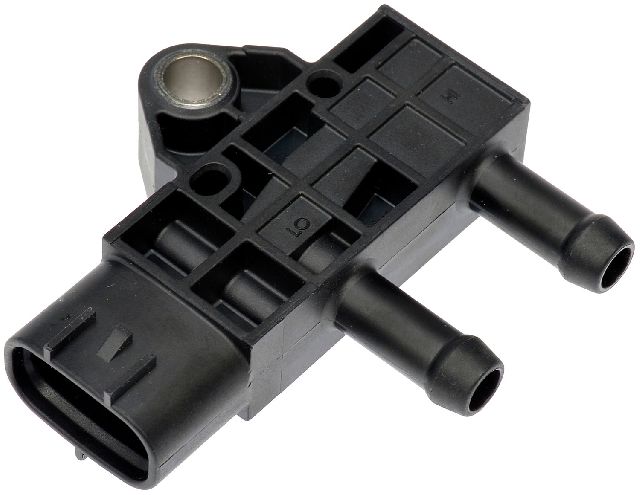
(OEM #05149229AA)— If the hoses and wiring are intact, the sensor itself is the next most likely part to have failed, providing incorrect readings to the PCM.
Trusted brands: Mopar, Bosch, Standard Motor Products
OEM price range: $100-$180
Aftermarket price range: $50-$150
Related Codes That Often Appear With This One
- P2463 — This code for 'DPF Restriction - Soot Accumulation' is a more severe indicator of the same problem, often appearing after P1451 has been present for some time.
- P2002 — This code for 'DPF Efficiency Below Threshold' relates to the same DPF performance monitoring system and is addressed in the same TSB (18-012-12 REV. A) as P1451.
- P242F — This code indicates 'DPF Restriction - Ash Accumulation'. Ash is the non-burnable material left after soot regeneration. If this code is present, the DPF may be at the end of its service life and require professional cleaning or replacement.
- P0128 — This code for 'Coolant Thermostat Malfunction' can cause P1451. If the engine doesn't get hot enough, it cannot perform a DPF regeneration, leading to soot buildup. This is especially common in cold climates.
Technical Service Bulletins (TSBs) & Recalls
- TSB #18-012-12 REV. A: Released November 21, 2012, this TSB involves a PCM software update to improve diagnostic and system performance. It specifically addresses false or premature setting of P1451, as well as P0101, P0471, P2002, and others, especially for cold climate or high altitude issues. A dealer can check if this update has been applied to the vehicle's VIN.
Platform-Specific Known Issues
- Metal Port Clogging: A very common issue on this platform is not just the rubber hoses clogging, but the small metal tubes or ports on the DPF housing itself getting packed with hard carbon. Many owners replace hoses and sensors only to find the problem persists because they didn't clear these ports with a wire or small drill bit.
- Cold Climate Issues: Owners in cold climates report a higher frequency of P1451 and related regeneration issues. The cold ambient temperatures can make it difficult for the exhaust system to reach and maintain the high temperatures needed for a successful regen, especially on short trips. This can be compounded by a thermostat that is failing open (P0128). Manufacturer service bulletin TSB #18-012-12 REV. A specifically notes that P0471 and P1451 can be triggered by cold climate or icing concerns.
Mechanic-Grade Diagnostic Values
- DPF Differential Pressure Sensor Signal Voltage (Key On, Engine Off) — expected: 0.68 - 0.77 VDC. Failure: A reading outside this range suggests a biased or faulty sensor. A reading near 0V or 5V points to a circuit issue.
- DPF Differential Pressure Sensor 5V Supply (Key On, Engine Off) — expected: 4.9V - 5.1V. Failure: Voltage outside this range indicates a problem with the wiring or the PCM, not the sensor.
- DPF Differential Pressure Sensor Ground Circuit Resistance — expected: < 10.0 Ohms. Failure: Resistance higher than 10 ohms points to a poor ground connection, which can cause erratic sensor readings.
- DPF Differential Pressure (Key On, Engine Off) via Scan Tool — expected: ~0.0 PSI. Failure: Any significant pressure reading with the engine off indicates a biased or failed sensor.
- DPF Differential Pressure (Engine at Idle) via Scan Tool — expected: 0.1 - 0.3 PSI. Failure: Pressure should increase smoothly with RPM. If it's stuck or erratic, suspect the sensor or blockages.
Scan Tool Commands That Help
- wiTECH: Flash ECU / Reprogram Engine Control Module (ECM) — Used to apply the software update from TSB #18-012-12 REV. A, which was released to correct overly sensitive diagnostics for P1451 and related codes. This should be checked before replacing parts.
- wiTECH or equivalent (AlfaOBD): Stationary Desoot / Forced DPF Regeneration — This is a service function used when the DPF is too clogged to regenerate during normal driving. It forces the engine to run at specific parameters while parked to burn off excessive soot. This is attempted after confirming sensors and hoses are good.
Wiring & Ground Locations
- DPF Pressure Sensor Connector — On the sensor itself, which is typically mounted to a bracket on the passenger side of the transmission.. This 3-pin connector is the primary test point for verifying the 5V reference, ground, and signal wires with a multimeter to diagnose a faulty sensor versus a wiring problem.
- Harness Chafe Point — The DPF sensor wiring harness where it routes near a metal ground strap on the passenger side of the transmission bell housing.. This is a documented failure point where the harness can rub through, causing the signal wire to short to ground. This can trigger P1451 or related codes like P2454 even if the sensor and hoses are perfectly fine.
- Main Engine Ground — A large ground cable runs from the negative battery terminal to the left front of the engine block.. While not a direct cause, a poor main engine ground can create a host of electrical issues and erratic sensor behavior across the vehicle. Ensuring this connection is clean and tight is a fundamental step in any electrical diagnosis.
Real Owner Repair Stories
- Ranger-Forums user 'fieroaddict' (Ford Ranger (Concept applies to Ram)) — Persistent P1451 code that would not clear.
❌ Tried (didn't work) Replacing the purge solenoid, Replacing the canister vent valve, Replacing the PCM (computer)
✅ What actually fixed it Found a spot where the wiring loom had rubbed through on a bracket, causing three wires to corrode and break. Repairing the broken wires in the harness resolved the code. - NHTSA ODI #11270262 — An owner reported that after P1451 appeared, the vehicle was pulled over to the side of the road and failed to restart. The failure reportedly recurred five times.
- NHTSA ODI #10239733 — An owner reported that while busy plowing snow, the engine code P1451 appeared. Despite having the dealer flash the ECM as per a TSB, the engine light remained on.
OEM Part Supersession History
5149044AA, 68043725AA→05149229AA— Standard part revision and consolidation by the manufacturer.
Model Year Variations Within This Range
- 2009 vs 2010: The 2009 model is the last year of the 3rd Generation Ram, while the 2010 model is the first year of the 4th Generation. While the 6.7L Cummins and its DPF system are fundamentally the same for this code, there can be minor differences in harness routing, bracket locations for sensors, and specific part numbers for non-engine components due to the chassis change.
Diagnostic Flowchart
Used vs. New Parts: Buying Guide for This Vehicle
When a used part is the smart pick: For this repair, used parts are generally not recommended. The primary failure items (hoses, sensor) are relatively inexpensive new and are wear-and-tear items. A used sensor or hose carries a high risk of having the same issue or a short remaining service life.
Donor-vehicle mileage cap: roughly under 30000 miles for the part to have meaningful remaining life.
What to inspect on the donor part:
- If considering a used sensor, visually inspect the plastic for any signs of heat stress, cracking, or brittleness.
- Check the electrical pins to ensure they are clean, straight, and free of corrosion.
- For hoses, they must be pliable with no signs of cracking, swelling, or hardness. This is very difficult to find in a used part.
OEM-only on this vehicle (don't cheap out):
- Diesel Particulate Filter (DPF) Assembly: Aftermarket DPFs can have issues with backpressure and soot capacity, potentially leading to more frequent regenerations and premature failure compared to the genuine Cummins part.
Aftermarket brands forum-validated for this vehicle:
- For Hoses: Gates, Dorman (ensure they are rated for high temperature).
- For Sensor: Bosch, Standard Motor Products (SMP).
Brands owners have reported issues with on this vehicle:
- Unnamed, no-brand sensors from online marketplaces should be avoided as their calibration and longevity are highly questionable.
Real Owner Stories
Aggregated from forums and TSBs cited above. Mileages and costs reflect what owners reported in those sources.
2009-2010 Dodge Ram 2500 6.7L Cummins Diesel
Symptoms: The P1451 code and 'CATALYST FULL' message kept returning even after replacing the DPF pressure sensor and the rubber hoses.
What fixed it: The problem was finally resolved by cleaning the small metal ports on the DPF housing itself, which were packed with hard carbon buildup, using a small wire.
Source hint: vehicle_specific_issues: Metal Port Clogging
2009-2010 Dodge Ram 2500 6.7L Cummins Diesel
Symptoms: The truck was setting a P1451 code and displaying a 'DPF full' message prematurely, particularly in cold weather or at high altitude, even when driving habits were correct.
What fixed it: A dealer performed a PCM software update according to TSB #18-012-12 REV. A, which recalibrated the system's diagnostic sensitivity.
Source hint: TSB #18-012-12 REV. A
2009-2010 Dodge Ram 2500 6.7L Cummins Diesel
Symptoms: The owner was still getting a 'DPF full' message and code P1451 even though the truck's DPF system had been physically deleted.
What fixed it: The issue was traced to an incorrect software tune being used for the deleted system. A proper tune that accounted for the removed hardware was required to clear the code.
Source hint: Diesel Truck Resource Forums thread titled 'ANY IDEAS??? Deleted 6.7 and still getting DPF full message with smarty'
Related OBD-II Codes
Frequently Asked Questions
Is there a software update for the P1451 code on my 2010 Ram 2500?
I mostly drive my Ram in the city for short trips. Could this cause the 'CATALYST FULL' message?
I replaced the DPF pressure sensor hoses but the P1451 code came back. What did I miss?
Where is the DPF differential pressure sensor located on my 2009 Ram 6.7L?
Why do I seem to get the P1451 code more often in the winter?
What's the first thing I should check for P1451 before spending any money?
Will my 2009 Ram 3500 have the same P1451 problem?
Helpful Videos
We Have This Part in Stock


The information in this article is provided for general reference and educational purposes only. Vehicle specifications, procedures, and part compatibility can vary by production date, trim level, and region. Always consult your vehicle's factory service manual and verify part numbers before purchasing or performing repairs. Safety-critical components such as airbags, seat belts, and braking systems should be installed by a qualified professional.
- Dodge Ram 2500:
- 🎬 Helpful Videos
- 🛍️ Shop This Part
- What's Unique About the 2009-2010 Dodge Ram 2500
- Symptoms You May Notice
- Most Likely Causes
- Rare But Worth Checking
- Diagnosis Steps
- Parts You'll Likely Need
- Related Codes That Often Appear With This One
- Technical Service Bulletins (TSBs) & Recalls
- Platform-Specific Known Issues
- Mechanic-Grade Diagnostic Values
- Scan Tool Commands That Help
- Wiring & Ground Locations
- Real Owner Repair Stories
- OEM Part Supersession History
- Model Year Variations Within This Range
- Diagnostic Flowchart
- Used vs. New Parts: Buying Guide for This Vehicle
- Real Owner Stories
- 2009-2010 Dodge Ram 2500 6.7L Cummins Diesel
- 2009-2010 Dodge Ram 2500 6.7L Cummins Diesel
- 2009-2010 Dodge Ram 2500 6.7L Cummins Diesel
- Related OBD-II Codes
- Frequently Asked Questions
- 🎟️ Get 5% Off