

P1441 on 2013-2019 Ram 1500 5.7L Hemi: EVAP Flow During Non-Purge Causes and Fixes
Code P1441 on a Ram 1500 means fuel vapor is flowing to the engine when it shouldn't be. The most likely causes are a faulty EVAP purge valve under the hood or a bad fuel tank pressure sensor near the fuel filler neck. On 5th Gen (2019+) trucks with fueling issues, a faulty Fuel Tank Pressure Sensor/Recirculation Tube Assembly is a known problem. Expect to spend $40-$100 for the part, with DIY difficulty rated at 2/5 for the purge valve.
- P1441 means fuel vapor is flowing when it shouldn't, usually due to a part being stuck open.
- The most likely fix is replacing the EVAP purge valve, located on the engine. It's an affordable part and a straightforward DIY job.
- Before buying parts, check for other codes. On these trucks, P1441 can also be caused by a bad Fuel Tank Pressure sensor or a cracked hose near the fuel tank.
- Never 'top off' your fuel tank. Consistently forcing more fuel in after the pump stops will damage the charcoal canister, leading to a much more expensive repair.
What's Unique About the 2013-2019 Ram 1500
While P1441 often points to a simple purge valve failure on many vehicles, on the Ram 1500 it can be more complex. These trucks use an Evaporative System Integrity Monitor (ESIM) switch instead of a traditional vent solenoid, which changes the diagnostic approach slightly. Furthermore, on this platform, P1441 (or the related generic code P0441) is often linked to other issues like difficulty filling the fuel tank. This symptom, especially when paired with code P062A, strongly suggests problems at the rear of the truck, such as a faulty Fuel Tank Pressure (FTP) sensor, a clogged canister filter due to dusty conditions (per TSB 25-001-21), or a chewed/cracked hose.
Generation note: This range covers two generations: the 4th Generation (2013-2018 and 2019 'Classic') and the 5th Generation (2019 'All-New' DT). While many EVAP parts like the purge valve are similar, diagnostic procedures can differ. A known issue on 5th Gen models points towards the Fuel Tank Pressure sensor assembly (P/N 52029939AC) causing P0441 and fueling issues. 🎬 Watch: 5th Gen Ram P0441 diagnosis and sensor location Cracked hoses near the tank have been documented on 4th Gen trucks, sometimes due to rodent damage.
Symptoms You May Notice
- Check Engine Light is on
- Vehicle may not switch into MDS/ECO mode
- Possible slight decrease in fuel economy
- Potential for a faint fuel smell, especially near the rear of the truck
- In some cases, difficulty starting the engine right after refueling
- May be accompanied by the fuel pump nozzle clicking off repeatedly when trying to fill the tank
- Replacing the gas cap. While a bad gas cap can cause other EVAP codes (like P0456 for a small leak), it is not a typical cause for a P1441 'flow' code, which indicates a component is stuck open rather than a system sealing issue.
Most Likely Causes
- Faulty EVAP Purge Valve / Solenoid 🔴 High Probability This is a common failure point on most modern vehicles. The valve's internal seal wears out or it gets stuck open with debris or age, allowing fuel vapor to flow when the valve should be closed.
How to confirm: Remove the valve from the engine. With no power applied, try to blow through it or apply vacuum with a hand pump. It should be sealed completely. If air passes through or it won't hold vacuum, it has failed.
Typical fix: Replace the EVAP purge valve assembly. It is located on the passenger side of the engine under the plastic 'Hemi' cover and is held on by a slide-mount and two quick-connect hoses. 🎬 See this step-by-step 5.7L Hemi purge valve replacement
Est. part cost: $40-$90 - Faulty Fuel Tank Pressure (FTP) Sensor 🟡 Medium Probability On 5th generation (2019+) Ram 1500s, this sensor has been documented to fail, causing a P0441 code by sending incorrect pressure readings to the computer, mimicking a flow issue. Owners report this part being replaced under warranty to solve both the code and refueling problems.
How to confirm: A mechanic with a capable scan tool can observe the FTP sensor voltage with the gas cap off (at atmospheric pressure). If the voltage is skewed (e.g., near 0V or 5V instead of ~2.5V), the sensor is likely bad.
Typical fix: Replace the Fuel Tank Pressure sensor, which is located near the fuel filler neck, on top of the fuel tank. On some models, it is part of a larger recirculation tube assembly.
Est. part cost: $110-$160 - Cracked or Disconnected EVAP Hose 🟡 Medium Probability Rubber and plastic hoses become brittle over time with exposure to heat and fuel vapors. Rodents can also chew through these lines, particularly on trucks that are parked outside. A specific hose between the tank and canister is a known weak point.
How to confirm: Visually inspect all accessible EVAP lines running from the engine bay to the charcoal canister near the fuel tank. Look for obvious cracks, damage, or disconnections. A smoke test is the most effective way to find small, hard-to-see leaks.
Typical fix: Replace the damaged section of hose. Mopar offers pre-formed hoses for specific sections, such as part number 55398515AB for a line near the tank on 4th Gen models.
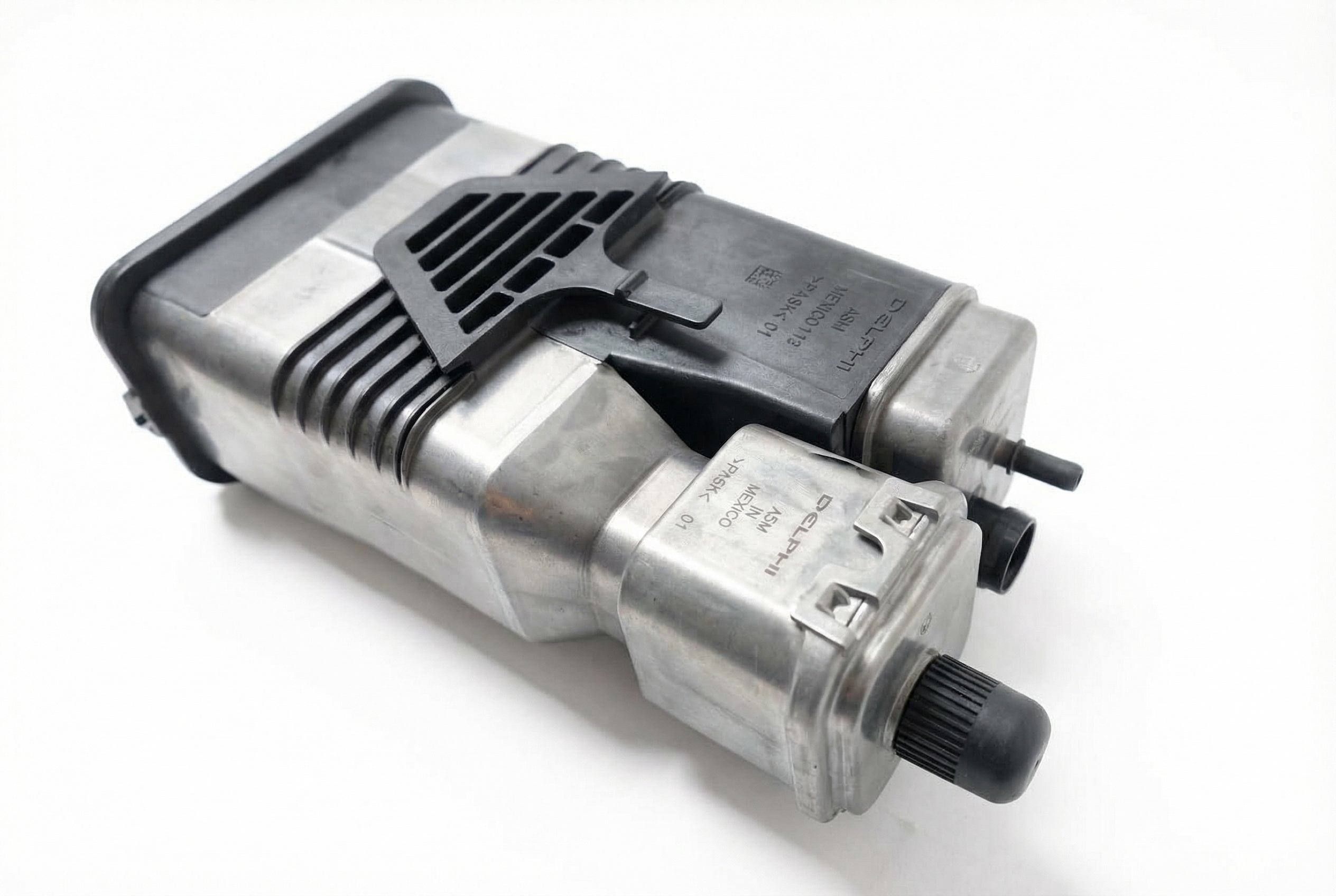
Est. part cost: $20-$80 - Saturated or Failed Charcoal Canister ⚪ Low Probability This is almost always caused by habitually overfilling the fuel tank (continuing to pump after the nozzle clicks off). This forces liquid fuel into the canister, which is only designed to handle vapor. In dusty environments, the canister's external filter can also become clogged, causing similar symptoms.
How to confirm: A strong, persistent fuel odor from the rear of the truck is a major clue. If the purge valve is confirmed good but the code returns, and especially if you have trouble refueling, the canister is the next suspect.
Typical fix: Replace the charcoal canister assembly, located near the fuel tank. This must be paired with changing the habit of overfilling the tank. For trucks in dusty areas, a dual filter kit (Mopar #68478013AA) may be needed per TSB 25-001-21.
Est. part cost: $150-$250
Diagnosis Steps
- Read Codes: Use an OBD-II scanner to confirm P1441 and check for any other related codes, especially P062A.
- Inspect Gas Cap: Ensure the gas cap (if not a capless system) is tight and the seal is not cracked or dirty. While not the most likely cause, it's a free and easy check.
- Visual Inspection: Check the EVAP hoses in the engine bay around the purge solenoid for any obvious cracks, loose connections, or damage. Then, inspect the lines near the fuel tank and charcoal canister for damage, particularly for signs of rodent activity.
- Test the Purge Valve: This is the most common culprit. Disconnect the valve. It should be normally closed. Try to blow air through it; if you can, it's stuck open and needs to be replaced.
- Advanced Scan Tool Diagnosis: If the purge valve is good, the next step requires a bi-directional scan tool. Monitor the Fuel Tank Pressure (FTP) sensor reading. With the engine off and gas cap removed, it should read near 0 inches of water and ~2.5 volts. If the reading is heavily skewed, the FTP sensor is likely faulty.
- Smoke Test: If sensors and the purge valve appear to be working, introduce smoke into the EVAP system to check for hard-to-see leaks in the lines or canister. This is the definitive test for finding cracked hoses or a faulty canister.
- Check TSBs: If the vehicle is operated in a dusty environment and experiences fueling issues, review TSB 25-001-19 REV. A (or later) regarding a clogged canister filter.
Parts You'll Likely Need
- EVAP Purge Valve / Solenoid
(OEM #04627996AC)— This is the most frequent failure point for a P1441 code. It gets stuck open, causing the improper flow condition detected by the computer. This part number supersedes 4627996AA and 4627996AB.
Trusted brands: Mopar, Standard Motor Products, Dorman
OEM price range: $60-$90
Aftermarket price range: $40-$70 - Fuel Tank Pressure Sensor
(OEM #52029939AC)— A known issue, particularly on 5th Gen (2019+) models, where a faulty sensor sends incorrect data, tricking the computer into setting a P0441 code. This part is often a 'Fuel Tank Pressure Sensor/Recirculation Tube Assembly'.
Trusted brands: Mopar, Bosch
OEM price range: $110-$160
Aftermarket price range: $80-$120 - EVAP Hose (Tank to Canister)
(OEM #55398515AB)— This specific hose for 4th Gen (2013-2018, 2019 Classic) models can crack or be damaged by rodents, causing a vacuum leak that can contribute to flow-related codes.
Trusted brands: Mopar
OEM price range: $50-$80
Aftermarket price range: N/A
Related Codes That Often Appear With This One
- P0440 — This is a general EVAP system malfunction code that can appear alongside more specific codes like P1441.
- P0496 — This is the generic SAE equivalent of P1441. Some scan tools may display this code instead of or in addition to the manufacturer-specific P1441.
- P062A — When seen with P0441 and difficulty fueling, this code strongly points to a problem with the EVAP components near the fuel tank, per TSB 25-001-21.
Technical Service Bulletins (TSBs) & Recalls
- TSB 25-001-19 REV. A / 25-001-21: Addresses P0441 and fueling issues in dusty environments by recommending an upgraded dual vapor canister filter kit.
- TSB 09-011-22 / 09-019-23: Details the diagnosis and repair for cracked exhaust manifolds that cause the common 'Hemi tick'.
Platform-Specific Known Issues
- Incorrect ESIM Installation: The Evaporative System Integrity Monitor (ESIM) switch, used on these trucks, can be installed in four different orientations, but only one is correct. If replaced, the electrical connector must be in the 3:00 position. Incorrect installation will prevent the switch from operating correctly and can set false EVAP codes.
- Clogged Canister Filter in Dusty Environments: Per TSB 25-001-21 and its revisions, trucks operated in continuously dusty conditions (e.g., farms, construction sites) can clog the single E
Mechanic-Grade Diagnostic Values
- EVAP Canister Purge Valve Solenoid Resistance — expected: 14.4 to 38 ohms. Failure: A resistance reading outside of this range indicates a faulty internal coil.
- Fuel Tank Pressure (FTP) Sensor Voltage (Key-On-Engine-Off, gas cap off) — expected: ~2.5 - 2.6 Volts (at atmospheric pressure). Failure: A reading stuck near 5V indicates an open circuit; a reading near 0V may indicate a short.
- Evaporative System Integrity Monitor (ESIM) Switch Voltage (during vacuum test) — expected: Voltage should drop to 0 volts. Failure: Voltage does not change or drop to zero when vacuum is applied, indicating a stuck switch.
Scan Tool Commands That Help
- Professional Bi-Directional Scan Tool (e.g., wiTECH, iCarsoft CR MAX): EVAP Purge Solenoid Activation Test — Use this to command the purge valve to open and close. You should hear an audible click. This verifies the solenoid's electrical circuit and mechanical function, distinguishing a stuck valve from a wiring problem.
- Advanced Scan Tool: Live Data Monitoring: Purge Flow Rate — Monitor the purge flow rate in L/min while commanding the solenoid on and off. A reading of 0 L/min when commanded open points to a blockage, while a reading greater than 0 L/min when commanded closed confirms a stuck-open valve causing the P1441 code.
Wiring & Ground Locations
- EVAP Purge Solenoid Connector — On the purge solenoid, located on the passenger side of the engine under the plastic engine cover.. This is a 2-terminal female black connector. Damage to the connector or its 14-gauge wires can prevent the solenoid from closing, mimicking a failed valve. A pigtail kit is available for repair.
- G924A — Rear of the right front fender.. This is a ground point referenced in the EVAP system wiring diagrams. A poor ground here can cause erratic behavior from system components like sensors and switches, leading to false codes.
- ESIM Switch Connector — On the Evaporative System Integrity Monitor (ESIM) switch, which is attached to the charcoal canister near the fuel tank.. The wiring for the switch includes a Brown/White wire and a Violet/Gray wire. Critically, the connector must be installed in the 3:00 clock position for the switch to function correctly.
Real Owner Repair Stories
- RamForum.com user (2016 Ram 1500 5.7 Hemi) — Check Engine Light with P0455, P0456, P0457, and 'Gas Cap' message on dash.
❌ Tried (didn't work) Replaced gas cap with a new Mopar one, Replaced the purge valve, Replaced the leak detection pump (ESIM)
✅ What actually fixed it After all parts failed to fix the issue, the owner used a mirror to inspect the newly installed leak detection pump. They discovered the O-ring seal was not seated correctly, causing a leak. Properly seating the pump and its seal finally resolved the codes. - RamForumz.com user (2016 Ram 1500 Outdoorsman, 77,000 miles) — Persistent Check Engine Light with code P0441.
❌ Tried (didn't work) Replaced the gas cap, Replaced the evaporative emissions system leak detection pump, Replaced the vapor canister purge solenoid valve, Paid a dealer $400 to perform a smoke test and replace the charcoal canister
✅ What actually fixed it The issue remained unresolved after replacing nearly every common component. A forum member suggested the dealer may have replaced the canister but not the ESIM switch that attaches to it, or that an aftermarket gas cap was used, which are known to cause issues. The story highlights that even a dealer-replaced canister might not solve the problem if the root cause is a smaller, related part.
"I Checked Everything" — The Actual Cause
- A known edge case for this platform is passing a smoke test but still having a persistent EVAP code. The cause was found to be an incorrectly installed Evaporative System Integrity Monitor (ESIM) switch. The part can be physically installed in four different orientations, but it only functions correctly when the electrical connector is in the 3:00 position. If installed incorrectly, it will not seal or test the system properly, but may not show as a leak during a standard smoke test.
When the Usual Fixes Don't Work
- In several owner-documented cases, replacing the most common cause (the purge valve) and even the secondary causes (ESIM, hoses) did not fix the code. One owner on RamForum.com went through multiple part replacements, including a new gas cap, purge valve, and leak detection pump, only to find the actual root cause was that the new leak detection pump's O-ring seal was not seated correctly during installation, a fix that required no new parts. Another owner had a dealership replace the entire charcoal canister after a smoke test, but the P1441 code returned, suggesting the fault lay elsewhere, possibly in the associated ESIM switch that was not replaced with the canister.
OEM Part Supersession History
4627996AA, 4627996AB→04627996AC— Component revision and improvement by the manufacturer.52029887AD→68606282AA— Component revision for the vapor canister assembly.
Heads up: This part is for trucks with the 26-gallon fuel tank only.
Model Year Variations Within This Range
- 2018, 2019 Classic: The vapor canister is NOT interchangeable between trucks with the standard 26-gallon fuel tank and the optional 32/33-gallon tank. Installing the wrong canister will cause persistent EVAP codes. Always verify tank size before ordering a replacement canister.
Diagnostic Flowchart
Other Known Issues on This Vehicle
Issues unrelated to this code that are worth knowing about as an owner of this generation:
- MDS Lifter / Camshaft Failure (Hemi Tick) 🔴 High — Common issue, particularly on 2011-2016 models, but can occur at any point, often after 75,000 miles. Associated with extended idling and oil quality.
- Cracked Exhaust Manifold / Broken Bolts 🟠 Medium — Very common. Presents as a ticking noise on cold starts that disappears as the engine warms up. (Ref: TSB 09-011-22, TSB 09-019-23)
- Air Suspension System Failures 🟠 Medium — Failures are more common in cold climates, leading to the suspension being unable to adjust height. Often caused by compressor failure or leaks.
- Water Leaks (Rear Window / CHMSL) 🟠 Medium — Known issue where the third brake light (CHMSL) gasket or the rear sliding window frame fails, allowing water to leak into the cab.
Used vs. New Parts: Buying Guide for This Vehicle
When a used part is the smart pick: Structural or simple mechanical parts like EVAP line brackets or even the plastic canister housing (if thoroughly inspected) can be sourced from a junkyard to save money. Pre-formed hose assemblies are also good candidates if the rubber is still pliable and not cracked.
Donor-vehicle mileage cap: roughly under 50000 miles for the part to have meaningful remaining life.
What to inspect on the donor part:
- For canisters, check for strong raw fuel smell, which indicates saturation and failure.
- Inspect all plastic parts for hairline cracks, especially around hose connections and mounting tabs.
- Check rubber hoses for any signs of dry rot, swelling, or sponginess.
- Ensure electrical connectors are free of corrosion and the locking tabs are intact.
OEM-only on this vehicle (don't cheap out):
- Gas Cap: Aftermarket gas caps are frequently reported by owners to fit poorly and cause EVAP leak codes, making an OEM Mopar cap a much safer bet.
- Sensors (FTP, ESIM): While more expensive, OEM sensors are less likely to have calibration or quality control issues that can lead to a repeat failure or incorrect readings right out of the box.
Aftermarket brands forum-validated for this vehicle:
- Dorman
- Standard Motor Products (SMP)
- Duralast (AutoZone)
Brands owners have reported issues with on this vehicle:
- No specific brands are consistently cited as problematic, but general-purpose, unbranded parts from online marketplaces are often a gamble regarding fitment and longevity.
Real Owner Stories
Aggregated from forums and TSBs cited above. Mileages and costs reflect what owners reported in those sources.
2019 Ram 1500 5.7L Hemi — 27000 miles
Symptoms: P0441 code accompanied by long-standing issues with the fuel nozzle shutting off.
What fixed it: The dealer replaced the 'Fuel Tank Pressure Sensor/Recirculation Tube Assembly' (P/N 52029939AC) under warranty.
Source hint: RamForum.com Thread: 'Code P0441 Help'
2014 Ram 1500 5.7L Hemi
Symptoms: Check Engine Light with codes P0441, P0456, and P0457.
What fixed it: Replaced a rodent-chewed EVAP hose running from the gas tank to the charcoal canister with Mopar part 55398515AB.
Source hint: YouTube: 'Fixing p0441 p0456 p0457 on a 2014 Ram 1500' by Dantastic
2019 Ram 1500 Hemi Bighorn
Symptoms: P0441 code appeared on a cold day.
What fixed it: The code was cleared and did not return, suggesting it was a temporary or weather-related issue. Another user in the same discussion attributed their code to a saturated charcoal canister caused by overfilling the fuel tank.
Source hint: Reddit r/ram_trucks: 'Anyone have P0441 CODE ON 2019 RAM 1500 HEMI BIGHORN before?'
Related OBD-II Codes
Frequently Asked Questions
I live on a farm and keep getting a P1441 code and my truck is hard to fuel. What's the deal?
What is the most likely part I need to replace for a P1441 on my 2015 Ram 1500?
My 2019 Ram 1500 has a P1441 code and the gas pump clicks off constantly when I try to fill it up. Are these related?
I just replaced the ESIM switch on my truck and now I have an EVAP code. What could I have done wrong?
The context mentions TSB 09-019-23 for a 'Hemi tick.' Is that related to the P1441 code?
Besides the Check Engine Light, will a P1441 code affect how my Ram 1500 drives?
Helpful Videos
Used OEM Parts in Stock




New Aftermarket Parts Available



The information in this article is provided for general reference and educational purposes only. Vehicle specifications, procedures, and part compatibility can vary by production date, trim level, and region. Always consult your vehicle's factory service manual and verify part numbers before purchasing or performing repairs. Safety-critical components such as airbags, seat belts, and braking systems should be installed by a qualified professional.
- Ram 1500:
- 🎬 Helpful Videos
- 🛍️ Shop This Part
- What's Unique About the 2013-2019 Ram 1500
- Symptoms You May Notice
- Most Likely Causes
- Diagnosis Steps
- Parts You'll Likely Need
- Related Codes That Often Appear With This One
- Technical Service Bulletins (TSBs) & Recalls
- Platform-Specific Known Issues
- Mechanic-Grade Diagnostic Values
- Scan Tool Commands That Help
- Wiring & Ground Locations
- Real Owner Repair Stories
- "I Checked Everything" — The Actual Cause
- When the Usual Fixes Don't Work
- OEM Part Supersession History
- Model Year Variations Within This Range
- Diagnostic Flowchart
- Other Known Issues on This Vehicle
- Used vs. New Parts: Buying Guide for This Vehicle
- Real Owner Stories
- 2019 Ram 1500 5.7L Hemi — 27000 miles
- 2014 Ram 1500 5.7L Hemi
- 2019 Ram 1500 Hemi Bighorn
- Related OBD-II Codes
- Frequently Asked Questions
- 🎟️ Get 5% Off