

P1440 on 1999-2006 BMW X5 (E53): EVAP System Causes and Fixes
On a 1999-2006 BMW X5, code P1440 indicates a fault in the evaporative emissions (EVAP) system. The most common causes are a failed Diagnostic Module Tank Leakage (DMTL) pump or a faulty fuel tank breather (purge) valve. Always check the gas cap first, as a bad seal is a simple and frequent cause.
- P1440 on your E53 X5 is an EVAP system fault, which will cause a failed emissions test but won't harm the engine.
- Always check the gas cap first. Ensure it is tight and the rubber seal is not cracked or brittle.
- The two most likely failed parts are the DMTL pump (in the driver's side rear wheel well) and the purge valve (in the engine bay).
- The DMTL pump is a very common failure item on this specific model.
- A smoke test is the best way to find any hard-to-see leaks in the system's hoses.
What's Unique About the 1999-2006 BMW X5
The first-generation BMW X5 (E53), like many BMWs from its era (including the E39 5-Series and E46 3-Series), uses a Diagnostic Module Tank Leakage (DMTL) pump to test the EVAP system for leaks, rather than the more common engine vacuum method. This DMTL pump is a known high-failure part and is a very frequent cause of EVAP-related codes like P1440 on this specific vehicle. Therefore, diagnosis often focuses on this component in addition to the more universal purge valve and gas cap issues.
Symptoms You May Notice
- Check Engine Light (or Service Engine Soon light) is illuminated
- Possible faint fuel odor around the rear of the vehicle
- Inability to pass an emissions/smog inspection
- Replacing the fuel pump. The main fuel pump is not part of the EVAP system and will not cause this code.
- Immediately replacing the DMTL pump without first checking the gas cap, which is a much cheaper and simpler fix.
Most Likely Causes
- Failed Diagnostic Module Tank Leakage (DMTL) Pump 🔴 High Probability The DMTL pump is a known high-failure item on this generation of BMWs. The internal motor or circuitry fails over time, preventing the EVAP system from being tested correctly.
How to confirm: The pump is located behind the driver's side rear wheel well liner. A BMW-specific scan tool (like INPA or ISTA) can command the pump to run for testing. If the pump fails to activate or a fault like 'DMTL pump current too high' is stored, it has failed. Often seen with codes like P1447 or BMW-specific code 2A17.
Typical fix: Replace the DMTL pump assembly. 🎬 Watch: Step-by-step DMTL pump replacement guide The Bosch OEM part is identical to the Genuine BMW part and is more affordable.
Est. part cost: $90-$160 - Faulty Fuel Tank Breather Valve (Purge Valve) 🟡 Medium Probability Located in the engine bay, this solenoid valve can become clogged with carbon or fail electrically. It may get stuck open or closed, disrupting the flow of fuel vapors from the charcoal canister to the intake manifold.
How to confirm: With the engine running, disconnect the hose running from the valve to the intake manifold and check for constant vacuum; there should be none at idle. A scan tool can also actuate the valve to check for an audible click and proper function. Often associated with codes like P0443 or P0444. A good valve should have a resistance of around 26-31 Ohms.
Typical fix: Replace the fuel tank breather valve. 🎬 See how to replace the breather valve
Est. part cost: $30-$100 - Loose or Worn Gas Cap 🟡 Medium Probability The rubber O-ring on the gas cap degrades over time, becoming brittle and cracked, which prevents a proper seal required for the EVAP system test. This is a very common first point of failure for any EVAP code.
How to confirm: First, ensure the cap is tightened until it clicks. Inspect the rubber seal for cracks, stiffness, or damage. A faulty cap is the simplest cause of any EVAP code. Swapping with a known good cap is an easy test. A high-pitched whistle from the gas cap area during the DMTL test cycle is a definitive sign of a bad seal.
Typical fix: Replace the gas cap. It is recommended to use a Genuine BMW or OEM-spec part, as aftermarket caps can have sealing issues.
Est. part cost: $25-$60 - Cracked or Disconnected EVAP Hoses ⚪ Low Probability Over time, the plastic and rubber hoses in the EVAP system can become brittle and crack, especially the lines around the charcoal canister and purge valve.
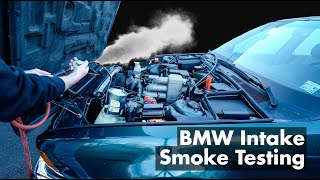
How to confirm: A visual inspection may reveal obvious cracks. The most effective method is a smoke test, which involves injecting low-pressure smoke into the EVAP system (often via the purge valve line or a dedicated port) and looking for where it escapes. 🎬 Watch: How to perform a smoke test
Typical fix: Replace the specific cracked hose section.
Est. part cost: $20-$80
Rare But Worth Checking
- Faulty Charcoal Canister: The charcoal canister can become saturated with fuel if the gas tank is frequently overfilled, or it can crack. This is less common than component failure but can cause persistent EVAP codes.
- Melted Fuel Pump Connector: In rare cases, a high-current issue with the fuel pump can cause the plastic around its electrical connector to melt, creating a small hole in the top of the fuel tank assembly. This allows fuel vapor to escape, causing an EVAP leak that is very difficult to trace. One owner on Xoutpost.com reported this as the final solution to their persistent leak code after replacing other components.
Diagnosis Steps
- Verify the Check Engine Light is on and scan for codes. Confirm P1440 is present, and note any other codes, especially P1447, 2A17, or P0443.
- Inspect the gas cap. Remove it, check the seal for cracks or damage, and reinstall it, ensuring it clicks at least once. Clear the codes and drive for a few days to see if the light returns. This is the easiest and cheapest first step.
- If the code returns, locate the fuel tank breather (purge) valve in the engine bay, typically on the driver's side near the intake manifold. With the engine idling, listen for a clicking sound. You can also disconnect the outlet hose to check if it's stuck open (pulling constant vacuum when it shouldn't be).
- Locate the DMTL pump. This requires jacking up the rear of the vehicle and removing the driver's side rear wheel and wheel well liner. Inspect the pump and its surrounding hoses for any visible cracks or damage.
- If no obvious faults are found, a smoke test is the most reliable way to find small leaks in the system's hoses or at the charcoal canister. The smoke is injected into the system and will visibly escape from any cracks or bad seals.
- If no leaks are found, the fault is likely electrical with either the purge valve or the DMTL pump. Testing with a multimeter or a BMW-specific scan tool (like INPA or ISTA) to actuate the components is the final diagnostic step.
Parts You'll Likely Need
- Diagnostic Module Tank Leakage (DMTL) Pump
(OEM #16137193479)— This is the most common failure point on the E53 X5 to cause a P1440 code, due to its design and frequent use in the EVAP self-test.
Trusted brands: Bosch (OEM), Genuine BMW
OEM price range: $120-$180
Aftermarket price range: $90-$150 - Fuel Tank Breather Valve / Purge Valve
(OEM #13901433603)— This valve is the second most likely component to fail, either by sticking open/closed or failing electrically.
Trusted brands: Bosch (OEM), Genuine BMW
OEM price range: $70-$110
Aftermarket price range: $30-$80 - Fuel Filler Cap
(OEM #16117222391)— A worn seal on the gas cap is a very common cause for all EVAP codes and should always be the first part checked/replaced due to its low cost.
Trusted brands: Genuine BMW, Blau
OEM price range: $40-$60
Aftermarket price range: $25-$40
Related Codes That Often Appear With This One
- P0440 — This is a general EVAP system malfunction code that can appear alongside the more specific P1440.
- P1447 — This is another BMW-specific code that points directly to a DMTL pump malfunction ('DMTL pump current too high'). If seen with P1440, the DMTL pump is almost certainly the cause.
- 2A17 — This is the BMW-specific hexadecimal fault code for 'DMTL system fault'. It indicates the DME has detected an electrical or mechanical issue with the DMTL pump itself, often related to the pump motor drawing incorrect amperage during its reference measurement.
- P0443 / P0444 — These codes point specifically to a fault in the purge valve's electrical circuit, which can accompany a P1440.
Mechanic-Grade Diagnostic Values
- Fuel Tank Breather (Purge) Valve Resistance — expected: 26 - 31 Ohms. Failure: A reading significantly outside this range, or an open/short circuit, indicates a failed solenoid coil. However, a valve can still be mechanically stuck even with correct resistance.
- DMTL Pump Amperage Draw — expected: The DME expects a specific amperage value when the pump runs against a reference orifice (e.g., 0.5mm or 1.0mm).. Failure: If the amperage draw is too high, it triggers a fault like P1447 or 2A17. If there is no amperage draw, it can indicate a large leak or a failed pump motor. The exact expected amperage values are stored in the DME and not typically published.
- Purge Valve Connector Voltage — expected: Should receive battery voltage (approx. 12V) when commanded ON by the DME. One user reported measuring only 8.5V at the connector, indicating a potential wiring or DME driver issue.. Failure: Significantly less than 12V when the valve should be active points to a wiring problem, bad ground, or a fault in the DME.
Hidden / Shadow Codes Worth Checking
- 2A17: DMTL System Fault. This is the direct BMW hexadecimal code for a DMTL pump failure. It is set when the DME compares the amperage drawn by the pump during its self-test against a reference value and finds a discrepancy (e.g., current too high). (see via BMW-specific scan tools like ISTA, INPA, or higher-end aftermarket scanners capable of reading manufacturer codes.)
- AF (Hex): Tank leak diagnosis with DMTL (minor leak). This is another BMW-specific fault, indicating the DMTL system completed its test and detected a small leak, as opposed to a major pump failure. (see via BMW-specific scan tools like ISTA or INPA.)
Scan Tool Commands That Help
- ISTA/D: DMTL System Test (Service Function) — This is the primary diagnostic function. It commands the DME to run the complete EVAP leak test sequence. The tool will display the test progress (reference leak, major leak test, minor leak test) and the final result. This allows a technician to activate the pump and listen for leaks without having to drive the vehicle through a full cycle.
- ISTA/D or INPA: Component Triggering / Activation — This allows for individual activation of the DMTL pump motor and the purge valve. It's used to confirm basic electrical function (e.g., listening for the pump motor to run or the purge valve to click) before running the full system test.
Wiring & Ground Locations
- DMTL Pump Connector (X17140 on some models) — At the DMTL pump, behind the driver's side rear wheel well liner.. This is the connection point for testing power and ground to the pump. On similar models, Pin 4 is typically power (Red/White wire) and Pin 1 is the ground switched by the DME (Brown/Blue wire). A bad connection or corroded pins here will cause pump failure codes.
- Main Engine Ground Strap — On the E53, a key engine-to-chassis ground is located on the right side (passenger side in US) front chassis rail, accessible through the wheel well.. While not directly for the DMTL pump (which is grounded locally or via the DME), a poor main engine ground can cause a host of electrical issues and voltage drops, potentially affecting DME operation and its ability to correctly interpret sensor readings and control actuators like the purge valve.
- Rear Body Ground Point — The E53 has several factory ground points in the trunk/boot area, often used for audio and other rear-mounted electronics. The main battery ground cable connects to the body in this area.. The DMTL pump is located in the rear wheel well. Its ground wire runs back to the DME, but ensuring the main body grounds in this quadrant of the vehicle are clean and secure is good practice to prevent floating ground issues that could affect the DME's reference.
Real Owner Repair Stories
- Xoutpost.com user 'oldskewel' (2001 BMW X5 3.0i, 203k miles) — Check Engine Light with code P0444 (Purge Control Valve Circuit Open).
❌ Tried (didn't work) Thoroughly testing the existing purge valve. It clicked with 12V, showed correct resistance (27.8 Ohms), and passed a bidirectional test with a Foxwell scanner, appearing to be perfectly functional.
✅ What actually fixed it Replacing the seemingly good purge valve with a new, Genuine BMW part (PN 13-90-1-433-603) resolved the code. The user noted that many forum posts swore by using only the Genuine part for this specific valve, suggesting some aftermarket versions may not meet the DME's precise electrical or flow specifications, even if they appear to function on basic tests.
"I Checked Everything" — The Actual Cause
- A persistent EVAP leak code (like P1440) that does not show up on a smoke test can be caused by a faulty purge valve that is not sealing properly only when the engine is running, or a DMTL pump that has an internal electrical fault rather than a system leak. The DME's test logic is complex; it monitors pump amperage, not just pressure, so a failing motor can set a code even with a perfectly sealed system.
OEM Part Supersession History
16136752551, 16136764191→16137193479— Standard part evolution and consolidation by BMW.
Heads up: The newest part number, 16137193479, is the correct and backward-compatible replacement for the earlier numbers on the E53 X5.
Diagnostic Flowchart
Other Known Issues on This Vehicle
Issues unrelated to this code that are worth knowing about as an owner of this generation:
- Timing Chain Guide Failure (V8 Engines) 🔴 High — Common on M62/N62 V8 engines, typically after 80,000-120,000 miles. The plastic guides become brittle and break.
- Crankcase Ventilation (CCV) System Failure (6-Cyl Engines) 🟠 Medium — Very common on M54 engines. The oil separator and hoses clog or crack, leading to high oil consumption, white/blue smoke from the exhaust, rough idle, and lean codes (P0171/P0174).
- Window Regulator Failure 🟠 Medium — Extremely common on all E53s. The plastic clips holding the window glass break, or the regulator cable tangles, causing the window to drop into the door and not come back up.
- Final Stage Resistor (FSR) Failure 🟡 Low — A very frequent failure causing the HVAC blower fan to work erratically (changing speeds on its own) or not at all. Can also cause parasitic battery drain.
- Cooling System Component Failure 🔴 High — Expansion tanks, radiators, water pumps, and plastic hoses are known to become brittle and fail, leading to coolant leaks and potential overheating. Often requires proactive replacement around 80,000-100,000 miles.
- Self-Leveling Air Suspension Failure 🟠 Medium — Common on models equipped with rear air suspension. Airbags develop leaks, or the compressor fails, causing the rear of the vehicle to sag and triggering a 'Self Level Susp Inact' message.
Used vs. New Parts: Buying Guide for This Vehicle
When a used part is the smart pick: For this repair, used parts are generally not recommended. The primary failure components (DMTL pump, purge valve, gas cap) are all wear items with a finite lifespan. A used part may have significant wear and could fail shortly after installation, making the cost savings negligible.
Donor-vehicle mileage cap: roughly under 75000 miles for the part to have meaningful remaining life.
What to inspect on the donor part:
- For a DMTL pump, visually inspect for cracks in the plastic housing.
- Check electrical connector pins for any signs of corrosion or moisture intrusion.
- Avoid parts from vehicles in regions with heavy road salt usage, as this accelerates corrosion of under-car components.
OEM-only on this vehicle (don't cheap out):
- Fuel Filler Cap: Many owners report that aftermarket gas caps do not seal correctly and fail to resolve EVAP codes.
- Fuel Tank Breather (Purge) Valve: Forum wisdom suggests that some aftermarket purge valves, even if they test well, may not satisfy the DME's sensitive checks, leading to persistent codes. Sticking with Genuine BMW or the OEM (Bosch) is highly recommended.
Aftermarket brands forum-validated for this vehicle:
- Bosch: Bosch is the Original Equipment Manufacturer (OEM) for both the DMTL pump and the purge valve. Buying the Bosch-branded part is identical to the Genuine BMW part but is often significantly cheaper.
Brands owners have reported issues with on this vehicle:
- Unbranded or 'white-box' parts for the purge valve and gas cap should be avoided due to the high likelihood of them not meeting the precise specifications required by the BMW EVAP system.
Real Owner Stories
Aggregated from forums and TSBs cited above. Mileages and costs reflect what owners reported in those sources.
2004 BMW X5 (E53)
Symptoms: The owner encountered a P1447 code indicating 'DMTL pump current too high.' They initially attempted to fix the EVAP issue by swapping the gas cap, but the light remained.
What fixed it: Replacement of the DMTL pump assembly with a Bosch OEM unit, which was found to be identical to the BMW part.
Source hint: Xoutpost.com - Thread 'DMTL System diagnosis' (2014)
2008 BMW X5 (E70)
Symptoms: A persistent EVAP leak code that was difficult to diagnose through standard component replacement.
What fixed it: The issue was traced to a melted electrical connector on the fuel pump, which had created a physical hole in the system.
Source hint: Xoutpost.com - Thread 'DIY: Replacing DMTL' (2014)
Related OBD-II Codes
Frequently Asked Questions
Where is the DMTL pump located on my E53 X5?
Can I use a Bosch part instead of the Genuine BMW DMTL pump for my P1440 code?
How can I tell if my gas cap is causing the EVAP leak without a smoke machine?
What should the resistance be for a healthy fuel tank breather valve on the X5?
Is the P1440 code related to the common CCV failure on the 6-cylinder M54 engine?
Will a generic scan tool be enough to diagnose a failing DMTL pump?
Helpful Videos
We Have This Part in Stock


The information in this article is provided for general reference and educational purposes only. Vehicle specifications, procedures, and part compatibility can vary by production date, trim level, and region. Always consult your vehicle's factory service manual and verify part numbers before purchasing or performing repairs. Safety-critical components such as airbags, seat belts, and braking systems should be installed by a qualified professional.
- BMW X5:
- 🎬 Helpful Videos
- 🛍️ Shop This Part
- What's Unique About the 1999-2006 BMW X5
- Symptoms You May Notice
- Most Likely Causes
- Rare But Worth Checking
- Diagnosis Steps
- Parts You'll Likely Need
- Related Codes That Often Appear With This One
- Mechanic-Grade Diagnostic Values
- Hidden / Shadow Codes Worth Checking
- Scan Tool Commands That Help
- Wiring & Ground Locations
- Real Owner Repair Stories
- "I Checked Everything" — The Actual Cause
- OEM Part Supersession History
- Diagnostic Flowchart
- Other Known Issues on This Vehicle
- Used vs. New Parts: Buying Guide for This Vehicle
- Real Owner Stories
- 2004 BMW X5 (E53)
- 2008 BMW X5 (E70)
- Related OBD-II Codes
- Frequently Asked Questions
- 🎟️ Get 5% Off