

P1299 on 2020-2025 Ford Explorer: Cylinder Head Overtemperature Protection Causes & Fixes
On 2020-2025 Ford Explorers, especially with the 2.3L or 3.0L EcoBoost, P1299 means the computer thinks the engine is overheating. It's often a faulty Engine Coolant Temperature (ECT) sensor or its wiring, not actual overheating. Replacing the sensor is a common fix, and several TSBs address this specific issue.
- P1299 on a 2020-2025 Explorer is a critical code indicating the engine's protective over-temperature mode is active.
- Do not drive the vehicle; you risk severe engine damage if the overheating is real.
- The most likely cause is not actual overheating, but a faulty Engine Coolant Temperature (ECT) sensor or its wiring, especially if the warning appears on a cold engine.
- Diagnosis should start by reading the live sensor data with a scan tool to see if it's giving illogical readings.
- Check for Ford Technical Service Bulletins (TSBs) related to your specific year and engine, as this is a well-documented issue.
What's Unique About the 2020-2025 Ford EXPLORER

On the 2020-2025 Ford Explorer, particularly those with 2.3L and 3.0L EcoBoost engines, this code is frequently triggered by a faulty sensor rather than a true overheating event. Multiple Technical Service Bulletins (TSBs) highlight issues where the Engine Coolant Temperature (ECT) sensor or its wiring provides incorrect readings, especially after a cold start in cold weather. This can cause the vehicle to incorrectly display an over-temperature warning and enter fail-safe mode when the engine is not actually hot, a scenario frequently discussed by owners in forums.
Diagnostic Flowchart

Tap your situation to follow the diagnostic path that matches what you're seeing on this vehicle.
Symptoms You May Notice

- Check Engine Light (MIL) illuminated
- Engine over-temperature warning light or message on the instrument panel
- Temperature gauge suddenly shooting to HOT, even on a cold engine
- Reduced engine power or vehicle entering "limp mode"
- Engine may run rough, vibrate, or stall
- Cooling fans running at high speed constantly
- Replacing the entire cooling system (radiator, water pump) when the issue is just a faulty sensor or wiring.
- Assuming the engine needs a new head gasket without confirming a legitimate, sustained overheating event or performing a combustion leak test.
Most Likely Causes

- Faulty Engine Coolant Temperature (ECT) Sensor 🔴 High Probability Multiple Ford TSBs (SSM 49407, TSB 24-2393) for the Explorer platform directly cite a faulty ECT sensor as a primary cause for P1299, sometimes in conjunction with a knock sensor replacement. 🎬 Watch: How to address the ECT and knock sensor TSB. This is the most common failure point leading to false overheating warnings.
How to confirm: Use a scan tool to monitor the ECT sensor data. If the reading is erratic, nonsensical (e.g., showing 250°F when the engine is cold), or doesn't match the actual engine temperature (verified with an infrared thermometer), the sensor is bad. This is a hallmark of the failure on this platform.
Typical fix: Replace the Engine Coolant Temperature (ECT) sensor. On the 3.0L EcoBoost, this sensor is located in the valley of the engine and may require removing the intake manifold for access.
Est. part cost: $20-$60 - ECT Sensor Wiring Harness Issue 🔴 High Probability TSB SSM 49407 explicitly mentions the ECT sensor wiring harness as a potential culprit. The harness can become damaged, corroded, or have a poor connection, leading to false signals.
How to confirm: Visually inspect the wiring and connector for any signs of damage, corrosion, or loose pins. Perform a continuity and resistance test on the wiring between the sensor and the PCM.
Typical fix: Repair the damaged section of the harness or replace the connector pigtail.
Est. part cost: $15-$40 - Low Engine Coolant 🟡 Medium Probability While not specific to this platform, it's a universal cause. A leak in the system can cause the coolant level to drop. If the sensor is exposed to an air pocket instead of coolant, it can lead to an inaccurate high-temperature reading and trigger the code.
How to confirm: Visually inspect the coolant level in the reservoir and radiator (only when the engine is completely cool). Pressure test the cooling system to find any leaks.
Typical fix: Top off the coolant with the correct Ford-specified type (Motorcraft Yellow P-OAT) and repair any leaks found in the system.
Est. part cost: $20-$40 - Stuck Thermostat ⚪ Low Probability
How to confirm: Monitor the temperature of the upper and lower radiator hoses as the engine warms up. If the thermostat is stuck closed, the upper hose will get very hot while the lower hose remains cool.
Typical fix: Replace the thermostat and gasket.
Est. part cost: $30-$80
Rare But Worth Checking
- Failing Water Pump: A failing water pump will cause a genuine overheating condition. Look for coolant leaks from the pump's weep hole or listen for grinding noises from the pump bearing.
- Air in the Cooling System: If the cooling system was recently serviced, trapped air can cause hot spots and trigger the sensor. The system may need to be properly 'burped' or vacuum-filled to remove all air pockets.
- Powertrain Control Module (PCM) Fault: In very rare cases, the PCM itself can be the source of the problem, requiring a software update or replacement. TSBs sometimes call for a PCM reprogram as part of the fix. All other possibilities should be exhausted first.
Diagnosis Steps
- Check the engine coolant level in the reservoir and radiator (only when the engine is completely cold). Top off if necessary with the correct Ford-specified coolant (Motorcraft Yellow P-OAT).
- Use an OBD-II scanner to check for other accompanying fault codes. Note any codes related to the ECT sensor circuit (P0116-P0119).
- With the scanner, observe the live data for the Engine Coolant Temperature (ECT) or Cylinder Head Temperature (CHT).
- On a cold engine, the ECT/CHT reading should be close to the ambient air temperature. If it reads very high (e.g., 250°F) immediately upon startup, the sensor or its circuit is faulty. This is a key indicator on this platform.
- If the reading seems plausible, start the engine and monitor the temperature as it warms up. Look for sudden jumps, drops, or a reading that doesn't rise smoothly.
- If a sensor fault is suspected, locate the ECT sensor. On the 3.0L EcoBoost, it is located in the engine valley, requiring intake manifold removal. 🎬 Watch: A walkthrough of the 3.0L engine coolant sensor fix. Inspect its connector and wiring for any visible damage, corrosion, or looseness.
- If the wiring looks good, the most common repair is to replace the ECT sensor. Be prepared for coolant to spill when removing the old sensor.
- If the sensor and wiring check out, diagnose for an actual overheating condition: pressure test the system for leaks, check for a stuck thermostat, failing water pump, or blocked radiator.
- After the repair, clear the codes with a scanner. Note that some codes may be stored as 'permanent' and may require a drive cycle or disconnecting the battery for 10 minutes to fully clear.
Parts You'll Likely Need
- Engine Coolant Temperature (ECT) Sensor
(OEM #ME2Z-12A648-A)— This is the most frequent point of failure for this code on this vehicle, as documented in multiple Ford TSBs. It sends the temperature reading to the PCM.
Trusted brands: Motorcraft, Bosch, Delphi
OEM price range: $40-$70
Aftermarket price range: $20-$50
Related Codes That Often Appear With This One
- P1026 — Often appears with P1299 on 2.3L Explorers, especially in cold weather, pointing towards a sensor or circuit issue as described in TSBs SSM 51984, SSM 51756, and SSM 51333.
- P0116, P0117, P0118, P0119 — These are generic codes related to the ECT sensor circuit performance, range, low input, and high input, respectively. Their presence strongly supports a diagnosis of a faulty ECT sensor or wiring, as noted in TSB SSM 49407.
- P1285 — This code, "Cylinder Head Overtemperature Condition," is a precursor to P1299. It indicates the first stage of overheating detection, where the temperature gauge may be pegged, before the PCM starts actively shutting down injectors (which triggers P1299).
- P2C38, P2C39 — TSB 24-2393 mentions these codes appearing alongside P1299 on 2.3L/3.0L engines, indicating a related fault within the engine temperature monitoring system.
Technical Service Bulletins (TSBs) & Recalls
- TSB 24-2393: Notes P1299 on 2.3L/3.0L engines with an over-temperature warning.
- SSM 51984: Mentions intermittent P1299 on 2.3L engines after a cold start.
- SSM 49407: Identifies the ECT sensor or wiring as the likely cause for P1299 on 2020 models.
- SSM 51756: Describes intermittent P1299 on 2.3L engines after a cold start.
- SSM 51333: Details intermittent P1299 on 2.3L engines after a cold start in cold ambient temper
Platform-Specific Known Issues
- TSB SSM 49407: Affects 2020 models with 2.3L/3.0L engines. Links P1299 (and other codes) directly to a faulty ECT sensor or wiring harness, specifically calling for ECT sensor replacement on 2.3L vehicles and replacement of both the ECT and knock sensor on 3.0L vehicles.
- TSBs SSM 51333, 51756, 51984: Affects 2022-2023 2.3L Explorers. Notes an intermittent over-temperature message and P1299/P1026 codes after a cold start in cold temperatures, even when the engine is not overheating. The fix involves a PCM software update.
- TSB 24-2393: Affects 2025 models with 2.3L/3.0L EcoBoost engines built before Oct 15, 2024. Mentions an engine over-temperature warning with P1299 along with codes P2C38 or P2C39, pointing to a PCM software update for resolution.
- Owner Experiences: Owners on forums frequently report the classic symptom of the temperature gauge pegging to HOT immediately after a cold start, followed by limp mode. The consensus fix is almost always replacing the ECT sensor.
Mechanic-Grade Diagnostic Values
- Engine Coolant/Cylinder Head Temperature Sensor Resistance vs. Temperature — expected: Resistance decreases as temperature increases. At 70°F (~21°C), resistance is ~37,000 Ohms. At 180°F (~82°C), resistance is ~2,475 Ohms. At 220°F (~104°C), resistance is ~1,180 Ohms.. Failure: If resistance is infinite (open circuit), near zero (short circuit), or does not match the expected value for a known temperature (measured with an infrared thermometer), the sensor is faulty.
Scan Tool Commands That Help
- Ford IDS (Integrated Diagnostic System): Datalogger — To monitor live PID (Parameter ID) data for the CHT/ECT sensor, RPM, and other engine parameters. This is used to watch for irrational sensor readings, like a sudden spike to maximum temperature on a cold engine.
- Ford IDS (Integrated Diagnostic System): Self-Test — To retrieve all on-demand and continuous memory diagnostic trouble codes from all vehicle modules, which is more comprehensive than a generic OBD-II scan.
- Ford IDS (Integrated Diagnostic System) or FORScan: PCM - Reset All Adaptations / Clear Transmission Adaptive Tables — After replacing a component like the CHT sensor or fixing a wiring issue, a PCM reset can be necessary to clear learned values and potentially remove 'permanent' DTCs that a basic scanner cannot erase.
Wiring & Ground Locations
- Underhood Fuse Box (Power Distribution Box) — Located on the driver's side of the engine compartment.. This box contains critical fuses for the Powertrain Control Module (PCM), such as 'Powertrain control module power' and 'Powertrain control module keep alive power'. A fault in this area could disrupt the PCM's ability to correctly process sensor data.
- Alternator and CHT Sensor Harnesses — Engine bay, specifically the wiring running to the alternator and the wiring running to the CHT/ECT sensor on the cylinder head.. A failing alternator can introduce significant electrical noise (AC ripple) into the vehicle's electrical system. If the CHT sensor wiring is routed nearby or shares a compromised ground, this noise can induce a false high-temperature signal in the CHT circuit, triggering P1299 even when the sensor and its direct wiring are perfectly fine.
Real Owner Repair Stories
- Reddit user on r/Ford (2015 Ford Police Interceptor Utility (Explorer Platform)) — Sudden overheating warning, smoke from hood, P1299 code.
❌ Tried (didn't work) Clearing the code with a standard OBD-II reader after fixing the mechanical issue (re-attaching a radiator hose that had come off). The code was stored as 'permanent'.
✅ What actually fixed it The 'permanent' DTC needed to be cleared by either disconnecting the battery for 10+ minutes to reset the PCM's memory, or by using a more advanced scan tool like FORScan that can clear persistent codes. - G Auto Repair on YouTube (2020 Ford Transit Connect (Demonstrates a principle applicable to other Fords)) — Temperature gauge pinned to HOT, rough idle, codes P1299 and P017D (CHT Sensor Circuit High).
❌ Tried (didn't work) Replacing the CHT sensor did not fix the problem. Checking the sensor wiring and its continuity back to the PCM showed no faults.
✅ What actually fixed it The root cause was a failing alternator creating electrical interference (noise) that was back-feeding into the electrical system and causing a false reading on the CHT sensor circuit. Replacing the alternator resolved all symptoms and codes.
"I Checked Everything" — The Actual Cause
- In a case involving a Ford with P1299, the CHT sensor was replaced and its wiring was tested for continuity back to the PCM, with all checks passing. The problem persisted with the temperature gauge spiking to hot. The actual cause was found to be a failing alternator creating electrical noise, which interfered with the CHT sensor signal. The problem was diagnosed by disconnecting the alternator's positive cable, which made the symptoms disappear, confirming the alternator as the source of the electrical interference.
When the Usual Fixes Don't Work
- While the most common cause of a false P1299 code is a failed ECT/CHT sensor, simply replacing the sensor may not fix the issue. In one documented case, the root cause was a failing alternator creating electrical noise that interfered with the sensor's signal, a problem that persisted after a new sensor was installed. Furthermore, even after a legitimate overheating event is repaired (e.g., a burst hose), the P1299 code may be stored as a 'permanent' fault in the PCM. This type of code cannot always be cleared by a basic OBD-II scanner and may require a full battery disconnect or the use of a dealer-level tool like Ford IDS or FORScan to fully erase.
OEM Part Supersession History
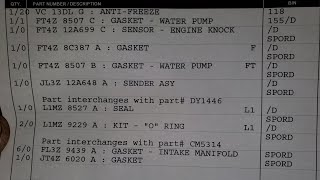
JL3Z-12A648-A→JL3Z-12A648-B— Standard part revision and update by the manufacturer.
Heads up: The new part number (JL3Z-12A648-B) is the correct service part for 2020-2025 Explorers that originally used the -A version.JL3Z-12A648-B→P2GZ-12A648-A— New part introduced for later model years.
Heads up: Part P2GZ-12A648-A is specified for some 2023-2025 models, particularly noting a start date of May 13, 2024, for the 2025 2.3L model. This indicates a potential design change in the newest vehicles.
Model Year Variations Within This Range
- 2020: TSB SSM 49407 specifically points to a faulty ECT sensor or its wiring harness as the primary cause for P1299 on this model year.
- 2022-2023: TSBs SSM 51333, 51756, and 51984 identify a software issue causing false P1299/P1026 codes after a cold start. The specified fix is a PCM software update, not a hardware replacement.
- 2025 (built before 15-Oct-2024): TSB 24-2393 notes that P1299 may appear with codes P2C38 or P2C39 and that the prescribed fix is a PCM software update.
- 2024-2025: A new ECT/CHT sensor part number, P2GZ-12A648-A, is specified for vehicles built from mid-2024 onward, suggesting a hardware change in the cooling system monitoring components.
Helpful Videos

We Have This Part in Stock



The information in this article is provided for general reference and educational purposes only. Vehicle specifications, procedures, and part compatibility can vary by production date, trim level, and region. Always consult your vehicle's factory service manual and verify part numbers before purchasing or performing repairs. Safety-critical components such as airbags, seat belts, and braking systems should be installed by a qualified professional.
- Ford EXPLORER:
- 🎬 Helpful Videos
- 🛍️ Shop This Part
- What's Unique About the 2020-2025 Ford EXPLORER
- Diagnostic Flowchart
- Symptoms You May Notice
- Most Likely Causes
- Rare But Worth Checking
- Diagnosis Steps
- Parts You'll Likely Need
- Related Codes That Often Appear With This One
- Technical Service Bulletins (TSBs) & Recalls
- Platform-Specific Known Issues
- Mechanic-Grade Diagnostic Values
- Scan Tool Commands That Help
- Wiring & Ground Locations
- Real Owner Repair Stories
- "I Checked Everything" — The Actual Cause
- When the Usual Fixes Don't Work
- OEM Part Supersession History
- Model Year Variations Within This Range
- 🎟️ Get 5% Off