

P1299 on 2023-2025 Ford Escape: Engine Overheating Causes and Fixes
On 2023-2025 Ford Escapes with the 1.5L EcoBoost engine, code P1299 is most often caused by a known manufacturing defect where machining chips block coolant passages in the cylinder head. This triggers an overheat warning under load. The fix, outlined in Ford TSBs, requires a professional cooling system flush and, in some cases, cylinder head replacement.
- P1299 on a 2023-2025 Ford Escape is a critical alert for engine overheating and should be addressed immediately.
- The most likely cause for 1.5L EcoBoost engines in this year range is a known manufacturing defect involving machining chips blocking coolant passages, as documented in Ford TSBs.
- Do not continue driving. The vehicle's limp mode is only for getting to a safe place to stop, not for driving to a destination.
- Diagnosis and repair require professional service due to the complex flushing procedure and potential need for cylinder head replacement.
- Check with a Ford dealership to see if repairs may be covered under warranty or any customer satisfaction programs related to the TSBs.
What's Unique About the 2023-2025 Ford ESCAPE

For the 2023-2025 Ford Escape, particularly with the 1.5L EcoBoost engine, the P1299 code is strongly associated with a specific manufacturing issue affecting vehicles built on or before January 11, 2024. Ford has issued multiple Technical Service Bulletins (TSBs) acknowledging that metal machining chips from the manufacturing process can become trapped in the cylinder head. These chips can block coolant passages, specifically near the CHT2 (Cylinder Head Temperature) sensor port, leading to a sudden spike in temperature and the P1299 code, especially during hard acceleration or high-load conditions. This is a well-documented issue, making it the primary suspect over more common cooling system failures.
🎬 Watch: Understanding the P1299 cylinder head overtemperature protection system.Diagnostic Flowchart

Tap your situation to follow the diagnostic path that matches what you're seeing on this vehicle.
Symptoms You May Notice

- Check Engine Light (Malfunction Indicator Lamp) illuminated
- "Engine Coolant Over-Temperature" warning message on the dashboard.
- Sudden and severe loss of engine power (limp mode).
- Temperature gauge spiking to 'H' or maximum
- Rough running or engine vibration.
- Engine may shut down completely.
- Cooling fans running at maximum speed.
- Replacing only the CHT sensor without investigating the root cause. If machining chips are the problem, a new sensor will not fix the overheating and the code will return.
- Simply clearing the code and continuing to drive. This ignores a critical warning and will likely lead to severe engine damage.
- Performing a standard coolant flush without the specific backflushing procedure outlined in TSB SSM 52219, which may not be sufficient to dislodge trapped debris.
Most Likely Causes

- Machining Chips in Cylinder Head Coolant Passages 🔴 High Probability A documented manufacturing defect acknowledged by Ford in multiple TSBs (SSM 52162, SSM 52219, SSM 54068, SSM 54288) for 2023-2025 models with the 1.5L EcoBoost engine, particularly those built on or before January 11, 2024.
How to confirm: A technician will follow the diagnostic procedure in TSB SSM 52219. This involves a road test with wide-open throttle (WOT) hard accelerations to replicate the overheat condition. If replicated, the system is drained and a systematic backflush of the radiator, heater core, and engine block is performed. Black sediment in the degas bottle is a strong indicator.
Typical fix: A thorough backflush of the radiator, heater core, and engine block is required, without using chemical flush additives. If this does not resolve the issue, the cylinder head must be replaced. Ford notes that validated replacement heads have a blue or green mark near the EGR cooler.
Est. part cost: $0 - $2500+ - Faulty Cylinder Head Temperature (CHT) Sensor 🟡 Medium Probability While the machining chip issue is prevalent, CHT sensors can fail, providing false overheating readings to the PCM. A false P1299 can be triggered on a cold start if the sensor fails, which is a key symptom pointing away from a genuine overheat. Coolant can sometimes leak past the sensor's O-ring and short the connector, a common failure mode on some Ford engines.
How to confirm: Monitor live sensor data with an OBD-II scanner to see if the temperature reading jumps erratically or goes to maximum instantly on a cold engine. The sensor can also be tested with a multimeter for correct resistance against temperature specifications.
Typical fix: Replace the Cylinder Head Temperature sensor and its connector if corroded. Clean any coolant residue from the wiring harness. The code must be cleared with a scan tool after replacement, as disconnecting the battery may not be sufficient.
Est. part cost: $10 - $100 - Low Engine Coolant Level ⚪ Low Probability While not specific to this platform, any vehicle can develop coolant leaks from hoses, the radiator, water pump, or thermostat housing, leading to an overheat condition. Another TSB for some Escapes mentions a potential turbocharger coolant return tube seal leak.
How to confirm: Visually inspect the coolant reservoir to ensure the level is between the 'MIN' and 'MAX' marks when the engine is cold. Perform a cooling system pressure test to find any leaks.
Typical fix: Identify and repair the source of the leak, then refill and bleed the cooling system with the correct type of coolant (Ford's Motorcraft Yellow).
Est. part cost: $10 - $500+
Rare But Worth Checking
- Stuck Thermostat: A thermostat stuck in the closed position will prevent coolant from circulating to the radiator, causing a genuine and rapid overheat condition.
- Failing Water Pump: A water pump with a worn impeller will not circulate coolant effectively, leading to overheating under load. A weeping water pump is a sign of impending failure.
- Restricted Radiator: External fins blocked by debris or internal passages clogged by sediment can reduce cooling efficiency.
Diagnosis Steps
- DO NOT clear the code. Check for any 'Engine Coolant Over-Temperature' messages on the instrument panel.
- When the engine is completely cool, check the coolant level in the expansion tank. Ensure it is between the MIN and MAX lines.
- Scan the PCM for stored trouble codes. Note if P1299 is present with P1285, as this points strongly to the TSB issue.
- Using a capable OBD-II scanner, monitor the CHT sensor data live. Watch for erratic behavior or instant-max readings on a cold start, which would suggest a bad sensor.
- If the coolant level was low, perform a cooling system pressure test to check for external leaks from hoses, the radiator, or water pump.
- If no leaks or sensor faults are found, proceed with the diagnostic steps outlined in TSB SSM 52219. This involves a specific road test above -4°F (-20°C) with 'wide-open throttle (WOT) hard accelerations in rapid succession' to replicate the condition.
- If the condition is replicated, perform the systematic backflush of the radiator, heater core, and engine as detailed in the TSB. Check the degas bottle for black sediment.
- If flushing the system does not resolve the recurring overheat condition, cylinder head replacement is the next step as per the TSB.
Parts You'll Likely Need
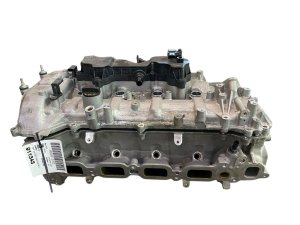
- Cylinder Head
(OEM #PV4Z-6049-A)— Required if the cooling system flush fails to resolve the overheating caused by trapped machining chips, as per Ford TSBs. Some owners have reported significant delays in receiving this part.
Trusted brands: Motorcraft
OEM price range: $600 - $1500 - Cylinder Head Temperature (CHT) Sensor
(OEM #JX6Z-6G004-B or P2GZ-6G004-B)— Can fail and give false overheat readings, or can be damaged by a true overheat event. This is a relatively inexpensive part to replace during diagnosis.
Trusted brands: Motorcraft, NTK, Dorman
OEM price range: $7 - $20
Aftermarket price range: $15 - $50 - Engine Coolant / Antifreeze
(OEM #VC-13-G (Motorcraft Yellow))— The cooling system must be drained, flushed, and refilled as part of the diagnosis and repair.
Trusted brands: Motorcraft
OEM price range: $25 - $35 per gallon
Related Codes That Often Appear With This One
- P1285 — This code, for 'Cylinder Head Overtemperature Condition', is explicitly mentioned alongside P1299 in all relevant Ford TSBs for this issue. They often appear together as the PCM detects the overheat event.
Technical Service Bulletins (TSBs) & Recalls
- SSM 54288: Mentions P1299 on 2025 models due to machining chips.
- SSM 54068: Mentions P1299 on 2024 models due to machining chips.
- SSM 52219: Provides the detailed diagnostic and repair procedure (road test, backflushing, potential cylinder head replacement) for P1299 on 2023-2024 models due to machining chips. Specifies a build date on or before 11-Jan-2024.
- SSM 52162: Acknowledges the P1299 concern on 2023 models.
Platform-Specific Known Issues
- Ford has issued multiple Technical Service Bulletins for 2023-2025 Escapes with 1.5L EcoBoost engines regarding P1299. The core issue is machining chips from manufacturing getting trapped in the cylinder head's coolant passages, causing blockages and overheating under load. The primary diagnostic and repair procedure is detailed in TSB SSM 52219.
- Owner complaints and mechanic reports suggest that when the cylinder head is removed for replacement due to this issue, some engines are found to have premature camshaft wear, despite low mileage.
- There are multiple reports from owners who have had dealers confirm the issue but then face long delays waiting for the replacement cylinder head to become available.
Mechanic-Grade Diagnostic Values
- Cylinder Head Temperature (CHT) Sensor Resistance — expected: Resistance is inversely proportional to temperature. Example values for a similar Ford sensor are: 37.3 kOhms @ 68°F (20°C), 7.48 kOhms @ 140°F (60°C).. Failure: An open circuit (infinite resistance) or short circuit (zero resistance) indicates a failed sensor. Readings that do not correspond to the temperature chart are also a failure.
- Cylinder Head Temperature (CHT) Sensor Signal Voltage — expected: At 86°F (30°C), voltage should be about 4.29V. At normal operating temperature of 194°F (90°C), voltage should be about 2.03V.. Failure: P1299 triggers when the sensor reports a temperature exceeding ~250-280°F, which corresponds to a very low voltage (e.g., 1.68V at 212°F). A reading of 5V may indicate an open in the signal wire.
- Engine Block Ground Resistance — expected: Less than 5 ohms, ideally close to 0 ohms.. Failure: High resistance on a ground path can cause erratic sensor readings and module behavior. A reading above 5 ohms indicates a poor ground that needs to be cleaned or repaired.
Scan Tool Commands That Help
- Ford IDS (Integrated Diagnostic System): Self-Test > All CMDTCs — This is the initial step to retrieve all Diagnostic Trouble Codes from all vehicle modules, which is more comprehensive than a generic OBD-II scan. It will confirm if P1299 is accompanied by P1285 as the TSBs suggest.
- Ford IDS (Integrated Diagnostic System): Datalogger > CHT Sensor PID — Used to monitor the live temperature reading from the Cylinder Head Temperature sensor. This is critical for diagnosis to determine if the engine is truly overheating or if the sensor is providing an erratic, false reading (e.g., spiking to max temp on a cold engine).
- Ford IDS (Integrated Diagnostic System): Powertrain > Power Balance — This bidirectional test allows a technician to see the contribution of each cylinder. When P1299 is active, the PCM is disabling fuel injectors. The Power Balance test can help visualize which cylinders are being shut down as part of the fail-safe cooling strategy.
Wiring & Ground Locations
- CHT Sensor — On the 1.5L EcoBoost, the CHT sensor is located on the cylinder head, often towards the rear of the engine, making it difficult to access. It is a threaded sensor that measures the metal temperature of the head directly.. This is the sensor that triggers the P1299 code. Its physical location is needed for inspection of the connector for corrosion, testing the wiring, and for replacement.
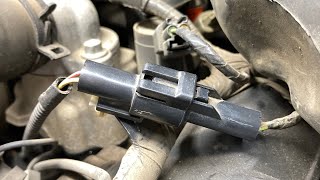
- CHT Sensor Connector — A two-wire connector attached to the top of the CHT sensor.. One pin is the signal wire and the other is the PCM ground. A poor connection, corrosion, or damage to this connector or its pigtail can cause a false P1299 code.
- Engine Block Ground — A heavy gauge wire or strap connecting the engine block to the vehicle's chassis/body to ensure a common ground.. The CHT sensor circuit relies on a good ground. A corroded or loose engine ground can cause a voltage drop, leading to erratic sensor readings and potentially a false P1299 code.
Real Owner Repair Stories
- NHTSA Complaint reported by Lemberg Law (2023 Ford Escape) — Engine over-temperature warning message displayed, followed by the vehicle cutting power.
✅ What actually fixed it The dealer diagnosed metal shavings in the engine cylinder head, confirming the issue described in Ford TSB SSM 52219. The prescribed fix was to replace the cylinder head, but the owner was informed the part was not available with no estimated time for arrival. - Ford F150 Forum user (2016 Ford F-150 2.7L (different vehicle, but same code and common Ford sensor failure)) — On a cold start, the engine had a rough idle. After 2 miles, the check engine light came on, an engine overheat alert flashed, the fan went to high speed, and the truck entered a very rough-running limp mode.
❌ Tried (didn't work) The user noted the coolant reservoir was full and transmission temperature was still low, indicating it was not a true overheat.
✅ What actually fixed it The user replaced the Cylinder Head Temperature (CHT) sensor. After replacing the sensor, the code had to be manually cleared with a scan tool to restore normal operation; simply driving or disconnecting the battery did not clear the limp mode condition.
"I Checked Everything" — The Actual Cause
- The primary issue for this vehicle, machining chips in the cylinder head, is a perfect example of a problem that would pass a standard cooling system pressure test. A pressure test only checks for external or major internal leaks. In this case, the system is sealed and can hold pressure, but the internal blockage prevents proper coolant flow under high load (like hard acceleration), causing a localized overheat at the CHT sensor and triggering P1299. This is why the TSB's diagnostic method involves a specific high-load road test rather than a static pressure test.
When the Usual Fixes Don't Work
- While the Technical Service Bulletins pointing to machining chips in the cylinder head are the most probable cause for P1299 on a 2023-2025 Escape under load, it is not the only cause. There is significant evidence from owner forums and general mechanic knowledge that a faulty Cylinder Head Temperature (CHT) sensor can trigger a P1299 code by itself, often on a cold start. In these cases, the engine is not actually overheating, and the fix is a simple, inexpensive sensor replacement, not a complex engine-out procedure. A key diagnostic clue is when the overheat warning appears: if it happens instantly on a cold engine, the sensor or its wiring is the prime suspect; if it only happens during hard driving, the machining chip blockage is more likely.
OEM Part Supersession History
jx6z6g004a→JX6Z-6G004-B— Part revision or manufacturer change for the Cylinder Head Temperature (CHT) sensor.Standard Cylinder Head (pre-TSB fix)→Cylinder Head with blue or green mark (PV4Z-6049-A)— The replacement cylinder heads validated by Ford to address the machining chip issue are marked for identification.
Heads up: A technician performing the TSB repair must verify the replacement head has the blue or green mark near the EGR cooler to ensure it is the corrected part.
Model Year Variations Within This Range
- 2023-2024: TSB SSM 52219 specifically calls out vehicles with the 1.5L engine built on or before January 11, 2024, as being susceptible to the machining chip issue. Vehicles built after this date are presumed to have a corrected manufacturing process, though later TSBs for 2025 models suggest the issue may have persisted.
- 2023-2025: This platform uses a Cylinder Head Temperature (CHT) sensor that measures the metal temperature of the head, not an Engine Coolant Temperature (ECT) sensor that measures fluid temp. This is a key design choice for Ford's fail-safe cooling strategy, as it can detect an overheat even with total coolant loss.
Helpful Videos




We Have This Part in Stock



The information in this article is provided for general reference and educational purposes only. Vehicle specifications, procedures, and part compatibility can vary by production date, trim level, and region. Always consult your vehicle's factory service manual and verify part numbers before purchasing or performing repairs. Safety-critical components such as airbags, seat belts, and braking systems should be installed by a qualified professional.
- Ford ESCAPE:
- 🎬 Helpful Videos
- 🛍️ Shop This Part
- What's Unique About the 2023-2025 Ford ESCAPE
- Diagnostic Flowchart
- Symptoms You May Notice
- Most Likely Causes
- Rare But Worth Checking
- Diagnosis Steps
- Parts You'll Likely Need
- Related Codes That Often Appear With This One
- Technical Service Bulletins (TSBs) & Recalls
- Platform-Specific Known Issues
- Mechanic-Grade Diagnostic Values
- Scan Tool Commands That Help
- Wiring & Ground Locations
- Real Owner Repair Stories
- "I Checked Everything" — The Actual Cause
- When the Usual Fixes Don't Work
- OEM Part Supersession History
- Model Year Variations Within This Range
- 🎟️ Get 5% Off