

P1285 on 2023-2025 Ford Escape 1.5L: Cylinder Head Over Temperature Causes and Fixes
On 2023-2025 Ford Escapes with the 1.5L EcoBoost engine, code P1285 almost always points to a known manufacturing issue where machining chips are blocking coolant passages in the cylinder head. This is a serious issue that requires immediate professional diagnosis and repair, often performed under warranty by a Ford dealer. The official fix involves a specific flushing procedure, and if that fails, cylinder head replacement.
- P1285 on a 2023-2025 Ford Escape 1.5L is a critical code indicating the cylinder head is overheating.
- The most likely cause is a known manufacturing defect where machining chips are blocking coolant flow, as documented in multiple Ford TSBs.
- Do not drive the vehicle. Immediately contact a Ford dealership for diagnosis.
- The repair involves a special coolant flush or, if that fails, a cylinder head replacement, which should be covered under the vehicle's powertrain warranty.
What's Unique About the 2023-2025 Ford ESCAPE

For the 2023-2025 Ford Escape with the 1.5L EcoBoost engine, P1285 is not a typical random overheating event. It is strongly linked to a specific, documented manufacturing issue. Multiple Technical Service Bulletins (TSBs) issued by Ford state that machining chips left over from the engine's production can become trapped in the cylinder head's cooling passages, specifically near the Cylinder Head Temperature 2 (CHT2) sensor port. This creates a blockage, leading to a localized and dangerous overheat condition, especially under load. Therefore, a diagnosis on this vehicle must prioritize investigating this known TSB issue over more common causes like a faulty thermostat on other vehicles.
Diagnostic Flowchart

Tap your situation to follow the diagnostic path that matches what you're seeing on this vehicle.
Symptoms You May Notice

- "Engine Coolant Over-Temperature" warning message on the instrument panel.
- Check Engine Light (Malfunction Indicator Lamp) is illuminated.
- Symptoms appear most frequently during hard, wide-open throttle (WOT) accelerations or under high load conditions (e.g., climbing a hill).
- Temperature gauge reading at maximum (HOT).
- Engine may enter a reduced power "limp mode" as the PCM activates its fail-safe cooling strategy.
- A Reddit user with a 2024 Escape noted CHT sensor readings of 230-250°F on flat ground, exceeding 300°F under acceleration, which are indicative of this problem.
- Replacing the Cylinder Head Temperature (CHT) sensor without confirming an actual overheat condition. The sensor is often correctly reporting a real problem caused by the coolant blockage. Ford explicitly warns in TSB SSM 52162 that this may not fix the issue.
- Performing a standard coolant flush without following the specific, more aggressive procedure outlined in Ford's TSBs, which may not be sufficient to dislodge the machining chips. TSB SSM 54114 specifies the exact WSM procedure to use and notes not to use a flush additive.
- Assuming the issue is a faulty thermostat, which is a common cause for overheating on many other vehicles but is not the primary documented cause for this specific code on this platform.
Most Likely Causes

- Machining Chips Blocking Coolant Passages 🔴 High Probability This is a known manufacturing-related issue documented by Ford in multiple TSBs (SSM 54288, SSM 54068, SSM 52219, SSM 54114) for this specific engine and year range. The chips get trapped in a coolant passage near the CHT2 (Cylinder Head Temperature 2) sensor, causing a localized hot spot.
How to confirm: A Ford dealer will follow the diagnostic procedure outlined in TSB SSM 54114. This involves a road test with 'wide-open throttle (WOT) hard accelerations in rapid succession' to try and replicate the overheat warning. If the issue is confirmed, they proceed with the prescribed repair steps.
Typical fix: The official Ford procedure per TSB SSM 54114 is to first perform a specialized cooling system flush without using the VC-1 flush additive. If the flushing procedure does not resolve the issue, the cylinder head must be replaced. This repair is typically covered under the vehicle's powertrain warranty. The causal part for warranty claims is listed as 6049 (Cylinder Head).
Est. part cost: $0 (if under warranty)
Rare But Worth Checking
- Faulty Cylinder Head Temperature (CHT) Sensor: While less likely than the machining chip issue on these models, a sensor can fail and send incorrect high-temperature readings to the PCM. TSB SSM 52162 specifically notes that replacing the CHT sensor may not resolve this condition, pointing back to the machining chips as the primary cause. This should only be considered if the TSB diagnostics for blockage are inconclusive.
- CHT Sensor Wiring Harness Issue: A damaged, shorted, or disconnected wire in the CHT sensor circuit can trigger this code, often along with P1299. Rodent damage or a harness that is pulled too tight, creating a sharp bend, are possible causes.
- Low Engine Coolant: A simple, yet critical check. If the coolant level is low due to a leak elsewhere, the CHT sensor may eventually report an overheat condition as air pockets develop. Always verify the coolant level in the reservoir is correct. Note that other issues like a failing water pump can also cause coolant loss on this engine.
Diagnosis Steps
- Check for any applicable Technical Service Bulletins (TSBs) for your vehicle's VIN. For this issue, TSBs SSM 54288, SSM 54068, SSM 52219, and especially the repair procedure in SSM 54114 are highly relevant.
- Schedule a service appointment with a Ford dealership, referencing the P1285 code and the relevant TSBs.
- The technician will verify the concern by following the TSB diagnostic steps, which include idling the engine for 15 minutes and then performing a road test with 'wide-open throttle (WOT) hard accelerations in rapid succession' to trigger the overheat warning.
- If the concern is replicated, the technician will perform the prescribed cooling system flush procedure as detailed in the Workshop Manual (WSM) section 303-03A, specifically without using VC-1 flush additive.
- If the flush does not resolve the issue, the next step is cylinder head replacement, as per TSB SSM 54114.
- If the TSB does not apply or does not fix the issue, the technician will then diagnose other potential causes, such as testing the CHT sensor, its wiring, and the overall health of the cooling system (coolant level, leaks, etc.).
Parts You'll Likely Need
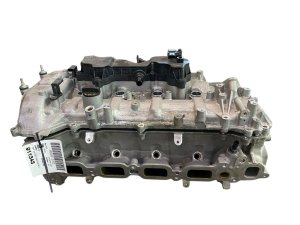
- Cylinder Head Assembly
(OEM #Varies by VIN, Causal Part 6049)— This is the ultimate fix prescribed by Ford's TSBs if a specialized coolant flush does not resolve the blockage caused by machining chips. TSB SSM 54114 notes that validated replacement heads have a blue or green mark near the EGR cooler.
Trusted brands: Motorcraft
OEM price range: $2500-$4000
Aftermarket price range: N/A - Engine Coolant
(OEM #Motorcraft VC-13-G (Yellow))— The cooling system must be drained and refilled for either the flushing procedure or the cylinder head replacement.
Trusted brands: Motorcraft
OEM price range: $20-$30 per gallon
Aftermarket price range: $15-$25 per gallon
Related Codes That Often Appear With This One
- P1299 — P1299 (Cylinder Head Temperature Protection Active) is the next stage in Ford's fail-safe cooling strategy. It indicates the PCM has started taking protective action, like shutting down fuel injectors, because the overheat condition reported by P1285 has persisted or worsened. The TSBs for this issue explicitly mention that P1285 and P1299 are often stored together.
Technical Service Bulletins (TSBs) & Recalls
- SSM 54288: Mentions P1285/P1299 on 2025 models with 1.5L EcoBoost due to machining chips.
- SSM 54068: Mentions P1285/P1299 on 2024 models with 1.5L EcoBoost due to machining chips.
- SSM 52219: Mentions P1285/P1299 on 2023-2024 models with 1.5L EcoBoost due to machining chips near the CHT2 port.
- SSM 52162: Notes Ford's awareness of P1285/P1299 on 2023 models under high load and advises that replacing the CHT sensor may not resolve the condition.
- SSM 54114: Provides the most detailed diagnostic and repair procedure for the machining chip issue on 2023-2025 Escapes, including the WOT acceleration test, a specific flush procedure, and potential cylinder head replacement.
Platform-Specific Known Issues
- A series of Technical Service Bulletins (including SSM 54288, SSM 54068, SSM 52219, and SSM 54114) have been issued for 2023-2025 Ford Escapes with the 1.5L EcoBoost engine regarding P1285 and P1299. The bulletins state that machining chips from the manufacturing process can get trapped in the cylinder head, causing a blockage in a coolant passage near the CHT2 sensor, leading to an overheat warning during hard acceleration.
- An owner of a 2024 model filed a complaint with the NHTSA (ODI #11706940) after experiencing this issue and finding the P1285 code, noting that online research showed the problem was a known issue with Ford.
- TSB SSM 54114 provides the detailed repair path: first, attempt a specific cooling system flush (without additives), and if that fails, the cylinder head (causal part 6049) must be replaced.
Mechanic-Grade Diagnostic Values
- Cylinder Head Temperature (CHT) Sensor Resistance — expected: Resistance is inversely proportional to temperature. Example values are approximately 37.3 kOhms at 68°F (20°C) and 7.48 kOhms at 140°F (60°C).. Failure: A reading that is wildly out of this expected range for a given temperature, or an open/short circuit, indicates a faulty sensor. With the engine cold, the CHT reading on a scan tool should be close to the ambient air temperature.
- Cylinder Head Temperature (CHT) Sensor Voltage (Signal Wire to Ground) — expected: Voltage decreases as temperature increases. For example, approximately 2.0-2.1 volts at normal operating temperature (~198°F / 92°C). With the key on and engine off, unplugging the sensor should result in a 5-volt reference signal at the connector.. Failure: Voltage greater than 4.6V with the key on and engine off can indicate a sensor fault. If the reference voltage is missing, it points to a wiring or PCM issue.
Scan Tool Commands That Help
- Ford IDS (Integrated Diagnostic System) / FDRS (Ford Diagnosis & Repair System): Active Commands / Bidirectional Controls — The dealer-level scan tool allows technicians to command components like the cooling fans to operate, helping to verify their function independently of the CHT sensor input. It can also run guided diagnostics, network tests, and access detailed live data PIDs (Parameter IDs) not available on generic scanners.
Wiring & Ground Locations
- Cylinder Head Temperature (CHT) Sensor — On the 1.5L EcoBoost engine, the CHT sensor is typically located on the cylinder head toward the back of the engine (firewall side), often making it very difficult to access without removing the upper cowl panel and wiper assembly.. This is the sensor that directly measures the temperature triggering the P1285 code. Its physical location is critical for inspection of the sensor and its connector for damage or corrosion, and for replacement if it is determined to be faulty.
- CHT Sensor Connector — Connected directly to the top of the CHT sensor at the back of the cylinder head.. Corrosion or damage to the connector or pigtail can cause incorrect readings, leading to false P1285 codes. The Motorcraft replacement pigtail part number is WPT-1469.
OEM Part Supersession History
9L8Z-6G004-B→9L8Z-6G004-E— Part revision or manufacturer change for the CHT sensor.
Heads up: The part appears to be backward compatible, but it is critical to verify fitment by VIN. Note: Ford service information states that if a CHT sensor is removed for any reason, it is a single-use part and must be replaced with a new one.
Helpful Videos


We Have This Part in Stock



The information in this article is provided for general reference and educational purposes only. Vehicle specifications, procedures, and part compatibility can vary by production date, trim level, and region. Always consult your vehicle's factory service manual and verify part numbers before purchasing or performing repairs. Safety-critical components such as airbags, seat belts, and braking systems should be installed by a qualified professional.
- Ford ESCAPE:
- 🎬 Helpful Videos
- 🛍️ Shop This Part
- What's Unique About the 2023-2025 Ford ESCAPE
- Diagnostic Flowchart
- Symptoms You May Notice
- Most Likely Causes
- Rare But Worth Checking
- Diagnosis Steps
- Parts You'll Likely Need
- Related Codes That Often Appear With This One
- Technical Service Bulletins (TSBs) & Recalls
- Platform-Specific Known Issues
- Mechanic-Grade Diagnostic Values
- Scan Tool Commands That Help
- Wiring & Ground Locations
- OEM Part Supersession History
- 🎟️ Get 5% Off