

P1285 on 2015-2022 Ford Escape: Cylinder Head Over Temperature Causes and Fixes
Code P1285 on a 2015-2022 Ford Escape means the engine's computer has detected an overheat condition at the cylinder head. This is a critical warning, often caused by coolant leaking into the engine cylinders—a known issue on 1.5L and 2.0L EcoBoost engines documented in multiple Ford Technical Service Bulletins (TSBs). Stop driving immediately to prevent catastrophic engine damage. This issue is so prevalent it has led to multiple class-action lawsuits.
- P1285 is a critical overheat warning for the cylinder head. Stop driving immediately.
- The most likely cause on a 2015-2022 Escape with a 1.5L or 2.0L EcoBoost engine is a serious internal coolant leak.
- Check for symptoms of internal leaks: unexplained coolant loss and white smoke from the exhaust.
- Diagnosis requires a cooling system pressure test to differentiate between internal and external leaks.
- Due to the high probability of needing major engine work (short or long block replacement), this issue should be diagnosed and repaired by a qualified professional.
What's Unique About the 2015-2022 Ford ESCAPE

The 2015-2022 Ford Escape, particularly models with the 1.5L and 2.0L EcoBoost engines, is susceptible to specific design flaws that cause this code. A primary issue is coolant intrusion into the cylinders due to a defect in the engine block's 'open-deck' design, where coolant can seep through minuscule cracks in the thin passages between the cylinders. This problem is so well-documented that Ford has issued multiple Technical Service Bulletins (TSBs), such as TSB 22-2322 for the 1.5L and TSB 19-2346 for the 2.0L, advising technicians to replace the engine short block or long block assembly as the definitive fix. Another documented cause, especially on 2.0L models, is an internal leak in the EGR (Exhaust Gas Recirculation) cooler, which is addressed in TSB SSM 48345. These widespread issues have resulted in numerous owner complaints and class-action lawsuits against Ford.
🎬 Watch: Expert breakdown of EcoBoost coolant consumption design flaws.Diagnostic Flowchart

Tap your situation to follow the diagnostic path that matches what you're seeing on this vehicle.
Generation note: This range covers the end of the 3rd generation (2013-2019) and the start of the 4th generation (2020-present). The primary causes, specifically coolant intrusion in 1.5L and 2.0L EcoBoost engines and EGR cooler leaks in 2.0L engines, are documented across both generations within this year range. The 4th generation Escape shares its C2 platform and engine options with the Bronco Sport, which is also susceptible.
Symptoms You May Notice

- Check Engine Light illuminated
- Engine temperature gauge reading high or in the red zone
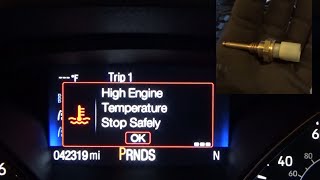
- "Engine Overheat" or similar warning message on the dashboard
- Noticeable loss of engine power as the PCM enters fail-safe mode (Limp Mode)
- White smoke from the exhaust, which is burning coolant
- Unexplained, recurring low coolant level in the reservoir with no visible external leaks
- Rough running engine or misfires, especially on a cold start
- Sweet smell of coolant from the exhaust or engine bay
- Replacing only the Cylinder Head Temperature (CHT) sensor without verifying if the engine is actually overheating. The code is often a symptom of a real cooling system failure, not a sensor failure.
- Replacing a head gasket without addressing the underlying engine block flaw. The issue is typically not a failed gasket but a crack in the block itself, so a new gasket will not solve the problem long-term.
Most Likely Causes

- Coolant Intrusion into Cylinders (Cracked Engine Block) 🔴 High Probability A known design flaw in the open-deck 1.5L and 2.0L EcoBoost engine blocks allows coolant to leak into the cylinders. Ford has acknowledged this with TSB 22-2322 (1.5L) and TSB 19-2346 (2.0L).
How to confirm: Perform a cooling system pressure test; a rapid loss of pressure with no external leaks is a strong indicator. Use a borescope to visually inspect inside the cylinders for coolant, moisture, or 'steam-cleaned' pistons. A chemical block test can detect exhaust gases in the coolant, confirming a breach.
Typical fix: The official Ford-recommended repair is to replace the engine short block (1.5L) or long block (2.0L) assembly with a revised part.
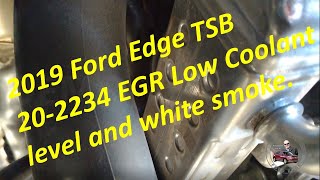
Est. part cost: $2000-$5000+ - Leaking EGR Cooler 🟡 Medium Probability On 2.0L EcoBoost engines, the EGR cooler can develop internal leaks, allowing coolant to enter the intake and exhaust systems. TSB SSM 48345 and TSB 20-2234 directly address this issue.
How to confirm: Pressure test the cooling system while visually inspecting the EGR cooler for external leaks. An internal leak may require removing the cooler to check for coolant residue in the exhaust passages or a 'steam-cleaned' appearance.
Typical fix: Replace the EGR cooler assembly (Part # K2GZ-9F464-A or similar) and associated gaskets.
Est. part cost: $300-$600 - Low Engine Coolant Level 🟡 Medium Probability Caused by an external leak from a component like a cracked radiator, a faulty water pump, or a leaking hose. The plastic quick-connect fittings on heater hoses are a common failure point.
How to confirm: Visually inspect the engine bay for signs of coolant leaks (stains, drips, or steam). Perform a cooling system pressure test to locate the source of the external leak.
Typical fix: Repair or replace the leaking component (e.g., radiator, water pump, hose, gasket).
Est. part cost: $50-$800 - Failed Cylinder Head Temperature (CHT) Sensor ⚪ Low Probability
How to confirm: If the engine shows no physical signs of overheating (coolant level is normal, no steam, hoses are not excessively hot), the sensor itself may be faulty. This often happens immediately on startup. Test the sensor's resistance against specifications or monitor its reading with a scan tool for erratic behavior.
Typical fix: Replace the Cylinder Head Temperature (CHT) sensor. (Motorcraft Part # DY1177 or similar).
Est. part cost: $25-$75
Rare But Worth Checking
- Stuck Thermostat: A thermostat stuck closed will prevent coolant from circulating to the radiator, causing a rapid overheat condition. This is a basic cooling system failure that should be checked early in the diagnosis.
- Failed Water Pump: A water pump with a broken impeller or a slipping belt will not circulate coolant, leading to an overheat. On some engines, the water pump is driven by a dedicated belt that can fail.
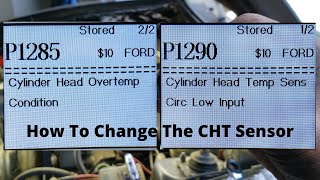
- CHT Sensor Wiring Damage: The wiring to the CHT sensor can become damaged from heat or rodents, causing a false overheat signal. This would typically be accompanied by code P1290. Water intrusion into the C1164 connector is a known issue on some Ford models, leading to corrosion and false signals.
Diagnosis Steps
- Verify the code with a reliable OBD-II scanner. Note any other codes present, especially P1299, P030x, and P0316.
- CRITICAL: Check the engine coolant level in the reservoir. DO NOT open a hot, pressurized system.
- If coolant is low, inspect for obvious external leaks (radiator, hoses, water pump, thermostat housing). Pay close attention to heater hose quick-connect fittings.
- If no external leaks are found, perform a cooling system pressure test. The system should hold pressure (typically 15-20 psi) for at least 30 minutes. A steady drop in pressure with no visible leak points to an internal leak (engine block or EGR cooler).
- Perform a chemical block test (combustion leak test). This test uses a blue fluid that turns yellow or green in the presence of exhaust gases in the coolant, providing definitive proof of an internal engine leak.
- If an internal leak is confirmed, use a borescope to inspect the inside of the cylinders for any signs of moisture, coolant pooling, or 'steam-cleaned' pistons, which indicate coolant intrusion.
- Check for white, sweet-smelling smoke from the exhaust, a classic sign of burning coolant.
- For 2.0L EcoBoost engines, specifically inspect and pressure test the EGR cooler 🎬 See how to diagnose a leaking EGR cooler per TSB. for internal leaks as outlined in TSB SSM 48345.
- If the engine does not appear to be physically overheating and the coolant system holds pressure, test the CHT sensor and its wiring harness for proper resistance and continuity back to the PCM.
Parts You'll Likely Need
- Engine Short Block Assembly
(OEM #Varies by VIN, refer to TSB 22-2322)— This is the official Ford-recommended fix for the common coolant intrusion issue on 1.5L EcoBoost engines, as per TSB 22-2322.
Trusted brands: Motorcraft (OEM)
OEM price range: $2000-$4000 - Engine Long Block Assembly
(OEM #Varies by VIN, refer to TSB 19-2346)— This is the official Ford-recommended fix for the coolant intrusion issue on 2.0L EcoBoost engines, as per TSB 19-2346.
Trusted brands: Motorcraft (OEM)
OEM price range: $4000-$7000 - EGR Cooler Assembly
(OEM #K2GZ-9F464-A)— For 2.0L EcoBoost engines, an internal failure of this part can cause coolant loss and overheating, as documented in TSB SSM 48345.
Trusted brands: Motorcraft (OEM)
OEM price range: $300-$600 - Cylinder Head Temperature (CHT) Sensor
(OEM #8S4Z-6G004-A or DY1177)— In rare cases, the sensor itself fails, providing a false overheat signal. This should only be replaced after confirming the engine is not actually overheating.
Trusted brands: Motorcraft (OEM)
OEM price range: $25-$75
Related Codes That Often Appear With This One
- P1299 — Cylinder Head Overtemperature Protection Active. This code confirms the PCM has entered a fail-safe mode, reducing engine power to prevent damage due to the overheat condition detected by P1285.
- P0217 — Engine Coolant Overtemperature Condition. This is a more general overheat code that is often stored alongside the more specific P1285.
- P0300, P0301-P0304 — Random or specific cylinder misfire codes. These are triggered when coolant intrudes into the cylinders, fouling the spark plugs and disrupting combustion.
- P0316 — Misfire Detected on Startup (First 1000 Revolutions). This often occurs with coolant intrusion, as coolant that has pooled in a cylinder overnight causes an immediate misfire upon starting.
Technical Service Bulletins (TSBs) & Recalls
- TSB 22-2322: Covers 1.5L EcoBoost engines. Acknowledges coolant intrusion causing codes like P1285 and recommends short block replacement as the fix.
- TSB 19-2346: Covers 2.0L EcoBoost engines. Addresses coolant intrusion causing low coolant, white smoke, and codes including P1285. Recommends long block engine assembly replacement.
- SSM 48345: Covers 2.0L EcoBoost engines. Specifically points to a leaking EGR cooler as a cause for low coolant, white smoke, and a list of DTCs including P1285.
Platform-Specific Known Issues
- 1.5L EcoBoost Coolant Intrusion: TSB 22-2322 details a known issue where coolant intrudes into the cylinders on 2017-2019 Escapes. The fix is a new engine short block.
- 2.0L EcoBoost Coolant Intrusion: TSB 19-2208 addresses a similar coolant intrusion issue on 2017-2019 Escapes, requiring a new long block engine assembly.
- 2.0L EcoBoost EGR Cooler Leaks: TSB SSM 48345 points to a leaking EGR cooler as a cause for coolant loss and overheating symptoms on 2019-2020 Escapes.
Mechanic-Grade Diagnostic Values
- Cylinder Head Temperature (CHT) Sensor Resistance — expected: Approximately 37.4 kΩ at 68°F (20°C), 10.8 kΩ at 122°F (50°C), and 2.4 kΩ at 194°F (90°C). Resistance decreases as temperature increases.. Failure: Resistance is infinite (open circuit), near zero (short circuit), or does not match the expected value for a given temperature.
- Cylinder Head Temperature (CHT) Sensor Voltage (Live Data) — expected: Voltage should be high when the engine is cold (e.g., ~3.26V at 68°F/20°C) and decrease smoothly as the engine warms up (e.g., ~0.82V at 200°F/93°C).. Failure: Voltage is stuck high (e.g., 5V) or low (e.g., 0V), or jumps erratically, indicating a sensor or wiring fault.
Scan Tool Commands That Help
- Ford IDS (Integrated Diagnostic System): Power Balance Test — When P1285 is accompanied by misfire codes (P0300-P0304), this bidirectional test allows a technician to disable individual fuel injectors one at a time to identify which cylinder(s) are not contributing to engine power. This helps pinpoint the location of coolant intrusion.
- Ford IDS (Integrated Diagnostic System): Datalogger with CHT PIDs — To monitor the CHT sensor voltage and inferred temperature in real-time. This is crucial for determining if the sensor is providing a plausible reading or if it is behaving erratically, suggesting a sensor or wiring fault rather than a true overheat.
Wiring & Ground Locations
- Main Engine Ground Strap — A primary ground strap connects from the engine block (often near the transmission bell housing or a starter bolt) to the vehicle's chassis/frame rail in the engine bay.. A poor engine ground can cause erratic sensor readings across the engine, including from the CHT sensor. While not a primary cause, verifying this connection is a fundamental step in diagnosing any electrical fault.
- G104 / G105 (Example Ground Points) — Under the battery tray and airbox assembly, there are several critical chassis ground points for various engine and body harnesses.. Corrosion or looseness at these points can cause a host of electrical issues, including intermittent sensor failures. A repair shop noted cleaning these grounds resolved hard starting issues, which can be related to poor sensor data.
- CHT Sensor Connector (C1164 on some models) — At the CHT sensor itself, located on the back of the cylinder head for the 1.5L EcoBoost, often requiring removal of the cowl panel for access.. This connector is a known point of failure due to water intrusion and corrosion, which can directly cause false P1285 and P1290 codes even when no overheat condition exists. A TSB for other Ford models highlights this exact issue.
Real Owner Repair Stories
- Reddit user in r/fordfusion (2015 Ford Fusion SE 1.5L EcoBoost, 113k miles) — Running rough, white smoke on startup, consuming a gallon of coolant every 100 miles. Coolant intrusion was found in all 4 cylinders.
❌ Tried (didn't work) The initial repair involved replacing the short block and catalytic converter for $7500.
✅ What actually fixed it The initial repair failed, with coolant intrusion re-appearing in cylinder #4 shortly after. The vehicle had to be returned to the dealer for a second, more thorough repair under warranty. This highlights that even the standard TSB fix can fail if not executed perfectly. - Maintenance/Repairs forum user (2017 Ford Escape) — Vehicle would not accelerate out of the driveway, mimicking a major engine or transmission failure.
❌ Tried (didn't work) The owner was considering taking the vehicle to the dealer for a warranty claim.
✅ What actually fixed it The owner discovered a loose ground nut for the wiring harness on the valve cover. Tightening this nut resolved the issue completely. This serves as a critical reminder to check basic electrical connections before assuming a catastrophic failure. - Reddit user in r/fordescape (2019 Ford Escape, 94k miles, build date 11/27/2018) — Confirmed coolant intrusion in cylinder 4.
❌ Tried (didn't work) The vehicle was outside the mileage for Ford's recall/customer satisfaction program.
✅ What actually fixed it The owner was quoted nearly $9,000 by the dealer for a short block replacement. An independent shop offered a Ford remanufactured motor (built after mid-2019 to avoid the defect) for $9,500. The owner opted for the repair, emphasizing the importance of ensuring the replacement engine is the revised design.
Model Year Variations Within This Range
- 2017-2019 (1.5L EcoBoost): Ford TSB 22-2322 specifies that 2017-2019 Escape models built on or before April 8, 2019, are affected by the original engine block design prone to coolant intrusion. Vehicles built after this date should have the revised engine block with filled-in coolant channels between the cylinders, which prevents the leak path.
- 2020-2022 (1.5L EcoBoost): Starting in the 2020 model year, the Ford Escape began using a completely different 1.5L engine. It is a 3-cylinder engine (nicknamed 'Dragon') instead of the previous 4-cylinder. While early versions of this new engine also had some reports of coolant intrusion, the design and failure mode are distinct from the 2017-2019 4-cylinder engine.
Helpful Videos
We Have This Part in Stock



The information in this article is provided for general reference and educational purposes only. Vehicle specifications, procedures, and part compatibility can vary by production date, trim level, and region. Always consult your vehicle's factory service manual and verify part numbers before purchasing or performing repairs. Safety-critical components such as airbags, seat belts, and braking systems should be installed by a qualified professional.
- Ford ESCAPE:
- 🎬 Helpful Videos
- 🛍️ Shop This Part
- What's Unique About the 2015-2022 Ford ESCAPE
- Diagnostic Flowchart
- Symptoms You May Notice
- Most Likely Causes
- Rare But Worth Checking
- Diagnosis Steps
- Parts You'll Likely Need
- Related Codes That Often Appear With This One
- Technical Service Bulletins (TSBs) & Recalls
- Platform-Specific Known Issues
- Mechanic-Grade Diagnostic Values
- Scan Tool Commands That Help
- Wiring & Ground Locations
- Real Owner Repair Stories
- Model Year Variations Within This Range
- 🎟️ Get 5% Off