

P1285 on 2011-2025 Dodge Durango 3.6L: Cylinder Head Over Temperature Guide
Code P1285 means the engine computer thinks the cylinder head is dangerously hot. This is either a real overheating problem caused by a failing water pump, thermostat, or a cracked oil cooler housing, or it's a faulty engine coolant temperature sensor. Do not drive until you confirm if it's a real overheat. The most common cause is a cracked plastic oil filter/cooler housing located in the engine 'V'.
- P1285 is a critical code. Immediately and safely stop the vehicle to prevent engine damage.
- The first step is to determine if the engine is actually overheating or if it's a sensor error. An inexpensive infrared thermometer is the best tool for this.
- On the 3.6L Pentastar, the most likely causes of a real overheat are a failed water pump, a stuck thermostat, or a cracked oil cooler housing.
- The oil cooler housing is a very common failure. If you have an unexplained coolant loss, suspect a crack in this part, which is located under the intake manifold.
- If the engine is not hot but the gauge says it is, the Engine Coolant Temperature (ECT) sensor is the most likely cause.
What's Unique About the 2011-2025 Dodge Durango
The 3.6L Pentastar engine, while generally durable, has several well-documented cooling system weaknesses that make it prone to genuine overheating events that trigger a P1285 code. The plastic oil filter/cooler housing, located in the hot engine valley, is a very common failure point that can cause a rapid and catastrophic coolant loss. Additionally, water pumps and thermostat housings are frequent culprits. Early models (2011-2013) were also susceptible to a left-side cylinder head design flaw that could cause localized overheating and valve seat issues, sometimes manifesting as misfire codes (P0300, P0302, P0304, P0306) before a full overheat event.
Generation note: The 2011-2025 Dodge Durango is the third generation (WD). However, there is a key difference in the location of the Engine Coolant Temperature (ECT) sensor. On earlier models (approx. 2011-2018), the sensor is located on the rear of the left cylinder head, making it difficult to access. On later models (approx. 2019+), the sensor is integrated into the thermostat housing at the front of the engine, which is much easier to service. This change simplifies diagnosis when a faulty sensor is suspected.
Symptoms You May Notice
- Check engine light is on
- Temperature gauge suddenly shoots to maximum (H)
- Warning message on the dashboard (e.g., 'OVERHEAT')
- Engine power is significantly reduced (limp mode)
- Engine shuts off while driving and may not restart
- Cooling fans running at maximum speed, or not at all
- Steam coming from under the hood
- A sweet smell of coolant around the vehicle
- Engine running rough or vibrating as injectors are shut off
- Replacing only the temperature sensor without confirming if the engine is actually overheating. A real overheating issue will persist and cause engine damage.
- Replacing the radiator cap when the leak is actually from the thermostat housing or oil cooler.
- Assuming a misfire code is unrelated. On early models (2011-2013), left cylinder head issues could cause misfires and were linked to overheating problems.
Most Likely Causes
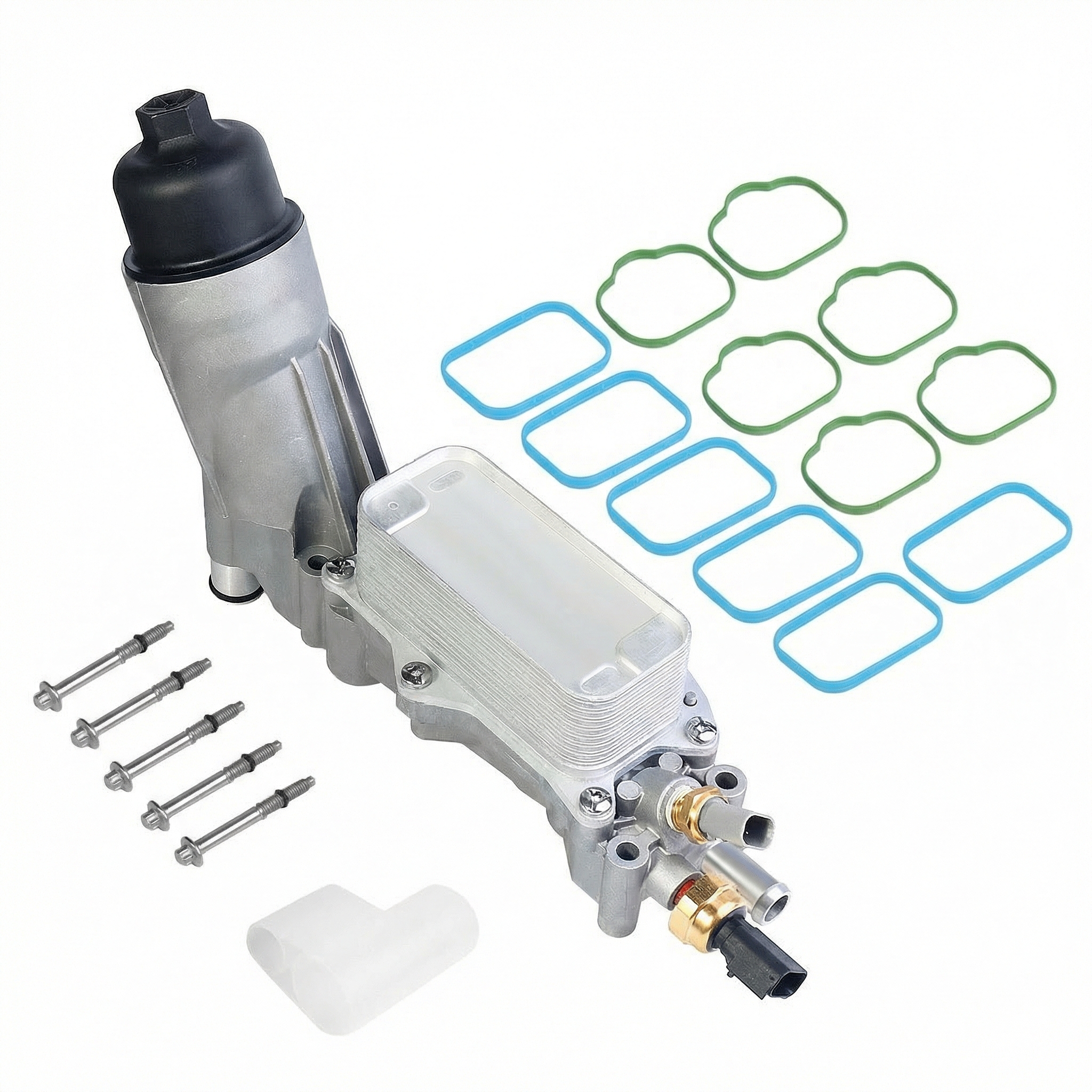
- Leaking/Cracked Oil Filter Housing / Oil Cooler 🔴 High Probability The housing is made of plastic and sits in the hot 'V' of the engine, causing it to become brittle and crack over time, leading to coolant and/or oil leaks. Heat cycling and pressure are the primary cause of failure.
How to confirm: Visually inspect the engine valley below the intake manifold for signs of pooled coolant (pink/purple) or oil. A pressure test of the cooling system will often reveal the leak. The leak is often not visible from above or below without some disassembly, but the smell of burning coolant is a strong indicator.
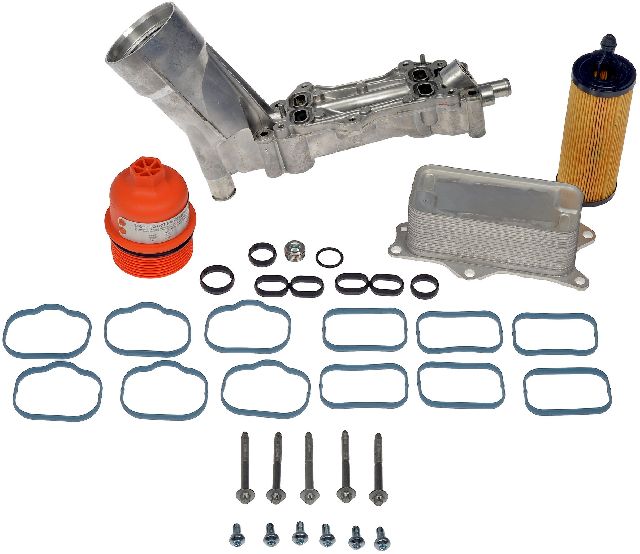
Typical fix: Replace the entire oil filter housing and cooler assembly. This is labor-intensive as the upper and lower intake manifolds must be removed. Many owners opt for an upgraded all-aluminum replacement part (e.g., Dorman 926-876 or 926-959) instead of another OEM plastic unit.
Est. part cost: $100-$350 - Failed Water Pump 🔴 High Probability The water pumps on the 3.6L Pentastar are a known common failure item, with internal seals that wear out or bearings that seize.
How to confirm: Check for coolant leaks or weeping from the water pump weep hole. A grinding or whining noise from the front of the engine can also indicate a failing pump bearing. With the engine cool and belt removed, check for play or roughness when turning the water pump pulley by hand; a seized pump will not spin at all.
Typical fix: Replace the water pump and flush the cooling system.
Est. part cost: $50-$200 - Faulty Thermostat or Housing 🟡 Medium Probability The thermostat can stick closed, preventing coolant from circulating to the radiator. The plastic housing can also crack and leak.
How to confirm: Use an infrared thermometer to check temperatures. If the upper radiator hose is hot but the lower hose is cool after the engine has warmed up, the thermostat is likely stuck closed. Check the housing for visible cracks or leaks.
Typical fix: Replace the thermostat and housing assembly.
Est. part cost: $40-$150 - Faulty Engine Coolant Temperature (ECT) Sensor 🟡 Medium Probability
How to confirm: First, verify the engine is not actually overheating using an infrared thermometer on the thermostat housing. If the engine temperature is normal (e.g., ~210°F) but the gauge reads hot and P1285 is present, the sensor is a likely culprit. Use a scan tool to monitor the ECT data; erratic, illogical, or pegged readings (e.g., 250°F+ on a cold engine) point to a bad sensor or wiring.
Typical fix: Replace the ECT sensor. On early models, this is difficult as it's on the back of the head. On later models (2019+), it's part of the thermostat housing and much easier to access, sometimes held in by a small clip.
Est. part cost: $20-$60 - Failed Radiator Cooling Fan Assembly ⚪ Low Probability
How to confirm: If the vehicle overheats primarily at idle or in slow traffic but is fine at highway speeds, suspect the fan. Turn on the A/C, which should command the fan to run. If it doesn't, check the fuse, relay, and wiring for power and ground before condemning the fan motor.
Typical fix: Replace the cooling fan assembly, relay, or repair the wiring.
Est. part cost: $150-$400
Rare But Worth Checking
- Clogged Radiator: Can be caused by internal restrictions from casting sand on early models or external blockage from debris. Check for even temperature distribution across the radiator core with an infrared thermometer; large cold spots can indicate a clog.
- Blown Head Gasket: A severe overheat can cause a head gasket to fail, or a pre-existing failure can cause the overheat. Use a block tester kit to check for combustion gases in the coolant, which is a definitive sign of a failed head gasket.
Diagnosis Steps
- SAFETY FIRST: Do not open the radiator cap on a hot engine. Pressurized coolant will cause severe burns.
- Check the coolant level in the reservoir. If it is low, top it off and look for obvious leaks on the ground.
- Use a scan tool to confirm P1285 and check for any other codes, especially P1299.
- CRITICAL STEP: Determine if the engine is actually overheating. Use an infrared thermometer to measure the temperature at the thermostat housing and cylinder heads. If temps are above 240°F (115°C), it's a real overheat. If temps are normal (195-220°F or 90-104°C), suspect a faulty sensor or wiring.
- IF IT IS A REAL OVERHEAT: Perform a cooling system pressure test to find leaks. Pay close attention to the water pump, thermostat housing, and the engine valley under the intake (oil cooler).
- Test the cooling fan operation by turning on the air conditioning. The fan should engage. If not, inspect the fan fuse, relay, and connector for power.
- If no leaks are found, test the thermostat. Check if the lower radiator hose gets hot as the engine warms up. If it stays cold, the thermostat is likely stuck closed.
- IF IT IS NOT A REAL OVERHEAT: Suspect the Engine Coolant Temperature (ECT) sensor. Monitor its reading on a scan tool for erratic behavior. Test the sensor's wiring and connector for damage or corrosion. On later models, the sensor is on the front of the engine; on earlier models it is on the rear of the driver's side head.
- For severe cases or if a head gasket is suspected, use a block tester (combustion leak detector) to check for exhaust gases in the cooling system.
Parts You'll Likely Need
- Engine Oil Filter Housing / Oil Cooler Assembly
(OEM #68105583AG, 68596317AB (supercedes many previous numbers))— This is the most common major failure point for the cooling system on the 3.6L Pentastar, frequently cracking and causing major coolant loss.
Trusted brands: Mopar, Dorman (e.g., 926-876, 926-959 - Aluminum OE FIX)
OEM price range: $180-$250
Aftermarket price range: $120-$200
Related Codes That Often Appear With This One
- P1299 — P1299 is 'Cylinder Head Over Temperature Protection Active'. It often appears with P1285 and indicates the PCM has started actively intervening (like cutting fuel injectors) to cool the engine down.
- P0128 — 'Coolant Thermostat Rationality'. This code indicates the engine is not reaching operating temperature as quickly as expected, which can be an early sign of a failing thermostat that could later stick closed and cause a P1285.
- P0300, P0302, P0304, P0306 — Misfire codes, particularly on the left bank (cylinders 2, 4, 6). On 2011-2013 models, this could be related to the cylinder head design issue which caused localized overheating and valve seat failure.
Technical Service Bulletins (TSBs) & Recalls
- Chrysler extended warranty for the left cylinder head on 2011-2013 models due to potential valve seat issues. The revised head part number is RL141353AC.
- TSB 09-002-15 has been mentioned in relation to rocker arm/lifter issues, which can be exacerbated by oil breakdown or overheating.
Platform-Specific Known Issues
- Early models (2011-2013) had a higher incidence of left cylinder head failure, which could be related to or worsened by overheating events.
- Casting sand from the manufacturing process could clog radiators and heater cores on early production Pentastar engines, leading to chronic overheating issues.
Mechanic-Grade Diagnostic Values
- ECT Sensor Signal Voltage (KOEO - Key On, Engine Off) — expected: Approx. 2.0V to 3.0V on a cold engine (e.g. 20°C / 68°F). Approx. 0.5V on a fully warm engine (e.g. 90°C / 194°F).. Failure: Voltage that is illogical for the current temperature (e.g., 0.5V on a stone-cold engine) or does not change as the engine warms up.
- ECT Sensor Resistance — expected: Approx. 2000-3000 Ohms at 20°C (68°F). Approx. 200-300 Ohms at 90°C (194°F).. Failure: Readings that are far outside the expected range for a given temperature, or an open/short circuit reading.
- ECT Sensor Circuit Voltage (Sensor Disconnected) — expected: Approx. 5.0 Volts on the signal wire.. Failure: Voltage significantly lower than 5.0V or 0V indicates a wiring problem or an issue with the PCM's 5V reference circuit.
Scan Tool Commands That Help
- wiTECH (Dealer Tool): View Live Data (ECT Sensor Voltage/Temperature) — This is the primary method to determine if the sensor is providing a logical reading. A technician can watch the temperature rise as the engine warms up to see if it's smooth or if it jumps erratically, which would indicate a faulty sensor or wiring.
- wiTECH (Dealer Tool): Reprogram PCM — In some cases, manufacturers release software updates to change the sensitivity or logic related to sensor inputs. Checking for an available PCM flash is a valid diagnostic step if no physical cause is found, as outlined in technical service bulletins for other codes on this platform.
Wiring & Ground Locations
- ECT Sensor Connector — On earlier models (approx. 2011-2018), it's on the rear of the left (driver's side) cylinder head. On later models (approx. 2019+), it's integrated into the thermostat housing at the front of the engine.. This connector is a common point of failure due to heat and vibration. The terminals can corrode or the wiring can become brittle. Testing for the 5V reference and signal voltage occurs here.
- G305 — Reported to be in the left front of the engine compartment, near the left fender.. This is a chassis ground point. A corroded or loose main ground can cause floating voltages and erratic behavior from various engine sensors that rely on a stable ground reference.
- Engine Block to Chassis Ground Strap — A braided strap typically connecting the engine block or transmission to the vehicle's firewall or frame rail.. This is the primary ground path for the engine block and all sensors mounted to it. If this strap is broken or corroded, the sensor's ground path can become unstable, leading to incorrect readings and false codes like P1285.
Real Owner Repair Stories
- YouTube channel 'Auto repair' (Vehicle with 3.6L Pentastar engine) — Engine would run for a while, then die. Check engine light was on with codes P1285 and P1299. Scan tool showed engine temperature rising extremely fast after starting.
❌ Tried (didn't work) The technician noted that a common mistake would be to just replace the temperature sensor without further diagnosis.
✅ What actually fixed it The technician removed the serpentine belt and found the water pump pulley was completely seized and would not spin by hand. Replacing the failed water pump resolved the overheating condition. - YouTube channel 'P1285 & P1290 (New Edge Mustang)' (Ford Mustang (different vehicle, but identical code and sensor failure mode)) — A coolant hose came loose and sprayed coolant all over the engine, causing an initial P1285 overheat code. After fixing the hose and clearing the code, P1285 and P1290 returned 40 miles later without the engine actually overheating.
❌ Tried (didn't work) Fixing the coolant leak and clearing the codes.
✅ What actually fixed it The coolant that sprayed onto the Cylinder Head Temperature (CHT) sensor had damaged its internal circuitry. Replacing the CHT sensor, which was now reading incorrectly, permanently fixed the codes.
"I Checked Everything" — The Actual Cause
- The equivalent for a cooling system is a pressure test that holds steady, indicating no external leaks. If a pressure test passes but the engine still overheats and sets P1285, the cause is a lack of coolant circulation. This is most commonly a thermostat stuck closed or a failed water pump whose impeller is not spinning (due to a seized bearing or separated impeller), even if it isn't leaking from its weep hole.
OEM Part Supersession History
68105583AG (and many others, e.g., AF, AE, AD, etc.)→68596317AB— Multiple revisions to the plastic oil filter housing to address cracking and leaking issues.
Heads up: The latest OEM part number, 68596317AB, may not include the oil temperature and pressure sensors, requiring the technician to reuse the old ones or purchase them separately.OEM Plastic Oil Filter Housing (2011-2013 models)→OEM Plastic Oil Filter Housing (2014+ models)— Design change in oil filter style and sensor configuration.
Heads up: The electrical connectors for the oil sensors changed around the 2014 model year. Ordering an assembly for the wrong year range will result in connectors that do not fit the vehicle's harness. Aftermarket aluminum kits like the Dorman 926-959 are designed to fit a wider range (e.g., 2011+) by including adapters or plugs for the unused sensor ports on newer engine designs.
Model Year Variations Within This Range
- 2011-2013 vs 2014+: The oil filter housing assembly has different sensor configurations and uses a different oil filter cartridge. The electrical connectors for the integrated sensors are not interchangeable between these ranges. When purchasing an aftermarket aluminum housing, it is critical to verify fitment for the specific year, as some kits (like Dorman 926-876) are for 2014+ while others (like Dorman 926-959) are more universal kits for 2011+ applications.
- approx. 2011-2018 vs 2019+: The primary Engine Coolant Temperature (ECT) sensor moved from a difficult-to-access location on the rear of the left cylinder head to an easily accessible location on the front-mounted thermostat housing. This significantly reduces labor time if the sensor itself is the suspected cause.
- approx. 2016+: Introduction of the updated 'Pentastar Upgrade' (PUG) engine with features like two-stage variable valve lift (VVL) and cooled EGR. This can affect compatibility with some aftermarket parts; for example, some early aluminum oil cooler housings were reported as not being compatible with the EGR cooling system on these later engines.
Diagnostic Flowchart
Other Known Issues on This Vehicle
Issues unrelated to this code that are worth knowing about as an owner of this generation:
- Rocker Arm / Lifter Failure ('Pentastar Tick') 🔴 High — Common, especially on 2011-2016 models. Often appears after 60,000 miles. Can be caused by worn needle bearings in the rocker arm rollers. (Ref: TSB 09-002-15 has been associated with this issue. The fix involves replacing the affected rocker arms with an updated part (e.g., Mopar #68066266AD).)
- TIPM (Totally Integrated Power Module) Failure 🔴 High — Widespread on 2011-2013 models. Can cause a vast array of random electrical issues, including no-start, fuel pump staying on/off, horn honking, and wipers activating randomly. (Ref: No official recall, but subject of class-action lawsuits. Many owners opt for third-party repair services.)
- Delaminating/Bubbling Leather Dashboard 🟡 Low — Very common on higher trim levels (e.g., Citadel, R/T) with leather dashboards, especially in hot climates. The adhesive fails, causing the leather to lift near the defrost vents. (Ref: No recall, as it's considered a cosmetic issue. Repair is very expensive as it requires dashboard replacement. Covered under the 3yr/36k bumper-to-bumper warranty but not after.)
- Left Cylinder Head Failure (Early Models) 🔴 High — Affected a small percentage of 2011-2013 models. Caused by overheating valve seats on cylinder #2, leading to misfires (P0302, etc.) and ticking noises. (Ref: Chrysler issued an extended warranty (10 years/150,000 miles) for the left cylinder head on affected vehicles. The issue was fixed in production in mid-2012.)
- Rear Spoiler Misalignment/Damage 🟡 Low — Reported on 2021-2023 models where the spoiler can be damaged by the liftgate during use. (Ref: Recall 20A (expansion of 21V-842). Dealers will inspect and replace the spoiler if necessary.)
Used vs. New Parts: Buying Guide for This Vehicle
When a used part is the smart pick: For this repair, used parts are generally a poor choice for the common failure items. However, a used radiator fan assembly or a coolant reservoir from a low-mileage, accident-damaged vehicle can be a cost-effective option.
Donor-vehicle mileage cap: roughly under 75000 miles for the part to have meaningful remaining life.
What to inspect on the donor part:
- For a fan assembly, ensure there are no cracks in the shroud or blades.
- Manually spin the fan blades to feel for any roughness or binding in the motor's bearing.
- For any plastic part like a reservoir, inspect for chalkiness, discoloration, or hairline cracks, which indicate heat fatigue.
OEM-only on this vehicle (don't cheap out):
- Engine Coolant Temperature (ECT) Sensor: While not strictly 'OEM-only', using a cheap, unbranded sensor is a major risk. Stick with the Mopar part or a reputable OE supplier like NTK or Denso to avoid inaccurate readings and repeat failures.
Aftermarket brands forum-validated for this vehicle:
- Dorman (Aluminum OE FIX Oil Cooler Housing, PNs 926-876 or 926-959): Widely regarded in forums and by technicians as a permanent upgrade over the failure-prone OEM plastic housing.
Brands owners have reported issues with on this vehicle:
- Unbranded/generic plastic oil filter housings: These are likely made to the same or lower standards as the original part and are prone to the same heat-induced cracking and failure. It is not a reliable long-term repair.
Real Owner Stories
Aggregated from forums and TSBs cited above. Mileages and costs reflect what owners reported in those sources.
2014 Dodge Durango 3.6L Pentastar V6
Symptoms: Owner performed a teardown after finding metal in the oil filter; noted issues with lifters and rockers.
What fixed it: Replacing the lifters and rocker arms.
Source hint: https://bobistheoilguy.com/forums/threads/replacing-lifters-and-rockers-in-2014-dodge-3-6l-pentastar-after-finding-metal-in-oil-filter.399623/
2011-2012 Dodge Durango 3.6L
Symptoms: Technicians discussed early 3.6L left cylinder head failures that resulted in overheating conditions.
What fixed it: Replacement of the left cylinder head with the revised part (RL141353AC).
Source hint: https://www.reddit.com/r/Justrolledintotheshop/comments/1h89n0/recall_on_20112012_jeepdodge_with_a_36_happens/
Related OBD-II Codes
Frequently Asked Questions
Is there a specific TSB for the cylinder head issues on my 2011-2013 Durango 3.6L?
My 2014 Durango has metal shavings in the oil filter along with overheating; is this a known issue?
Should I replace my cracked plastic oil filter housing with the same OEM part?
Why does my Durango go into 'limp mode' when the P1285 code triggers?
Is the Engine Coolant Temperature (ECT) sensor easy to replace on a 2020 Durango?
Could casting sand be causing my Durango to overheat?
Used OEM Parts in Stock

New Aftermarket Parts Available

The information in this article is provided for general reference and educational purposes only. Vehicle specifications, procedures, and part compatibility can vary by production date, trim level, and region. Always consult your vehicle's factory service manual and verify part numbers before purchasing or performing repairs. Safety-critical components such as airbags, seat belts, and braking systems should be installed by a qualified professional.
- Dodge Durango:
- 🛍️ Shop This Part
- What's Unique About the 2011-2025 Dodge Durango
- Symptoms You May Notice
- Most Likely Causes
- Rare But Worth Checking
- Diagnosis Steps
- Parts You'll Likely Need
- Related Codes That Often Appear With This One
- Technical Service Bulletins (TSBs) & Recalls
- Platform-Specific Known Issues
- Mechanic-Grade Diagnostic Values
- Scan Tool Commands That Help
- Wiring & Ground Locations
- Real Owner Repair Stories
- "I Checked Everything" — The Actual Cause
- OEM Part Supersession History
- Model Year Variations Within This Range
- Diagnostic Flowchart
- Other Known Issues on This Vehicle
- Used vs. New Parts: Buying Guide for This Vehicle
- Real Owner Stories
- 2014 Dodge Durango 3.6L Pentastar V6
- 2011-2012 Dodge Durango 3.6L
- Related OBD-II Codes
- Frequently Asked Questions
- 🎟️ Get 5% Off