

P1233 on 2004-2008 Ford F-150: Fuel Pump Driver Module Failure Causes and Fixes
On a 2004-2008 F-150, P1233 almost always means the Fuel Pump Driver Module (FPDM) has failed due to corrosion. The fix is to replace the module, located above the spare tire. An OEM replacement kit with updated mounting hardware costs around $70-$120.
- P1233 on a 2004-2008 F-150 means the Fuel Pump Driver Module (FPDM) has failed, usually due to corrosion.
- Before suspecting the fuel pump, always inspect the FPDM first. It's located on the frame crossmember above the spare tire.
- The fix is to replace the FPDM with a new kit that includes standoff hardware.
- Also, check the 20-amp FPDM fuse in the passenger kick panel, as a shorted module will often blow it.
- This is a very common and well-documented issue, and is a relatively easy and inexpensive DIY repair.
What's Unique About the 2004-2008 Ford F-150

The 2004-2008 F-150 is notorious for this specific failure due to a design flaw. Ford mounted the aluminum-cased Fuel Pump Driver Module directly against the truck's steel frame. This contact between dissimilar metals, exposed to road salt and moisture, causes severe galvanic corrosion that eats through the module's housing, allowing water to destroy the internal electronics. This issue is so common that the replacement part from Ford includes redesigned mounting hardware to prevent a recurrence.
Symptoms You May Notice
- Engine cranks but will not start.
- Engine stalls while driving, sometimes intermittently.
- Check Engine Light is on.
- No sound from the fuel pump when the key is turned to the 'on' position.
- Long crank time before the engine starts.
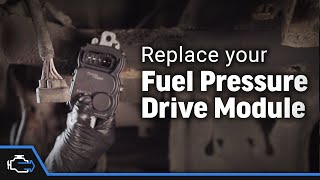
- Replacing the in-tank fuel pump. The symptoms of a failed FPDM (crank-no-start) are identical to a failed fuel pump. Owners often replace the more expensive and difficult-to-access fuel pump 🎬 Watch this walkthrough to see how easy the FPDM replacement is. when the actual, and much more common, failure is the FPDM.
Most Likely Causes

- Corroded/Failed Fuel Pump Driver Module (FPDM) 🔴 High Probability The module's aluminum body is mounted directly to the steel frame, causing galvanic corrosion that cracks the housing and allows water intrusion, shorting out the circuit board.
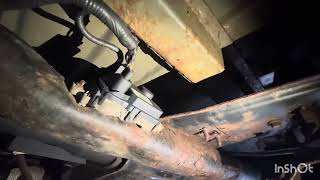
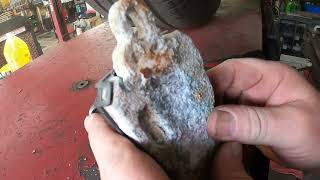
How to confirm: Lower the spare tire to access the FPDM, which is mounted to a frame crossmember. Visually inspect the back of the module for white, chalky corrosion, cracks, or a hole eaten through the case.
Typical fix: Replace the Fuel Pump Driver Module. The new part should be installed with the included standoff hardware to create an air gap between the module and the frame, preventing future corrosion. 🎬 See ChrisFix demonstrate the FPDM replacement and standoff installation.
Est. part cost: $50-$120 - Blown Fuse or Faulty Relay 🟡 Medium Probability The FPDM failing can short circuit and blow the fuse that powers it.
How to confirm: Check the fuse for the FPDM circuit. On many F-150s, this is a 20-amp fuse in the passenger side kick panel fuse box (e.g., Fuse #9). Also check the fuel pump relay.
Typical fix: Replace the blown fuse. If the fuse blows again immediately, the FPDM is likely shorted and needs to be replaced.
Est. part cost: $1-$15 - Damaged Wiring or Connector ⚪ Low Probability The wiring and connector for the FPDM are located under the truck and are exposed to road debris and moisture, which can lead to damage or corrosion.
How to confirm: After locating the FPDM, unplug its electrical connector and inspect it for melted plastic, green or white corrosion on the pins, or any broken/chafed wires in the harness.
Typical fix: Clean the connector terminals if corroded. If the connector or wiring is melted or broken, it will need to be repaired or replaced.
Est. part cost: $10-$50
Rare But Worth Checking
- Tripped Inertia Fuel Shutoff Switch: This safety switch cuts power to the fuel system in a collision. A hard jolt could potentially trip it. It's located in the passenger-side footwell area; check to ensure the button is pressed down.
Diagnosis Steps

- Scan for trouble codes. Confirm P1233 is present. 🎬 Watch: How to diagnose and fix a P1233 no-start condition.
- Check the FPDM fuse. In the passenger kick panel, inspect the 20A fuse for the fuel pump driver module (often Fuse #9). If it's blown, replace it and see if it blows again.
- Check the inertia fuel shutoff switch, typically located in the passenger footwell. Ensure it is not tripped.
- Lower the spare tire to gain access to the frame crossmember above it.
- Visually inspect the Fuel Pump Driver Module (FPDM). Look for heavy corrosion, cracks in the aluminum housing, or a hole rotted through the back.
- If the module looks physically damaged, it is almost certainly the cause and should be replaced.
- If the module looks okay, unplug the electrical connector. Inspect the connector and the module's pins for corrosion or signs of melting/overheating.
- If no obvious damage is found, further electrical testing of the power, ground, and communication wires between the PCM and FPDM would be the next step.
Parts You'll Likely Need

- Fuel Pump Driver Module Kit — This is the overwhelmingly most common failure point for code P1233 on this truck due to corrosion from its mounting location.
Trusted brands: Motorcraft, Dorman
OEM price range: $70-$120
Aftermarket price range: $50-$90
Related Codes That Often Appear With This One
- P1237 — This code indicates a fault in the secondary circuit between the FPDM and the fuel pump itself, which can be triggered by a malfunctioning FPDM.
- P0190 — This code for a Fuel Rail Pressure Sensor circuit malfunction can appear because when the FPDM fails, the PCM can no longer control or see fuel pressure, leading to illogical readings.
Platform-Specific Known Issues
- The original design mounted the aluminum FPDM directly to the steel frame, causing galvanic corrosion that destroys the module. The official Ford replacement part includes new bolts and rubber/metal standoffs to create an air gap, which solves the design flaw.
Mechanic-Grade Diagnostic Values
- FPDM Connector: Pin 5 (White Wire) to Ground — expected: ~12.6V (Battery Voltage) with key in ON position.. Failure: 0V indicates a problem with the power supply from the fuel pump relay, inertia switch, or fuse.
- FPDM Connector: Pin 3 (Black/Yellow Wire) to Chassis Ground — expected: < 5.0 Ohms of resistance.. Failure: High or infinite resistance (Open Line) indicates a bad ground connection for the module.
- Scan Tool Live Data: Fuel Pump Duty Cycle (FPDC) or FPDM Command % — expected: Fluctuating between 20-50% at idle.. Failure: A value of 75% or higher at idle suggests the FPDM is commanding maximum effort to compensate for a weak fuel pump. A value of 0% or 100% constantly may indicate a PCM or wiring fault.
- Scan Tool Live Data: FPDM Feedback Signal — expected: 50% duty cycle indicates normal operation.. Failure: 25% indicates the FPDM is not receiving a valid command from the PCM. 75% indicates the FPDM has detected a fault in the circuit to the fuel pump (e.g., open wire or failed pump).
- Scan Tool Live Data: Fuel Rail Pressure — expected: Approximately 39-45 PSI at idle.. Failure: Significantly lower or zero pressure when a start is attempted.
- FPDM Bypass Test — expected: Jumping specific pins at the FPDM connector should cause the fuel pump to run at 100% power, producing high fuel pressure (e.g., 70+ PSI).. Failure: If the pump does not run when bypassed, and the fuse does not blow, the pump itself or its wiring is faulty. If the fuse blows, the pump is likely shorted internally.
Hidden / Shadow Codes Worth Checking
- FPDM Feedback PID: While not a traditional DTC, the FPDM sends a feedback duty cycle signal to the PCM that can be read with a capable scan tool. A 50% duty cycle is normal. A 25% duty cycle means the FPDM isn't getting a command from the PCM. A 75% duty cycle means the FPDM has detected a fault in the secondary circuit (to the fuel pump). This is a critical diagnostic data point. (see via Advanced scan tool capable of reading Ford-specific live data PIDs.)
Scan Tool Commands That Help
- Ford IDS (Integrated Diagnostic System): Active Test / Bi-Directional Control — Allows a technician to directly command the fuel pump on/off or to a specific duty cycle through the FPDM. This is used to verify if the FPDM, fuel pump, and wiring are capable of functioning, separating a component failure from a command issue originating at the PCM.
- Ford IDS (Integrated Diagnostic System): DataLogger — Used to monitor and record all relevant PIDs in real-time, such as 'Fuel Pump Duty Cycle', 'FPDM Command', 'Fuel Rail Pressure', and the FPDM feedback signal. This is essential for diagnosing intermittent faults that may not be present at key-on.
Wiring & Ground Locations
- FPDM Connector — Mounted on the frame crossmember, directly above the spare tire.. This is the central connection point for all power, ground, and communication signals for the module. It is exposed to the elements and is a primary point for inspection of corrosion or damage.
- Fuse #9 — In the Central Junction Box (passenger side kick panel).. This 20A fuse provides the main power to the FPDM. A shorted FPDM will almost always blow this fuse, causing the P1233 'offline' code.
- G100 — On the left-hand (driver's) side of the radiator core support in the engine bay.. This is the main chassis ground point for the fuel pump itself. While the FPDM has its own ground wire in the harness, a poor G100 connection can cause the pump to operate poorly or not at all, mimicking FPDM failure.
- Inertia Fuel Shutoff Switch — In the passenger-side footwell, often behind a removable panel near the kick panel.. This safety switch is in series between the fuel pump relay and the FPDM. If it is tripped, it will cut all power to the FPDM, causing a P1233 code and a no-start condition.
Real Owner Repair Stories
- F150online Forums, user 'izzy_mustang' (2004-2008 F-150) — Wrestled with a no-start issue for two weeks.
❌ Tried (didn't work) Replacing the Fuel Pump Driver Module.
✅ What actually fixed it The final root cause was a faulty crankshaft position sensor. The user noted that after fixing it, they wanted to share the FPDM pinout information they had gathered during their extensive diagnosis. This highlights a key dead-end where a no-start from a different sensor can be confusing. - Ford F150 Forum, user 'F150Torqued' (2004-2008 F-150) — Crank no-start, runs on starting fluid. Scan tool shows 0 PSI fuel pressure and FPDM duty cycle at 75%.
❌ Tried (didn't work) Replacing the in-tank fuel pump., Replacing the FPDM.
✅ What actually fixed it The issue was unresolved in the thread, but the diagnosis correctly identified the next step: the 75% duty cycle indicated a fault between the FPDM and the pump. Since both components were new, the problem was almost certainly in the wiring harness running along the frame rail between the FPDM connector and the top of the fuel tank. - NHTSA ODI #10577490 — An owner reported an intermittent starting issue that eventually left them stranded. After running a diagnostic check with a scanner, they received a P1233 code indicating the Fuel Pump Driver Module was offline.
When the Usual Fixes Don't Work
- While P1233 almost always points to the FPDM itself, there are documented cases where the code persisted after replacement. In one instance, the true cause was a failed crankshaft position sensor; the PCM will not enable the fuel system if it doesn't see an engine RPM signal, but the resulting diagnostic code can be misleading. In another case, after replacing both the FPDM and the fuel pump, the code remained with a 75% FPDM fault duty cycle, indicating the problem was not either component, but rather a break in the wiring harness between them. This confirms that if a new FPDM doesn't solve the issue, a full circuit diagnosis is mandatory before replacing more parts.
OEM Part Supersession History
4L3Z-9D370-A→The OEM replacement kit often carries the same base number but includes updated mounting hardware. Newer Ford parts like GA8Z-9D370-A also exist and supersede multiple previous versions.— The original part failed due to galvanic corrosion from direct contact with the steel frame. The replacement kits include standoff bolts and spacers to create an air gap, preventing this failure.Motorcraft (OEM)→Dorman 590-001 (Aftermarket)— Dorman created an 'OE FIX' part that often uses a powder-coated or plastic housing and includes the required standoff hardware to prevent corrosion, sometimes at a lower price point.
Heads up: While a direct fit, some professional technicians and forum users report a higher failure rate with Dorman modules compared to the OEM Motorcraft part and recommend spending the extra money for the OEM unit.
Model Year Variations Within This Range
- 2004-2008: The original FPDM mounting bolts are typically an 8mm hex head, while the bolts included in the updated replacement kits are often a 10mm hex head. This is a minor detail but important for having the correct tools on hand for the repair.
Diagnostic Flowchart
Used vs. New Parts: Buying Guide for This Vehicle
When a used part is the smart pick: It is strongly recommended to NEVER use a used Fuel Pump Driver Module for this repair. The primary failure mode is age-related corrosion and electronic failure due to water intrusion. A used part from a salvage yard is highly likely to be suffering from the same corrosion and will have a very short service life, if it works at all.
What to inspect on the donor part:
- Not applicable, as used parts are not recommended.
OEM-only on this vehicle (don't cheap out):
- Fuel Pump Driver Module (recommended)
Aftermarket brands forum-validated for this vehicle:
- Motorcraft (OEM - Highly Recommended)
- Dorman (OE FIX 590-001 is a common, budget-friendly alternative, but some users report longevity issues compared to OEM).
Brands owners have reported issues with on this vehicle:
- Unbranded, low-cost modules from online marketplaces are generally not recommended due to unknown quality and reliability.
Real Owner Stories
Aggregated from forums and TSBs cited above. Mileages and costs reflect what owners reported in those sources.
2004-2008 F-150
Symptoms: The truck threw code P1233 once without a Check Engine Light, and there was a strong fuel smell that disappeared after clearing the code.
What fixed it: The owner dropped the spare tire, saw the FPDM was badly corroded, and ordered a new replacement module.
Source hint: F150online Forums
2004-2008 F-150
Symptoms: The truck was intermittently throwing code P1233 but was still able to run sometimes, causing confusion about whether the module was truly bad.
What fixed it: After being advised by other forum members that the module can fail intermittently, the owner decided to go ahead and replace the FPDM.
Source hint: Ford F150 Forum
2004-2008 Ford F-150
Symptoms: Owner experienced low fuel pressure or stalling issues.
What fixed it: The owner was advised to check the FPDM for corrosion before replacing the fuel pump, as a bad FPDM is the most common fix for P1233.
Source hint: reddit.com/r/FordTrucks
Documented NHTSA Reports
NHTSA ODI #10335887 (Cross-Manufacturer Reference)
Symptoms: While reported on a different Ford model (Focus), the owner noted that code P1233 caused the vehicle to stall while traveling at 75 mph on the interstate.
Related OBD-II Codes
Frequently Asked Questions
Where is the Fuel Pump Driver Module (FPDM) located on my 2004-2008 F-150?
Why does the FPDM fail so often on this specific generation of F-150?
To prevent this from happening again, is there a special way to install the new FPDM?
My truck cranks but won't start and has code P1233. Could the FPDM be the cause?
I replaced the 20-amp FPDM fuse in the passenger kick panel and it blew again immediately. What's next?
Should I buy a used FPDM from a junkyard to save money?
What brand of replacement FPDM is recommended for my F-150?
Helpful Videos

We Have This Part in Stock


The information in this article is provided for general reference and educational purposes only. Vehicle specifications, procedures, and part compatibility can vary by production date, trim level, and region. Always consult your vehicle's factory service manual and verify part numbers before purchasing or performing repairs. Safety-critical components such as airbags, seat belts, and braking systems should be installed by a qualified professional.
- Ford F-150:
- 🎬 Helpful Videos
- 🛍️ Shop This Part
- What's Unique About the 2004-2008 Ford F-150
- Symptoms You May Notice
- Most Likely Causes
- Rare But Worth Checking
- Diagnosis Steps
- Parts You'll Likely Need
- Related Codes That Often Appear With This One
- Platform-Specific Known Issues
- Mechanic-Grade Diagnostic Values
- Hidden / Shadow Codes Worth Checking
- Scan Tool Commands That Help
- Wiring & Ground Locations
- Real Owner Repair Stories
- When the Usual Fixes Don't Work
- OEM Part Supersession History
- Model Year Variations Within This Range
- Diagnostic Flowchart
- Used vs. New Parts: Buying Guide for This Vehicle
- Real Owner Stories
- 2004-2008 F-150
- 2004-2008 F-150
- 2004-2008 Ford F-150
- Documented NHTSA Reports
- NHTSA ODI #10335887 (Cross-Manufacturer Reference)
- Related OBD-II Codes
- Frequently Asked Questions
- 🎟️ Get 5% Off