

OBD-II Code P0230: Fuel Pump Primary Circuit Malfunction
What P0230 means, why it triggers, and how to fix it
- Code P0230 indicates an electrical failure in the fuel pump's control circuit, meaning the problem is usually a blown fuse or bad relay, not a dead fuel pump.
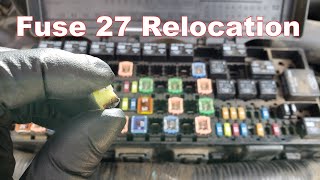
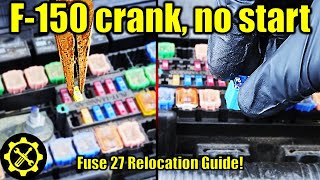
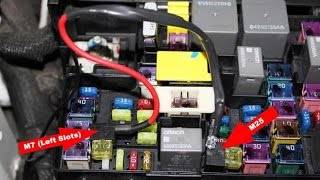
- On 2009-2014 Ford F-150s, this code is almost always caused by a melted Fuse 27, requiring a $25 Ford relocation kit (EL3Z-14293-A) to permanently fix.
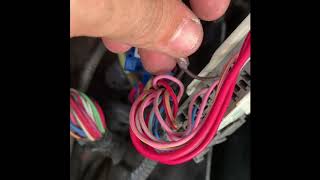
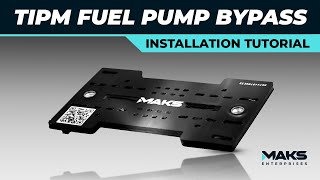
- For 2005-2013 Dodge, Ram, and Jeep vehicles, P0230 frequently points to a failed internal relay inside the TIPM, which can be bypassed for under $50 instead of replacing the $1,000 module.
- Never replace the fuel pump for a P0230 code without first testing the relay socket for 12V power; a missing 12V signal guarantees the new pump will not run.
What Does P0230 Mean?

P0230 means the Engine Control Module (ECM) detects a fault in the fuel pump's primary electrical circuit. This circuit includes the fuse, relay, wiring, and driver module. When the ECM commands the pump on, it receives incorrect voltage feedback, indicating a failure on the control side of the circuit.
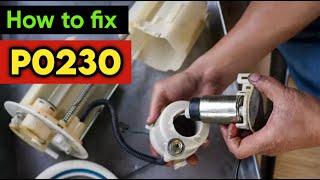
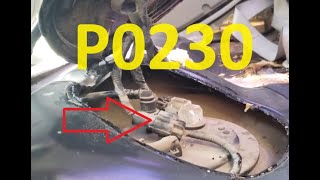
Technical definition: The official SAE definition is 🎬 Watch: A mechanic explains the P0230 circuit fault "Fuel Pump Primary Circuit Malfunction." The ECM monitors the low-current primary circuit (which activates the high-current relay powering the pump). If the ECM detects voltage outside the expected range when the relay is commanded on or off, it sets code P0230.
Can I Drive With P0230?
No — Do Not Drive. The engine stalls unpredictably, creating a severe safety hazard at high speeds or in heavy traffic. Driving with this code guarantees you will eventually be stranded without warning.
Common Causes

- Faulty Fuel Pump Relay (Very Common) — The relay is an electrical switch that turns the fuel pump on and off. Its internal contacts wear out, corrode, or the internal coil fails with high resistance, preventing activation.
- Blown Fuel Pump Fuse (Common) — The fuse protects the circuit from excess current. A failing fuel pump or a short in the wiring blows the fuse to prevent damage. On some vehicles, the fuse terminal itself overheats and melts, destroying the connection.
- Damaged Wiring, Connectors, or Control Circuit (Common) — Wires corrode, fray, or break due to heat and vibration. A broken control wire (open circuit) or a wire touching ground (short circuit) directly prevents the PCM from operating the relay.
- Poor Ground Connection (Common) — The fuel pump circuit requires a solid ground. A corroded or loose ground strap on the frame near the fuel tank causes intermittent power loss and triggers the code.
- Tripped Inertia Switch (Uncommon) — Many Ford vehicles feature an inertia switch that cuts fuel pump power during a collision. Hitting a large pothole or curb accidentally trips this switch, instantly causing a P0230 code.
- Defective Fuel Pump (Less Common) — While P0230 is an electrical code, an internally shorted or worn-out fuel pump draws excessive current. This blows the fuse or overheats the relay, triggering the primary circuit code.
- Faulty Fuel Pump Driver Module (FPDM) or PCM (Rare) — The FPDM or the PCM itself fails and stops sending the correct signal to the fuel pump relay. This requires module replacement or repair.
Symptoms
- Engine Cranks but Won't Start — The engine turns over but never fires because the fuel pump delivers zero fuel.
- Engine Stalls Unexpectedly — The engine shuts off while driving or idling because the electrical circuit intermittently cuts fuel supply.
- No Sound from the Fuel Pump — Turning the key to 'On' normally produces a 2-second hum from the rear of the car. Silence confirms the pump is not receiving power.
- Loss of Power, Hesitation, or Misfires — The car feels weak, sluggish, or runs rough under acceleration because the pump provides inconsistent fuel pressure.
- Check Engine Light is On — The vehicle's computer detects the electrical fault and illuminates the dashboard warning light.
- Fuel Pump Runs Continuously — A shorted relay or control circuit forces the fuel pump to stay on even when the key is off, rapidly draining the battery.
Diagnostic Flowchart

Tap your situation to follow the diagnostic path that matches what you're seeing on this code.
Common Fixes & Costs
- Replace Fuel Pump Relay
— Parts: $15-$40, Labor: $0-$50, ~0.5 hr book time
(DIY)
Ford F-150 (2009-2014): OEM
Chevrolet Silverado 1500 (2007-2013): OEM - Replace Fuel Pump Fuse — Parts: $1-$5, Labor: $0, ~0.1 hr book time (DIY)
- Install Ford Fuse Relocation Kit
— Parts: $20-$35, Labor: $100-$150, ~1.0 hr book time
(Intermediate)
Ford F-150 (2009-2014): OEM - Replace Fuel Pump Driver Module (FPDM)
— Parts: $100-$250, Labor: $100-$150, ~0.8 hr book time
(Intermediate)
Ford F-150 (2004-2008): OEM - Replace or Bypass TIPM Module
— Parts: $50-$1,200, Labor: $150-$400, ~1.5 hr book time
(Professional)
Dodge/Ram/Jeep (2007-2016): OEM - Repair Wiring or Connectors — Parts: $10-$50, Labor: $150-$500, ~2.0 hr book time (Professional)
- Replace Fuel Pump Assembly
— Parts: $200-$800, Labor: $250-$500, ~3.5 hr book time
(Professional)
Ford F-150 (2011-2014, 5.0L): OEM
Dodge Ram 1500 (2011-2013, 5.7L): OEM
DIY vs Professional
- Replace Fuel Pump Relay — Beginner:
Tools: None, or small pliers. - Replace Fuel Pump Fuse — Beginner:
Tools: Fuse puller or small pliers. - Install Ford Fuse Relocation Kit — Beginner:
Tools: Wire cutters, wire strippers, crimping tool, heat gun. - Replace Fuel Pump Driver Module (FPDM) — Beginner:
Tools: Socket set, flashlight. - Install TIPM Bypass Cable — Beginner:
Tools: Pliers, trim removal tools. - Repair Wiring or Connectors — Beginner:
Tools: Multimeter, wire strippers, soldering iron, heat shrink tubing, wiring diagrams. - Replace Fuel Pump Assembly — Beginner:
Tools: Floor jack, jack stands, socket set, fuel line disconnect tools, lock ring tool.
Used vs. New Parts: Buying Guide
When a used part is worth it: For expensive electronic modules like a TIPM or FPDM on a vehicle over 10 years old, a used part from a reputable salvage yard offers significant savings. Fuses and relays must always be purchased new.
Donor-vehicle mileage cap: roughly under 100000 miles for the part to have meaningful remaining life.
Donor quality checklist:
- Verify the donor vehicle was not scrapped for an electrical or fuel system fire.
- For FPDMs, inspect the used part for any signs of white corrosion or cracks in the housing.
- Match the part number exactly. Superseded numbers may not be compatible with your software.
Decision logic:
- If The part is a fuse or relay → Always buy new; the cost is minimal and reliability is critical.
- If The part is a high-cost module (TIPM, FPDM) and the vehicle is over 10 years old → A used part with a 90-day warranty is a reasonable choice to save money.
- If The part is the fuel pump assembly itself → Buy a new OEM or high-quality aftermarket part. Labor is too high to risk a premature failure from a used pump.
Warranty tradeoff: Used parts typically come with a 30-90 day parts-only warranty. New aftermarket parts offer 1-year to lifetime warranties. OEM parts installed by a dealer carry a 1-2 year warranty on parts and labor.
Worst-case if a used part fails: $400-$800 if a used fuel pump fails after the warranty period, requiring repeat labor costs.
What Happens If You Wait — Timeline
- 0-4 weeks (Intermittent Fault): Code P0230 appears intermittently. You experience occasional long crank times or a brief hesitation when accelerating. The Check Engine Light turns on and off. (MPG impact: 0-2%% · Added cost: $0)
- 1-3 months (Consistent Fault): The Check Engine Light stays on. The engine consistently takes longer to start, and you experience noticeable stalling at idle as the relay or wire connection fails frequently. (MPG impact: 3-8%% · Added cost: $75-$200 (for a tow truck when it fails to start).)
- 3-6 months (Progressive Damage): Intermittent fuel supply creates a lean running condition, increasing combustion temperatures. This causes premature wear on spark plugs and thermal stress on the catalytic converter. (MPG impact: 5-15%% · Added cost: $200-$500 (for diagnostic fees and stressed battery replacement).)
- 6+ months (Hard Failure & Secondary Damage): The vehicle is completely unreliable. A failing pump motor drawing high current destroys the fuse box or the TIPM, turning a $50 relay fix into a massive repair bill. (MPG impact: N/A (vehicle is not reliably driveable)% · Added cost: $500-$1500+ (for replacing a damaged TIPM, fuse box, or fuel pump).)
Cost of Not Fixing It
- Immediate: The vehicle will not start or stalls in traffic, creating a serious safety hazard and leaving you stranded. (Added cost: $75-$200 (for a tow truck).)
- 1-3 months: An intermittent fault causes a lean running condition, increasing combustion temperatures and damaging spark plugs. (Added cost: $100-$300 (for new spark plugs and diagnostic time).)
- 6+ months: Sustained lean conditions from poor fuel delivery overheat and destroy the catalytic converter. (Added cost: $1200-$2800 (for catalytic converter replacement).)
Diagnosis Steps

- Listen for the Fuel Pump Prime
Turn the key to the 'On' position without starting the engine. Listen closely near the fuel tank for a 2-second humming sound. If you hear nothing, the pump is not getting power, confirming an electrical fault.
Tools: None (Beginner) - Check for Other Codes
Use an OBD-II scanner to confirm P0230 and check for related codes like P0231 (low voltage) or P0232 (high voltage). These pinpoint whether you are dealing with an open circuit or a short circuit.
Tools: OBD-II Scanner (Beginner) - Inspect the Fuel Pump Fuse
Locate the fuel pump fuse (typically 15-20A) in the fuse box. Pull it out and check if the metal strip is broken. Inspect the fuse socket for melted plastic or heat damage, which indicates a destroyed connection.
Tools: Fuse Puller or Pliers (Beginner) - Test the Fuel Pump Relay
Find the fuel pump relay. Swap it with an identical relay from a non-essential system (like the horn). If the car starts, the original relay is dead and must be replaced.
Tools: None (Beginner) - Check the Inertia Switch (If Equipped)
Check your owner's manual for a fuel pump inertia switch (common in Fords). Ensure the reset button on top of the switch is fully depressed.
Tools: Flashlight (Beginner) - Check Voltage at the Relay Socket
Remove the relay and use a multimeter to probe the socket terminals. One terminal must show constant battery voltage (12.0V-12.6V). Another must receive a signal from the PCM for 2 seconds when the key turns on. Missing voltage indicates a wiring fault upstream.
Tools: Multimeter (Intermediate) - Inspect Wiring and Connectors
Visually inspect the wiring harness from the fuse box to the fuel tank. Look for melted plastic, green corrosion on connectors, or frayed wires. Check the connector at the Fuel Pump Driver Module if your vehicle has one.
Tools: Flashlight (Intermediate) - Perform a Ground Circuit Voltage Drop Test
Place the multimeter's positive lead on the negative battery terminal and the negative lead on the fuel pump's ground wire. Have a helper cycle the key. A reading above 0.2 volts indicates excessive resistance in the ground circuit.
Tools: Multimeter (Advanced) - Check Voltage at the Fuel Pump
Access the fuel pump connector. With a helper turning the key to 'On', check for 11-14V for 2 seconds. If voltage is present but the pump is silent, the pump is dead. If there is no voltage, the wiring between the relay and pump is broken.
Tools: Multimeter (Advanced) - Test Fuel Pressure
Connect a fuel pressure gauge to the fuel rail service port. Turn the key on. If pressure is below manufacturer spec (typically 40-65 PSI), it confirms a delivery problem. If pressure is perfect but the car won't start, the issue is not fuel-related.
Tools: Fuel Pressure Gauge Kit (Advanced) - Analyze Live Data with a Scan Tool
Use a bidirectional scan tool to command the fuel pump on and off. Monitor 'Fuel Rail Pressure' and 'Fuel Trims'. High positive fuel trims (>10%) suggest the PCM is compensating for a weak pump.
Tools: Advanced Bi-Directional Scan Tool (Advanced)
When This Code Triggers (Freeze-Frame Conditions)
- Engine State: Key On, Engine Off (The code sets during the initial 2-second fuel pump prime cycle when the PCM expects specific voltage feedback but receives none.)
- RPM: 0 or 700-1500 RPM (The fault is detected either at startup (crank-no-start) or during low RPM driving if the circuit fails intermittently.)
- System Voltage: <11.5V or >13.5V (The PCM monitors control circuit voltage; unexpectedly low voltage indicates an open circuit, while high voltage indicates a short.)
- Engine Load: Any (Because this is an electrical circuit fault, it is independent of engine load and occurs at idle, cruise, or acceleration.)
Related Codes
- P0231 — Means 'Fuel Pump Secondary Circuit Low.' P0230 points to the control side, while P0231 points to the high-current side (relay to pump). P0231 suggests a loss of voltage after the relay due to a bad contact or broken wire.
- P0232 — Means 'Fuel Pump Secondary Circuit High.' Indicates voltage is present in the high-current circuit when it shouldn't be, caused by a stuck-closed relay or a short to power.
- P0627 — Means 'Fuel Pump A Control Circuit/Open.' Functionally identical to P0230, indicating an open in the control circuit. Diagnostic steps are exactly the same.
- P025A — Means 'Fuel Pump Module Control Circuit/Open.' Often seen alongside P0230 in Ford vehicles, specifically pointing to a fault in the Fuel Pump Driver Module (FPDM) wiring.
Climate & Environmental Factors
- Humidity and Road Salt: High humidity and winter road salt rapidly accelerate corrosion on wiring, ground points, and the Ford FPDM. This corrosion increases electrical resistance, causing voltage drops that trigger P0230.
- Extreme Cold: In sub-zero temperatures, an aging fuel pump motor struggles to turn, drawing excessive current on startup. This amperage spike blows fuses or overheats marginal relays.
- High Altitude: Lower air density forces fuel pumps to work harder to maintain pressure, exposing pre-existing weaknesses in the pump or electrical circuit.
How to Talk to a Mechanic About This Code
Say this: "I have a P0230 code and a crank-no-start condition. I'd like to book a diagnostic appointment. Please start by testing the fuel pump fuse, relay, and checking for voltage at the relay socket before quoting a new fuel pump."
This signals you know P0230 is an electrical circuit code. It directs the technician to perform a logical, cost-effective diagnosis instead of immediately quoting the most expensive part.
Avoid saying:
- 'My car won't start, I think it's the fuel pump.'
- 'Just fix whatever's wrong, my check engine light is on.'
- 'I read online it's probably the fuel pump, can you give me a price?'
Questions to ask before authorizing the repair:
- Did the fuel pump fuse and relay test good?
- What was the voltage reading at the relay's power and control terminals?
- If you recommend a fuel pump, did you confirm it receives correct voltage but still fails to run?
- Can you show me the failed part and explain why it needs replacement?
- What is the warranty on this repair, for both parts and labor?
Where to Take It: Dealer vs Independent vs Chain
- Dealer:
Recommended if a known manufacturer-specific issue applies or if the vehicle is under warranty. Otherwise, an independent shop is more cost-effective.
Best for: Vehicles still under powertrain warranty., Known complex issues like a Chrysler/Dodge TIPM failure where a recall applies., Intermittent electrical faults that are hard to trace.
Downsides: Highest labor rates., Defaults to replacing an entire module (like a TIPM) when a less expensive bypass is possible. (Typical cost: +50% vs. baseline) - Independent Shop:
Best fit for most consumers. An experienced independent mechanic diagnoses and fixes the common causes of P0230 efficiently and for a reasonable price.
Best for: Most P0230 scenarios, especially on out-of-warranty vehicles., Well-known fixes like the Ford Fuse 27 relocation or FPDM replacement., Basic electrical diagnosis of fuses, relays, and wiring.
Downsides: Quality varies. Vet shops by looking for ASE certifications and positive reviews on electrical work. (Typical cost: +0% vs. baseline) - Chain Shop:
AVOID. The diagnostic complexity of a circuit fault is beyond the scope of most quick-lube or tire chains. The likelihood of an incorrect repair is very high.
Best for: Not recommended for this type of diagnostic work.
Downsides: Technicians are pressured to replace parts rather than perform detailed electrical diagnostics., High risk of misdiagnosis, such as selling an expensive fuel pump when the fault is a $20 relay. (Typical cost: -10% vs. baseline)
When to Walk Away From the Repair
If the estimated repair cost for a critical failure like this exceeds 50% of the car's private-party value, sell or trade in the vehicle.
- Car worth $4000, fix is $1400: Walk away. A $1400 repair for a TIPM replacement on a vehicle worth only $4000 is a poor investment.
- Car worth $15000, fix is $800: Fix it. An $800 fuel pump replacement is well below the 50% threshold and restores a critical function.
- Car worth $2500, fix is $450: Borderline. A $450 wiring repair is significant relative to the car's value. Get a second opinion before proceeding.
What Scan Tool You Need for This Code
Minimum: A basic code reader that reads and clears engine trouble codes. This confirms P0230 but offers no diagnostic help.
A $20 code reader only tells you the code exists. To properly diagnose P0230, you need to see live system voltage and command the fuel pump relay on and off to test circuit integrity.
Budget: MUCAR BT200 Max (~$70) — This Bluetooth dongle offers full system diagnostics and limited bidirectional control to command the fuel pump relay on/off. It reads live data for system voltage.
Mid-range: Foxwell NT510 Elite / Xtool D7 (~$150) — Provides full bidirectional control to actively command the fuel pump on and off, confirming if the control circuit, relay, and pump are working. Shows comprehensive live data streams.
Professional: Autel MaxiCOM MK808S (~$500) — Offers full OE-level bidirectional control, extensive live data graphing, and access to wiring diagrams directly on the tool. Definitively tests the entire primary and secondary fuel pump circuits.
Rent vs buy: AutoZone's Loan-A-Tool program allows you to borrow a basic OBD-II scanner for free. This is sufficient to read and clear the code, but buying a budget bidirectional tool is required for actual diagnosis.
How to Clear the Code After You Fix It
- Fix the underlying electrical fault (e.g., replace relay, repair wire).
- Use an OBD-II scan tool to clear the diagnostic trouble code.
- Perform a complete drive cycle to allow the vehicle's readiness monitors to reset.
Drive cycle (~30 minutes): Start the engine from a cold start. Idle for 3 minutes with A/C and defroster on. Drive at a steady 55 mph for 10 minutes. Perform stop-and-go city driving for 15 minutes. Allow the engine to cool completely.
Readiness monitors affected: Comprehensive Component Monitor, Fuel System Monitor, Catalyst Monitor
Before emissions retest: drive at least 50 miles to fully set monitors.
Watch out for:
- Disconnecting the battery clears the code but resets all readiness monitors, guaranteeing an emissions test failure.
- The code returns immediately if the root electrical fault was not properly repaired.
Will This Fail Emissions / State Inspection?
Yes — this code typically fails an OBD-II emissions inspection.
- California: An active P0230 code results in an automatic smog check failure. A full drive cycle must be completed to set all readiness monitors before a retest.
- New York: The NYS DMV inspection includes an OBD-II scan. An illuminated Check Engine Light for code P0230 is an automatic failure.
- Texas: In counties requiring emissions testing, an illuminated Check Engine Light from a P0230 code causes an automatic inspection failure.
Most Commonly Affected Vehicles

- Ford F-150 (2009-2014) — These trucks suffer from a melted Fuse 27 in the under-hood fuse box. Ford issued TSB 15-0137 with a relocation kit (EL3Z-14293-A) to permanently fix the issue.
- Ford F-150 / Expedition (2004-2008) — The Fuel Pump Driver Module (FPDM) is mounted directly to the steel frame. Galvanic corrosion cracks the aluminum housing, destroying the electronics. Aftermarket kits include spacers to prevent recurrence.
- Dodge / Ram / Jeep Ram 1500/2500, Grand Cherokee (2005-2013) — The fuel pump relay is soldered inside the Totally Integrated Power Module (TIPM) and frequently fails. Aftermarket bypass cables are widely used to avoid a $1,000 TIPM replacement.
- Chevrolet / GMC Silverado / Sierra (2007-2013) — The wiring harness running along the frame rail frequently rubs through on the front driveshaft on 4WD models, causing a direct short.
- Hyundai Elantra, Sonata (2011-2020) — P0230 is commonly triggered by a faulty main relay or a blown 'sensor 2' fuse that powers the relay coil.
- Subaru Forester, WRX (2003-2008) — The ECU detects an incorrect amperage draw caused by a failing fuel pump controller or corroded wiring to the controller.
- Honda Accord, Civic (2003-2012) — P0230 traces back to a failure of the PGM-FI Main Relay or a blown fuse caused by an aging fuel pump drawing excessive current.
Manufacturer-Specific Notes
- Ford: On 2009-2014 F-150s, the 20-amp fuel pump fuse (Fuse 27) melts its terminal in the fuse box, causing a no-start condition. The official fix is relocation kit EL3Z-14293-A.
- Chrysler / Dodge / Jeep: The fuel pump relay is soldered directly into the Totally Integrated Power Module (TIPM). If the relay fails, aftermarket bypass kits allow an external relay to be wired in, saving over $1,000.
- Ford (2004-2008 Trucks/SUVs): The Fuel Pump Driver Module (FPDM) is mounted to the steel frame above the spare tire. Galvanic corrosion cracks the aluminum body. The fix requires installing a new module with standoffs to create an air gap.
- Vauxhall / Opel: On models with Delphi Delco Multec ECUs, P0230 is frequently caused by an internal failure of the ECU itself, requiring ECU repair or replacement.
Real Owner Stories
2013 Ford F-150 with crank-no-start
The truck cranked but wouldn't start, and the fuel pump made no sound. The owner pulled code P0230.
Outcome: A shop confirmed the infamous Fuse 27 issue. The fuse socket itself had melted and lost tension, causing an intermittent connection. The permanent fix was installing the Ford Fuse 27 relocation kit.
Lesson: On 2009-2014 F-150s, a visual check of the fuse is not enough. The socket melts. Swapping the relay is a good temporary test, but the relocation kit is the only permanent fix.
2001 Citroen Dispatch stalling and in limp mode
The van went into limp mode and cut out randomly. The garage read code P0230.
Outcome: The owner noticed the van ran perfectly when parked on a steep downward slope, proving gravity was assisting fuel delivery. This confirmed the replacement in-tank lift pump was defective out of the box.
Lesson: P0230 is an electrical code, but a mechanically defective pump drawing incorrect current triggers it. Never assume a brand-new part is perfectly functional.
2007 Ford F-250 6.0L Diesel stalling after impact
After abruptly hitting a curb, the truck idled roughly, stalled, and refused to restart with a P0230 code.
Outcome: The sudden jolt tripped the inertia switch, which cuts fuel in an impact. The owner pressed the reset button on the switch, and the truck started immediately.
Lesson: Always consider the events immediately preceding a fault. If P0230 appears right after hitting a pothole or curb, check and reset the inertia switch before performing complex electrical diagnostics.
How to Prevent This Code From Triggering
- Keep the fuel level above a quarter tank (Always) — Fuel cools and lubricates the electric fuel pump motor. Running the tank low overheats the pump, causing it to draw excessive current and stress the electrical circuit.
- Replace the fuel filter at recommended intervals (Every 30,000 miles) — A clogged filter forces the pump to work harder, increasing electrical current draw. This extra strain overheats the relay and blows fuses.
- Use high-quality fuel from busy gas stations (Every fill-up) — Debris from old underground tanks clogs the fuel pump's strainer, straining the pump motor and spiking electrical resistance.
- Inspect and clean electrical connections (Every 2-3 years) — Corrosion on battery terminals and ground straps causes voltage drops that trigger P0230 and destroy relays.
- Add an anti-ethanol fuel stabilizer (For vehicles stored more than a month) — Ethanol attracts water and corrodes the fuel tank and pump internals, leading to electrical shorts within the pump motor.
Frequently Asked Questions
Why did replacing my fuel pump not fix the P0230 code?
P0230 is a primary circuit code, meaning the fault lies in the control system (fuse, relay, wiring), not the pump itself. Replacing the pump ignores the electrical supply issue. Always test the circuit before replacing the pump.
What is the difference between the 'primary' and 'secondary' fuel pump circuit?
The primary circuit is the low-current control side, including the computer's signal and the relay's coil. The secondary circuit is the high-current power side carrying amperage to the pump motor. P0230 specifically flags a fault on the primary control side.
Can a bad ground cause P0230?
Yes. The fuel pump relay and pump require a solid ground to complete the circuit. A corroded or loose ground wire causes intermittent power loss and triggers the code.
What is an inertia switch and could it cause P0230?
An inertia switch is a safety device (common in Fords) that cuts fuel pump power during an accident. A sharp jolt from a pothole or curb can accidentally trip it, triggering P0230. You can manually reset it by pressing the button on the switch.
Why would the fuel pump run all the time with a P0230 code?
This happens when the fuel pump relay fails in the 'closed' position or the control wire shorts to ground. The pump receives continuous power, draining the battery. Disconnect the battery and replace the relay immediately.
How much does it cost to fix code P0230?
A simple fuse or relay replacement costs $15 to $100. Wiring repairs or bypass kits range from $150 to $400. If the TIPM, ECM, or fuel pump requires replacement, costs escalate to $500–$1,500.
Can a weak battery cause a P0230 code?
Yes. A failing battery with a resting voltage below 12.4V causes low voltage across the electrical system. The ECM detects this low voltage in the fuel pump control circuit during cranking and sets the code.
Will a P0230 code clear itself?
No. This code indicates a hard fault in a critical electrical circuit. You must repair the underlying problem and clear the code with a scan tool.
Key Takeaways
- Code P0230 indicates an electrical failure in the fuel pump's control circuit, meaning the problem is usually a blown fuse or bad relay, not a dead fuel pump.
- On 2009-2014 Ford F-150s, this code is almost always caused by a melted Fuse 27, requiring a $25 Ford relocation kit (EL3Z-14293-A) to permanently fix.
- For 2005-2013 Dodge, Ram, and Jeep vehicles, P0230 frequently points to a failed internal relay inside the TIPM, which can be bypassed for under $50 instead of replacing the $1,000 module.
- Never replace the fuel pump for a P0230 code without first testing the relay socket for 12V power; a missing 12V signal guarantees the new pump will not run.
Helpful Videos



The information in this article is provided for general reference and educational purposes only. Vehicle specifications, procedures, and part compatibility can vary by production date, trim level, and region. Always consult your vehicle's factory service manual and verify part numbers before purchasing or performing repairs. Safety-critical components such as airbags, seat belts, and braking systems should be installed by a qualified professional.
- 🎬 Helpful Videos
- What Does P0230 Mean?
- Can I Drive With P0230?
- Common Causes
- Symptoms
- Diagnostic Flowchart
- Common Fixes & Costs
- DIY vs Professional
- Used vs. New Parts: Buying Guide
- What Happens If You Wait — Timeline
- Cost of Not Fixing It
- Diagnosis Steps
- When This Code Triggers (Freeze-Frame Conditions)
- Related Codes
- Climate & Environmental Factors
- How to Talk to a Mechanic About This Code
- Where to Take It: Dealer vs Independent vs Chain
- When to Walk Away From the Repair
- What Scan Tool You Need for This Code
- How to Clear the Code After You Fix It
- Will This Fail Emissions / State Inspection?
- Most Commonly Affected Vehicles
- Manufacturer-Specific Notes
- Real Owner Stories
- 2013 Ford F-150 with crank-no-start
- 2001 Citroen Dispatch stalling and in limp mode
- 2007 Ford F-250 6.0L Diesel stalling after impact
- How to Prevent This Code From Triggering
- Frequently Asked Questions
- Why did replacing my fuel pump not fix the P0230 code?
- What is the difference between the 'primary' and 'secondary' fuel pump circuit?
- Can a bad ground cause P0230?
- What is an inertia switch and could it cause P0230?
- Why would the fuel pump run all the time with a P0230 code?
- How much does it cost to fix code P0230?
- Can a weak battery cause a P0230 code?
- Will a P0230 code clear itself?
- Key Takeaways
- 🎟️ Get 5% Off