

P1025 on 2009-2016 Volkswagen CC 2.0T: Fuel Pressure Fault Causes and Fixes
On the 2009-2016 VW CC 2.0T, code P1025 almost always means the high-pressure fuel pump (HPFP) cam follower has worn out. This is a small, relatively inexpensive part that, if ignored, can cause catastrophic damage to the fuel pump and camshaft, leading to repairs costing over $1,000. This specific failure is a widely documented weak point of the EA888 engine family.
- P1025 on a 2.0T VW CC is a serious code that requires immediate attention. Do not continue to drive the vehicle.
- The most likely cause is a worn-out HPFP cam follower, a relatively cheap part.
- Ignoring the code can lead to the destruction of the much more expensive High-Pressure Fuel Pump and intake camshaft.
- When diagnosing, always inspect the cam follower first before considering replacing the HPFP.
- Due to the high pressures involved, proper safety procedures must be followed when working on the fuel system.
What's Unique About the 2009-2016 Volkswagen CC

The 2.0T TSI (EA888) engine in the VW CC uses a direct injection system where a High-Pressure Fuel Pump (HPFP) is driven by a special tri-lobe on the intake camshaft. A small, bucket-shaped tappet called a 'cam follower' sits between the camshaft lobe and the pump's piston. This cam follower is a known weak point and a common wear item. When its protective coating wears down, it fails rapidly, preventing it from properly driving the pump. This leads to a severe loss of fuel pressure, triggering codes P1025 and often P0087 ('Fuel Rail/System Pressure - Too Low'). This specific failure mode is the most famous and frequent cause for this code on this engine, discussed extensively in owner forums.
Symptoms You May Notice
- Check Engine Light on (sometimes with EPC light)
- Engine hesitation or stumbling, especially under acceleration
- Significant loss of power or 'limp mode'
- Rough idle
- Engine stalling unexpectedly, sometimes refusing to restart immediately
- Poor fuel economy
- High-pitched whining noise from the engine bay
- Replacing the fuel rail pressure sensor (G247) first. While a sensor can fail, the P1025 code specifically points to a mechanical failure, making the pump and its drive mechanism the primary suspects.
- Replacing the HPFP without checking the cam follower. A new pump can be quickly damaged or destroyed if installed with a worn or failing cam follower.
- Assuming the HPFP is bad when the LPFP is actually weak. Proper diagnosis requires checking low-side pressure first.
Most Likely Causes

- Worn High-Pressure Fuel Pump (HPFP) Cam Follower 🔴 High Probability The flat tappet cam follower in the EA888 Gen1/Gen2 engine is a sacrificial component with a coating that wears away. Once breached, the metal deteriorates rapidly. Enthusiast communities like VWVortex recommend preventative inspection every 20,000-30,000 miles.
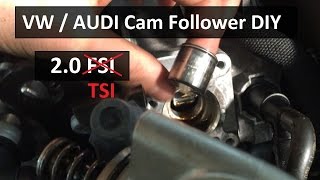
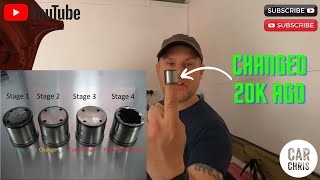
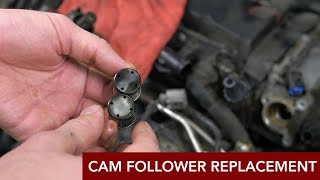
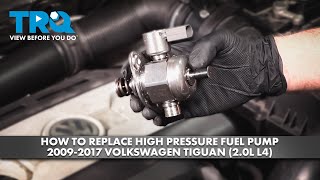
How to confirm: Depressurize the fuel system and physically remove the HPFP to inspect the cam follower. Look for a hole worn through the center, deep scoring, or a concave surface. A new follower has a flat, black surface. If the follower is damaged, also inspect the tip of the HPFP piston and the camshaft lobe for scoring or damage. A helpful DIY video is available from 'Deutsche Auto Parts' on YouTube.
Typical fix: Replace the cam follower. If the follower has worn completely through, you must also replace the High-Pressure Fuel Pump and inspect the intake camshaft for damage, potentially requiring its replacement as well.
Est. part cost: $40-$60 - Failed High-Pressure Fuel Pump (HPFP) 🟡 Medium Probability The HPFP can fail internally (the N276 valve shorts out or sticks), but it is most often damaged as a direct result of a worn-through cam follower. The pump's piston gets over-extended and damaged when the follower fails. Manufacturer TSB Bulletin #TT 01 20 05_4 notes that P1025 may set if the high pressure fuel pump is out of time or sync.
How to confirm: If a new cam follower does not resolve the issue, or if the follower was found to be intact, the pump is the next suspect. A technician can use a scan tool (like VCDS) to monitor requested vs. actual fuel rail pressure; if the pump cannot meet the requested pressure (should be ~40 bar at idle), it is faulty. An audible click test can also be performed with a scan tool.
Typical fix: Replace the High-Pressure Fuel Pump. This is always done in conjunction with replacing the cam follower to protect the new pump.
Est. part cost: $250-$500 - Failing In-Tank Low-Pressure Fuel Pump (LPFP) or Control Module ⚪ Low Probability The HPFP requires a steady supply of fuel from the in-tank pump. If the LPFP is weak or the control module fails, it can starve the HPFP and trigger high-pressure side codes. A recall (VW #20AE / NHTSA #17V509000) was issued for the control module on 2009-2016 CC models.
How to confirm: Before replacing expensive high-pressure components, a technician should test the low-pressure fuel system. The pressure should be between 4.0 and 7.0 bar (58-101 PSI). If it's below this range, the in-tank pump or its control module is the likely issue.
Typical fix: Replace the in-tank fuel pump and/or its controller. 🎬 Watch: Diagnosing low-pressure fuel pump and module issues. Check if the recall has been performed.
Est. part cost: $200-$400
Rare But Worth Checking
- Damaged Intake Camshaft: This is almost always collateral damage from a completely failed cam follower. If the follower wears through, the HPFP piston can directly contact and destroy the camshaft lobe, requiring a very expensive repair. There are forum threads with pictures showing the scarred lobe next to a destroyed follower.
- Wiring Issue to N276 Valve or G247 Sensor: A break or short in the wiring to the HPFP's integrated regulator (N276) or the fuel rail pressure sensor (G247) could theoretically cause this code, but it is far less common than mechanical failure. A short to ground on the N276 circuit will set a specific fault.
Diagnosis Steps

- Scan the vehicle for fault codes to confirm P1025 and check for any other related codes like P0087, P0088, or P2293.
- Use a VW-specific scan tool to view live data. Check Measuring Value Blocks for requested vs. actual fuel rail pressure at idle (actual should be near 40 bar) and under load.
- CRITICAL: Depressurize the fuel system. This is a high-pressure system and failure to do so can result in injury. The fuel rail pressure sensor (G247) is located under the intake manifold.
- Remove the High-Pressure Fuel Pump (HPFP) from the cylinder head. It is held by three bolts.
- Remove and inspect the cam follower. Look for any signs of wear, scoring, or a hole in the surface. This is the most likely failure point.
- If the cam follower is damaged, carefully inspect the lobe on the intake camshaft and the piston on the bottom of the HPFP for any scoring or damage.
- If the cam follower is intact, the issue may be the HPFP itself or the low-pressure fuel system. Test the low-pressure side to ensure it's supplying 58-101 PSI to the HPFP.
- Inspect the wiring harness and connector at the HPFP for any visible damage, corrosion, or loose connections.
Parts You'll Likely Need

- HPFP Cam Follower
(OEM #06L109311)— This is the correct part for the EA888 engine. It is the most common failure point that directly causes code P1025 and is a critical wear item.
Trusted brands: INA, Volkswagen Genuine
OEM price range: $50-$70
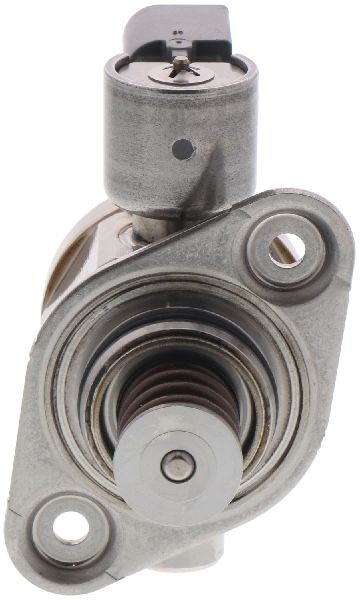
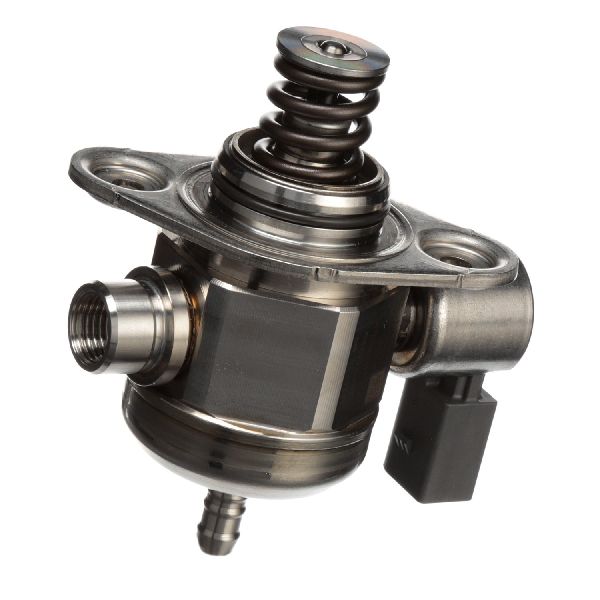
Aftermarket price range: $35-$55 - High-Pressure Fuel Pump (HPFP)
(OEM #06J127025K (or superseding revisions like L))— This pump often fails as a direct result of a worn-through cam follower, or it can fail internally. It contains the N276 valve referenced in the code definition.
Trusted brands: Bosch, Hitachi, Volkswagen Genuine
OEM price range: $450-$600
Aftermarket price range: $250-$400
Related Codes That Often Appear With This One
- P0087 — P0087 means 'Fuel Rail/System Pressure - Too Low'. This code is commonly stored with P1025 because a failed cam follower or HPFP prevents the system from building enough pressure.
- P2293 — P2293 means 'Fuel Pressure Regulator 2 Performance'. This code also points directly to a fault with the N276 valve on the HPFP and is often seen with P1025, indicating a mechanical performance issue with the pump.
- P0088 — P0088 means 'Fuel Rail/System Pressure - Too High'. While less common than P0087 with this failure, a sticking N276 valve can sometimes cause pressure to spike, triggering this code along with P1025.
Technical Service Bulletins (TSBs) & Recalls

- VW TSB 20-15-02: While not for P1025 specifically, this bulletin details the diagnostic procedure for the HPFP on the 2.0T CCTA/CBFA engine, including how to test low pressure, run the HPFP function test, and what pressure values to expect (~40 bar at idle). This is critical for accurate diagnosis.
- VW TSB 2025746: Mentioned by Ross-Tech as applicable to the NAR market for P1025 issues, suggesting official manufacturer guidance exists for this fault code.
- Manufacturer TSB Bulletin #TT011605_2045487 provides enhanced diagnostic assistance specifically for DTCs P0088 and P1025.
- The TSB mentioned in Pass 1 (TT 01-20-05) primarily applies to the 3.6L VR6 engine, where P1025 is caused by timing chain issues, not the 2.0T engine in this vehicle.
Platform-Specific Known Issues
- The cam follower for the HPFP is a widely documented wear item on the EA888 engine. Many enthusiasts recommend inspecting it every 20,000-30,000 miles and replacing it as preventative maintenance to avoid costly damage to the pump and camshaft.
- There was a recall for the fuel pump control module (VW Recall 20AE, NHTSA 17V509000) that can cause stalling and fuel pressure issues. Owners should verify if this service has been performed on their vehicle.
Mechanic-Grade Diagnostic Values
- Fuel Pressure Regulator Valve (N276) Resistance — expected: 1.5 to 11 Ω at approx. 20°C (68°F). Failure: A reading outside this range, or 0 ohms (dead short), indicates a faulty solenoid on the HPFP. Note: A value of 25-35 Ω is for the older FSI engine and is incorrect for the TSI.
- Fuel Pressure Sensor (G247) Signal Voltage — expected: ~0.5V with Key On, Engine Off. ~2.2V at idle.. Failure: Signal voltage greater than 4.8V suggests a short to power or internal sensor failure.
- Fuel Pressure Sensor (G247) Reference Voltage — expected: Constant 5V at the connector (Pin 3, Black/Gray wire). Failure: Absence of 5V indicates a wiring or ECM (J623) power supply issue.
- High-Pressure Fuel Rail (Cranking) — expected: Should rise significantly towards the specified value of ~40-50 bar.. Failure: Remaining near low-pressure system levels (e.g., 5-7 bar) during cranking is insufficient for the engine to start.
- VCDS - Fuel Pressure Deviation (MVB 230) — expected: Maximum 5.0 bar. Failure: A deviation greater than 5.0 bar between specified and actual fuel pressure indicates a regulation problem.
Hidden / Shadow Codes Worth Checking
- 17433 / 004133: This is the VAG-specific fault code number for P1025, 'Fuel Pressure Regulation Valve (N276): Mechanical Failure'. It will be displayed by VW-specific tools like VCDS. (see via VCDS (VAG-COM) or ODIS)
- P119A / 004506: Fuel Pressure Sensor (G247): Malfunction. This code may be stored alongside P1025 and can help pinpoint a sensor-related issue, though P1025 itself points to a mechanical fault. (see via VCDS (VAG-COM) or ODIS)
Scan Tool Commands That Help
- VCDS (VAG-COM): Advanced Measuring Values (or Measuring Blocks on older controllers) — Log 'Fuel Rail Pressure (Specified)' vs. 'Fuel Rail Pressure (Actual)' in groups like 106, 140, or 230. This is the primary method to see if the HPFP is meeting the ECM's request under different loads (idle, WOT).
- ODIS (VW Dealer Tool): Guided Fault Finding / Test Plan for P1025 — The existence of a TSB (2025746) for P1025 implies a specific, step-by-step diagnostic plan is available in the dealer software to test components like the N276 valve directly.
Wiring & Ground Locations
- Ground Point 15 — On the cylinder head.. The High-Pressure Fuel Pump (HPFP) bolts directly to the cylinder head. A poor ground at this location could potentially affect the operation of the integrated N276 electronic regulator valve.
- Ground Point 652 — Main ground strap for the engine and gearbox assembly to the chassis.. A compromised main engine ground can cause a host of bizarre electrical issues, including erratic sensor readings and actuator behavior. This should be checked for corrosion and tightness.
- G247 Sensor Connector — On the fuel rail, under the intake manifold.. The harness to the G247 sensor provides power, ground, and signal. Pin 3 should have a 5V reference. The resistance of the wiring between this connector and the ECM (J623) should be less than 1.5 ohms.
Real Owner Repair Stories
- Rennlist Forum User (Porsche Cayenne (similar DFI system)) — P1025 code returned after replacing the HPFP.
❌ Tried (didn't work) Clearing the code, Replacing the High-Pressure Fuel Pump with a cheap eBay unit.
✅ What actually fixed it The user determined the first replacement HPFP (a rebuilt unit from eBay) was faulty out of the box. Replacing it a second time with a quality part resolved the code, highlighting the risk of non-OEM or poorly rebuilt pumps. - Rennlist Forum User (Porsche Cayenne (similar DFI system)) — Hesitation and P1025 code.
❌ Tried (didn't work) Replacing the High-Pressure Fuel Pump (HPFP).
✅ What actually fixed it The issue persisted after replacing the HPFP. The actual cause was a failing in-tank Low-Pressure Fuel Pump (LPFP) that was starving the new HPFP of fuel. Replacing the LPFP resolved all issues.
When the Usual Fixes Don't Work
- While the cam follower is the most common cause, it is not the only one. In a documented case on a similar DFI engine, a technician replaced the HPFP to fix a P1025, but the code remained. The actual root cause was a weak in-tank low-pressure fuel pump (LPFP) which was starving the high-pressure side. This underscores the importance of testing low-side fuel pressure (should be 58-101 PSI) before condemning the more expensive high-pressure components.
- Another counter-example involves installing the wrong part. A technician was chasing fuel pressure codes after an engine swap. The new engine came with a G247 fuel pressure sensor that was incorrect for the car's original ECM. Despite being a new OEM part that fit perfectly, its internal calibration was wrong, causing persistent faults. The issue was only resolved by reinstalling the original sensor from the old engine. This proves that even with all mechanical parts being healthy, an incorrect (but physically identical) electronic part can be the root cause.
OEM Part Supersession History
06J127025C / D / E / F / G / J→06J127025K, then 06J127025L— Multiple revisions by VW/Bosch to improve reliability and address internal failures of the N276 valve.
Heads up: Always use the latest available revision. While older revisions may work, they are known to be less reliable.06H127025E / G / K / M / N / P→06H127025Q— Similar to the 06J series, these are revisions to improve pump durability and performance.
Heads up: The 2.0T TSI engine used both 06H and 06J series pumps depending on engine code and build date. It is critical to verify the correct base part number with the VIN before ordering.06D906051A (G247 Sensor)→06J906051C— Sensor calibration update for later model year ECMs.
Heads up: These sensors are NOT interchangeable despite fitting physically. Installing the wrong sensor for your car's VIN and ECM will cause fuel pressure reading errors and trigger fault codes. This is a critical trap for mechanics.
Model Year Variations Within This Range
- e.g., 2009-2010: Some very early 2.0T TSI engines used a different style of fuel line connection at the HPFP. When replacing an original pump on these early models with a newer, superseded part number, an adapter fitting (OEM P/N 06E-127-065-G) is required to connect the existing fuel line to the new pump.
Diagnostic Flowchart
Used vs. New Parts: Buying Guide for This Vehicle
When a used part is the smart pick: For collateral damage parts like the intake camshaft or the engine wiring harness, a used part from a reputable salvage yard is a viable option.
Donor-vehicle mileage cap: roughly under 80000 miles for the part to have meaningful remaining life.
What to inspect on the donor part:
- For a used camshaft, meticulously inspect the HPFP drive lobe for any signs of scoring, pitting, or wear. The surface should be perfectly smooth.
- For a wiring harness, check for brittle plastic connectors, cracked wire insulation, or any signs of previous repairs (splices, tape).
OEM-only on this vehicle (don't cheap out):
- HPFP Cam Follower: This is a sacrificial wear item. Never install a used one.
- High-Pressure Fuel Pump (HPFP): Forum reports indicate a high failure rate for cheap, unbranded, or even some rebuilt HPFPs. The risk of a faulty used/rebuilt unit causing further issues is high.
- Fuel Pressure Sensor (G247): Due to VIN-specific part number requirements, using a used sensor is risky as it may have the wrong calibration for your ECM, causing persistent codes.
Aftermarket brands forum-validated for this vehicle:
- INA (Cam Follower - OEM supplier)
- Bosch (HPFP - OEM supplier)
- Hitachi (HPFP - OEM supplier)
Brands owners have reported issues with on this vehicle:
- Unbranded, generic HPFPs from marketplaces like eBay or Amazon are frequently reported as being defective out of the box or failing prematurely.
Real Owner Stories
Aggregated from forums and TSBs cited above. Mileages and costs reflect what owners reported in those sources.
2011 CC 2.0T
Symptoms: Owner was chasing a fuel pressure regulator issue (P2293) and experienced significant engine problems.
What fixed it: The root cause was a failed cam follower which had, in turn, caused a scarred intake camshaft, requiring replacement of the damaged components.
Source hint: Reddit r/Volkswagen - P2293 Fuel Pressure Regulator Issue Help
2010 CC
Symptoms: The vehicle was stalling and had fault codes P2293 and P1025 stored in the engine computer.
What fixed it: A mechanic diagnosed the issue as a failing N276 valve, which is an integral part of the High-Pressure Fuel Pump (HPFP). The fix was to replace the entire HPFP assembly.
Source hint: YouTube - VW 2.0t TSI Engine with Fault Code P2293 (N276 Valve) by Deutsche Auto Parts
Related OBD-II Codes
Frequently Asked Questions
How often should I inspect the HPFP cam follower on my 2009-2016 CC 2.0T?
My CC is stalling and I have a P1025 code. Is there a recall I should check for?
What fuel pressure readings should I expect when diagnosing my CC 2.0T?
If my cam follower has a hole worn through it, what other parts must I replace?
I found TSB 01-20-05 for code P1025. Does this apply to my 2.0T engine?
Can I use a used or aftermarket HPFP to save money on the repair?
Helpful Videos

Used OEM Parts in Stock


New Aftermarket Parts Available


The information in this article is provided for general reference and educational purposes only. Vehicle specifications, procedures, and part compatibility can vary by production date, trim level, and region. Always consult your vehicle's factory service manual and verify part numbers before purchasing or performing repairs. Safety-critical components such as airbags, seat belts, and braking systems should be installed by a qualified professional.
- Volkswagen CC:
- 🎬 Helpful Videos
- 🛍️ Shop This Part
- What's Unique About the 2009-2016 Volkswagen CC
- Symptoms You May Notice
- Most Likely Causes
- Rare But Worth Checking
- Diagnosis Steps
- Parts You'll Likely Need
- Related Codes That Often Appear With This One
- Technical Service Bulletins (TSBs) & Recalls
- Platform-Specific Known Issues
- Mechanic-Grade Diagnostic Values
- Hidden / Shadow Codes Worth Checking
- Scan Tool Commands That Help
- Wiring & Ground Locations
- Real Owner Repair Stories
- When the Usual Fixes Don't Work
- OEM Part Supersession History
- Model Year Variations Within This Range
- Diagnostic Flowchart
- Used vs. New Parts: Buying Guide for This Vehicle
- Real Owner Stories
- 2011 CC 2.0T
- 2010 CC
- Related OBD-II Codes
- Frequently Asked Questions
- 🎟️ Get 5% Off