

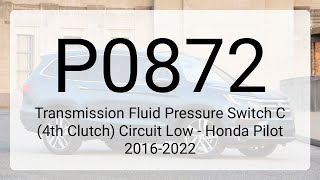
P0872 on 2016-2022 Honda Pilot: 4th Clutch Pressure Switch Causes and Fixes
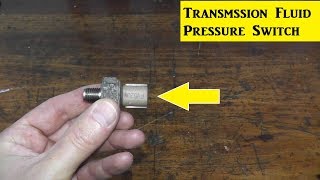
P0872 on a 2016-2022 Honda Pilot most often indicates a failed 4th clutch transmission fluid pressure switch, especially on models with the 6-speed automatic transmission. Replacing this external sensor is the most common fix. The original part (28600-R97-004) has been superseded. Use of a genuine Honda replacement part is strongly recommended as aftermarket switches are known to fail prematurely.
- P0872 on a 2016-2022 Pilot almost always points to the 4th clutch pressure switch, especially on models with the 6-speed automatic transmission.
- Before replacing parts, always check the transmission fluid level and condition first. Use only Honda Genuine fluid.
- For 6-speed models, the switch is an inexpensive, external part that is reasonably accessible. For 9-speed models, the cause and fix are less clear and may require professional diagnosis.
- Always use a genuine Honda (OEM) replacement switch, as aftermarket versions are known to be unreliable.
- The code indicates a serious issue that puts the transmission in a protective 'limp mode'; driving should be limited until the fault is repaired.
What's Unique About the 2016-2022 Honda Pilot

The 2016-2022 Honda Pilot was equipped with two different automatic transmissions: a 6-speed automatic on lower trims (LX, EX, EX-L) and a ZF-manufactured 9-speed automatic on upper trims (Touring, Elite, Black Edition). This code is a well-documented and very common issue on the 6-speed, where the 4th clutch pressure switch is an accessible, external part mounted on the transmission case. Conversely, there is very little information available about P0872 occurring on the 9-speed models, suggesting the fault is either rare or the pressure switches are internal to the valve body, making for a much more complex and expensive repair.
Symptoms You May Notice
- Flashing 'D' (Drive) indicator light on the dashboard
- Check Engine Light is on
- Transmission is stuck in a single gear or has a limited gear range (e.g., only 1st and 4th)
- Harsh, erratic, or delayed shifting
- Poor acceleration or vehicle feels sluggish
- Transmission slipping during acceleration
- A burning smell from overheated transmission fluid in severe cases
- Replacing the entire transmission when only an inexpensive external switch is needed.
- Replacing shift solenoids instead of the specific pressure switch indicated by the code.
- On 6-speed models, replacing the entire valve body when the faulty switch is external.
- Using a cheap aftermarket pressure switch which fails again shortly after installation.
Most Likely Causes

- Failed 4th Clutch Transmission Fluid Pressure Switch 🔴 High Probability These pressure switches are a very common failure point on many Honda 6-speed automatic transmissions across different models. Aftermarket switches are widely reported in forums to have a high premature failure rate, making OEM parts the recommended solution.
How to confirm: After checking fluid and wiring, test the switch's circuit. With the ignition on and connector unplugged, a scan tool should show the switch as 'OFF'. Grounding the signal wire pin in the harness connector should change the status to 'ON'. If the circuit tests good, the switch is faulty. 🎬 Watch: How to diagnose and test the 4th clutch circuit The switch is located on the front of the transmission case, accessible by removing the driver's side front wheel and splash shield.
Typical fix: Replace the 4th clutch transmission fluid pressure switch and its sealing washer. Use of a genuine Honda part is strongly recommended. The original part number 28600-R97-004 has been superseded by updated parts. Torque the new switch to 14 N.m (10 lb-ft).
Est. part cost: $50-$90 - Low or Dirty Transmission Fluid 🟡 Medium Probability The 6-speed transmission on these Pilots can be sensitive to fluid condition. TSB 16-091 noted that fluid can deteriorate faster than expected, causing judder. TSB 23-078 also addresses judder from deteriorated fluid. Low, dirty, or deteriorated fluid can cause erratic hydraulic pressure, foaming, and overheating, which can trigger a pressure switch code.
How to confirm: Check the transmission fluid dipstick for level and condition. The fluid should be at the correct level, pink/red in color, and not smell burnt. Dark, brown, or burnt-smelling fluid needs to be changed.
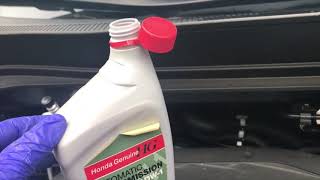
Typical fix: Perform a transmission fluid drain-and-fill. 🎬 Watch: Step-by-step transmission fluid change for 6-speed Pilot models Use only the correct Honda Genuine ATF: DW-1 for the 6-speed or ATF Type 3.1 for the 9-speed. For issues related to fluid deterioration, a triple flush may be recommended by Honda.
Est. part cost: $40-$150 - Wiring Harness or Connector Issue ⚪ Low Probability
How to confirm: Visually inspect the wiring and connector going to the 4th clutch pressure switch for any signs of damage, corrosion, or loose pins. The connector is often brown. Perform a continuity test from the switch connector to the PCM connector to check for a short to ground or an open circuit.
Typical fix: Repair the damaged section of the wire or clean/replace the connector.
Est. part cost: $5-$50
Rare But Worth Checking
- Faulty Powertrain Control Module (PCM): This is very rare. The PCM should only be considered after all other possibilities (switch, fluid, wiring) have been exhaustively ruled out by following Honda's diagnostic procedure.
- Internal Transmission Failure: In rare cases, the code could be triggered by an internal hydraulic blockage in the valve body or a failing transmission pump, even if the switch and wiring are good. This is an unlikely cause and would typically present with more severe symptoms.
Diagnosis Steps

- Check the transmission fluid level and condition. If low, top it off with the correct fluid type (ATF DW-1 for 6-speed) and check for leaks. If dirty or burnt, perform a drain-and-fill.
- Scan the system for any other related trouble codes. Note that P0700 is expected to accompany P0872.
- Locate the 4th clutch pressure switch. On 6-speed models, remove the driver's side front wheel and the plastic splash shield in the wheel well. The switch is on the front of the transmission case. 🎬 See this walkthrough on how to replace the pressure switch It often has a brown electrical connector.
- Inspect the electrical connector and wiring to the switch for any visible damage, corrosion, or loose connections.
- Test the switch circuit. Disconnect the switch and use a scan tool to monitor the switch status. The status should change from 'OFF' to 'ON' when the signal wire in the harness connector is grounded. If the circuit responds correctly, the switch itself is the failure.
- If the circuit test fails, inspect the wiring for a short to ground or an open circuit between the switch and the PCM.
- If the fluid, wiring, and circuit are all good, replace the 4th clutch pressure switch and its sealing washer. Torque the new switch to 14 N.m (10 lb-ft).
- Clear the codes and perform a road test, ensuring the transmission shifts smoothly through all gears to confirm the repair.
Parts You'll Likely Need

- 4th Clutch Transmission Fluid Pressure Switch (For 6-Speed AT)
(OEM #28600-R97-013)— This is the most common component to fail and trigger a P0872 code on the 6-speed transmission. The original part 28600-R97-004 is superseded by this part.
Trusted brands: Honda (Genuine OE)
OEM price range: $50-$90
Aftermarket price range: $20-$50 - Pressure Switch Sealing Washer (10mm)
(OEM #90471-PW7-A00)— This crush washer should always be replaced with the pressure switch to prevent leaks. It is inexpensive.
Trusted brands: Honda (Genuine OE)
OEM price range: $2-$5
Aftermarket price range: $1-$3 - Honda Genuine ATF DW-1 (For 6-Speed AT)
(OEM #08200-9008)— Required for drain-and-fill procedures. Using the correct fluid is critical for Honda transmission health.
Trusted brands: Honda (Genuine OE)
OEM price range: $10-$15 per quart
Aftermarket price range: N/A - Honda Genuine ATF Type 3.1 (For 9-Speed AT)
(OEM #08200-9017)— Required for any fluid service on the 9-speed transmission. Do not substitute with other fluid types.
Trusted brands: Honda (Genuine OE)
OEM price range: $25-$40 per quart
Aftermarket price range: N/A
Related Codes That Often Appear With This One
- P0700 — P0700 is a generic 'Transmission Control System Malfunction' code. It is an informational code that simply means the TCM has stored a more specific fault, like P0872. It will almost always be present alongside a specific transmission code.
Technical Service Bulletins (TSBs) & Recalls
- 16-091 - 2016 Pi
Platform-Specific Known Issues
- Honda Service Bulletin 16-091 was issued for 2016 Pilots with the 6-speed transmission for a judder condition caused by deteriorated transmission fluid, recommending a fluid flush. While not for P0872, it reinforces the importance of fluid condition in these transmissions.
- Honda Service Bulletin 23-078 also addresses torque converter judder on 2016-17 Pilots with the 6-speed AT, again pointing to deteriorated ATF as the cause and prescribing a software update and fluid flush.
Mechanic-Grade Diagnostic Values
- Voltage at the 4th clutch pressure switch connector (harness side) with connector unplugged and ignition ON. — expected: Approximately 5V or 12V reference voltage from the PCM.. Failure: If voltage is 0V, it indicates an open circuit or a PCM issue. If voltage is present, the wiring from the PCM is likely good.
- Continuity check on the signal wire between the PCM connector and the switch connector. — expected: Less than 1.0 Ω.. Failure: High resistance or no continuity (OL) indicates an open/broken wire.
- Continuity check between the signal wire at the switch connector and body ground. — expected: No continuity (Open Line - OL).. Failure: Continuity to ground (near 0 Ω) indicates a short circuit in the harness.
Scan Tool Commands That Help
- Honda HDS (or equivalent professional scanner): Live Data / Data List Monitoring for 'TFP Switch C (4th)' or '4th Pressure Switch'. — This is the primary method for diagnosis. The status should read 'OFF' when the transmission is not in 4th gear and 'ON' when it is. For P0872, the PCM sees a low signal (stuck ON) when it should be OFF. Manually grounding the harness-side connector pin should force the status to change on the scan tool, confirming the wiring and PCM are responsive.
Wiring & Ground Locations
- G101 — Typically located on the transmission case, near the top or front, often near the thermostat housing.. This is a primary ground point for the engine and transmission. While a fault here would likely cause multiple, widespread issues, a loose or corroded G101 connection can create unpredictable electrical problems. It's a good-practice check if other electrical symptoms are present.
- 4th Clutch Pressure Switch Connector — On the front of the 6-speed transmission case, accessible after removing the driver's side wheel and splash shield. It is a single-pin connector, often brown in color.. This is the direct connection point for the faulty component. The P0872 code specifically means the circuit for this switch is shorted to ground or the switch itself is stuck closed, completing the ground path internally.
Real Owner Repair Stories
- Piloteers.org Forum User (2016 Honda Pilot EX-L (6-speed AT), ~85,000 miles) — Flashing 'D' light on the dash, Check Engine Light on, transmission stuck in a lower gear, harsh shifting.
❌ Tried (didn't work) Initially suspected low transmission fluid, but level was correct.
✅ What actually fixed it Replaced the 4th clutch pressure switch (brown connector) with a genuine Honda OEM part (28600-R97-013). The user noted that after removing the driver's side wheel and inner fender liner, the switch was easily accessible on the front of the transmission. After replacing the switch and clearing the codes, all symptoms were resolved. - NHTSA ODI #10788968 — An owner reported checking gas cover and transmission fluid levels after the vehicle threw codes P0872 and P0700. The owner noted that Honda had previously fixed the problem for nearly $500, but the issue recurred.
- NHTSA ODI #10331781 — A driver reported that their vehicle, with approximately 62,232 miles, was scanned for code P0872 by an independent shop. However, the dealer was unable to duplicate the problem during a subsequent inspection.
OEM Part Supersession History
28600-R97-004→28600-R97-013— Part revision and update by Honda, likely for improved reliability.
Heads up: The part 28600-R36-004 is for the 3rd clutch pressure switch on some Honda models and is often confused in aftermarket catalogs. It should NOT be used to fix a P0872 code.
Model Year Variations Within This Range
- 2016-2020: The 6-speed automatic transmission, which is prone to this specific P0872 failure, was primarily used on LX, EX, and EX-L trims. For model years 2021-2022, the 9-speed automatic became standard across all trims, making this specific failure mode and fix inapplicable to those later model years.
Diagnostic Flowchart
Other Known Issues on This Vehicle
Issues unrelated to this code that are worth knowing about as an owner of this generation:
- Faulty Fuel Injectors 🔴 High — Common on 2016-2019 models. Can cause misfires, rough idle, and catalytic converter damage. Codes P0300-P0306, P0420, P0430, P219A, P219B are common. (Ref: TSB 20-100, 21-010; Warranty Extension (10 yrs/150k miles))
- Transmission Judder / Harsh Shifting (6-Speed and 9-Speed) 🟠 Medium — Common complaint on both transmissions. 6-speed issue is often due to deteriorated fluid. 9-speed issue is often related to software logic and requires updates. (Ref: TSB 16-091, 17-044, 23-078 (for 6-speed fluid); TSB 16-008 (for 9-speed software))
- Infotainment System Glitches (Black Screen, Popping/Crackling Audio) 🟡 Low — Widespread issue across many model years. Screen may go black or freeze, and speakers may crackle. Often related to a loose MOST bus network connector. (Ref: TSB 23-047)
- Auto Idle-Stop Failure to Restart 🟠 Medium — Affects various model years, where the engine may not restart after an auto-stop event, requiring the driver to shift to Park and restart manually. (Ref: TSB 23-008, TSB 23-023)
- Engine Failure (Connecting Rod Bearings) 🔴 High — A recall was issued for some 2016-2019 models due to improperly manufactured crankshafts that could lead to premature connecting rod bearing wear and catastrophic engine failure. (Ref: NHTSA Recall 23V-751)
- Hood Flutter at Highway Speeds 🟡 Low — Common on 2016-2019 models. The hood appears to vibrate or flutter at speed, causing concern but not posing a direct safety risk. (Ref: TSB 17-083 (fix is to add supplemental hood seals and adjust stops))
Used vs. New Parts: Buying Guide for This Vehicle
When a used part is the smart pick: For this specific repair, a used part from a junkyard is never a smart choice. The part has a very high failure rate, a new OEM part is relatively inexpensive, and the labor involved makes it impractical to risk using a part with an unknown history.
What to inspect on the donor part:
- Not applicable, do not use used parts for this repair.
OEM-only on this vehicle (don't cheap out):
- 4th Clutch Transmission Fluid Pressure Switch
Aftermarket brands forum-validated for this vehicle:
- None. Forum consensus across multiple Honda platforms strongly indicates that only Genuine Honda OEM switches are reliable for this repair.
Brands owners have reported issues with on this vehicle:
- Dorman
- Standard Motor Products (SMP)
- Generic/unbranded parts store switches
Real Owner Stories
Aggregated from forums and TSBs cited above. Mileages and costs reflect what owners reported in those sources.
2016-2022 Honda Pilot (3rd Generation)
Symptoms: A flashing 'D' light on the dashboard accompanied by code P0872.
What fixed it: Replacing the failed 4th clutch transmission fluid pressure switch with a genuine OEM part. Aftermarket parts were reported to fail quickly.
Source hint: piloteers.org - Multiple threads for 2nd and 3rd generation Pilots
2016 Honda Pilot (6-speed transmission)
Symptoms: A judder condition from the transmission.
What fixed it: A transmission fluid flush, as recommended by the service bulletin.
Source hint: Honda Service Bulletin 16-091
2016-2017 Honda Pilot (6-speed AT)
Symptoms: Torque converter judder.
What fixed it: A software update and a transmission fluid flush.
Source hint: Honda Service Bulletin 23-078
2016-2022 Honda Pilot (3rd Generation)
Symptoms: Juddering and harsh shifting.
What fixed it: Dealer-performed software update and a triple fluid flush, as outlined in Honda TSBs.
Source hint: Reddit r/hondapilot
Honda Pilot Owner Complaint
Symptoms: Flashing 'D' light and codes P0872 and P0700.
What fixed it: An owner reported checking fluid levels and noted that Honda had previously fixed this issue for nearly $500, but the problem occurred again later.
Source hint: NHTSA ODI #10788968
Honda Pilot Owner Complaint
Symptoms: Code P0872 scanned at 62,232 miles.
What fixed it: An owner took the vehicle to an independent shop where the code was identified, though a subsequent dealer visit resulted in the problem not being duplicated.
Source hint: NHTSA ODI #10331781
Related OBD-II Codes
Frequently Asked Questions
My 2017 Pilot has a flashing 'D' light and code P0872. Is it safe to continue driving?
I need to replace the 4th clutch pressure switch. Can I use a cheaper aftermarket part from Amazon?
Where is the 4th clutch pressure switch located on my 2018 Honda Pilot?
My dealer mentioned TSB 16-091 and TSB 23-078 for my Pilot's transmission judder. Are these related to the P0872 code?
What type of transmission fluid does my 2016 Pilot with the 6-speed automatic take?
What is the correct torque specification for the 4th clutch pressure switch?
Helpful Videos
Used OEM Parts in Stock

New Aftermarket Parts Available


The information in this article is provided for general reference and educational purposes only. Vehicle specifications, procedures, and part compatibility can vary by production date, trim level, and region. Always consult your vehicle's factory service manual and verify part numbers before purchasing or performing repairs. Safety-critical components such as airbags, seat belts, and braking systems should be installed by a qualified professional.
- Honda Pilot:
- 🎬 Helpful Videos
- 🛍️ Shop This Part
- What's Unique About the 2016-2022 Honda Pilot
- Symptoms You May Notice
- Most Likely Causes
- Rare But Worth Checking
- Diagnosis Steps
- Parts You'll Likely Need
- Related Codes That Often Appear With This One
- Technical Service Bulletins (TSBs) & Recalls
- Platform-Specific Known Issues
- Mechanic-Grade Diagnostic Values
- Scan Tool Commands That Help
- Wiring & Ground Locations
- Real Owner Repair Stories
- OEM Part Supersession History
- Model Year Variations Within This Range
- Diagnostic Flowchart
- Other Known Issues on This Vehicle
- Used vs. New Parts: Buying Guide for This Vehicle
- Real Owner Stories
- 2016-2022 Honda Pilot (3rd Generation)
- 2016 Honda Pilot (6-speed transmission)
- 2016-2017 Honda Pilot (6-speed AT)
- 2016-2022 Honda Pilot (3rd Generation)
- Honda Pilot Owner Complaint
- Honda Pilot Owner Complaint
- Related OBD-II Codes
- Frequently Asked Questions
- 🎟️ Get 5% Off