

P0847 on 2007-2011 Honda CR-V: Causes and Fixes for 3rd Clutch Pressure Switch Failure
On a 2007-2011 Honda CR-V, code P0847 is almost always caused by a failed 3rd Clutch Transmission Fluid Pressure Switch. This is a very common issue that causes a flashing 'D' light. Expect to pay $40-$100 for an OEM switch and about 1-2 hours of labor if done at a shop. The switch is located on the front of the transmission and has a blue, single-wire connector.
- P0847 on a 2007-2011 CR-V almost certainly means the 3rd Clutch Pressure Switch has failed.
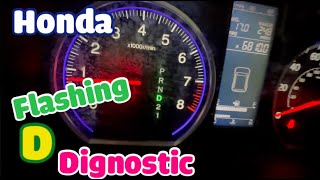
- The most obvious symptom is a flashing 'D' light on your dashboard.
- This is a very common, well-documented problem and is relatively inexpensive to fix.
- Always use a new crush washer with the new switch to prevent leaks.
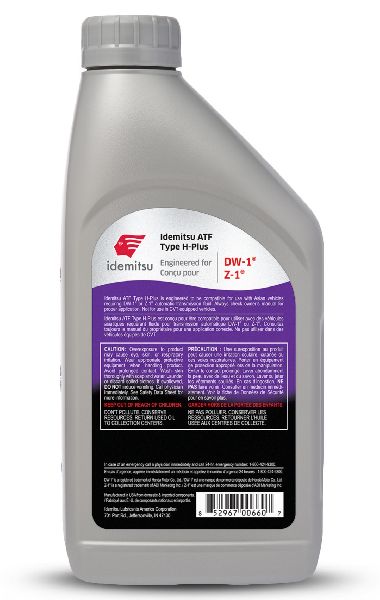
- It is critical to use Honda Genuine ATF DW-1 fluid if you perform a transmission fluid change during the repair.
What's Unique About the 2007-2011 Honda CR-V

This is a very common failure on many Honda models from this era, not just the CR-V. The key platform-specific detail is the confusing code definition: a 'Circuit Low' fault code is triggered by a switch that is stuck 'ON' (shorted to ground). Mechanics and experienced DIYers know to suspect the switch itself immediately when P0847 appears with a flashing 'D' light, often without extensive electrical diagnosis. Honda explicitly states this code is for an electrical circuit problem, not an internal mechanical transmission issue.
Symptoms You May Notice
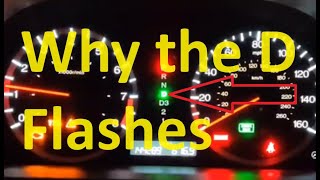
- Flashing 'D' (Drive) indicator light on the dashboard. 🎬 Watch: Why the D light flashes and how to fix it
- Check Engine Light is on.
- Harsh or erratic shifting.
- Vehicle may feel stuck in one gear (often 3rd gear).
- Poor acceleration from a stop.
- Inability to shift into certain gears.
- Replacing the entire transmission. This code points to a specific, external, and relatively inexpensive electrical component.
- Replacing other transmission solenoids. P0847 is specific to the 3rd clutch pressure switch circuit.
Most Likely Causes

- Failed 3rd Clutch Transmission Fluid Pressure Switch 🔴 High Probability This specific pressure switch is a widely documented common failure part across many Honda models of this vintage that use the same transmission family.
How to confirm: Use a scan tool to monitor the live data for the '3rd Clutch Pressure Switch'. If it reads 'ON' even when the vehicle is in Park, Neutral, or any gear other than 3rd, the switch is faulty. Alternatively, disconnect the switch's blue connector. If the code changes from P0847 (Circuit Low) to P0848 (Circuit High), the switch is confirmed bad. A multimeter test on the removed switch will show continuity to ground, confirming it is internally shorted.
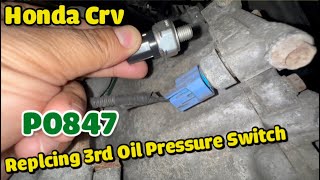
Typical fix: Replace the 3rd clutch pressure switch and its aluminum crush washer. The switch is located on the front of the transmission housing, often below the air intake box 🎬 Watch: 2009 CR-V P0847 diagnosis and switch replacement walkthrough, and has a distinctive blue connector. It is highly recommended to perform a transmission fluid drain and fill with Honda Genuine ATF DW-1 at the same time.
Est. part cost: $40-$100 - Low or Dirty Transmission Fluid ⚪ Low Probability While not usually the direct cause of the P0847 electrical fault code, chronically low or degraded fluid can cause erratic transmission behavior, overheating, and contribute to premature component failure.
How to confirm: Check the transmission fluid level and condition using the dipstick. The fluid should be at the correct level and reddish in color, not dark brown or black, and should not have a burnt smell.
Typical fix: Perform a transmission fluid drain and fill (do NOT flush) using Honda Genuine ATF DW-1 fluid. This is often done when replacing the switch, but it will not fix a failed switch on its own.
Est. part cost: $40-$70 - Wiring or Connector Issue ⚪ Low Probability
How to confirm: Visually inspect the single wire (often blue/white or black/red) and the blue connector going to the switch for any signs of damage, corrosion, or looseness. Check for a short to ground in the harness between the switch connector and the PCM. If the connector is unplugged and the code P0847 remains, the wire is shorted to ground somewhere.
Typical fix: Repair the damaged section of the wire or clean/replace the connector.
Est. part cost: $5-$50
Rare But Worth Checking
- Faulty Powertrain Control Module (PCM): This is extremely rare. The PCM should only be considered after the switch and wiring have been definitively ruled out by proper testing.
Diagnosis Steps

- Confirm the presence of code P0847 using an OBD-II scanner. Note if the 'D' light is flashing.
- Check the transmission fluid level and condition. Top up or change if necessary, but understand this is unlikely to be the sole cause.
- Using a capable scan tool, monitor the live data parameter for the 3rd clutch pressure switch. If it is stuck 'ON' at all times (in Park, Neutral, etc.), the switch has failed.
- If a scan tool is not available, locate the switch on the transmission. It is on the front of the case, has a single wire, and a blue connector.
- Disconnect the connector. Inspect the connector and wire for damage or corrosion.
- With the connector disconnected, clear the codes and start the engine. If the code changes to P0848 (Circuit High), it confirms the wiring and PCM are likely good and the original switch was shorted. 🎬 See how to diagnose the P0847 code using live data This is a very reliable diagnostic trick for this issue.
- To be certain, test the old switch with a multimeter. There should be no continuity between the electrical pin and the switch body (ground). If there is continuity, the switch is internally shorted and must be replaced.
- If the switch and wiring test good, the issue may be an intermittent fault or a problem with the PCM, which requires more advanced diagnostics.
Parts You'll Likely Need

- 3rd Clutch Transmission Fluid Pressure Switch
(OEM #28600-RCL-004)— This is the component that fails in over 95% of cases for this specific trouble code on this vehicle. This part number supersedes older versions like 28600-RCL-003, 28600-PRP-013, and 28600-P6H-013.
Trusted brands: Honda (Genuine), Standard Motor Products (Intermotor), Wells Vehicle Electronics
OEM price range: $60-$100
Aftermarket price range: $20-$50 - Pressure Switch Gasket / Crush Washer
(OEM #90471-PW7-A00)— This is a one-time-use aluminum sealing washer that must be replaced with the switch to prevent leaks.
Trusted brands: Honda (Genuine)
OEM price range: $3-$5
Aftermarket price range: $1-$3 - Honda Genuine ATF DW-1 Fluid
(OEM #08200-9008)— A fluid drain and fill is recommended during the repair. Using the correct OEM fluid is critical for Honda automatic transmissions. A drain and fill requires approximately 3-4 quarts.
Trusted brands: Honda (Genuine)
OEM price range: $10-$15 per quart
Aftermarket price range: N/A
Related Codes That Often Appear With This One
- P0848 — P0848 is for 'Transmission Fluid Pressure Switch B (3rd Clutch) Circuit High'. These codes are for the same component but indicate opposite failure modes (P0847 = stuck ON/shorted, P0848 = stuck OFF/open circuit). Seeing either points directly to an issue with the 3rd clutch pressure switch or its circuit.
Technical Service Bulletins (TSBs) & Recalls
- Honda TSB 09-010: While not for code P0847, this is a critical TSB for the 2007-2011 CR-V's K24Z engine. It addresses a loud rattle from the VTC actuator on cold startups and advises replacing the actuator.
- Honda Service News: A manufacturer bulletin titled "Hard or Delayed Shifting with A/T DTCs P0756 and P0847" provides specific diagnostic guidance for these concurrent codes, as noted in NHTSA ODI #10836670.
Platform-Specific Known Issues
- The primary issue is the extremely high failure rate of the 3rd clutch pressure switch, leading to the P0847 code and a flashing 'D' light. This is one of the most common electronic faults on the 2007-2011 CR-V.
- Owner experience: An owner of a 2007 CR-V with 285k miles experienced a flashing D light and Check Engine Light for almost a year. After a dealership failed to diagnose it correctly, a private mechanic, guided by online videos, replaced the 2nd and 3rd clutch pressure sensors, which resolved the issue completely and improved performance and MPG.
Mechanic-Grade Diagnostic Values
- Voltage at the 3rd clutch pressure switch connector (disconnected from switch), Key On Engine Off. — expected: 5V or 12V reference from the PCM.. Failure: If reference voltage is not present, the fault is in the wiring or PCM, not the switch.
- Continuity test on the removed pressure switch. — expected: No continuity (infinite resistance) between the electrical pin and the switch body/threads when no pressure is applied.. Failure: Any continuity reading indicates the switch is internally shorted to ground and has failed.
- Live data scan tool parameter for '3rd Clutch Pressure Switch'. — expected: Should read 'OFF' in Park, Neutral, or any gear other than 3rd. Should switch to 'ON' only when the 3rd clutch is engaged.. Failure: If the status is stuck 'ON' at all times, the switch is shorted or the wire is shorted to ground. If the status is stuck 'OFF' when it should be on, it indicates an open circuit or different failure mode (P0848).
Scan Tool Commands That Help
- Honda Diagnostic System (HDS) or capable professional scanner: Live Data Monitoring for '3rd Clutch Pressure Switch Status' — This is the primary and most effective way to diagnose the fault. Observing the switch status stuck 'ON' in real-time while the vehicle is in Park or Neutral immediately points to a shorted switch or wiring.
- Professional scanner with bidirectional controls: Grounding the signal wire at the connector with a jumper while observing live data. — After disconnecting the switch, if you manually ground the signal wire terminal in the connector, the scan tool's live data for the switch should change from 'OFF' to 'ON'. This confirms the integrity of the wiring from the connector to the PCM and the PCM's ability to see the signal change, definitively isolating the fault to the switch itself.
Wiring & Ground Locations

- 3rd Clutch Pressure Switch Wire — Runs from the blue single-pin connector on the front of the transmission case to the PCM.. The wire color is often cited as black with a red tracer. A short to ground anywhere along this wire will cause a P0847 code, mimicking a failed switch. If the code persists after unplugging the switch, this wire is the likely culprit.
- G101 — Main engine-to-chassis ground, typically located on the left side of the engine or on the transmission housing itself.. While not the direct cause of a 'Circuit Low' code (which is a short to ground), a poor main ground at G101 can cause a host of bizarre electrical issues and floating voltages across the system. Ensuring this ground is clean and tight is a fundamental step in any electrical diagnosis.
- PCM Connector B, Pin 25 — At the Powertrain Control Module (PCM).. On some Honda platforms, this is the specific pin where the 3rd clutch pressure switch signal wire (OP3SW) terminates. Testing for a short to ground would involve checking for continuity between this pin (with the PCM disconnected) and the chassis ground. This is an advanced step if the switch and external wiring have been ruled out.
Real Owner Repair Stories
- YouTube channel 'RB The Mechanic' (2010 Honda CR-V) — Flashing 'D' (drive) light on the instrument cluster after driving for a short period, causing the transmission to enter a fail-safe mode.
❌ Tried (didn't work) The diagnosis was direct; no other parts were tried first.
✅ What actually fixed it Scanning the vehicle revealed code P0847 for '3rd clutch transmission fluid pressure switch stuck or stuck short or stuck on'. The mechanic replaced the 3rd clutch pressure switch (OEM Part No. 28600-RCL-004) and the associated crush washer, which resolved the code and the flashing 'D' light. - NHTSA ODI #11132314 — An owner reported that while driving on city streets, a dealership found code P0847 for the 3rd clutch transmission fluid pressure switch being short or stuck on, alongside an EVAP system code.
- NHTSA ODI #10836670 — A report describes the check engine light coming on and the vehicle shifting roughly while in motion on city streets, with diagnostics confirming code P0847.
OEM Part Supersession History
28600-P6H-003, 28600-P6H-013, 28600-PRP-003, 28600-PRP-013, 28600-RCL-003→28600-RCL-004— Standard part evolution for improved reliability or manufacturing changes.
Heads up: The latest part number, 28600-RCL-004, is the correct and recommended replacement for all previous versions for this application. Using old stock of a superseded number is not advised.
Diagnostic Flowchart
Other Known Issues on This Vehicle
Issues unrelated to this code that are worth knowing about as an owner of this generation:
- A/C Compressor Catastrophic Failure ('Black Death') 🔴 High — A widely known and common issue for this generation. The compressor fails internally, contaminating the entire A/C system with metal debris. (Ref: Honda issued TSB 12-072 for A/C compressor clutch wear, a related but less severe failure mode.)
- VTC Actuator Rattle on Cold Start 🟠 Medium — Very common on the 2.4L K24Z engine. Causes a brief, loud metallic rattle for 1-2 seconds upon starting the engine when cold. (Ref: Honda TSB 09-010 addresses this issue, recommending the replacement of the VTC actuator.)
- Excessive Oil Consumption 🟠 Medium — Particularly noted on 2010-2011 models. Sticking piston rings can lead to burning oil, requiring frequent top-offs. (Ref: Honda Service Bulletin 12-089 was released to address this problem.)
- Power Door Lock Actuator Failure 🟡 Low — Extremely common across all model years. One or more door lock actuators will fail, preventing locking/unlocking with the remote or door switch. (Ref: Honda TSB 14-083 and 14-084 describe the issue and repair procedure for the driver's and other doors, respectively.)
- Rear Differential Groan/Moan During Turns 🟡 Low — Common if the rear differential fluid is not changed regularly. Causes a groaning or shuddering noise from the rear of the vehicle during slow, tight turns. (Ref: A common dealer recommendation and informal TSB is to replace the fluid with Honda Dual Pump System Fluid (DPSF) and burnish the clutches.)
Used vs. New Parts: Buying Guide for This Vehicle
When a used part is the smart pick: For this specific repair, using a used part is NOT recommended. The failure rate of this switch is extremely high due to an internal design flaw, not simple wear. A used switch from a junkyard vehicle is very likely to have the same fault or fail shortly after installation. The cost of a new OEM or quality aftermarket part is low enough that the labor to install a questionable used part is not justified.
What to inspect on the donor part:
- Not applicable as used parts are not recommended.
OEM-only on this vehicle (don't cheap out):
- 3rd Clutch Transmission Fluid Pressure Switch (Strongly Recommended)
- Honda Genuine ATF DW-1 Fluid
Aftermarket brands forum-validated for this vehicle:
- Standard Motor Products (SMP)
- Wells Vehicle Electronics
Brands owners have reported issues with on this vehicle:
- Unnamed, no-brand 'white box' parts from online marketplaces should be avoided. While they may be cheaper, forum users frequently report premature failures, leading to doing the job twice. Stick to Genuine Honda or reputable aftermarket brands.
Real Owner Stories
Aggregated from forums and TSBs cited above. Mileages and costs reflect what owners reported in those sources.
2007 Honda CR-V — 285000 miles
Symptoms: A flashing D light and Check Engine Light that were on for almost a year.
What fixed it: A private mechanic replaced the 2nd and 3rd clutch pressure sensors, which resolved the issue completely.
Source hint: vehicle_specific_issues
Honda Fit Owner — NHTSA ODI #11132314
Symptoms: While driving on city streets, the vehicle was taken to a dealer where two codes were found: P0456 and P0847.
What fixed it: The dealer identified the P0847 code as "Transmission Fluid Pressure Switch B (3rd Clutch) (Short or Stuck On)" and performed troubleshooting.
Honda Fit Owner — NHTSA ODI #10836670
Symptoms: The check engine light came on and the vehicle began shifting roughly while in motion on city streets.
What fixed it: Diagnostic codes P0756 and P0847 were found. Diagnostics were run per a Honda Service News article regarding hard or delayed shifting with these specific codes.
Related OBD-II Codes
Frequently Asked Questions
My 2009 CR-V has a flashing 'D' light and code P0847. Is this a common problem?
What is the most likely part I need to fix code P0847 on my CR-V?
Is there a quick way to confirm the 3rd clutch pressure switch is bad without a professional scan tool?
What transmission fluid should I use in my 2007-2011 CR-V when fixing this issue?
I also hear a loud rattle when starting my CR-V on cold mornings. Is this related to the P0847 transmission code?
Does the P0847 pressure switch failure affect other Honda models?
My mechanic says the wiring is shorted to ground. How can I be sure it's not just the switch?
Helpful Videos


We Have This Part in Stock




The information in this article is provided for general reference and educational purposes only. Vehicle specifications, procedures, and part compatibility can vary by production date, trim level, and region. Always consult your vehicle's factory service manual and verify part numbers before purchasing or performing repairs. Safety-critical components such as airbags, seat belts, and braking systems should be installed by a qualified professional.
- Honda CR-V:
- 🎬 Helpful Videos
- 🛍️ Shop This Part
- What's Unique About the 2007-2011 Honda CR-V
- Symptoms You May Notice
- Most Likely Causes
- Rare But Worth Checking
- Diagnosis Steps
- Parts You'll Likely Need
- Related Codes That Often Appear With This One
- Technical Service Bulletins (TSBs) & Recalls
- Platform-Specific Known Issues
- Mechanic-Grade Diagnostic Values
- Scan Tool Commands That Help
- Wiring & Ground Locations
- Real Owner Repair Stories
- OEM Part Supersession History
- Diagnostic Flowchart
- Other Known Issues on This Vehicle
- Used vs. New Parts: Buying Guide for This Vehicle
- Real Owner Stories
- 2007 Honda CR-V — 285000 miles
- Honda Fit Owner — NHTSA ODI #11132314
- Honda Fit Owner — NHTSA ODI #10836670
- Related OBD-II Codes
- Frequently Asked Questions
- 🎟️ Get 5% Off