

P0767 on 2017-2023 Ford F-150: Shift Solenoid 'D' Stuck On Causes and Fixes
On 2017-2023 F-150s with the 10R80 transmission, code P0767 is almost always caused by a faulty main control valve body or a related internal mechanical failure like a slipped CDF drum sleeve, not just a single bad solenoid. The most reliable fix is replacing the entire valve body assembly, and in some cases, the CDF drum. This repair can cost between $2,000 and $4,500 at a shop, though some owners have reported dealer quotes as high as $9,000 for a full transmission replacement.
- P0767 on a 2017-2023 F-150 is a serious code that points to a significant transmission issue.
- The problem is very likely the main control valve body, not just a single solenoid.
- Always check for other transmission codes; a cluster of codes is a strong indicator of valve body failure.
- The correct fix is typically a full replacement of the valve body assembly, which is a complex and expensive job best left to professionals.
- When speaking with a repair shop, reference the Ford TSBs related to 10R80 shifting issues.
What's Unique About the 2017-2023 Ford F-150
This issue on the F-150 is strongly linked to the 10-speed 10R80 automatic transmission. While the code points to a single solenoid, the root cause is frequently a known mechanical issue within the transmission. Ford's Technical Service Bulletins (TSBs) reveal that P0767 is often a symptom of either sticking valves in the main control valve body or, more seriously, a design flaw where a sleeve inside the CDF (Clutch D/F) drum moves axially, causing a hydraulic leak. This pressure loss leads to erratic shifting and triggers various solenoid and gear ratio codes. Simply replacing the 'D' solenoid is almost never a permanent fix.
Diagnostic Flowchart
Tap your situation to follow the diagnostic path that matches what you're seeing on this vehicle.
Generation note: This code affects both the thirteenth generation (2017-2020) and fourteenth generation (2021-2023) of the F-150. The common factor is the 10R80 10-speed automatic transmission, which was introduced in 2017 models and is the source of the issue, rather than a specific vehicle generation.
Symptoms You May Notice
- Harsh or delayed shifts, particularly between 3rd and 5th gear. [TSB 24-2176, TSB 26-2046, 27]
- Harsh or delayed engagement from Park to Drive or Reverse. [TSB 25-2018, 3]
- Check Engine Light or wrench light is on. [TSB 24-2176, 29]
- Transmission feeling like it's slipping, hunting for gears, or getting stuck in one gear.
- Vehicle enters 'limp mode,' often locking into a single gear.
- Loud clunking noises during upshifts or downshifts, especially at low speeds.
- Replacing only the 'D' shift solenoid. Because the root cause is almost always a systemic hydraulic or mechanical issue within the valve body or CDF drum, the problem is highly likely to return.
- Assuming it's just a software issue. While a PCM reprogram and adaptive learning reset is part of the repair process, it will not fix a mechanically sticking valve or a hydraulic leak from a failed drum sleeve.
Most Likely Causes
- Faulty Main Control Valve Body 🔴 High Probability The 10R80 transmission in these F-150s has a known history of valve body issues, as documented in numerous Ford TSBs. Internal wear, debris from clutch material, or inherent design flaws can cause spool valves to stick, leading to the P0767 code.
How to confirm: After ruling out fluid and wiring issues, a diagnostic scan showing multiple solenoid or gear ratio codes (as listed in the TSBs) strongly points to the valve body. A transmission specialist can perform pressure tests to confirm.
Typical fix: Replace the entire main control valve body assembly, which includes all new solenoids. This is the fix recommended by Ford's TSBs when the CDF drum is not the primary cause.
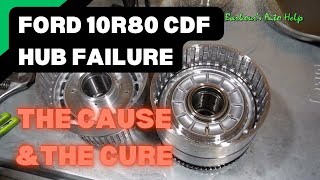
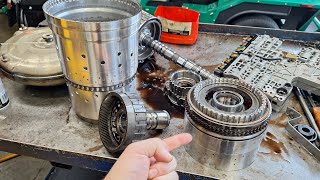
Est. part cost: $600-$1300 - CDF Clutch Drum Sleeve Failure 🔴 High Probability A widely recognized design flaw in the 10R80 involves a bushing/sleeve inside the CDF drum that can slide out of position. This uncovers hydraulic passages, causing a significant pressure loss that leads to erratic shifting, clutch damage, and a host of DTCs, including P0767. Ford has updated the drum design to prevent this movement. 🎬 Watch: A deep dive into the CDF hub failure and fix.
How to confirm: This is a deeper mechanical failure. Diagnosis often starts with a valve body replacement. If symptoms persist, or if a technician performs specific hydraulic leak tests outlined in later TSBs (like 24-2254), the CDF drum is identified as the culprit. Finding significant metal debris in the pan is another strong indicator.
Typical fix: Requires partial transmission disassembly to replace the CDF clutch drum with the updated part. This is a more labor-intensive repair than a valve body swap.
Est. part cost: $200-$400 for the drum itself, but labor is significant. - Low or Contaminated Transmission Fluid 🟡 Medium Probability While not specific to this platform, low fluid levels can cause pressure drops, and old, contaminated fluid (often with clutch material) can lead to sludge that clogs solenoid passages and sticks valves in the valve body.
How to confirm: Check the transmission fluid level and condition. The fluid should be at the correct level and be bright red (for Ford Mercon ULV), not dark brown, black, or smell burnt.
Typical fix: Perform a transmission fluid and filter change using only OEM-specified Ford Mercon ULV fluid. This is often a first step but rarely a final solution if mechanical wear has begun.
Est. part cost: $100-$200 - Failed Shift Solenoid 'D' ⚪ Low Probability While the code directly names the solenoid, it's far less common for a single solenoid to fail electrically than it is for the valve body or CDF drum to cause a mechanical or hydraulic issue that makes the solenoid stick.
How to confirm: A technician can test the solenoid's electrical resistance with a multimeter after dropping the transmission pan. However, this does not test for mechanical sticking, which is the reported fault.
Typical fix: Replace the individual shift solenoid. This is widely considered a temporary fix that fails to address the root cause in the 10R80.
Est. part cost: $50-$150 - Wiring Harness or Connector Issue ⚪ Low Probability Damage to the transmission wiring harness can cause a short or open circuit, leading to erratic solenoid behavior.
How to confirm: Visually inspect the wiring harness leading to the transmission for any signs of chafing, melting, or corrosion at the connectors.
Typical fix: Repair the damaged section of the harness or replace the affected connector.
Est. part cost: $20-$100
Rare But Worth Checking
- Faulty Powertrain Control Module (PCM): A failing PCM driver circuit can send a continuous voltage to the solenoid, causing it to stick on. This is very rare and should only be considered after all other mechanical and electrical possibilities, especially the valve body and CDF drum, have been exhaustively ruled out.
Diagnosis Steps
- Check the transmission fluid level and condition. Ensure it is clean, full, and does not smell burnt. Use only Mercon ULV fluid.
- Use an advanced OBD-II scanner to check for other transmission-related codes. A long list of solenoid and gear ratio codes strongly suggests a valve body or internal hydraulic issue per Ford TSBs.
- Inspect the external transmission wiring harness and connectors for any visible damage, corrosion, or loose connections.
- If fluid and wiring are okay, the next step is to drop the transmission pan to inspect the fluid and pan magnet for excessive metal debris or clutch material.
- Given the high probability of a valve body failure, if no other obvious cause is found, replacing the main control valve body is the most common professional repair.
- If a new valve body does not solve the issue, or if TSBs like 24-2254 are followed, a hydraulic leak test should be performed to check for a failed CDF clutch drum sleeve.
- After any major transmission repair (valve body, drum, or rebuild), the transmission's adaptive learning tables must be reset using a diagnostic tool, followed by a specific relearn drive cycle. 🎬 Watch: How to perform 10R80 solenoid strategy programming.
Parts You'll Likely Need
- Transmission Main Control Valve Body Assembly
(OEM #JL3Z-7A100-B (supersedes HL3Z-7A100-B and HL3Z-7A100-A))— This is the most common root cause of P0767 and related codes on the 10R80 transmission, as identified in multiple Ford TSBs. It contains all new solenoids and valves.
Trusted brands: Motorcraft (OEM)
OEM price range: $700 - $1300
Aftermarket price range: $500 - $900 - Automatic Transmission Fluid
(OEM #Motorcraft Mercon ULV (XT-12-QULV))— The system must be refilled with 8-10 quarts of fresh, correct-specifi
Related Codes That Often Appear With This One
- P0751 — Shift Solenoid 'A' Stuck Off. Like P0767, this is another solenoid code often caused by the same failing valve body or CDF drum issue.
- P0756 — Shift Solenoid 'B' Stuck Off. Another common companion code pointing to a systemic valve body or internal hydraulic leak issue.
- P2703 — Friction Element 'D' Apply Time Range/Performance. This indicates a clutch pack issue, which can be triggered by the incorrect hydraulic pressure from the problem causing P0767. [ODI #11634937]
- P0729, P0731-P0736, P076F — These are all incorrect gear ratio codes. They are logged when the transmission's actual gear ratio doesn't match what the PCM expects, a direct consequence of a solenoid being stuck on/off or a major hydraulic leak. [TSB 24-2176, 21]
Technical Service Bulletins (TSBs) & Recalls
- TSB 24-2176: Addresses harsh/delayed shifts and numerous DTCs, including P0767. It identifies potential causes as PCM/TCM software, solenoid strategy, sticking valves in the main control body, and/or axial movement of the CDF clutch cylinder sleeve.
- TSB 24-2254: Supersedes TSB 24-2176 for some vehicles, focusing on diagnosing and replacing the CDF clutch cylinder if hydraulic leaks are found.
- TSB 26-2046: Covers harsh/delayed shifts and DTCs like P0767 for some 2022-2023 models.
- TSB 25-2018: Addresses harsh/delayed engagement and shifts with a similar list of DTCs for 2020 models.
- TSB 25-2302: Similar to other TSBs, this one covers 2022 models with harsh shifts and a wide array of transmission codes including P0767.
Platform-Specific Known Issues
- Ford has issued multiple Technical Service Bulletins (TSBs) for the 10R80 transmission concerning harsh or delayed shifts accompanied by a host of diagnostic trouble codes, including P0767. The bulletins consistently point to an issue with the main control valve body and/or a failed CDF clutch drum sleeve requiring replacement. [TSB 24-2176, TSB 24-2254, TSB 25-2018, TSB 25-2302, 10, 16]
- An owner of a 2019 model filed a complaint with the NHTSA after experiencing transmission failure with codes P2703, P2705, and P0767, noting that this is a known issue. [ODI #11634937]
- A deeper mechanical issue involving a slipped sleeve in the CDF drum is a well-documented failure point that causes hydraulic leaks, leading to these codes. An owner on f150forum.com shared pictures of this exact failure, where the moved bushing destroyed a seal, requiring a transmission rebuild.
Mechanic-Grade Diagnostic Values
- Shift Solenoid (A-F) Electrical Resistance — expected: 5.0 - 5.4 Ohms at 68°F (20°C). Failure: A reading outside this range, or infinite resistance (open circuit), indicates a failed solenoid coil.
Hidden / Shadow Codes Worth Checking
- P163E: Transmission Control Module (TCM) - Solenoid Body ID Not Programmed (see via This code can be generated during the programming sequence after a valve body replacement if the 12-digit solenoid body ID is entered instead of the required 13-digit solenoid body strategy number.)
Scan Tool Commands That Help
- Ford IDS or FORScan: Clear Transmission Adaptive Tables / Reset KAM — This is a mandatory step after replacing the valve body, CDF drum, or the entire transmission. It erases the learned values, allowing the TCM to adapt to the new components.
- Ford IDS or FORScan: Transmission Strategy Download / Solenoid Body Strategy Programming — Required when a new main control valve body is installed. The 13-digit strategy number from the new valve body must be programmed into the TCM/PCM for proper solenoid operation. Failure to do so will result in poor shifting and potential DTCs.
- Ford IDS or FORScan: Adaptive Learning Drive Cycle — Must be performed immediately after clearing the adaptive tables. It is a specific, multi-step driving procedure that allows the TCM to quickly relearn clutch fill times and shift pressures.
- FORScan: Halt Transmission Adaptive Learning — This is an aftermarket function used by some owners to lock in desirable shift characteristics and prevent the TCM from adapting further. It is not a Ford-recommended repair procedure and may carry risks.
Wiring & Ground Locations
- Body-to-Frame Ground Strap — Underneath the truck, often below the passenger side door area, connecting the aluminum body to the steel frame.. These grounds are known to corrode badly, especially in salt-belt regions. A poor ground can cause a wide range of intermittent and difficult-to-diagnose electrical issues, including erratic module behavior that could potentially trigger transmission codes. Cleaning or replacing this ground is a low-cost, high-impact preventative measure.
- Shift Solenoid D Connector Pin — Pin 26 (Brown/White wire) on the main transmission connector is the ground control for Shift Solenoid D.. When performing advanced electrical diagnostics, this specific pin can be tested for continuity or shorts to ground, helping to isolate a wiring fault from a component failure.
- BCM Ground Point — On the passenger side, near the fuse box/Body Control Module (BCM).. This is a known-good, clean grounding point inside the cabin if additional accessories are added or if a faulty ground needs to be relocated.
Real Owner Repair Stories
- Ford F150 Forum (2018 Ford F-150) — Not specified, but required a new valve body.
❌ Tried (didn't work) Using FORScan to program the new solenoid strategy resulted in a 'Solenoid Not Found' error from Ford's servers., Using the official Ford FJDS software with a J2534 pass-through device also resulted in the same 'Solenoid Not Found' error.
✅ What actually fixed it The issue was resolved when a Ford dealer manually wrote the new solenoid parameters into the PCM and then performed the relearn procedure. This indicates that even with the right tools, programming a new valve body can sometimes fail and require dealer-level intervention.
"I Checked Everything" — The Actual Cause
- This code pattern is more electrical/mechanical. A shift solenoid can pass a basic electrical resistance test with a multimeter (showing 5.0-5.4 ohms) but still be mechanically stuck internally due to debris or wear. This is why the code is 'Stuck On' and not an electrical circuit code. The fault is often hydraulic or mechanical within the larger valve body assembly, which a simple electrical test of the solenoid cannot detect.
When the Usual Fixes Don't Work
- While replacing the main control valve body is a common and often correct repair, it is not a guaranteed fix if the programming of the new part fails. As seen in a real-world repair story, both aftermarket (FORScan) and official Ford (FJDS) tools can fail to write the new solenoid strategy to the PCM, returning a 'Solenoid Not Found' error. In these cases, the repair is only completed after a dealer is able to manually program the parameters, adding a potential layer of complexity and cost to what seems like a straightforward parts replacement.
OEM Part Supersession History
HL3Z-7H351-A / JL3Z-7H351-A→JL3Z-7H351-B— The updated CDF Clutch Drum (JL3Z-7H351-B) features a redesigned casting with a built-in lip or 'dam' that prevents the internal sleeve/bushing from walking out of position and causing a major hydraulic leak.HL3Z-7A100-A / HL3Z-7A100-B→JL3Z-7A100-B— Represents revisions to the main control valve body assembly to address issues with sticking spool valves and improve durability.
Heads up: When replacing the valve body, the 13-digit solenoid strategy number from the new part MUST be programmed into the vehicle's computer using a tool like IDS or FORScan.
Model Year Variations Within This Range
- 2017 - 2022 (built on or before Aug 15, 2022): These model years may contain the original CDF clutch drum design, making them highly susceptible to the sleeve walking out and causing hydraulic leaks that trigger P0767 and other codes.
- 2022 (built on or after Aug 16, 2022) - 2023: These vehicles should have the updated CDF clutch drum (JL3Z-7H351-B) from the factory, making the CDF drum failure less likely, though not impossible. For these vehicles, a diagnosis of P0767 is more likely to point directly to the main control valve body.
Helpful Videos
Used OEM Parts in Stock


New Aftermarket Parts Available


The information in this article is provided for general reference and educational purposes only. Vehicle specifications, procedures, and part compatibility can vary by production date, trim level, and region. Always consult your vehicle's factory service manual and verify part numbers before purchasing or performing repairs. Safety-critical components such as airbags, seat belts, and braking systems should be installed by a qualified professional.
- Ford F-150:
- 🎬 Helpful Videos
- 🛍️ Shop This Part
- What's Unique About the 2017-2023 Ford F-150
- Diagnostic Flowchart
- Symptoms You May Notice
- Most Likely Causes
- Rare But Worth Checking
- Diagnosis Steps
- Parts You'll Likely Need
- Related Codes That Often Appear With This One
- Technical Service Bulletins (TSBs) & Recalls
- Platform-Specific Known Issues
- Mechanic-Grade Diagnostic Values
- Hidden / Shadow Codes Worth Checking
- Scan Tool Commands That Help
- Wiring & Ground Locations
- Real Owner Repair Stories
- "I Checked Everything" — The Actual Cause
- When the Usual Fixes Don't Work
- OEM Part Supersession History
- Model Year Variations Within This Range
- 🎟️ Get 5% Off