

P0761 on 2017-2023 Ford F-150: Shift Solenoid 'C' Performance and Fixes
On 2017-2023 F-150s with the 10R80 transmission, P0761 is most often a symptom of a larger internal transmission problem, specifically a faulty main valve body or a failed CDF clutch drum. This is a complex, expensive repair often requiring transmission removal and overhaul. The root cause is a well-documented design flaw where a sleeve inside the CDF drum walks out, causing a hydraulic leak.
- P0761 on a 2017-2023 F-150 is rarely a simple solenoid issue; it usually indicates a serious internal transmission problem.
- The most likely cause is a well-documented failure of the CDF clutch drum in the 10R80 10-speed transmission.
- Symptoms include harsh/delayed shifts and a Check Engine Light. Do not ignore these signs.
- Repair is complex and expensive, requiring transmission disassembly by a qualified technician.
- Check for applicable TSBs with your dealer, as Ford has issued multiple service bulletins related to this problem.
What's Unique About the 2017-2023 Ford F-150

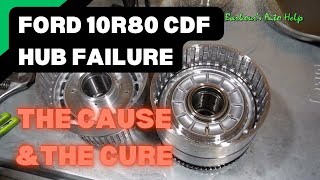
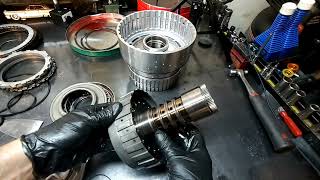
For the 2017-2023 F-150, this code is very frequently associated with a known weakness in the 10-speed (10R80) automatic transmission, which was co-developed with General Motors. While the code points to a single solenoid, the root cause is often a more significant mechanical failure within the transmission's main control valve body or, most commonly, the Clutch Drum F (CDF). Ford has issued multiple Technical Service Bulletins (TSBs) acknowledging that a bushing/sleeve within the CDF drum can move axially (walk out), uncovering an oil passage and causing a significant hydraulic leak. 🎬 Watch: Understanding how the CDF clutch drum causes shifting problems. This leak prevents clutches from engaging properly and triggers a host of shift solenoid and gear ratio codes, including P0761. This issue is so widespread that a class-action lawsuit has been filed against Ford for the 10R80 transmission's behavior.
Diagnostic Flowchart

Tap your situation to follow the diagnostic path that matches what you're seeing on this vehicle.
Generation note: This issue affects the Ford 10R80 10-speed automatic transmission, which was introduced in the 2017 model year F-150. It spans the end of the 13th generation (2017-2020) and the 14th generation (2021-2023). The underlying mechanical issues with the CDF drum are common to the 10R80 transmission across these years, though Ford has released updated parts to address the problem.
Symptoms You May Notice

- Harsh or abrupt shifting, sometimes feeling like being rear-ended. [TSB 24-2176, TSB 26-2046, TSB 25-2018, 32]
- Delayed gear engagement, especially from Park to Drive or Reverse. [TSB 24-2176, TSB 26-2046, TSB 25-2018, 37]
- Check Engine Light or illuminated powertrain malfunction (wrench) indicator. [TSB 24-2176, TSB 26-2046, TSB 25-2018]
- Transmission slipping or flaring (engine RPMs rise without a corresponding increase in speed), especially on the 3-4 or 3-5 shift.
- Vehicle entering 'limp mode' with limited available gears, sometimes getting stuck in one gear.
- Torque converter shudder, a mild vibration felt at cruising speeds (40-60 mph).
- Consistently high transmission fluid temperatures (above 210°F) during normal driving.
- Replacing only the 'C' shift solenoid. While the code points to this solenoid, it is rarely the root cause on the 10R80 transmission. The failure is typically the mechanical part (CDF drum) that the solenoid is trying to control, or the valve body it sits in.
- Performing only a transmission fluid flush. While clean fluid is critical, it will not fix the underlying hydraulic leak caused by the displaced CDF drum sleeve.
- Resetting the adaptive learning tables. Ford's TSBs mention this as a step, but it is meant to be done after a mechanical repair. On its own, it will not solve a hardware failure and the harsh shifting will return.
Most Likely Causes
- Internal CDF Clutch Drum Failure 🔴 High Probability A widely documented design flaw where a sleeve/bushing within the CDF drum assembly 'walks out' or moves from its intended position, uncovering hydraulic fluid passages. This causes a loss of hydraulic pressure to the C, D, and F clutches, leading to erratic shifting and numerous DTCs. This is the root cause cited in multiple Ford TSBs. Owner complaints for 2018 and 2020 models specifically mention the CDF drum being the diagnosed failure for code P0761. [ODI #11638871, ODI #11689469]
How to confirm: A technician must perform a specialized hydraulic pressure test on the transmission circuits as outlined in Ford's TSBs. This often requires removing the valve body for inspection. Visual inspection of the removed drum will show the displaced sleeve.
Typical fix: Removal of the transmission to replace the entire CDF clutch drum assembly with an updated part that has a machined lip to prevent the sleeve from moving. 🎬 Watch: A deep dive into the CDF hub failure and cure.
Est. part cost: $400-$800 for the drum assembly - Faulty Main Control Valve Body 🟡 Medium Probability The valve body houses the shift solenoids and can develop internal leaks, cross-leaks, or cracks in the separator plate. Debris from a failing CDF drum can also contaminate and damage the valve body, leading to sticking valves or blocked passages. Sometimes it is replaced as a precaution during a CDF drum repair.
How to confirm: After dropping the transmission pan, the valve body is inspected for cracks, warping, and debris. Solenoids can be tested for resistance with a multimeter. A technician may decide to replace it based on the symptoms and presence of other codes.
Typical fix: Replacement of the entire main control valve body assembly, which includes the solenoids. This is often done after a CDF drum failure is ruled out or in conjunction with it.
Est. part cost: $800-$1500 - Low or Contaminated Transmission Fluid ⚪ Low Probability While not a unique cause, low fluid can cause overheating and pressure loss, worsening existing issues. Contaminated fluid (with gray clutch material or metallic 'glitter') is usually a symptom of the CDF drum or other internal mechanical failure, not the root cause.
How to confirm: Check the transmission fluid level and condition. The 10R80 has a specific, complex procedure for checking the fluid level at operating temperature. The fluid should be bright red (Motorcraft ULV) and not smell burnt.
Typical fix: Top off with the correct fluid (Motorcraft MERCON ULV) or perform a fluid and filter change. This is highly unlikely to be a permanent fix if mechanical damage is present and may only be a temporary measure.
Est. part cost: $150-$300 for fluid and filter - Wiring or Connector Issue ⚪ Low Probability Not specific to this platform, but damage to the transmission wiring harness or the main connector can interrupt the signal to the solenoid. This is less common than the internal mechanical failures on the 10R80.
How to confirm: Visually inspect the wiring harness leading to the transmission for any signs of damage, corrosion, or loose connections. A multimeter can be used to check for continuity and proper voltage at the connector.
Typical fix: Repair or replace the damaged section of the wiring harness or clean/replace the connector.
Est. part cost: $50-$250
Diagnosis Steps
- Verify the code with a professional OBD-II scanner that can read transmission-specific data and DTCs.
- Check for any applicable Technical Service Bulletins (TSBs) as they provide a direct diagnostic path.
- Check the transmission fluid level and condition following the specific Ford procedure. Note any burnt smell or metallic debris, which indicates internal damage.
- Inspect the external transmission wiring harness and connectors for any visible damage.
- Review live data on the scan tool to monitor the commanded state versus the actual state of Shift Solenoid 'C'.
- Follow the diagnostic procedure outlined in the relevant Ford TSB to perform a hydraulic pressure test of the transmission circuits. This is a specialized step requiring specific tools.
- If the pressure test fails or TSB guidance directs, the transmission must be removed. The main valve body and CDF clutch drum must be inspected. Look for a displaced sleeve and worn bushings on the CDF drum, which is the most probable cause.
Parts You'll Likely Need

- CDF Clutch Cylinder Assembly
(OEM #JL3Z-7H351-B (supersedes HL3Z-7H351-A, JL3Z-7H351-A))— This is the most common point of failure on the 10R80 transmission leading to code P0761. The updated part has a redesigned housing with an integrated retention lip to prevent the internal sleeve from walking out and causing a hydraulic leak.
Trusted brands: Motorcraft
OEM price range: $400-$800
Aftermarket price range: $300-$600 - Main Control Valve Body Assembly
(OEM #JL3Z-7A100-B (example part number, verify by VIN))— May be replaced if it is contaminated with debris from the failing CDF drum, has its own internal failure, or as part of the TSB procedure. It is often replaced in conjunction with the CDF drum.
Trusted brands: Motorcraft
OEM price range: $800-$1500
Aftermarket price range: $600-$1200
Related Codes That Often Appear With This One
- P0751, P0756, P2700-P2708, etc. — These are all shift solenoid and clutch performance codes for the 10R80 transmission. Ford's TSBs list a large group of over 20 DTCs together, as they can all be triggered by the same underlying hydraulic leak from the CDF drum failure. [TSB 24-2176, TSB 26-2046, TSB 25-2018]
Technical Service Bulletins (TSBs) & Recalls
- TSB 25-2126: Supersedes earlier versions. Addresses harsh/delayed shifts and multiple DTCs including P0761, pointing to axial movement of the CDF clutch cylinder sleeve causing hydraulic leaks. It provides a detailed procedure for pressure testing the circuits.
- TSB 23-2123: Also addresses harsh shifts and the same list of DTCs. In some cases, this TSB recommends overhauling the main control valve body and performing an adaptive learning drive cycle.
- TSB 24-2176, TSB 26-2046, TSB 25-2018: These are among the many TSBs that list P0761 as a potential DTC related to the common 10R80 shifting complaints.
Platform-Specific Known Issues
- A known design flaw in the 10R80 transmission's CDF clutch drum can cause a sleeve to move, resulting in hydraulic leaks. This is documented in multiple Ford TSBs (e.g., TSB 25-2126, TSB 23-2123) and is the most common cause for a wide range of transmission codes, including P0761.
- Owner complaints filed with the NHTSA for 2018 and 2020 F-150s with code P0761 confirm that dealership diagnosis pointed to the CDF drum as the failure point. [ODI #11638871, ODI #11689469]
- A class-action lawsuit was filed against Ford in April 2023 concerning the 10R80 transmission, alleging the defect causes harsh, erratic shifting and poses a safety risk.
Mechanic-Grade Diagnostic Values
- Shift Solenoid Resistance — expected: 5.0-5.4 Ohms at 20°C (68°F). Failure: A reading outside of this range indicates a faulty solenoid coil.
- Solenoid Connector Voltage Supply — expected: 11.8-12.5 V with ignition on. Failure: No voltage or significantly lower voltage suggests a problem in the wiring or TCM power supply.
Scan Tool Commands That Help
- Ford IDS (or equivalent professional scanner): Solenoid Test / Actuator Test — To command Shift Solenoid 'C' on and off while the vehicle is stationary. This helps verify if the solenoid is mechanically clicking and if the control circuit from the TCM is functional.
- Ford IDS (or equivalent professional scanner): Solenoid Strategy Programming — This is a required step after replacing the main control valve body or the entire transmission assembly. The unique strategy number from the tag on the new valve body must be programmed into the TCM for proper transmission operation.
Wiring & Ground Locations
- Main Transmission Connector Pin A11 — On the main 32-pin connector at the transmission case.. This pin, with a Blue-Green (BU-GN) wire, is the shared power supply for all six shift solenoids (A-F). A loss of power on this pin would affect all shift solenoids, not just 'C'.
- Main Transmission Connector Pin B2 — On the main 32-pin connector at the transmission case.. This pin, with a Gray-Brown (GY-BN) wire, is the specific ground control for Shift Solenoid 'C'. The TCM pulses the ground to actuate the solenoid. A break in this specific wire would cause P0761.
- G200 — Behind the left (driver's side) center of the dash.. This is a major chassis ground point. While not directly tied to the solenoid control circuit in the diagrams found, poor grounds in this area can cause a variety of module communication and electronic issues.
Real Owner Repair Stories
- Reddit user post in r/f150 (2018 F-150 3.5L EcoBoost with 85,000 miles) — Vehicle felt like it went into neutral at low speeds, followed by rough 1-3 shifts when cold.
❌ Tried (didn't work) Initially thought it was a turbo issue.
✅ What actually fixed it The dealer diagnosed a bad bushing/sleeve in the CDF drum. The entire transmission was replaced. The initial quote was $9,600 in March 2023. The owner filed a 'customer loyalty claim' with Ford, who then covered 60% of the cost, leaving a $3,800 out-of-pocket expense for the owner. The new transmission came with a 3-year/unlimited mile warranty.
OEM Part Supersession History
HL3Z-7H351-A, JL3Z-7H351-A→JL3Z-7H351-B— The original CDF drum design allowed an internal bushing/sleeve to 'walk' out of position, uncovering an oil passage and causing a major hydraulic pressure leak. The updated JL3Z-7H351-B part features a machined lip or 'anti-walk' design that physically prevents the sleeve from moving.
Model Year Variations Within This Range
- 2017 - Mid-2022: Vehicles built on or before August 15, 2022, may have been assembled with the original, failure-prone CDF drum design. According to TSBs and forum discussions, vehicles built on or after August 16, 2022, are expected to have the updated CDF drum (part JL3Z-7H351-B or newer) from the factory, reducing the likelihood of this specific failure.
Helpful Videos
We Have This Part in Stock



The information in this article is provided for general reference and educational purposes only. Vehicle specifications, procedures, and part compatibility can vary by production date, trim level, and region. Always consult your vehicle's factory service manual and verify part numbers before purchasing or performing repairs. Safety-critical components such as airbags, seat belts, and braking systems should be installed by a qualified professional.
- Ford F-150:
- 🎬 Helpful Videos
- 🛍️ Shop This Part
- What's Unique About the 2017-2023 Ford F-150
- Diagnostic Flowchart
- Symptoms You May Notice
- Most Likely Causes
- Diagnosis Steps
- Parts You'll Likely Need
- Related Codes That Often Appear With This One
- Technical Service Bulletins (TSBs) & Recalls
- Platform-Specific Known Issues
- Mechanic-Grade Diagnostic Values
- Scan Tool Commands That Help
- Wiring & Ground Locations
- Real Owner Repair Stories
- OEM Part Supersession History
- Model Year Variations Within This Range
- 🎟️ Get 5% Off