

P0757 on 2017-2024 Ford F-150: Shift Solenoid 'B' Stuck On Causes and Fixes
P0757 on a 2017-2024 F-150 indicates Shift Solenoid 'B' is stuck on. This can be a simple solenoid or fluid issue, but a Ford TSB points to a possible damaged one-way clutch, especially if code P2701 is also present. Another common cause is a displaced CDF drum sleeve within the 10R80 transmission. The fix ranges from a fluid change to a full transmission rebuild.
- P0757 on a 2017-2024 F-150 means Shift Solenoid 'B' is stuck on, which severely impacts shifting.
- Do not drive the vehicle. A primary symptom is being stuck in a low gear, which is unsafe for normal road speeds and can cause further damage.
- Crucially, check for code P2701. If both codes are present, a Ford TSB strongly indicates a serious internal transmission failure (damaged one-way clutch) that requires a rebuild.
- If P0757 appears alone, the cause could be a faulty solenoid, contaminated fluid, or a bad valve body.
- Due to the complexity of the 10R80 transmission and the potential for major mechanical failure, professional diagnosis is strongly recommended over DIY parts swapping.
What's Unique About the 2017-2024 Ford F-150

The 2017-2024 F-150 primarily uses the 10-speed 10R80 automatic transmission, co-developed by Ford and GM. While P0757 often points to a faulty solenoid or valve body on many vehicles, Ford has issued specific Technical Service Bulletins (TSBs) for this platform that identify more severe mechanical causes. Specifically, TSB 26-2112 links P0757 with code P2701 to a damaged internal one-way clutch (OWC), a known failure point requiring a complete teardown. Additionally, a widely documented failure is the axial movement or 'walking' of the CDF clutch drum sleeve, which can cause internal leaks and trigger various shift codes, including P0757. This makes diagnosis more critical, as it's not always just a simple solenoid swap.
Diagnostic Flowchart

Tap your situation to follow the diagnostic path that matches what you're seeing on this vehicle.
Generation note: This range covers the 13th generation (2017-2020) and 14th generation (2021-2024) of the Ford F-150. Both generations heavily feature the 10R80 10-speed automatic transmission, where this code and its specific causes are prevalent. The underlying mechanical issues, particularly with the CDF drum and one-way clutch, are common to the 10R80 across these model years.
Symptoms You May Notice
- Inability to upshift past second or third gear.
- Harsh or delayed shifts, sometimes described as 'slamming' into gear. [TSB 24-2252, TSB 24-2176, TSB 26-2046, TSB 25-2018]
- Delayed or harsh engagement when shifting from Park into Drive or Reverse. [TSB 24-2252, TSB 24-2176, TSB 26-2046, TSB 25-2018]
- Check Engine Light (Malfunction Indicator Lamp) is illuminated.
- Transmission gets stuck in one gear (limp mode).
- Reduced fuel economy.
- Vibration at high RPMs or during acceleration.
- Transmission temperature running higher than normal.
- Replacing only the shift solenoid when the root cause is a more severe mechanical failure like the one-way clutch or a worn/displaced CDF drum sleeve. This is especially true if code P2701 is also present or if there is significant metal debris in the pan.
Most Likely Causes

- Damaged One-Way Clutch (OWC) 🔴 High Probability Ford TSB 26-2112 specifically identifies a damaged OWC as the cause for P0757, particularly when accompanied by code P2701. This is a known mechanical failure point within the 10R80 transmission's planetary gear set.
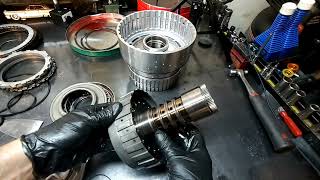
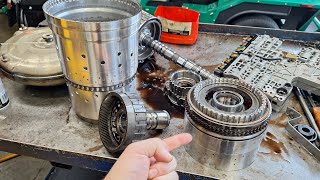
How to confirm: Confirm by scanning for both P0757 and P2701 codes. A physical inspection requires complete transmission disassembly. 🎬 Watch: Full teardown showing the CDF drum bushing failure.
Typical fix: The transmission must be removed and completely disassembled to replace the one-way clutch. This is a full rebuild, often costing over $5,000.
Est. part cost: $200-$400 for the clutch component itself, but it's part of a larger rebuild kit. - Displaced or Damaged CDF Drum Sleeve 🔴 High Probability A widely documented issue on the 10R80 is the sleeve inside the C-D-F clutch drum walking out of position. This is attributed to poor press fit and different thermal expansion rates between the steel sleeve and aluminum drum. This movement uncovers fluid passages, causing pressure loss and erratic shifting. TSB 22-2428 acknowledges this issue for various shift concerns.
How to confirm: After removing the valve body, the CDF drum can be inspected. If the sleeve has moved, it will expose oil passages and may have damaged the seal rings. Excessive metal shavings in the pan are also a strong indicator.
Typical fix: Requires transmission removal and disassembly to replace the CDF drum. Ford has released an updated drum with a machined lip to prevent the sleeve from moving. Aftermarket solutions, like the Sonnax CDF Drum Saver Kit (129910-01K) 🎬 Watch: See exactly how the CDF drum fails internally., also exist to repair or prevent the issue.
Est. part cost: $300-$500 for an updated CDF drum assembly. - Faulty Shift Solenoid 'B' 🟡 Medium Probability Solenoids can fail electrically or become mechanically stuck due to debris in the transmission fluid, a common issue in many automatic transmissions. The 10R80 has eight solenoids in total, and they can be sensitive to contaminated fluid.
How to confirm: A technician can use a high-end scan tool to command the solenoid on and off. If it fails to respond, and its wiring tests good, the solenoid is faulty. Resistance should be checked with a multimeter and should be between 5.0-5.4 ohms.
Typical fix: Replace the shift solenoid. This requires dropping the transmission pan and valve body. Solenoids are often sold in a complete kit.
Est. part cost: $50-$150 for a single solenoid, or $250-$400 for a full set. - Low or Contaminated Transmission Fluid 🟡 Medium Probability The 10R80 is sensitive to fluid level and condition and requires Mercon ULV fluid. Low fluid can cause pressure loss, while old or contaminated fluid (often with clutch material) can cause solenoids and valves to stick.
How to confirm: Check the transmission fluid level and condition. If it is dark, burnt, or contains metallic 'glitter', suspect internal wear.
Typical fix: Perform a transmission fluid drain and fill. If the fluid is heavily contaminated, a simple fluid change will not fix the underlying mechanical damage.
Est. part cost: $150-$300 for Ford Mercon ULV fluid. - Faulty Transmission Valve Body ⚪ Low Probability The valve body houses the solenoids and intricate fluid passages. Internal wear, cracks, or cross-leaks can cause pressure losses that trigger solenoid codes. TSBs suggest valve body overhaul or replacement for various shifting issues.
How to confirm: Diagnosis involves pressure testing specific ports on the transmission and inspecting the valve body for wear or damage after removal. Often replaced as a unit if multiple solenoids are suspected or passages are clogged.
Typical fix: Replace the entire valve body assembly, which includes all solenoids. The new valve body will require programming with the vehicle's specific solenoid strategy.
Est. part cost: $800-$1200 for a new OEM valve body assembly.
Rare But Worth Checking
- Wiring Harness Damage: The wiring from the TCM to the transmission can become chafed or corroded, causing a short or open circuit that mimics a failed solenoid. Always inspect the harness before replacing internal components.
- Faulty Transmission Control Module (TCM): In rare cases, the TCM itself can fail, sending an incorrect signal or misinterpreting data. This should be the last item to consider after all other possibilities are ruled out.
Diagnosis Steps
- Scan the TCM for all diagnostic trouble codes. Pay close attention if P2701 is present alongside P0757, as this strongly points to an internal mechanical failure per TSB 26-2112.
- Check the transmission fluid level and condition. The fluid should be at the correct level and red, not dark brown, black, or smelling burnt. Use only Mercon ULV fluid.
- Inspect the fluid for metal shavings or clutch material ('glitter'), which indicates serious internal mechanical wear.
- If fluid is clean, inspect the external wiring harness and connectors leading to the transmission for any visible damage, corrosion, or loose connections.
- Using a professional scan tool like Ford IDS, command Shift Solenoid 'B' on and off to check for an audible click and to monitor its status electronically.
- If the solenoid does not respond, drop the transmission pan to access the valve body. Test the solenoid's resistance with a multimeter. It should be between 5.0-5.4 ohms at 68°F (20°C). Test its wiring for power and ground.
- If wiring is good and the solenoid fails tests, replace the solenoid. Consider replacing the entire solenoid pack as a preventative measure.
- If P0757 and P2701 are present and symptoms match TSB 26-2112 (stuck in 2nd gear), suspect an internal failure of the one-way clutch, which requires transmission removal and teardown for confirmation and repair.
- If symptoms include harsh shifts and other solenoid codes are present, investigate TSB 22-2428, which points to a possible displaced CDF drum sleeve or valve body issues requiring overhaul.
Parts You'll Likely Need
- One-Way Clutch (OWC) — Identified in a Ford TSB as a primary cause for P0757 when paired with P2701. Failure requires a full transmission rebuild.
Trusted brands: Motorcraft
OEM price range: $200-$400
Aftermarket price range: $100-$250 - Shift Solenoid
(OEM #BC3Z-7G383-L or AL3Z-7G383-L (Note: Part numbers vary, verify with VIN. Solenoids are often specific to their function/position).)— The code directly points to this solenoid being stuck. It can fail electrically or get stuck with debris.
Trusted brands: Motorcraft, Bosch
OEM price range: $80-$150
Aftermarket price range: $40-$90 - Transmission Valve Body
(OEM #JL3Z-7A100-B (supercedes HL3Z-7A100-B).)— Can be replaced as an assembly if solenoids and internal passages are failing. Some known 10R80 issues like a walking CDF drum bushing are related to this area.
Trusted brands: Motorcraft
OEM price range: $800-$1200
Aftermarket price range: $500-$800 - CDF Clutch Drum Assembly — Required if the internal sleeve has shifted, causing pressure loss. Updated Ford parts have a machined lip to prevent recurrence.
Trusted brands: Motorcraft
OEM price range: $300-$500
Related Codes That Often Appear With This One
- P2701 — This code for 'Transmission Friction Element B Apply Time Range/Performance' is specifically mentioned in Ford TSB 26-2112 as appearing with P0757 when the one-way clutch is damaged.
- P0756 — This code for 'Shift Solenoid B Performance or Stuck Off' is the opposite of P0757. Seeing both or either can point to an intermittent electrical or mechanical issue with the solenoid 'B' circuit.
- P0729, P0731-P0736 — These are codes for incorrect gear ratios. They often appear alongside solenoid codes when the transmission is unable to achieve or hold the correct gear, as noted in multiple Ford TSBs. [TSB 24-2252, TSB 24-2176, TSB 26-2046, TSB 25-2018]
Technical Service Bulletins (TSBs) & Recalls
- TSB 26-2112
- TSB 24-2252
- TSB 24-2176
- TSB 26-2046
- TSB 25-2018
- TSB 22-2428
- TSB 21-2357
Platform-Specific Known Issues
- TSB 26-2112: For vehicles that cannot upshift past second gear and have both P0757 and P2701 codes, Ford identifies the cause as a damaged one-way clutch (OWC), requiring transmission overhaul.
- TSB 24-2252, 24-2176, 26-2046, 25-2018: These bulletins list P0757 among a large group of codes related to harsh or delayed shifting. The fix often involves inspecting the valve body and, in some cases, replacing it due to internal wear or issues with the CDF drum bushing.
Mechanic-Grade Diagnostic Values
- Shift Solenoid Resistance — expected: 5.0 - 5.4 Ohms at 68°F (20°C). Failure: A reading outside this range indicates a faulty solenoid coil.
- Transmission Fluid Temperature (TFT) Sensor Resistance — expected: Approximately 1.5k to 0.8k Ohms. Failure: This resistance corresponds to a temperature range of 231°F to 266°F (111°C to 130°C). Readings outside the expected range for a given temperature indicate a faulty sensor, which can affect shift scheduling.
Scan Tool Commands That Help
- Ford IDS (Integrated Diagnostic System): Self Test > Retrieve Continuous Memory DTCs — This is the initial step to read all stored trouble codes from the Powertrain Control Module (PCM) and Transmission Control Module (TCM).
- Ford IDS (Integrated Diagnostic System): Data Logger — To monitor live data PIDs (Parameter IDs) for all shift solenoids (SSA-SSF), commanded gear, output shaft speed, and transmission fluid temperature. This helps verify if the TCM is commanding the solenoid and if the transmission is responding as expected.
- Ford IDS (Integrated Diagnostic System): Service Functions > Transmission > Clear Transmission Adaptive Tables — This function should be performed after replacing the valve body or the entire transmission assembly to reset the transmission's learned shift strategy. It forces the TCM to relearn shift points and clutch application times.
Wiring & Ground Locations
- C175T Connector — This is one of the main connectors at the Powertrain Control Module (PCM).. This connector contains the wiring for many transmission components. For example, Pin 26 (Brown-White wire) is the ground control for Shift Solenoid D. While this is for solenoid D, it illustrates that testing for Solenoid B would involve identifying its corresponding pin at this connector to check for continuity, shorts to power, or shorts to ground between the TCM and the transmission harness.
Real Owner Repair Stories
- PerformanceTrucks.net Forums (GM Truck (older, non-F150, but illustrates a common scenario)) — Threw code P0757, transmission temps rose from 120°F to 170°F, torque converter felt 'looser' than normal.
❌ Tried (didn't work) Initially, the user was unsure of the cause.
✅ What actually fixed it The user found the transmission was low by one quart of fluid. After adding fluid, the symptoms improved and the converter felt normal again. The code was cleared and did not immediately return, suggesting low fluid was the primary cause.
OEM Part Supersession History
HL3Z-7H351-A, JL3Z-7H351-A→JL3Z-7H351-B— This is the updated CDF drum assembly for the 10R80 transmission. The new part has an improved design to prevent the internal sleeve from 'walking' or moving out of position, which was a common failure causing internal pressure leaks and multiple shift-related trouble codes.
Heads up: Vehicles built on or after August 16, 2022, should have the updated part from the factory.AL3Z-7G383-L→BC3Z-7G383-L— Part number supersession for transmission control solenoids. Note that these part numbers often apply to the 6-speed (6R80) as well, and are sometimes listed for the 10R80. It is critical to verify the correct solenoid part number for the specific position (A-F, TCC, LPC) and transmission model (10R80) via VIN, as using the wrong solenoid can cause shift problems.
Heads up: The 10R80 uses specific 'Casting-Integrated Direct-Acting Solenoids' (CIDAS) which are mechanically acting and different from traditional hydraulic solenoids. Ensure the replacement part is specified for the 10R80.
Model Year Variations Within This Range
- 2017 - Mid-2022: Vehicles built on or before August 15, 2022, are susceptible to the original CDF drum design where the internal sleeve can walk out of position. This is a primary cause of various shifting issues and codes, including P0757.
- Mid-2022 - 2024: Vehicles built on or after August 16, 2022, received an updated CDF drum from the factory (part JL3Z-7H351-B or newer) designed to prevent the sleeve from moving. While this reduces the likelihood of this specific failure, other causes for P0757 still exist.
Helpful Videos
Used OEM Parts in Stock


New Aftermarket Parts Available


The information in this article is provided for general reference and educational purposes only. Vehicle specifications, procedures, and part compatibility can vary by production date, trim level, and region. Always consult your vehicle's factory service manual and verify part numbers before purchasing or performing repairs. Safety-critical components such as airbags, seat belts, and braking systems should be installed by a qualified professional.
- Ford F-150:
- 🎬 Helpful Videos
- 🛍️ Shop This Part
- What's Unique About the 2017-2024 Ford F-150
- Diagnostic Flowchart
- Symptoms You May Notice
- Most Likely Causes
- Rare But Worth Checking
- Diagnosis Steps
- Parts You'll Likely Need
- Related Codes That Often Appear With This One
- Technical Service Bulletins (TSBs) & Recalls
- Platform-Specific Known Issues
- Mechanic-Grade Diagnostic Values
- Scan Tool Commands That Help
- Wiring & Ground Locations
- Real Owner Repair Stories
- OEM Part Supersession History
- Model Year Variations Within This Range
- 🎟️ Get 5% Off