

P0740 on 2004-2008 Ford F-150: Torque Converter Clutch Circuit Malfunction Guide
P0740 on a 2004-2008 F-150 indicates an electrical problem with the torque converter clutch (TCC) circuit. The most common fix is replacing the TCC solenoid inside the transmission pan, which costs about $40-$60 for the part. Other causes include bad wiring, low/dirty fluid, or in some cases, a blown fuse.
- P0740 on a 2004-2008 F-150 is an electrical circuit code for the torque converter clutch.
- The most likely cause is a failed TCC solenoid, which is located inside the transmission pan.
- Before replacing parts, always check the transmission fluid level and condition first.
- Replacing the TCC solenoid is a moderately difficult DIY job that also requires a new transmission filter and fluid.
- Do not immediately assume the torque converter or transmission has failed; this code is usually caused by a much cheaper and simpler component.
What's Unique About the 2004-2008 Ford F-150
The 2004-2008 Ford F-150 (11th generation) primarily uses the 4R70E or 4R75E automatic transmissions. For these specific transmissions, the P0740 code is a well-documented issue that almost always points to an electrical fault rather than a major mechanical failure. Unlike some vehicles where this code might suggest a failing torque converter, on this F-150 platform, the issue is most frequently the TCC solenoid itself, the wiring leading to it, or a related fuse. The solenoid is accessible after dropping the transmission pan, making it a manageable repair for experienced DIYers. In some instances, a blown fuse (specifically fuse #33 in the fuse panel) has been known to cause P0740 along with other transmission codes after a high-stress event like getting stuck.
Symptoms You May Notice
- Check Engine Light is on
- Flashing O/D (Overdrive) Off light on the gear selector
- Shuddering at highway speeds, feeling like driving over rumble strips.
- Poor fuel economy.
- Engine RPMs are higher than usual at cruising speed.
- Harsh or delayed shifts.
- Engine stalling or near-stalling when coming to a stop. 🎬 See how dirty fluid and filter issues cause engine stalling.
- Transmission feels like it's slipping or has a loss of power.
- Replacing the entire torque converter when only the solenoid is bad. The P0740 code points to an electrical circuit issue, not necessarily a mechanical failure of the converter itself.
- Replacing the transmission valve body. While the solenoid is mounted to the valve body, the body itself is rarely the cause of a P0740 code, although degraded check balls within it can be a contributing factor.
- Assuming a complete transmission rebuild is needed when the fault is a simple external connector or a blown fuse.
Most Likely Causes
- Faulty Torque Converter Clutch (TCC) Solenoid 🔴 High Probability The TCC solenoid is an electronic component located inside the transmission that can fail over time due to heat and wear. It's the most frequently cited cause for this code on F-150 forums and is a known weak point.
How to confirm: After dropping the transmission pan, the solenoid's resistance can be tested with a multimeter. A typical specification for this solenoid is between 10-15 ohms; one technician measured a good one at 14.3 ohms. 🎬 Watch: How to test the TCC solenoid with a multimeter. A reading of 0 (short) or infinite (open) ohms indicates a failed solenoid. You can also apply 12V directly to the solenoid's pins and listen for an audible click.
Typical fix: Replace the TCC solenoid. This requires draining the transmission fluid, dropping the pan, unbolting the old solenoid, and installing the new one. The solenoid can be replaced without removing the valve body.
Est. part cost: $40-$60 - Low or Dirty Transmission Fluid 🟡 Medium Probability Over time, transmission fluid breaks down and can become contaminated with clutch material and metal shavings, which can clog solenoid passages or cause erratic operation. While Ford considered the transmission 'filled for life,' high mileage and heavy use necessitate fluid services.
How to confirm: Check the transmission fluid level and condition via the dipstick. The fluid should be bright red and not have a burnt smell. If it's brown, black, or low, it needs attention.
Typical fix: Perform a transmission fluid and filter change. If the fluid is very dirty, a full fluid flush may be recommended by a professional.
Est. part cost: $50-$150 for fluid and filter - Damaged Wiring or Connectors 🟡 Medium Probability The external transmission bulk connector can become loose, contaminated with fluid, or have bent pins, causing intermittent connection to multiple solenoids. The internal transmission wiring harness passes through a hot environment and can become brittle or damaged over time.
How to confirm: Visually inspect the main external transmission connector for looseness or corrosion. Test for continuity in the TCC solenoid circuit from the PCM to the transmission connector. The internal harness can be inspected after dropping the pan. A common issue is a loose connection at the main harness plug, which can throw multiple solenoid codes at once.
Typical fix: Repair the damaged section of wiring or replace the faulty connector. In some cases, the internal transmission wiring harness may need to be replaced. Ensure the main external connector is fully seated. 🎬 Watch: Fixing multiple codes by cleaning the main transmission connector.
Est. part cost: $5-$150 - Blown Fuse ⚪ Low Probability Several transmission solenoids, including the TCC, receive power through a shared fuse. A short circuit in any of these components or their wiring can blow the fuse, cutting power to all of them and triggering multiple codes, including P0740.
How to confirm: Check fuse #33 (15A) in the central junction box. If it is blown, this is likely the source of the electrical fault.
Typical fix: Replace the fuse. If the fuse blows again immediately, there is an active short circuit in the transmission wiring or one of the solenoids that must be diagnosed and repaired.
Est. part cost: <$5
Rare But Worth Checking
- Faulty Powertrain Control Module (PCM): This is very rare. The PCM's internal driver for the TCC solenoid can fail, but all other potential causes should be eliminated first before condemning the PCM.
- Internal Transmission Mechanical Failure: A clogged transmission filter, failing valve body check balls, or a failing torque converter can also trigger this code, but these issues are usually accompanied by other symptoms like severe slipping, noise, or other trouble codes. For example, degraded rubber check balls in the valve body can cause pressure leaks that manifest as TCC issues.
Diagnosis Steps
- Verify the code with an OBD-II scanner. Note any other codes present.
- Check fuse #33 in the central junction box. If it's blown, replace it and see if the code returns. If it blows again, diagnose the short circuit.
- Check the transmission fluid level and condition. Top off or change if necessary.
- Inspect the main external wiring connector at the transmission for any visible damage, corrosion, or loose connections. Ensure it is fully seated.
- If the fluid and external wiring are okay, the next step is to test the TCC solenoid and its circuit.
- Drain the transmission fluid and remove the transmission pan.
- Locate the TCC solenoid on the valve body. It is a single solenoid that can be replaced individually.
- Disconnect the solenoid and test its resistance with a multimeter. It should be within 10-15 ohms. An open (infinite) or shorted (0) reading means the solenoid is bad.
- Test the internal wiring harness from the transmission connector to the solenoid for continuity.
- If the solenoid or wiring tests bad, replace the faulty component.
- While the pan is off, it's wise to inspect for excessive metal shavings on the magnet, which could indicate a more severe mechanical issue.
- Install a new transmission filter and pan gasket, then refill with the correct type and amount of transmission fluid (Ford MERCON V).
- Clear the trouble codes and perform a test drive to ensure the lock-up function is restored.
Parts You'll Likely Need
- Torque Converter Clutch (TCC) Solenoid
(OEM #F8AZ-7G136-AA)— This solenoid is the most common failure point for a P0740 code on this platform. It is an electromechanical part that wears out over time.
Trusted brands: Motorcraft, PowerTorque, Rostra
OEM price range: $40-$60
Aftermarket price range: $25-$50 - Transmission Filter and Pan Gasket Kit
(OEM #F6AZ-7A098-A (Filter))— This should always be replaced when the transmission pan is removed for any service.
Trusted brands: Motorcraft, Wix, ATP
OEM price range: $20-$30
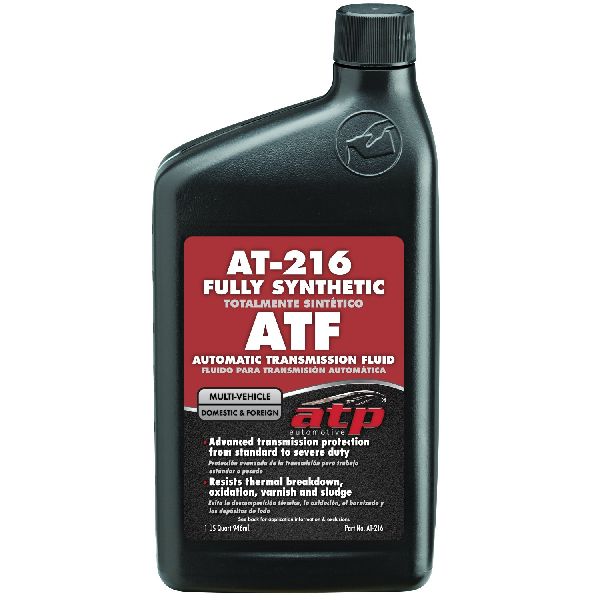
Aftermarket price range: $15-$25 - MERCON V Automatic Transmission Fluid
(OEM #XT-5-QMC)— The correct fluid is required to refill the transmission after service. A pan drop and filter change typically requires 5-6 quarts.
Trusted brands: Motorcraft, Valvoline, Castrol
OEM price range: $8-$12 per quart
Aftermarket price range: $6-$10 per quart
Related Codes That Often Appear With This One
- P0741 — P0741 indicates 'Torque Converter Clutch Circuit Performance or Stuck Off.' If the electrical circuit fails (P0740), the clutch performance will also be flagged as faulty (P0741).
- P0743 — P0743 is 'Torque Converter Clutch Solenoid Electrical.' This is a more specific electrical fault code that is very similar to P0740 and often points to the same root causes. They frequently appear together.
- P0750, P0755, P0962 — These are codes for other shift solenoids. If you see a group of solenoid codes together with P0740, it strongly suggests a power supply problem, like a blown fuse (#33) or a loose main transmission connector, rather than multiple individual solenoid failures.
Platform-Specific Known Issues
- Blown Fuse #33: In several documented cases, a blown 15A fuse in position #33 of the fuse panel has been the sole cause of P0740 and other transmission solenoid codes. This can happen after a high-load situation. Always check this fuse before beginning more invasive repairs.
- Loose Bulkhead Connector: The main electrical connector on the outside of the transmission case can become loose or have poor contact, leading to intermittent power loss for all internal solenoids. This will typically set multiple codes at once (P0740, P0743, P0750, etc.). Reseating this connector can sometimes resolve the issue. A manufacturer service bulletin for similar Ford platforms, TSB Bulletin #SSM 46719, notes that vehicles may exhibit P0740 or P0743 and advises technicians to check connector C168 for correct fitment prior to replacing components.
- Degraded Valve Body Check Balls: While not a direct cause of the P0740 electrical code, a known issue on 4R70/75E transmissions is the degradation of rubber check balls within the valve body. A failing #7 check ball can cause pressure to bleed into the TCC circuit, causing symptoms like stalling and low power that can be confused with a stuck-on solenoid.
Mechanic-Grade Diagnostic Values
- TCC Solenoid Circuit Resistance — expected: 10-15 Ohms. A technician measured a known good circuit at 14.3 Ohms.. Failure: A reading of 0 Ohms indicates a short circuit. A reading of infinity (OL) indicates an open circuit.
- TCC Solenoid Power Supply Voltage — expected: Battery voltage (~12V) at Pin 1 of the transmission connector (C168) with key on. This power comes from Fuse #33 via a Violet/White wire.. Failure: 0V indicates a blown fuse, or an open in the wiring between the fuse box and the transmission.
- PCM Control Signal Test — expected: The PCM grounds the circuit to activate the solenoid. When testing the TCC control wire (Pin 36 at PCM connector C175T), voltage should be high when the solenoid is off and drop to near 0V when commanded on by a scan tool.. Failure: Voltage that does not change when commanded, or is always at 0V (short to ground), points to a wiring or PCM driver issue.
Scan Tool Commands That Help
- Ford IDS (or equivalent professional scan tool): TCC Solenoid ON/OFF Command (or Duty Cycle Control) — This bidirectional command is used to functionally test the entire TCC circuit. While monitoring voltage at the solenoid control wire, a technician can command the solenoid on and off to verify the PCM driver, wiring, and solenoid are all working correctly without a test drive.
Wiring & Ground Locations
- PCM Connector C175T, Pin 36 — This is one of the main connectors at the Powertrain Control Module (PCM), located on the passenger side firewall in the engine bay.. This is the specific pin where the PCM sends the control signal (ground) to the TCC solenoid. It is the starting point for testing the control side of the circuit back from the computer.
- Transmission Connector C168 — This is the main round bulk connector on the passenger side of the transmission case.. This is the junction between the external and internal transmission harnesses. Pin 1 is the 12V power feed (Violet/White wire) for multiple solenoids, and Pin 2 is the control wire for the TCC solenoid. Testing resistance between these two pins checks the solenoid and internal harness. It's also a common spot for fluid intrusion or loose connections.
- Firewall Connector C110 — Located on the firewall in the engine bay, near the PCM.. The power feed wire (Violet/White) for the transmission solenoids passes through this connector at Pin 2. It can be a point of failure (corrosion, loose pin) and is a convenient place to test for power continuity from the fuse box without accessing the transmission itself.
Real Owner Repair Stories
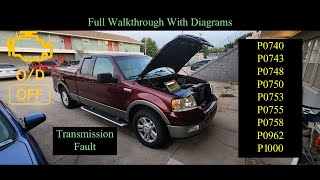
- YouTube video from user 'ScannerDanner' (2004 Ford F-150) — P0740 and P0743 codes, flashing O/D light, transmission in limp mode.
❌ Tried (didn't work) Clearing codes (they returned instantly).
NHTSA Report: Similar persistent symptoms were noted in NHTSA ODI #10191579, where an owner reported a persistent P0740 light accompanied by a rough ride and stalling.
✅ What actually fixed it The diagnosis pointed to an intermittent electrical fault. The technician measured 14.3 ohms across the TCC circuit, which was within spec. After finding transmission fluid inside the external harness connector, he cleaned it, and the code temporarily went away. The final diagnosis was a high likelihood of an intermittent open/short in the wiring harness, which he planned to confirm by graphing resistance while wiggling the harness. The story highlights that even with a good solenoid, the wiring and connectors are frequent failure points. - YouTube video from user 'FordTechMakuloco' (2004-2008 Ford F-150 with 4R75E) — Stalling or near-stalling when coming to a stop, bogging/low power in 2nd gear, perceived rapid shifts. These symptoms are often confused with a faulty TCC or solenoid.
❌ Tried (didn't work) Diagnosing only the TCC electrical circuit, as the symptoms mimic a locked-up converter.
✅ What actually fixed it The actual cause was a worn and shrunken #7 rubber check ball in the valve body. This allowed hydraulic fluid from the 2nd gear circuit to bleed into the torque converter clutch apply circuit, causing the converter to partially lock up at low speeds. Replacing the small check ball resolved the drivability issue.
"I Checked Everything" — The Actual Cause
- A technician can test the TCC solenoid and find its resistance is perfect (e.g., 14 ohms), and verify the wiring from the PCM has continuity. However, the vehicle may still exhibit symptoms of a locked-up torque converter, such as stalling when coming to a stop. The actual cause can be a shrunken rubber check ball (specifically the #7 ball) inside the valve body, causing a hydraulic cross-leak that applies the TCC at the wrong time. This is a mechanical failure that produces symptoms often misdiagnosed as a purely electrical P0740 fault.
OEM Part Supersession History
F8AZ-7G136-AA→N/A— This part number has remained consistent for the TCC solenoid on the 4R70/4R75 series transmissions for this vehicle generation.
Heads up: Be cautious of parts listed for newer F-150s (2009+) with 6-speed (6R80) or 10-speed (10R80) transmissions, as their solenoids (e.g., HL3Z-7G136-M) are completely different and incompatible.
Model Year Variations Within This Range
- 2004-2008: The 5.4L V8 engine was exclusively paired with the heavier-duty 4R75E transmission, while the 4.6L V8 could have the 4R70E. While internally different in strength, for the purpose of diagnosing P0740, the TCC solenoid, its part number (F8AZ-7G136-AA), and the electrical circuit diagnosis are identical between them.
- 2004-2008: All transmissions in this generation are the 'E' variant (4R70E/4R75E), which feature a Turbine Speed Sensor (TSS) and an Output Shaft Speed (OSS) sensor. This differs from the pre-2004 'W' variants that had fewer sensors. This is important for diagnosing other transmission codes but does not change the P0740 diagnostic procedure.
Diagnostic Flowchart
Real Owner Stories
Aggregated from forums and TSBs cited above. Mileages and costs reflect what owners reported in those sources.
2004-2008 Ford F-150
Symptoms: Triggered multiple transmission codes, including P0740, even after a full transmission rebuild.
What fixed it: Discovered and fixed a loose main external transmission connector that was causing intermittent connection loss.
Source hint: Ford Truck Enthusiasts Forum (https://www.ford-trucks.com/forums/1223933-4r75e-mystery-please-help.html)
2004-2008 Ford F-150
Symptoms: Experienced multiple transmission fault codes simultaneously after putting the truck under stress and high load.
What fixed it: Replaced a single blown 15A fuse in position #33 of the fuse panel.
Source hint: f150forum.com (https://www.f150forum.com/f4/need-big-time-tranny-help-108891/)
2004-2008 Ford F-150
Symptoms: Experienced TCC solenoid failure and internal wiring connection issues.
What fixed it: Replaced the TCC solenoid and the internal transmission wiring harness.
Source hint: f150online.com
Related OBD-II Codes
Frequently Asked Questions
Is the TCC solenoid difficult to replace on my 2004-2008 Ford F-150?
My F-150 has code P0740 along with several other transmission codes. What should I check first?
What type of transmission fluid should I use when replacing the TCC solenoid on my F-150?
My truck is stalling when coming to a stop. Is this definitely a bad TCC solenoid?
How can I test if the TCC solenoid on my F-150 is actually faulty?
Could a wiring issue outside the transmission cause the P0740 code?
Helpful Videos
Used OEM Parts in Stock

New Aftermarket Parts Available


The information in this article is provided for general reference and educational purposes only. Vehicle specifications, procedures, and part compatibility can vary by production date, trim level, and region. Always consult your vehicle's factory service manual and verify part numbers before purchasing or performing repairs. Safety-critical components such as airbags, seat belts, and braking systems should be installed by a qualified professional.
- Ford F-150:
- 🎬 Helpful Videos
- 🛍️ Shop This Part
- What's Unique About the 2004-2008 Ford F-150
- Symptoms You May Notice
- Most Likely Causes
- Rare But Worth Checking
- Diagnosis Steps
- Parts You'll Likely Need
- Related Codes That Often Appear With This One
- Platform-Specific Known Issues
- Mechanic-Grade Diagnostic Values
- Scan Tool Commands That Help
- Wiring & Ground Locations
- Real Owner Repair Stories
- "I Checked Everything" — The Actual Cause
- OEM Part Supersession History
- Model Year Variations Within This Range
- Diagnostic Flowchart
- Real Owner Stories
- 2004-2008 Ford F-150
- 2004-2008 Ford F-150
- 2004-2008 Ford F-150
- Related OBD-II Codes
- Frequently Asked Questions
- 🎟️ Get 5% Off