

P0740 on 2008-2016 Chevrolet Cruze: Torque Converter Clutch Circuit Fixes
On a 2008-2016 Cruze, P0740 most often points to a faulty Torque Converter Clutch (TCC) solenoid inside the transmission. Replacing this solenoid is the most common fix and is much cheaper than a new torque converter or transmission. This is a well-documented failure on the GM 6T30/6T40/6T45 transmission family.
- P0740 on a 2008-2016 Cruze indicates an electrical fault in the Torque Converter Clutch (TCC) circuit.
- The most probable cause is a failed TCC solenoid inside the transmission, not a catastrophic failure.
- Do not immediately assume you need a new transmission or torque converter; the solenoid is a much cheaper and more common fix.
- Driving with this code can cause poor fuel economy and lead to transmission overheating, so it should be addressed promptly.
- The repair requires draining the transmission, removing the pan, and working on the valve body, so it is recommended for experienced DIYers or a professional shop.
What's Unique About the 2008-2016 Chevrolet Cruze

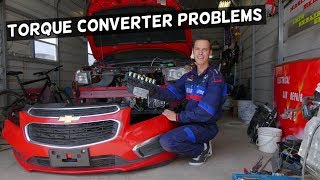
The first-generation Chevrolet Cruze (and related GM vehicles with the 6T30/6T40/6T45 transmission) is known for issues with transmission control solenoids. While P0740 can mean a major internal failure on some cars, on the Cruze, it very commonly isolates to the TCC solenoid itself. 🎬 Watch: How to diagnose Cruze transmission codes and solenoid issues Mechanics and DIYers familiar with this platform often check this specific solenoid first, as it's a frequent point of failure that is more accessible and affordable to replace than the torque converter it controls. Debris from other internal transmission issues, like a failing wave plate, can also travel through the fluid and cause the TCC solenoid to fail.
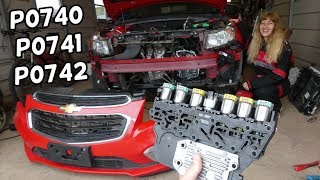
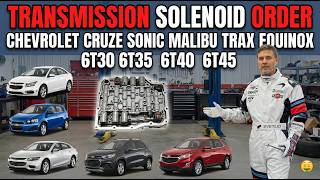
Generation note: The 2008-2016 range primarily covers the first-generation Chevrolet Cruze (2011-2016 in North America). The 6T30/6T40/6T45 transmissions used had two 'generations' of their own ('Gen 1' and 'Gen 2') which used visually different solenoids. Gen 1 solenoids are typically all black, while Gen 2 solenoids are different colors. However, the TCC solenoid that causes P0740 is in the same physical location in both versions, making the repair process similar.
Symptoms You May Notice
- Check Engine Light is on
- Poor fuel economy
- Engine RPM is higher than usual at highway speeds
- Shuddering or vibration at cruising speeds, feeling like driving over rumble strips
- Harsh or delayed gear shifts
- Vehicle may stall when coming to a stop if the clutch is stuck engaged
- Transmission may feel like it's slipping
- Transmission overheating warning light may come on during long drives
- Replacing the entire torque converter when only the TCC solenoid is bad.
- Replacing the entire transmission without properly diagnosing the solenoid, wiring, or fluid condition first.
- Replacing the TCM when the issue is a simple solenoid or wiring fault.
Most Likely Causes

- Faulty Torque Converter Clutch (TCC) Solenoid 🔴 High Probability The solenoids in the 6T-series transmissions are a widely documented common failure point across multiple GM models.
How to confirm: After checking fluid and wiring, the solenoid itself must be tested. A technician can command the solenoid on/off with a scan tool. It can also be tested for resistance with a multimeter once accessed; the expected resistance is typically between 3-5 ohms for pressure control solenoids in this transmission. A reading outside this range indicates a bad solenoid. However, it may test good when cold and only fail when hot.
Typical fix: Replace the TCC solenoid. This requires draining the transmission fluid, removing the side pan, and accessing the valve body where the solenoid is located. 🎬 Watch: How to remove and replace the transmission solenoids
Est. part cost: $40-$90 - Low or Dirty Transmission Fluid 🟡 Medium Probability Contaminated fluid, sometimes containing debris from a failing wave plate or other internal components, can cause solenoids to stick or passages to clog. Low fluid can cause a variety of pressure-related issues that prevent proper solenoid operation.
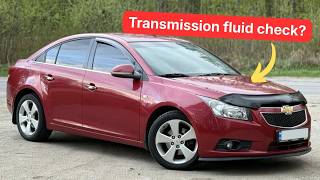
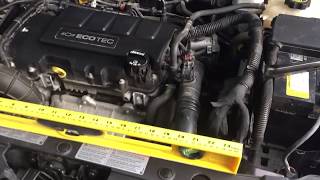
How to confirm: Check the transmission fluid level and condition. On a Cruze, this is done via a check plug on the side of the transmission case, as there is no dipstick. 🎬 See this step-by-step guide for checking your transmission fluid level The fluid should be red and clear, not brown, black, or smelling burnt.
Typical fix: Perform a transmission fluid drain-and-fill or a complete fluid exchange. Use only the specified fluid type (DEXRON-VI for GM).
Est. part cost: $70-$150 for fluid - Damaged Wiring or Connectors ⚪ Low Probability
How to confirm: Visually inspect the external wiring harness going to the transmission for any signs of damage, corrosion, or loose connections. Test for continuity in the TCC solenoid circuit between the TCM and the transmission connector using a digital multimeter.
Typical fix: Repair or replace the damaged section of the wiring harness or the connector. In some GM platforms, an ignition switch failure has been linked to these codes; NHTSA ODI #10702398 notes a recurring P0740 where testing revealed no power from the ignition switch to the circuit.
Est. part cost: $20-$100
Rare But Worth Checking
- Faulty Transmission Control Module (TCM): The TCM (the 'brain' of the transmission, located inside the transmission on the valve body as part of the TEHCM) can fail, but this is much less common than a solenoid failure. This should be considered only after all other causes are ruled out.
- Internal Transmission Failure / Bad Torque Converter: While this code points to an electrical circuit, a major mechanical failure of the torque converter itself or a cracked wave plate within the transmission can cause debris that leads to solenoid failure or trigger related codes. This is a more severe scenario but less likely than an isolated solenoid issue on the Cruze.
Diagnosis Steps
- Use an OBD-II scanner to confirm P0740 is present and check for any other codes (like P0700, P0741, or P0742).
- Check the transmission fluid level and condition via the check plug. If it is low, dark, or smells burnt, address this first. Look for excessive metal particles in the fluid, which could indicate a more serious internal problem.
- Inspect the external transmission wiring harness and connectors for any visible damage, corrosion, or loose pins.
- If possible, use an advanced scan tool to monitor the TCC operation in real-time and command the solenoid on and off to see if it responds electrically and mechanically (by observing RPM changes).
- If the solenoid does not respond or the circuit shows open/short, proceed with testing at the transmission connector. Disconnect the harness and test the resistance of the TCC solenoid pins.
- If external wiring is good, drain the transmission fluid and remove the transmission side cover to gain access to the valve body and solenoids.
- Visually inspect the internal wiring to the TCC solenoid for breaks or damage.
- Test the resistance of the TCC solenoid directly with a multimeter. A typical reading for a good pressure control solenoid is 3-5 ohms. A reading of 0 ohms indicates a short, and an infinite reading (OL) indicates an open circuit. Even if it tests okay, it may be failing intermittently when hot.
- If the solenoid is confirmed bad or is the most likely cause, replace it. Be sure to use the correct part for your transmission's generation (Gen 1 vs. Gen 2).
- If the solenoid and wiring are good, the problem may be in the valve body (clogged passages), the torque converter, or the TCM itself, which requires more advanced diagnostics.
Parts You'll Likely Need

- Torque Converter Clutch (TCC) Solenoid
(OEM #ACDelco 24256523 (Gen 1, Black) or 24275868 (part of Gen 2 kit))— This is the most frequent failure point for a P0740 code on this specific transmission. Note that Gen 1 (approx. 2011-2012) and Gen 2 (approx. 2013+) use different solenoids.
Trusted brands: ACDelco, Bosch, Rostra
OEM price range: $60-$120
Aftermarket price range: $40-$90 - Automatic Transmission Fluid (DEXRON-VI)
(OEM #ACDelco 10-9395 (or equivalent))— The fluid must be drained to access the solenoid and should be replaced with fresh, correct-spec fluid. You will need approximately 5-6 quarts for a pan drop.
Trusted brands: ACDelco, Valvoline, Castrol
OEM price range: $12-$20 per quart
Aftermarket price range: $8-$15 per quart - Transmission Pan Gasket
(OEM #ACDelco 24224781)— The gasket should be replaced when the transmission pan is removed to prevent leaks. Some technicians prefer using a quality RTV sealant designed for transmissions.
Trusted brands: ACDelco, Fel-Pro
OEM price range: $25-$50
Aftermarket price range: $15-$30
Related Codes That Often Appear With This One
- P0700 — P0700 is a general 'Transmission Control System Malfunction' code. It simply means the TCM has stored a fault code, and it is almost always present alongside a more specific transmission code like P0740.
- P0741 — P0741 indicates 'Torque Converter Clutch Circuit Performance or Stuck Off'. It is often seen with P0740 as they both relate to the TCC's function, with P0740 pointing to an electrical circuit fault and P0741 pointing to a performance issue (the computer commanded lock-up but didn't see the expected RPM drop).
- P0742 — P0742 indicates 'Torque Converter Clutch Circuit Stuck On'. This is another related code that can appear with P0740, pointing to a solenoid that is mechanically or electrically stuck in the engaged position.
Technical Service Bulletins (TSBs) & Recalls
- TSB 18-NA-358: Severe Launch Shudder: While not directly for P0740, this TSB addresses shudder conditions in various GM 6-speed transmissions. It guides technicians to differentiate between engine misfire, TCC shudder, and other internal issues. It mentions that debris in the valve body can cause performance problems and that TEHCM replacement is often not the correct fix.
- TSB 16-NA-019: Information on Transmission Adaptive Functions: This bulletin discusses harsh shifts, slips, or flares on low-mileage vehicles and explains the transmission's adaptive learning process. While not a direct fix for an electrical P0740, it's relevant if shift quality issues are also present and a transmission service (like solenoid replacement) has been performed, as a 'fast learn' procedure may be required.
Platform-Specific Known Issues
- Wave Plate Failure: In some early Gen 1 6T40 transmissions (pre-2010), a component called the 3-5-R wave plate can break. The resulting metal debris circulates in the transmission fluid and can clog passages or damage solenoids, including the TCC solenoid, leading to code P0740.
Documented NHTSA Reports
- NHTSA ODI #10836973: An owner reported an intermittent loss of 1st gear where the vehicle would start in 2nd or 3rd gear, accompanied by intermittent trouble codes P0758 and P0740. The report highlights the danger of stalling or failing to move when entering traffic from a stop.
- NHTSA ODI #10023435: A report describes a vehicle that would not move from a dead stop until reaching second gear speed, with the service engine light displaying codes P0740 (TCC sensor malfunction) and P1860.
- NHTSA ODI #10098357: A consumer reported experiencing multiple error codes including P0785, P1860, and P0740, noting that these were recurring issues known to the manufacturer.
Mechanic-Grade Diagnostic Values

- TCC Solenoid (and other Pressure Control Solenoids) Resistance — expected: 3.0 - 5.0 ohms. Failure: A reading of 0 ohms (short) or infinite/O.L. (open) indicates a failed solenoid. Readings slightly outside the range may also indicate a problem.
- Shift Solenoid Resistance — expected: 16 - 20 ohms. Failure: A reading outside this range indicates a failed shift solenoid.
- Gen 1 Pressure Switch Resistance (at rest) — expected: 2.2 - 2.8 ohms (Normally Closed). Failure: A reading of O.L. (open) at rest, or failure to go to O.L. when the switch is manually pressed, indicates a faulty switch. Loose rivets can also cause an open circuit.
- TCC Solenoid Circuit Voltage (at transmission connector) — expected: Approx. 10-12V on the power supply pin with Key On, Engine Off.. Failure: No voltage suggests a problem with the power supply from the TCM or a wiring issue upstream.
Hidden / Shadow Codes Worth Checking
- N/A (Diagnostic Logic): A technician can determine if the transmission is Gen 1 or Gen 2 by checking if pressure switch DTCs (e.g., P0842) are considered 'valid' or 'invalid' by the scan tool. If valid, it is a Gen 1. If invalid, it is a Gen 2. (see via Professional Scan Tool (e.g., GM GDS2/Tech2))
Scan Tool Commands That Help
- GM GDS2 / Tech2 or equivalent professional scanner: Solenoid Activation / Bidirectional Control — Used to command the TCC solenoid ON and OFF to verify electrical response and listen for a physical click from the solenoid. This helps isolate a circuit fault from a mechanical one.
- GM GDS2 / Tech2: Fast Learn / Transmission Adaptive Pressure Learn — This procedure MUST be performed after replacing the TEHCM (TCM/Solenoid assembly) or valve body to clear old adaptive data and force the TCM to learn the characteristics of the new components. Failure to do so can result in poor shift quality.
Wiring & Ground Locations
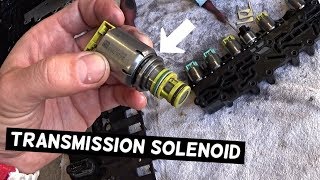
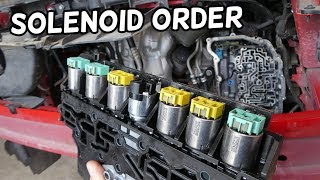
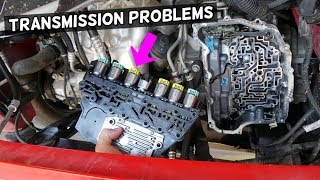
- TCC Solenoid — On the valve body, inside the transmission side cover. For both Gen 1 and Gen 2 models, it is the solenoid located next to the central shifter solenoid.. This is the component being controlled by the circuit that has faulted. Access is required for direct testing and replacement.
- TEHCM (Transmission Electro-Hydraulic Control Module) — Mounted to the valve body, inside the transmission. It is the 'brain' and solenoid pack combined.. The TCM is the source of the command and the diagnostic trouble code. The wiring for the TCC solenoid runs from the TCM portion of the TEHCM to the solenoid itself.
Real Owner Repair Stories
- YouTube Channel 'Electrical Car Repair Life' (Chevrolet Cruze with 6T40 Gen 2 Transmission) — Check Engine Light with codes P0740, P0741, or P0742.
❌ Tried (didn't work) The video advises against immediately assuming the torque converter or entire transmission is bad, which are common misdiagnoses.
✅ What actually fixed it The problem was isolated to the Torque Converter Clutch (TCC) solenoid on the valve body. The video identifies the specific solenoid and explains that replacing it is the common and cost-effective fix.
"I Checked Everything" — The Actual Cause
- The equivalent for this electrical code is when the TCC solenoid passes a cold resistance test with a multimeter but is actually failing. Multiple mechanics report that the solenoid can malfunction only when the transmission fluid reaches operating temperature. In these cases, the solenoid is the root cause, but it's an intermittent thermal failure, which a basic bench test will miss. Replacement is the only reliable fix if other circuit tests pass.
OEM Part Supersession History
Various (Gen 1 TEHCM)→Various (Gen 2 TEHCM)— Major redesign of the control system for the 2012 model year.
Heads up: Generation 1 and Generation 2 TEHCMs, valve bodies, and solenoids are NOT interchangeable. The TEHCM can be identified by the 8th digit of its barcode: a number (1, 2, 3) indicates Gen 1, while a letter (B, C, D) indicates Gen 2.
Model Year Variations Within This Range
- 2008 - approx. 2012: These vehicles use the 'Gen 1' 6T40 transmission. It has pressure switches on the TEHCM, and the solenoids are typically all black. They are prone to 3-5-R wave plate failure in earlier (pre-2010) models.
- approx. 2012 - 2016: These vehicles use the 'Gen 2' 6T40 transmission. The TEHCM does not have pressure switches and uses a 'Clutch Pulse Learning' strategy. The solenoids are different colors, and the valve body has a different design. Gen 1 and Gen 2 parts are not interchangeable.
Diagnostic Flowchart
Used vs. New Parts: Buying Guide for This Vehicle
When a used part is the smart pick: For this repair, a complete, used TEHCM (valve body with TCM and solenoids) from a low-mileage, verified-compatible donor vehicle can be a smart choice. It replaces all potential electronic failure points (TCM, solenoids, internal wiring) in one step, often for less than the cost of a new OEM TEHCM.
Donor-vehicle mileage cap: roughly under 80000 miles for the part to have meaningful remaining life.
What to inspect on the donor part:
- Verify the donor vehicle's VIN to confirm it is the correct Generation (Gen 1 vs Gen 2) for your vehicle.
- If possible, inspect the transmission fluid from the donor; it should be reddish and not smell burnt.
- Ask for any available history on the donor vehicle to ensure it wasn't junked for a severe transmission failure.
OEM-only on this vehicle (don't cheap out):
- TEHCM / Valve Body Assembly: Due to the need for precise calibration, it is strongly recommended to use an OEM part (either new, professionally remanufactured by a company like ACDelco, or a good used unit). Avoid cheap, unbranded clones from online marketplaces as they often have programming and reliability issues.
Aftermarket brands forum-validated for this vehicle:
- Sonnax: Known for high-quality transmission repair kits ('Zip Kit') and individual components that can address wear and design flaws in the valve body.
- Rostra: A known aftermarket supplier of transmission solenoids.
Brands owners have reported issues with on this vehicle:
- Unbranded, 'no-name' TEHCMs or individual solenoids from major online retailers are a high risk. Users frequently report issues with incorrect calibration, early failure, or incompatibility.
Real Owner Stories
Aggregated from forums and TSBs cited above. Mileages and costs reflect what owners reported in those sources.
2012 Cruze — 115000 miles
Symptoms: RPM flare between gears and a P0741 code.
What fixed it: Replacing the TCC solenoid (ACDelco part number 24256523 for the Gen 1 transmission).
Source hint: CruzeTalk Forum: P0741 Torque Converter Clutch Solenoid
2014 Cruze
Symptoms: Check Engine Light with codes P0700 and P0741 stored.
What fixed it: The forum consensus pointed to the TCC solenoid as the most probable cause, with multiple members recommending its replacement as the first step after checking the fluid.
Source hint: CruzeTalk Forum: P0700 and P0741
2012 Cruze
Symptoms: Check Engine Light with codes P0700 and P0741.
What fixed it: The repair was confirmed to be the TCC solenoid, with other forum members who performed the same repair reinforcing it as the common solution.
Source hint: CruzeTalk Forum: 2012 Cruze P0700, P0741
Related OBD-II Codes
Frequently Asked Questions
My 2012 Cruze is shuddering at highway speeds. Is this related to the P0740 code?
I have an early model Cruze (pre-2010). Is there a specific known issue that could cause P0740?
What is the most common cause of P0740 on my Chevrolet Cruze?
I replaced the TCC solenoid and now my transmission shifts harshly. What's wrong?
How do I check the transmission fluid on my Cruze since it doesn't have a dipstick?
What kind of transmission fluid does my 2008-2016 Cruze require?
My mechanic said the TCC solenoid tested okay with a multimeter. Could it still be the problem?
Helpful Videos

We Have This Part in Stock


The information in this article is provided for general reference and educational purposes only. Vehicle specifications, procedures, and part compatibility can vary by production date, trim level, and region. Always consult your vehicle's factory service manual and verify part numbers before purchasing or performing repairs. Safety-critical components such as airbags, seat belts, and braking systems should be installed by a qualified professional.
- Chevrolet Cruze:
- 🎬 Helpful Videos
- 🛍️ Shop This Part
- What's Unique About the 2008-2016 Chevrolet Cruze
- Symptoms You May Notice
- Most Likely Causes
- Rare But Worth Checking
- Diagnosis Steps
- Parts You'll Likely Need
- Related Codes That Often Appear With This One
- Technical Service Bulletins (TSBs) & Recalls
- Platform-Specific Known Issues
- Documented NHTSA Reports
- Mechanic-Grade Diagnostic Values
- Hidden / Shadow Codes Worth Checking
- Scan Tool Commands That Help
- Wiring & Ground Locations
- Real Owner Repair Stories
- "I Checked Everything" — The Actual Cause
- OEM Part Supersession History
- Model Year Variations Within This Range
- Diagnostic Flowchart
- Used vs. New Parts: Buying Guide for This Vehicle
- Real Owner Stories
- 2012 Cruze — 115000 miles
- 2014 Cruze
- 2012 Cruze
- Related OBD-II Codes
- Frequently Asked Questions
- 🎟️ Get 5% Off