

P0733 on 2017-2023 Ford F-150: Gear 3 Incorrect Ratio Causes and Fixes
On 2017-2023 F-150s with the 10R80 transmission, P0733 almost always points to a significant internal mechanical issue, specifically a failed CDF clutch drum bushing. This is not a simple DIY fix and often requires transmission overhaul or replacement. Expect a high repair cost.
- P0733 on a 2017-2023 F-150 is a serious code that strongly points to a known mechanical failure inside the 10-speed (10R80) transmission.
- The most likely culprit is a failed CDF clutch drum bushing, a repair that requires removing and disassembling the transmission.
- Do not assume the problem is a simple sensor or solenoid. Misdiagnosis can be costly.
- Driving with this condition can lead to more extensive and expensive transmission damage.
- This is not a DIY-friendly repair; it requires professional-level tools and expertise.
What's Unique About the 2017-2023 Ford F-150
The 2017-2023 Ford F-150 predominantly uses the 10-speed 10R80 automatic transmission, co-developed with GM. This specific transmission is known to have a design flaw that leads to this code. Multiple Ford Technical Service Bulletins (TSBs), including TSB 24-2254, point to a problem with the CDF clutch cylinder sleeve, which can move axially (a condition known as 'bushing walkout') and expose hydraulic passages. This causes a significant loss of hydraulic pressure to the clutch pack, leading to slipping and incorrect gear ratio codes like P0733. This makes the issue a well-documented mechanical failure pattern rather than a random electronic fault.
Diagnostic Flowchart
Tap your situation to follow the diagnostic path that matches what you're seeing on this vehicle.
Generation note: This issue affects both the 13th generation (2017-2020) and 14th generation (2021-2023) F-150, as both widely use the 10R80 transmission, which is at the center of this problem.
Symptoms You May Notice
- Harsh, jerky, or delayed shifting, especially involving third gear.
- Engine RPMs flare up during shifts without a corresponding increase in speed (transmission slipping), particularly when cold.
- Illuminated Check Engine Light or Wrench Light on the dashboard.
- Vehicle entering "limp mode," where it may get stuck in one gear to prevent further damage.
- Hesitation or loss of power during acceleration.
- A noticeable clunk when downshifting from 4th to 3rd gear.
- Delayed engagement when shifting from Park into Drive or Reverse.
- Replacing only the shift solenoids or valve body without inspecting the CDF clutch drum. The problem will likely return as the root cause is the mechanical wear of the drum sleeve, not an electronic or primary valve body failure.
- Performing only a transmission fluid flush. While fresh fluid is good, it cannot fix the underlying hydraulic leak from the walked-out bushing.
- Replacing the entire transmission without confirming the specific internal failure. While sometimes necessary if damage is widespread, a targeted repair of the CDF drum with the updated part can be more cost-effective.
Most Likely Causes
- Worn or Failed CDF Clutch Drum Bushing/Sleeve 🔴 High Probability This is a well-documented design flaw in the 10R80 transmission. Ford TSB 24-2254 specifically identifies 'axial movement of the CDF clutch cylinder (7H351) sleeve' as a primary cause for a group of codes that includes P0733. The sleeve, or bushing, walks out of position, uncovering hydraulic ports and causing a pressure leak.
How to confirm: Confirmation requires transmission disassembly and inspection of the CDF clutch drum assembly for a worn or out-of-place bushing. A technician may drop the transmission pan first and find excessive metallic debris, confirming internal failure. A specific 'CDF Test' using a pressure transducer is outlined in TSB 24-2254.
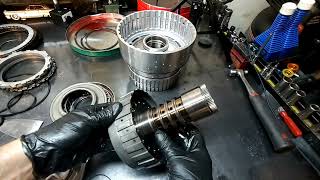
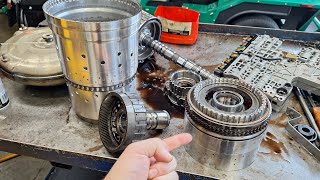
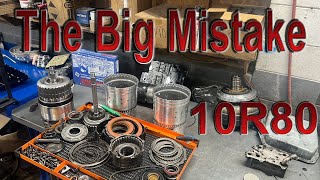
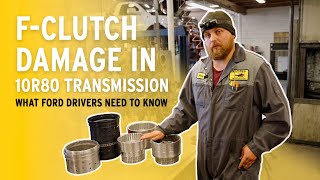
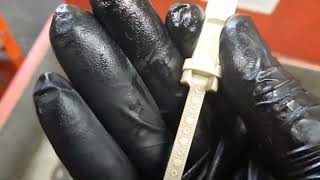
Typical fix: The transmission must be removed and disassembled to replace the faulty CDF clutch drum assembly with an updated part that has a machined lip to prevent the sleeve from moving. 🎬 Watch: A close-up look at the failed CDF drum sleeve. Some shops may recommend a full transmission rebuild or replacement, especially if metal debris has circulated.
Est. part cost: $300-$600 for the drum assembly - Low or Contaminated Transmission Fluid 🟡 Medium Probability While rarely the root cause for P0733 on this platform, low fluid level will cause hydraulic pressure loss and overheating, exacerbating the known mechanical issues. It's a critical first check. Contaminated fluid (with clutch material) is a symptom of the CDF drum failure, not the cause.
How to confirm: Check the transmission fluid level and condition. The 10R80 does not have a traditional dipstick, so this must be done from under the vehicle with the engine running at a specific temperature (206–215°F). 🎬 See how to properly check and add transmission fluid. Fluid should be clean, red (Motorcraft ULV is specified), and free of burnt smells or excessive metal particles.
Typical fix: Perform a transmission fluid and filter change using only the correct Motorcraft Mercon ULV fluid. If the fluid is heavily contaminated, it's a strong indicator of the internal mechanical wear described above, and a fluid change alone will not fix it.
Est. part cost: $150-$250 for fluid and filter - Main Control Valve Body Issues ⚪ Low Probability TSBs like 23-2123 mention sticking valves in the main control valve body as a possible cause, often due to debris from a failing CDF drum contaminating the solenoids and valves. In some cases, a valve body overhaul or replacement is required in addition to the CDF drum.
How to confirm: A technician can use a high-level scan tool to command solenoids on and off to check for response. Physical inspection for scoring or stuck valves is required for a definitive diagnosis, which involves removing the valve body.
Typical fix: Cleaning or replacing the main control valve body. Ford has procedures for overhauling the valve body, which may be performed alongside the CDF drum replacement.
Est. part cost: $700-$1500 for a new valve body
Rare But Worth Checking
- Failed Shift Solenoid: While a shift solenoid can fail, it's less common for this specific code on the 10R80 than the mechanical CDF drum failure. It's often replaced unnecessarily when the true fault is mechanical wear causing a hydraulic leak that the solenoid cannot overcome. The six shift solenoids are mechanical linear force solenoids and do not have fluid passing through them.
- Faulty Transmission Control Module (TCM): A software glitch or internal hardware failure in the TCM can theoretically cause this code, but it is very rare. TSBs suggest reprogramming (reflashing) as a potential step, but usually in conjunction with mechanical repairs like a valve body overhaul.
Diagnosis Steps
- Check the transmission fluid level and condition. This is a crucial first step, though it requires lifting the vehicle as there is no dipstick. The fluid must be checked at a specific operating temperature (206-215°F per service info).
- Use an advanced scan tool (like Ford's FDRS or FORScan) to check for any other pending or active trouble codes. Note any other gear ratio or solenoid codes, as a cluster of them points to the CDF drum.
- Review the freeze-frame data for the P0733 code to see the exact conditions (speed, RPM, temperature) when the fault occurred.
- Check for applicable Technical Service Bulletins (TSBs). TSB 24-2254 is the most relevant, directly linking P0733 to the CDF clutch cylinder sleeve failure and providing a specific pressure test procedure.
- If fluid is full and clean, and no other simple causes are found, the next step is to drop the transmission pan to inspect for excessive metal debris (looks like metallic paste or flakes on the magnet), which would confirm internal mechanical failure.
- Given the high probability of the CDF drum issue, the final diagnostic step is the removal and disassembly of the transmission for internal inspection and replacement of the CDF drum assembly.
Parts You'll Likely Need
- CDF Clutch Cylinder Assembly (Updated)
(OEM #JL3Z-7H351-B (replaces HL3Z-7H351-A and JL3Z-7H351-A))— This is the most common point of failure on the 10R80 transmission leading to P0733. The updated part has a machined lip to prevent the bushing/sleeve from walking out, which is the root cause of the hydraulic leak.
Trusted brands: Motorcraft (Ford OEM)
OEM price range: $300-$600
Aftermarket price range: $250-$500 - Transmission Fluid and Filter Kit — Required for any transmission service. Using the correct Ford Motorcraft Mercon ULV fluid (XT-12-QULV) is absolutely critical for the 10R80 transmission's health.
Trusted brands: Motorcraft
OEM price range: $150-$250
Aftermarket price range: $100-$180 - Main Control Valve Body — May be required if it has been damaged by debris from the primary failure or has sticking valves. Some owners report needing this replaced shortly after the CDF drum if not done at the same time.
Trusted brands: Motorcraft
OEM price range: $700-$1500
Aftermarket price range: $600-$1200
Related Codes That Often Appear With This One
- P0732 — Stands for 'Gear 2 Incorrect Ratio.' It often appears with P0733 because the underlying mechanical issue (the CDF drum failure) affects hydraulic pressure for multiple clutch packs and gear sets.
- P0729, P0731, P0734, P0735, P0736 — These are all incorrect gear ratio codes for other gears. Seeing multiple codes together strongly points to a systemic transmission problem like the CDF drum failure causing widespread hydraulic pressure loss, rather than an issue with a single gear.
Technical Service Bulletins (TSBs) & Recalls
- TSB 24-2254: Supersedes previous bulletins and directly addresses harsh/delayed shifts and a host of incorrect ratio DTCs (including P0733) by pointing to 'axial movement of the CDF clutch cylinder sleeve causing hydraulic circuit leaks' as the cause. It outlines the procedure to verify the leak and replace the CDF clutch cylinder.
- TSB 23-2123: Addresses harsh/delayed shifts and the same list of DTCs, but attributes the cause to 'incompatibility of the adaptive calibration to adapt to hardware break-in over time' and prescribes a valve body overhaul and/or adaptive learning drive cycle.
Platform-Specific Known Issues
- 10R80 CDF Clutch Drum Failure: The most significant issue for this platform. Ford has released multiple TSBs (including TSB 24-2254) that address harsh shifting and incorrect gear ratio codes. They spec
Mechanic-Grade Diagnostic Values
- Shift Solenoid Resistance — expected: 5.0 - 5.4 Ohms at 20°C (68°F). Failure: A reading outside this range indicates a faulty solenoid coil.
- Transmission Line Pressure Port Thread — expected: M10 x 1.00 thread. Failure: Not a value, but a critical warning: using a standard NPT (National Pipe Thread) fitting for a pressure gauge will damage the transmission case.
- Normal Transmission Operating Temperature (for fluid level check) — expected: 206°F - 215°F (96°C - 101°C). Failure: Checking the fluid level at the wrong temperature will result in an inaccurate reading, potentially masking a low-fluid condition.
Scan Tool Commands That Help
- FORScan / Ford IDS: Clear Transmission Adaptive Tables — This service procedure should be performed after most transmission repairs or fluid services. It erases the learned shift pressure adjustments, forcing the TCM to relearn shift characteristics from a clean baseline. This can resolve harsh or erratic shifting caused by the transmission learning to compensate for a developing mechanical issue that has since been fixed.
- FORScan / Ford IDS: Halt Transmission Adaptive Learning — This is a more advanced and controversial function that freezes the adaptive learning tables, preventing them from changing. Some users do this to maintain a crisp shift feel after a reset, but it is generally not recommended as it prevents the transmission from adjusting to normal wear over time, which could potentially reduce its lifespan.
- Ford IDS: CDF Test — Mentioned in TSB 24-2254, this is a specific diagnostic test run with a pressure transducer connected to the line pressure port to confirm failure of the CDF clutch cylinder, which is the primary cause of P0733.
- Ford IDS / High-End Scan Tool: Solenoid Body Identification & Strategy Programming — This is a mandatory step when a new transmission, valve body, or TCM is installed. The scan tool is used to program the unique 13-digit strategy number from the new solenoid body into the vehicle's control module to ensure correct solenoid operation.
Wiring & Ground Locations
- Main Transmission Connector — External connector on the transmission case.. Provides the electrical connection for all internal sensors and solenoids to the TCM. A pinout diagram is necessary for testing continuity and voltage for components like the input/output speed sensors and shift solenoids. Forum research indicates the wiring pinout is consistent for at least the 2018 through 2023 model years.
- Line Pressure Test Port — On the driver's side of the transmission case, a few inches in front of the range sensor.. This is the access point for performing a line pressure test, a key diagnostic step. TSB 24-2254 specifies using this port for the 'CDF Test' to confirm the common internal failure. It has an M10x1.0 thread.
Real Owner Repair Stories
- Reddit user Moritasgus2 on r/f150 (2022 F-150 SuperCrew 5.0 4x4 with 23k miles (pre-CDF drum revision)) — Erratic shifting, hanging in first gear.
❌ Tried (didn't work) A PCM reprogram and clearing of KAM/shift tables by the dealer only helped briefly.
✅ What actually fixed it The technician performed a pressure test which passed. An air pressure test on the removed main control also passed. However, upon disassembling the main control (valve body), the tech found 'a couple of the valves were sticking in their bores.' Overhauling the main control and performing the adaptive road test procedure resolved the shifting issues. - F150forum.com user 'gatorcrew' (2018 F-150 2.7L with 80k miles) — P0733 code, engine revs up on 3rd to 4th shift when cold, then vehicle entered limp mode and got stuck in 1st gear before slamming into 4th.
❌ Tried (didn't work) The user was in the initial diagnostic phase.
✅ What actually fixed it The user did not post a final resolution, but the symptoms and code are a textbook case pointing directly towards the common CDF drum failure, which the user was discussing with the dealer as a likely need for a transmission rebuild or replacement.
"I Checked Everything" — The Actual Cause
- In the context of this internal transmission code, the equivalent of a 'smoke test clean' scenario is when standard electronic and pressure tests show no faults. A real-world example occurred where a 2022 F-150 passed a line pressure test and a valve body air pressure test. The root cause was only found when a technician disassembled the main control valve body and discovered sticking valves, which were not detectable by the standard tests. Overhauling the valve body fixed the issue.
When the Usual Fixes Don't Work
- While the CDF clutch drum failure is the most common cause for P0733 on the 10R80, it is not the only cause. A documented case on a 2022 F-150 with only 23,000 miles showed that after passing pressure tests, the actual problem was sticking valves within the main control valve body. An overhaul of the valve body, without replacing the CDF drum, resolved the erratic shifting. This highlights that valve body issues can be the primary fault and should be considered, especially if the transmission fluid is clean and free of the metallic debris typical of a catastrophic drum failure.
OEM Part Supersession History
HL3Z-7H351-A, JL3Z-7H351-A→JL3Z-7H351-B— The original CDF clutch drum design allowed an internal bushing/sleeve to 'walk' out of its bore, uncovering oil passages and causing a hydraulic pressure leak. The updated JL3Z-7H351-B part features a machined retention lip that physically prevents the bushing from moving, permanently fixing the design flaw.
Model Year Variations Within This Range
- 2017-2020: Earlier model years of the 10R80 were known for having more aggressive or harsh-feeling software calibrations from the factory. While not a direct cause of P0733, the shift logic was noticeably different and subject to more TSBs for software updates compared to later years.
- 2021-2023: Ford reportedly revised some internal hardware, including the CDF drum, around the 2021 model year to address the known failure points. However, failures can still occur on early-build 2021/2022 models produced before the revised parts were fully implemented. Despite internal changes, the main external wiring and connectors appear to have remained consistent from 2018-2023.
Helpful Videos
Used OEM Parts in Stock


New Aftermarket Parts Available


The information in this article is provided for general reference and educational purposes only. Vehicle specifications, procedures, and part compatibility can vary by production date, trim level, and region. Always consult your vehicle's factory service manual and verify part numbers before purchasing or performing repairs. Safety-critical components such as airbags, seat belts, and braking systems should be installed by a qualified professional.
- Ford F-150:
- 🎬 Helpful Videos
- 🛍️ Shop This Part
- What's Unique About the 2017-2023 Ford F-150
- Diagnostic Flowchart
- Symptoms You May Notice
- Most Likely Causes
- Rare But Worth Checking
- Diagnosis Steps
- Parts You'll Likely Need
- Related Codes That Often Appear With This One
- Technical Service Bulletins (TSBs) & Recalls
- Platform-Specific Known Issues
- Mechanic-Grade Diagnostic Values
- Scan Tool Commands That Help
- Wiring & Ground Locations
- Real Owner Repair Stories
- "I Checked Everything" — The Actual Cause
- When the Usual Fixes Don't Work
- OEM Part Supersession History
- Model Year Variations Within This Range
- 🎟️ Get 5% Off