

P0720 on 2005-2015 Nissan Xterra: Output Speed Sensor and TCM Failure Guide
On a 2005-2015 Xterra, code P0720 is most often caused by a failed Transmission Control Module (TCM), not the external speed sensor. The TCM is part of the valve body inside the transmission, making this a costly repair, often over $1,000. Before replacing any parts, 2005-2010 models must be checked for coolant contamination in the transmission fluid (SMOD).
- For a 2005-2015 Xterra, P0720 almost always points to a failing Transmission Control Module (TCM), not the external speed sensor.
- The TCM is sold as part of the transmission valve body, making it an expensive and labor-intensive repair that requires programming.
- Before any repair, check the transmission fluid. If you have a 2005-2010 model, check carefully for a pink, milky consistency which indicates coolant contamination (SMOD) and a much larger problem.
- Do not replace the external Output Speed Sensor without first ruling out the more common TCM failure, as it will likely not solve the problem.
What's Unique About the 2005-2015 Nissan Xterra
While the P0720 code points to an output speed sensor circuit, on the second-generation Nissan Xterra (and related trucks like the Frontier and Titan), the root cause is very frequently a failure of the Transmission Control Module (TCM) itself. The TCM is integrated into the transmission valve body, located inside the oil pan where it is subjected to heat and vibration. Owners often mistakenly replace the inexpensive external speed sensor only to find the problem persists, because the internal TCM electronics have failed. This is a well-documented pattern on this specific Nissan platform using the RE5R05A transmission. Nissan has even issued service bulletins for other models with similar transmissions confirming that P0720 is often a false code caused by a failing TCM, not the sensor.
Symptoms You May Notice
- Harsh, erratic, or delayed shifting
- Transmission getting stuck in one gear (limp mode)
- Speedometer needle jumping, reading incorrectly, or dropping to zero
- Check Engine Light is on
- Cruise control not working
- Vehicle may hesitate or stall
- Torque converter clutch failing to lock up at highway speeds
- Replacing only the external output speed sensor without diagnosing the full circuit. On this platform, the TCM is the more likely culprit, so replacing the sensor alone often does not fix the issue.
Most Likely Causes
- Failed Transmission Control Module (TCM) / Valve Body 🔴 High Probability There is a high documented failure rate for the TCM, which is integrated with the valve body, on this Nissan truck platform (RE5R05A transmission). Heat, vibration, and internal corrosion of electronic traces are the primary reasons for failure. Antifreeze contamination from a leaking radiator can also destroy the TCM.
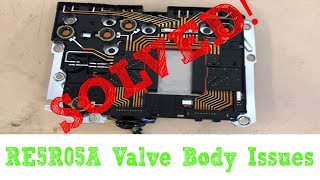
How to confirm: After ruling out the external sensor and wiring, this is the most likely cause. A professional diagnosis with an advanced scan tool is required. A key symptom is observing nonsensical data from the TCM, 🎬 See how to diagnose and fix these TCM issues such as the output speed reading 170mph when stopped, or 39mph regardless of actual speed. The problem is often intermittent and may worsen as the transmission warms up.
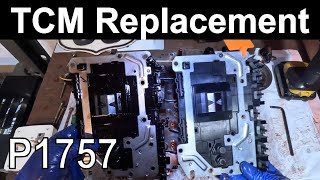
Typical fix: Replace the entire transmission valve body assembly, which includes the new TCM. 🎬 Watch: Step-by-step RE5R05A TCM replacement walkthrough The new module must be programmed to the vehicle's VIN, although many remanufactured units now come pre-flashed.
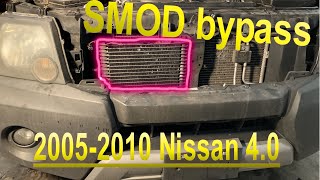
Est. part cost: $800-$1500 - Coolant Contamination ('Strawberry Milkshake of Death') 🟡 Medium Probability On 2005-early 2010 models, the internal radiator cooler for the transmission fluid is known to fail due to a design flaw, allowing coolant and transmission fluid to mix. This corrosive mixture destroys the transmission's electronic components, including the TCM, and clutch materials. This issue was so common it resulted in a class-action lawsuit.
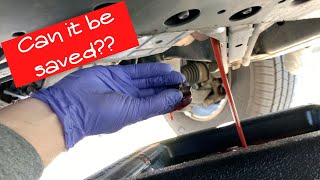
How to confirm: Check the transmission fluid via the dipstick and the coolant in the overflow reservoir. If the fluid is pink, milky, and resembles a strawberry milkshake, it is contaminated. 🎬 Watch: Real-world example of the Strawberry Milkshake of Death
Typical fix: This requires a complete transmission replacement or rebuild, a new radiator (using an updated part number like 21460-9CA0E), and flushing of all cooler lines. It is a catastrophic and very expensive failure.
Est. part cost: $3000-$6000 - Faulty Output Speed Sensor (VSS) ⚪ Low Probability While this is the part named by the code, it is not the most common point of failure on this specific vehicle. It's more often a symptom of the failing TCM or a wiring issue.
How to confirm: Use a scan tool to monitor the Output Speed Sensor PID in real-time. If the signal is absent or erratic while the vehicle is moving, and the wiring is confirmed to be good, the sensor itself may be faulty. On 4WD models, the sensor is located on the rear of the transfer case. You can also remove the sensor and check its magnetic tip for excessive metal debris.
Typical fix: Replace the output speed sensor. This is often attempted first but frequently fails to solve the problem.
Est. part cost: $40-$150 - Damaged Wiring or Connectors ⚪ Low Probability
How to confirm: Visually inspect the wiring harness leading to the output speed sensor and the main transmission harness for any signs of fraying, melting, corrosion, or loose pins. A user on XterraNation found a loose pigtail in the passenger wheel well caused the code. Perform a continuity and resistance test on the circuit with a multimeter.
Typical fix: Repair or replace the damaged section of the wiring harness or the connector.
Est. part cost: $10-$200
Rare But Worth Checking
- Low or Dirty Transmission Fluid: Extremely low or dirty fluid can cause a variety of shifting issues and overheating that might trigger sensor codes. Always check the fluid level and condition first as a basic step.
Diagnosis Steps
- Check the transmission fluid level and condition. Look for a low level or a milky pink color, which indicates coolant contamination (SMOD), especially on 2005-2010 models.
- Use an OBD-II scanner to check for other transmission-related or communication (U-prefix) codes. A U1000 code must be addressed first.
- Monitor the live data for the 'Output Shaft Speed' with an advanced scan tool while driving. Observe if the signal drops to zero, is erratic, or shows nonsensical values (e.g., 170mph while stopped) that do not correspond to the vehicle's actual speed. This strongly points to a bad TCM.
- Visually inspect the external output speed sensor (on the transfer case for 4WD models) and its electrical connector/harness for obvious damage, corrosion, or loose connections.
- If the wiring appears intact, test the circuit for proper voltage, ground, and signal using a digital multimeter, following the vehicle's service manual procedure. Check for a 5V reference and good ground at the sensor connector.
- If the external sensor and wiring test good, the fault is highly likely to be the internal Transmission Control Module (TCM), which is part of the valve body assembly.
Parts You'll Likely Need
- Transmission Valve Body with TCM
(OEM #31705-X428E (example, varies by VIN))— This is the most common cause of P0720 on the 2005-2015 Xterra. The TCM is integrated into the valve body and fails electronically. Remanufactured units are a popular, cost-effective alternative to new OEM.
Trusted brands: Nissan (OEM), Hitachi (OEM supplier), Street Smart Transmission (Remanufactured), Vertex (Remanufactured)
OEM price range: $1200-$1800
Aftermarket price range: $600-$1000 - Output Speed Sensor / Vehicle Speed Sensor (VSS)
(OEM #31935-1XJ0D)— This is the part directly implicated by the code definition, but it is a much less common failure point than the TCM on this vehicle. It's often replaced in a failed attempt to fix the issue.
Trusted brands: Hitachi, Bosch, NGK/NTK
OEM price range: $90-$150
Aftermarket price range: $40-$80 - Radiator
(OEM #21460-9CA0E (Updated/Safe Part))— For 2005-2010 models, if SMOD is detected, the radiator must be replaced to prevent immediate failure of the new transmission. Do not use old part numbers like 21460-EA215.
Trusted brands: Nissan (OEM), Koyo, Spectra Premium
OEM price range: $300-$500
Aftermarket price range: $100-$200
Related Codes That Often Appear With This One
- U1000 — A failing TCM can disrupt communication on the vehicle's CAN bus network, triggering this common Nissan communication code.
- P0715 — This code is for the Input Speed Sensor. Since both the input and output speed sensor signals are processed by the TCM, a failing TCM can cause faults for both circuits simultaneously.
Technical Service Bulletins (TSBs) & Recalls
- While no TSB explicitly names P0720 for the Xterra, Nissan has issued bulletins for other models with similar Jatco transmissions (like the 7-speed in the 370Z) confirming that P0720 is a false code caused by a failing TCM, not the sensor itself. This known issue is widely understood in the technician community to apply to the Xterra's RE5R05A as well. Nissan TSB NTB14-033b details the procedure for programming a blank replacement TCM for the Xterra.
- Manufacturer TSB Bulletin #NTB10150A for other Nissan models notes that for vehicles without ABS, a P0720 code may require replacing the transmission control valve assembly (valve body) and reprogramming.
- Manufacturer TSB Bulletin #NTB14019 notes that P0720 can occur alongside other speed sensor codes if moisture or corrosion is present on or around the speed sensor pins.
Platform-Specific Known Issues
- High failure rate of the Transmission Control Module (TCM), which is part of the valve body assembly, is the primary cause for P0720.
- For 2005-early 2010 models, the 'Strawberry Milkshake of Death' (SMOD) is a critical potential issue where a radiator failure causes coolant to mix with and destroy the transmission and its electronics.
Mechanic-Grade Diagnostic Values
- Output Speed Sensor Resistance — expected: 560 - 680 Ohms. Failure: A reading outside this range, or infinite resistance (open circuit), indicates a failed sensor.
- Output Speed Sensor Circuit Voltage — expected: 5V reference from the PCM/TCM on one wire, and a solid ground on another.. Failure: Missing reference voltage or a bad ground points to a problem in the wiring or the control module, not the sensor itself.
- Wiring Harness Continuity — expected: < 5.0 Ohms. Failure: Resistance higher than 5.0 Ohms between the sensor connector and the TCM connector indicates excessive resistance in the harness.
Scan Tool Commands That Help
- Nissan CONSULT-II / CONSULT-III: DATA MONITOR for "TRANSMISSION" — This is the primary diagnostic step to confirm the fault. A technician monitors the 'VHCL/S SE-A/T' (Vehicle Speed Sensor A/T) value and compares it to the 'VHCL/S SE-MTR' (Vehicle Speed from Meter) value while driving. If the A/T sensor value is erratic, zero, or does not match the meter speed, it confirms a fault in the output speed sensor circuit or the TCM.
- Nissan CONSULT-III plus: Programming > After Replace ECU — This function is required after installing a new 'blank' TCM/valve body. The technician must use this to write the correct vehicle-specific software to the new module. Failure to program the new TCM will result in a no-start condition or improper transmission function.
Wiring & Ground Locations
- TCM Ground Circuit — The ground for the TCM is provided through the A/T assembly harness connector.. A poor ground can cause erratic behavior from the TCM, potentially leading to false sensor codes like P0720. The service manual procedure involves checking continuity between terminals 5 and 10 of the A/T assembly harness connector and chassis ground.
- Output Speed Sensor (VSS) — On 4WD models, the sensor is located on the rear of the transfer case. On 2WD models, it is on the transmission housing near the output shaft.. This is the sensor implicated by the code. Its wiring harness is susceptible to damage from road debris or heat from the exhaust system.
Real Owner Repair Stories
- Commenter on YouTube video from 'Import Performance Trans' (Nissan 370Z with 7-speed automatic (RE7R01A, similar TCM issue)) — Transmission would not shift higher than 3rd gear, codes P0720 and P0500 were present.
❌ Tried (didn't work) AAMCO diagnosed it as needing a full $8,000 transmission replacement due to 'glitter' in the fluid.
✅ What actually fixed it A different shop researched a manufacturer tech bulletin for the P0720 code and replaced the TCM and valve body assembly. This resolved all issues for a total cost of $2,900.
OEM Part Supersession History
Various Bosch-made TCMs→Various Hitachi-made TCMs— Manufacturing changeover around 2004-2005.
Heads up: The manufacturer of the TCM integrated into the valve body changed from Bosch to Hitachi. While they serve the same function, they are not directly interchangeable without ensuring correct software compatibility. Replacement valve bodies must be correct for the vehicle's specific VIN and programming.e.g., 21460-EA215→21460-9CA0E— Original radiator design had an internal transmission cooler that was prone to fracturing, causing coolant to mix with transmission fluid (SMOD).
Heads up: When replacing a radiator on a 2005-2010 model to prevent or repair SMOD, it is critical to use the updated part number. Installing an old stock radiator will lead to the same failure.
Model Year Variations Within This Range
- 2005 - Early 2010: These models are equipped with a radiator prone to the internal failure that causes SMOD. Models from late 2010 onward have an updated radiator design that resolves this issue.
- 2011+: For 2011, the trim lineup was simplified. The SE trim was dropped and the 'Off Road' version was replaced by the PRO-4X trim. The 2WD model was no longer available with a manual transmission. These changes do not affect the P0720 diagnosis.
Diagnostic Flowchart
Other Known Issues on This Vehicle
Issues unrelated to this code that are worth knowing about as an owner of this generation:
- Secondary Timing Chain Tensioner Wear 🔴 High — Very common on 2005-2010 models, often presenting as a high-pitched engine whine between 70,000 and 120,000 miles. If ignored, can lead to catastrophic engine failure. (Ref: Nissan TSB NTB09-125 (and others like EM09-007) addresses this issue, outlining the replacement of chains and tensioner shoes.)
- Fuel Level Sending Unit Failure 🟠 Medium — Extremely common across all 2005-2015 model years. Causes erratic or incorrect fuel gauge readings, often showing more fuel than is actually in the tank. (Ref: NHTSA Campaign #10V074000 was a safety recall for 2006-2008 models, but the problem affects the entire generation.)
- Radiator Failure / Coolant Contamination (SMOD) 🔴 High — A critical, well-known issue for 2005-early 2010 models with automatic transmissions. The original radiator's internal transmission cooler fails, mixing coolant and ATF. (Ref: No recall, but a class-action lawsuit led to an extended warranty that has since expired.)
Used vs. New Parts: Buying Guide for This Vehicle
When a used part is the smart pick: A used valve body/TCM assembly from a reputable salvage yard can be a cost-effective option, especially given the high price and potential scarcity of new OEM parts. This is only advisable if the donor vehicle's VIN is known and the part is guaranteed.
Donor-vehicle mileage cap: roughly under 100000 miles for the part to have meaningful remaining life.
What to inspect on the donor part:
- Verify the donor vehicle was not involved in a front-end collision that could have damaged the radiator/transmission.
- Ask for the VIN of the donor vehicle to ensure compatibility. Many remanufacturers require the VIN to pre-program the module.
- Check the transmission fluid from the donor vehicle if possible. Avoid any parts from a vehicle that shows signs of SMOD (milky/pink fluid).
- Prefer parts from later model years (2011-2015) as they are less likely to have been exposed to the SMOD issue.
OEM-only on this vehicle (don't cheap out):
- Radiator: While aftermarket is an option, using a genuine Nissan radiator with the updated part number (21460-9CA0E or newer) is the safest bet to permanently prevent SMOD.
Aftermarket brands forum-validated for this vehicle:
- Street Smart Transmission (Remanufactured Valve Body/TCM)
- Vertex (Remanufactured Valve Body/TCM)
- Koyo (Aftermarket Radiator)
- Spectra Premium (Aftermarket Radiator)
Brands owners have reported issues with on this vehicle:
- Unbranded, no-name valve bodies from online marketplaces without a warranty or programming service should be avoided due to the high risk of incompatibility and failure.
Real Owner Stories
Aggregated from forums and TSBs cited above. Mileages and costs reflect what owners reported in those sources.
2005-2015 Nissan Xterra
Symptoms: A user experienced a P0720 code specifically after the transmission overheated.
What fixed it: The owner replaced the valve body/TCM assembly, though they noted the code returned, highlighting the complexity of the diagnostic challenge.
Source hint: r/XTerra on Reddit thread: 'P0720 code after overheating trans'
2005-2010 Nissan Xterra — ~95000 miles
Symptoms: High-pitched engine whine and eventual transmission issues related to coolant contamination.
What fixed it: Complete transmission replacement or rebuild and a new radiator due to the 'Strawberry Milkshake of Death' (SMOD).
Source hint: vehicle_specific_issues and known_issues
2005-2015 Nissan Xterra
Symptoms: P0720 code triggered by a loose electrical connection rather than a component failure.
What fixed it: Repairing a loose pigtail connector located in the passenger wheel well.
Source hint: XterraNation user report cited in common_causes
Documented NHTSA Reports
Nissan Platform Owner Report
Symptoms: An owner reported the vehicle entering limp mode on the highway, unable to exceed 40 mph in 70 mph traffic, with a P0720 code stored.
What fixed it: The owner noted that this code usually points to a valve body or transmission failure.
Source hint: NHTSA ODI #11652917
Nissan Platform Owner Report
Symptoms: A driver experienced a dangerous situation in traffic where the vehicle could not accelerate normally. A scan revealed a P0720 Speed Sensor Circuit failure.
What fixed it: The dealer advised replacing the valve body assembly at a cost of nearly $5,000.
Source hint: NHTSA ODI #11683803
Nissan Platform Owner Report
Symptoms: An inspection of a vehicle that stalled revealed OBD II codes P0500 and P0720.
What fixed it: Further investigation by the owner revealed existing recalls for similar makes and models exhibiting the same issue.
Source hint: NHTSA ODI #11115192
Related OBD-II Codes
Frequently Asked Questions
I have a P0720 code on my 2007 Xterra and the transmission fluid looks like a pink milkshake. What happened?
My scanner shows P0720, but the live data says I'm going 170mph while parked. Is the Output Speed Sensor actually bad?
Does Nissan TSB NTB14-033b apply to my Xterra's P0720 issue?
Can I just replace the external Output Speed Sensor (VSS) to fix P0720?
Is there a recall for the radiator failure that causes transmission codes on 2005-2010 models?
I'm also hearing a high-pitched whine from my 2009 Xterra engine along with the P0720. Are they related?
Helpful Videos
Used OEM Parts in Stock
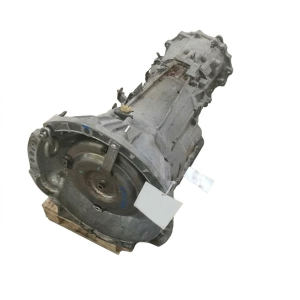
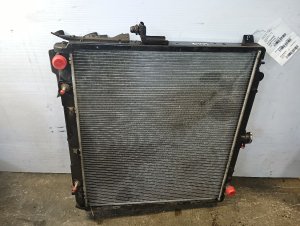
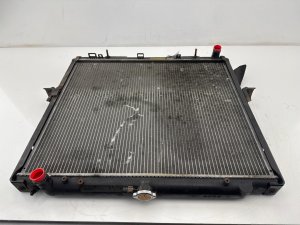

New Aftermarket Parts Available

The information in this article is provided for general reference and educational purposes only. Vehicle specifications, procedures, and part compatibility can vary by production date, trim level, and region. Always consult your vehicle's factory service manual and verify part numbers before purchasing or performing repairs. Safety-critical components such as airbags, seat belts, and braking systems should be installed by a qualified professional.
- Nissan Xterra:
- 🎬 Helpful Videos
- 🛍️ Shop This Part
- What's Unique About the 2005-2015 Nissan Xterra
- Symptoms You May Notice
- Most Likely Causes
- Rare But Worth Checking
- Diagnosis Steps
- Parts You'll Likely Need
- Related Codes That Often Appear With This One
- Technical Service Bulletins (TSBs) & Recalls
- Platform-Specific Known Issues
- Mechanic-Grade Diagnostic Values
- Scan Tool Commands That Help
- Wiring & Ground Locations
- Real Owner Repair Stories
- OEM Part Supersession History
- Model Year Variations Within This Range
- Diagnostic Flowchart
- Other Known Issues on This Vehicle
- Used vs. New Parts: Buying Guide for This Vehicle
- Real Owner Stories
- 2005-2015 Nissan Xterra
- 2005-2010 Nissan Xterra — ~95000 miles
- 2005-2015 Nissan Xterra
- Documented NHTSA Reports
- Nissan Platform Owner Report
- Nissan Platform Owner Report
- Nissan Platform Owner Report
- Related OBD-II Codes
- Frequently Asked Questions
- 🎟️ Get 5% Off