

P0720 on 2007-2019 Nissan Versa: Output Speed Sensor Causes and Fixes
On a 2007-2019 Nissan Versa, code P0720 most often means the external Output Speed Sensor on the transmission has failed. This is a common issue causing erratic shifting, a non-functional speedometer, and limp mode, often after the car has warmed up. Replacing the sensor is a DIY-friendly job, with parts costing between $30 and $150. Be sure to get the correct sensor for your specific transmission (CVT vs. 4-speed automatic).
- P0720 on a Nissan Versa almost always points to a bad Output Speed Sensor.
- Symptoms include a non-working speedometer, harsh shifting, and the car going into 'limp mode'.
- The sensor is located on the outside of the transmission and is held by a single 10mm bolt, making it a relatively easy DIY replacement.
- Unlike some other Nissans, a P0720 code on a Versa is unlikely to be a major internal transmission or TCM failure.
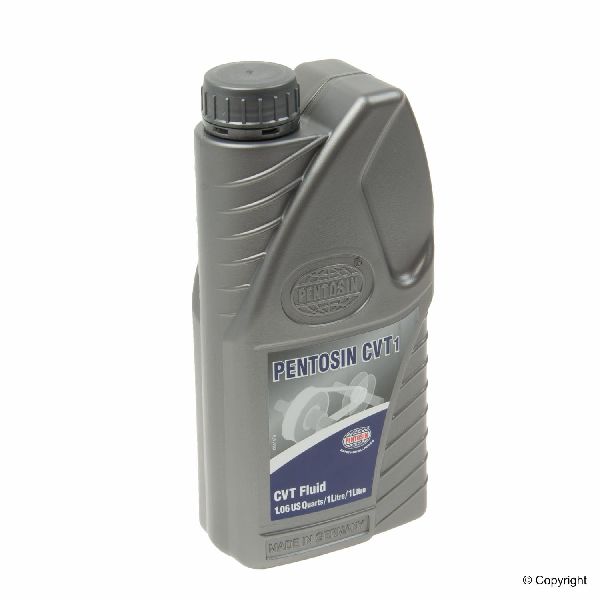
- Always use the correct Nissan-specific CVT fluid (NS-2 or NS-3) if you need to top off the fluid after the repair.
What's Unique About the 2007-2019 Nissan Versa

The Nissan Versa from 2007-2019 used both conventional 4-speed automatic transmissions (model RE4F03B) and, more commonly, Continuously Variable Transmissions (CVT), primarily the Jatco RE0F10A (also known as JF011E) and the later RE0F11A (JF015E). For both types, the P0720 code is very frequently caused by a simple failure of the externally mounted output speed sensor. Unlike some other Nissan models where P0720 points to a more serious internal TCM failure on the valve body, the Versa is more likely to be fixed with a straightforward and inexpensive sensor swap. However, it's crucial to identify which transmission your Versa has, as the exact location and part number of the sensor are different.
Generation note: This range covers the first generation Versa (2007-2012) and the second generation (2012-2019). The first generation offered a 4-speed automatic or a CVT, while the second generation primarily used a CVT. The P0720 code applies to both automatic and CVT models. The most common cause—a failed external speed sensor—is consistent across these generations, though the sensor's specific location on the transmission housing can differ slightly.
Symptoms You May Notice
- Check Engine Light is on.
- Erratic, harsh, or delayed shifting, often described as 'jerking' or 'slipping'.
- Speedometer reads 0 mph or behaves erratically, often after the car warms up.
- Vehicle enters 'limp mode,' resulting in a lack of power and inability to accelerate properly.
- Hesitation or stalling when coming to a stop.
- Cruise control not working.
- Decreased fuel efficiency.
- The 'S' (Sport) or 'O/D Off' light may flash.
- Replacing the input speed sensor instead of the output speed sensor. The transmission has at least two speed sensors; P0720 specifically refers to the output sensor. They often look similar and can be located near each other.
- Condemning the entire transmission. Due to the harsh shifting symptoms, it's easy to assume a major internal failure, but the issue is very often just the inexpensive external sensor.
Most Likely Causes

- Failed Output Speed Sensor 🔴 High Probability The speed sensor is an electronic component exposed to significant heat and vibration on the transmission case, leading to eventual failure. It is the most common point of failure for this code on the Versa, with countless owner reports online confirming this specific failure.
How to confirm: After confirming the code with a scanner, the most practical step is to inspect the sensor and its connector for damage. Given the high failure rate and low cost, many owners and shops proceed with replacement as the primary diagnostic step. If the speedometer drops to zero and shifting becomes harsh after 15-20 minutes of driving, the sensor is almost certainly the culprit. A critical check is to remove the sensor and inspect its magnetic tip for metal shavings; a significant amount of metal indicates a severe internal transmission failure is imminent.
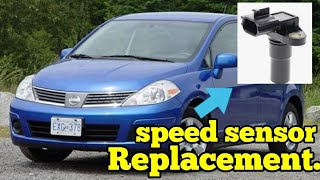
Typical fix: Replace the output speed sensor. It is typically held in by a single 10mm bolt on the exterior of the transmission case. On many models, it is located near the passenger side axle or on the top-rear of the transmission.
Est. part cost: $30-$150 - Damaged Wiring or Connector 🟡 Medium Probability The wiring harness leading to the sensor can be damaged by road debris, heat from the engine, or corrosion, causing a short or open circuit. A manufacturer service bulletin, TSB Bulletin #NTB14019, notes that moisture and/or corrosion present on or around speed sensor pins can trigger P0720.
How to confirm: Visually inspect the wiring harness from the sensor back to the main loom. Check the connector for corrosion, bent pins, or a loose fit. Use a multimeter to test for continuity and proper voltage at the connector.
Typical fix: Repair the damaged section of the wiring harness or clean/replace the connector.
Est. part cost: $5-$50 - Low or Contaminated Transmission Fluid ⚪ Low Probability While less common for causing just a P0720, extremely low or dirty fluid can cause a variety of transmission performance issues, including erratic sensor readings, especially in the sensitive CVT.
How to confirm: Check the transmission fluid level and condition. The fluid should be at the correct level and appear clean (pink/red for conventional automatics, light green/tan for CVT), not dark brown, black, or burnt-smelling.
Typical fix: Perform a transmission fluid drain-and-fill or a full fluid exchange using the correct Nissan-specific fluid (NS-2 or NS-3 for CVTs).
Est. part cost: $50-$200
Rare But Worth Checking
- Failed Transmission Control Module (TCM): While a common cause for P0720 on other Nissan models with different transmissions (like the Titan or those with the 7-speed automatic), it is a much rarer cause for the Versa. This would typically be suspected only after a new sensor and verified wiring fail to resolve the code. On some Nissans, TSBs point to replacing the entire valve body for similar codes, but this is not the standard procedure for a P0720 on a Versa.
Diagnosis Steps

- Scan for Codes: Use an OBD-II scanner to confirm P0720 is present and check for any other related codes.
- Inspect Transmission Fluid: Check the level and condition of the transmission fluid. Low or burnt fluid can indicate other problems that must be addressed.
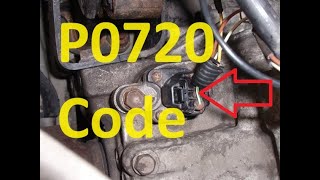
- Locate the Output Speed Sensor: On the Versa, the sensor is on the exterior of the transmission case. Its exact position can vary. For many CVT models, it is on the top/backside of the transmission, accessible from the top after removing the air intake ducting or from underneath near the passenger-side axle. The input and output sensors are often near each other; P0720 is for the output sensor.
- Inspect Sensor and Connector: Check the sensor's electrical connector for corrosion, damage, or loose pins. Inspect the visible wiring for any signs of fraying, melting, or breaks.
- Critical: Inspect for Metal Debris: Remove the sensor (typically one 10mm bolt). Inspect the magnetic tip of the sensor for metal shavings. A fine metallic paste is somewhat normal, but large chips or a thick, gritty accumulation indicates serious internal transmission wear (likely from the CVT belt or pulleys) and means a transmission replacement will be needed soon.
- Test the Sensor (Optional): Using a multimeter, you can test the sensor's resistance. While specific values for the Versa are not consistently published, a typical 2-wire sensor should have a resistance between 560 and 680 Ohms. A reading outside this range or an open circuit indicates a failed sensor.
- Replace the Output Speed Sensor: Given the high probability of sensor failure and its low cost, the most common next step is to replace the sensor. Ensure the old O-ring is removed with the old sensor and that the new sensor clicks into place. Some transmission fluid may leak out, so be prepared to top it off.
- Clear Codes and Test Drive: After replacing the sensor, clear the trouble codes with the scanner and perform a test drive of at least 20-30 minutes to ensure the symptoms and code do not return.
- Test the Circuit (If code returns): If a new sensor does not fix the issue, use a multimeter and a wiring diagram to test the harness for continuity, shorts to ground, and proper voltage from the TCM.
Parts You'll Likely Need
- Transmission Output Speed Sensor
(OEM #31935-1XF00 (for CVT), 31935-8E006 (for 4-speed Auto))— This is the component that fails most frequently, causing the P0720 code and associated symptoms on the Nissan Versa. It is critical to use the correct part number for your specific transmission type (CVT or conventional automatic).
Trusted brands: Hitachi (OEM supplier), NGK/NTK, Beck/Arnley, SKP
OEM price range: $100-$160
Aftermarket price range: $30-$90
Related Codes That Often Appear With This One
- P0715 — This code is for the Input Speed Sensor. If both appear together, it could point to a wiring harness issue common to both sensors or a more significant electrical problem within the transmission or TCM.
- P0500 — This code is a generic Vehicle Speed Sensor Malfunction. Since the output speed sensor's data is used to calculate vehicle speed, a P0720 fault can sometimes trigger a P0500 as well. NHTSA ODI #11115192 describes a vehicle where both P0500 and P0720 were found during inspection.
Technical Service Bulletins (TSBs) & Recalls

- ITB19-040: While this TSB is for other Nissan/Infiniti models, it discusses P0720 and instructs technicians to replace the entire control valve/TCM assembly if the diagnostic points to the output speed sensor. This highlights that on some Nissan platforms the issue is more complex, but for the Versa, this is not the typical failure mode.
- NTB15-037a: This TSB applies to 2012-2015 Versa models and addresses replacing the CVT valve body for a specific list of DTCs (P0720 is NOT on this list). This further corroborates that a P0720 code on a Versa should be diagnosed as a sensor/wiring issue first, not a valve body failure.
- TSB Bulletin #NTB10150A: This bulletin notes that for certain Nissan models without ABS, the MIL may be on with DTC P0720 stored, and instructs technicians to replace the transmission control valve assembly (valve body).
- TSB Bulletin #NTB14019: This manufacturer service bulletin addresses P0720 and related speed sensor codes, specifically advising the removal of moisture from secondary speed sensor pins if corrosion is present.
Platform-Specific Known Issues
- Heat-Soak Failure: A very common owner complaint is that the car drives perfectly fine for 15-20 minutes from a cold start. Once the engine and transmission reach full operating temperature, the speedometer suddenly drops to zero, the Check Engine Light comes on, and the transmission goes into limp mode with harsh shifting. This pattern strongly indicates a failing output speed sensor that becomes faulty when hot.
- Input vs. Output Sensor Confusion: Many DIY repair videos and forum posts highlight the confusion between the input and output speed sensors. They are often located near each other and can look similar. P0720 is for the OUTPUT sensor. Replacing the wrong sensor will not fix the problem. On some models, the output sensor has a 90-degree connector while the input is straight.
Mechanic-Grade Diagnostic Values
- Output Speed Sensor Resistance (2-wire type) — expected: 560 - 680 Ohms. Failure: A reading outside this range, or an open/infinite resistance, indicates a failed sensor.
- Nissan CONSULT-III Scan Tool Data Monitor — expected: The 'VHCL/S SE-A/T' value should increase in response to the 'VHCL/S SE-MTR' value while driving.. Failure: If the 'VHCL/S SE-A/T' value is erratic, zero, or does not correspond to vehicle speed, it points to a fault in the sensor or its circuit.
Scan Tool Commands That Help
- Nissan CONSULT-II / CONSULT-III: DATA MONITOR for A/T — This function is used to observe the live data stream from the transmission's sensors. For P0720, a technician would monitor 'VHCL/S SE-A/T' (Vehicle Speed Sensor A/T) and compare it to the vehicle speed from the meter ('VHCL/S SE-MTR'). A discrepancy confirms the fault is related to the transmission output speed signal received by the TCM.
Real Owner Repair Stories
- Reddit user in r/MechanicAdvice (2009 Nissan Versa Sedan (CVT)) — P0720 code present. Owner could not locate the output speed sensor based on YouTube videos for other models.
❌ Tried (didn't work) Searching for the sensor in the wrong location (e.g., under the starter, as seen in some videos).
✅ What actually fixed it The discussion clarified the sensor on this CVT model is on the backside of the transmission, near the engine, above the passenger side axle. The key diagnostic advice given was that if the user pulls the sensor and finds metal shavings on it, the entire CVT assembly is likely failing and needs replacement. The story highlights the importance of not just replacing the sensor but inspecting it for signs of larger failure. - NHTSA ODI #11652917: An owner reported the vehicle entered limp mode on the highway and would not exceed 40 mph where speeds were around 70 mph, putting them at risk with a code of P0720.
- NHTSA ODI #11683803: An owner described a dangerous situation in traffic where the vehicle could not accelerate normally; a scan revealed a P0720 Speed Sensor Circuit failure, and the dealer advised replacing the valve body assembly.
OEM Part Supersession History
31935-8E002, 31935-8E004→31935-8E006— Part revision and consolidation for 4-speed automatic transmissions.
Heads up: These parts are generally interchangeable for the specified 4-speed automatic applications.31935-1XF00→31935-1XF0C— Part revision for CVT applications.
Heads up: Interchangeable with other numbers like 31935-8E007, 31935-8E005, 31935-X420A. It is critical to verify by VIN as different CVT models (JF011E vs JF015E) may have specific sensor requirements.
Model Year Variations Within This Range
- 2007-2012 (Gen 1) vs 2012-2019 (Gen 2): The first generation offered a 4-speed automatic (RE4F03B) or a CVT (Jatco JF011E). The second generation primarily used a CVT, introducing the newer Jatco JF015E. This means the correct speed sensor part number is highly dependent on the specific transmission installed, not just the model year. The 4-speed auto uses P/N 31935-8E006, while the CVTs use variations of P/N 31935-1XF00.
- 2012+: Later models with the JF015E CVT have three speed sensors: a primary (input), secondary, and output speed sensor. The P0720 code specifically refers to the output sensor. This differs from some earlier transmissions that may only have two sensors.
Diagnostic Flowchart
Other Known Issues on This Vehicle
Issues unrelated to this code that are worth knowing about as an owner of this generation:
- Premature CVT Transmission Failure 🔴 High — Widespread across multiple model years, particularly 2012-2017. Can occur as early as 70,000 miles. Symptoms include shuddering, jerking, whining, and complete failure to accelerate. (Ref: Nissan extended the CVT warranty to 84,000 miles/84 months for many models due to class-action lawsuits.)
- Broken Front Coil Springs 🔴 High — Very common on the first generation (2007-2012), especially in 'salt belt' states. Springs corrode, fracture, and can puncture the tire, causing a sudden loss of air. (Ref: Nissan Recall 15V-573 (Campaigns PM565, PM701) was issued for 2007-2012 models in certain states to replace the front coil springs.)
- Premature Exhaust System Rust/Failure 🟠 Medium — Common across all years. The flanges, particularly between the muffler and mid-pipe, are made of low-quality steel and rust out, causing loud exhaust leaks. Heat shields also frequently rust at the mounting points and rattle.
- Failed Fuel Pump/Pressure Regulator 🟠 Medium — Reported on first-generation models (2007-2011), causing long crank times or a no-start condition. The regulator, integrated with the pump, fails and allows pressure to bleed off.
- Worn Engine Mounts 🟡 Low — The passenger-side engine mount is prone to wearing out, causing excessive vibration in the cabin, especially when stopped in gear.
Used vs. New Parts: Buying Guide for This Vehicle
When a used part is the smart pick: For this repair, buying a used speed sensor is NOT recommended. It is a relatively low-cost electronic part that fails from heat and age. A used sensor from a junkyard has unknown history and could fail quickly, forcing you to do the labor twice. The risk does not justify the minimal cost savings.
What to inspect on the donor part:
- Not applicable, as used purchase is not advised.
OEM-only on this vehicle (don't cheap out):
- While not strictly OEM-only, using a high-quality sensor is critical for the sensitive CVT. OEM (Nissan) or the original equipment supplier (Hitachi) are the safest bets. Low-quality aftermarket sensors are a common source of repeat failures.
Aftermarket brands forum-validated for this vehicle:
- Hitachi (often the OEM supplier)
- NGK/NTK
- Beck/Arnley
- Delphi
Brands owners have reported issues with on this vehicle:
- Generic, unbranded sensors from online marketplaces should be avoided. While they may be cheap, they have a high failure rate and can cause driveability issues that are difficult to diagnose, leading you to suspect other, more expensive components.
Real Owner Stories
Aggregated from forums and TSBs cited above. Mileages and costs reflect what owners reported in those sources.
2007-2019 Nissan Versa
Symptoms: The car drives perfectly fine for 15-20 minutes from a cold start. Once the engine and transmission reach full operating temperature, the speedometer suddenly drops to zero, the Check Engine Light comes on, and the transmission goes into limp mode with harsh shifting.
What fixed it: Replacement of the external output speed sensor located on the transmission case.
Source hint: vehicle_specific_issues section under 'Heat-Soak Failure'
Nissan Versa
Symptoms: P0720 code present; owner confirmed the heat-soak failure pattern where symptoms appear only after the vehicle is warmed up.
What fixed it: Replacing the output speed sensor.
Source hint: https://www.nissanversaforums.com/threads/p0720-output-speed-sensor.53881/
Related OBD-II Codes
Frequently Asked Questions
Does TSB NTB15-037a mean I need a new CVT valve body to fix my P0720 code?
Why does my Versa speedometer only stop working after I've been driving for 20 minutes?
I found two sensors that look the same on my transmission; which one is for P0720?
Can I just clean the sensor instead of replacing it?
Is the P0720 issue on my Versa the same as the one on the Nissan Sentra or Cube?
Helpful Videos
![P0720 [ Nissan/Infiniti 7at Automatic Transmission Fix ]](https://img.youtube.com/vi/Hmfrc9_6BME/mqdefault.jpg)
We Have This Part in Stock

The information in this article is provided for general reference and educational purposes only. Vehicle specifications, procedures, and part compatibility can vary by production date, trim level, and region. Always consult your vehicle's factory service manual and verify part numbers before purchasing or performing repairs. Safety-critical components such as airbags, seat belts, and braking systems should be installed by a qualified professional.
- Nissan Versa:
- 🎬 Helpful Videos
- 🛍️ Shop This Part
- What's Unique About the 2007-2019 Nissan Versa
- Symptoms You May Notice
- Most Likely Causes
- Rare But Worth Checking
- Diagnosis Steps
- Parts You'll Likely Need
- Related Codes That Often Appear With This One
- Technical Service Bulletins (TSBs) & Recalls
- Platform-Specific Known Issues
- Mechanic-Grade Diagnostic Values
- Scan Tool Commands That Help
- Real Owner Repair Stories
- OEM Part Supersession History
- Model Year Variations Within This Range
- Diagnostic Flowchart
- Other Known Issues on This Vehicle
- Used vs. New Parts: Buying Guide for This Vehicle
- Real Owner Stories
- 2007-2019 Nissan Versa
- Nissan Versa
- Related OBD-II Codes
- Frequently Asked Questions
- 🎟️ Get 5% Off