

OBD-II Code P0725: Engine Speed Input Circuit Malfunction
What P0725 means, why it triggers, and how to fix it
- Code P0725 indicates the Transmission Control Module (TCM) is missing the engine RPM signal, which it requires to shift gears correctly.
- A faulty Crankshaft Position Sensor (CKP) causes over 70% of P0725 codes, especially when paired with code P0335.
- Do not drive with an active P0725 code; sudden engine stalling poses a severe safety risk and erratic shifting turns a $150 sensor fix into a $3,000 transmission rebuild.
- Always verify battery voltage (12.4V+ off, 13.2-14.5V running) before replacing parts, as low voltage triggers module communication errors that mimic sensor failures.
What Does P0725 Mean?

Code P0725 means the Transmission Control Module (TCM) is not receiving a reliable engine speed (RPM) signal from the Engine Control Module (ECM). The TCM requires this RPM data to shift gears correctly. Without it, the transmission shifts erratically or defaults to limp mode, risking severe internal damage.
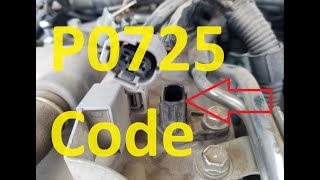
Technical definition: The SAE/OBD-II definition for P0725 is "Engine Speed Input Circuit Malfunction." 🎬 Watch: A quick breakdown of P0725 causes and common fixes. This indicates the TCM detects a fault in the engine speed input signal. The Crankshaft Position Sensor (CKP) generates this signal, the ECM processes it, and sends it to the TCM over the vehicle's CAN bus network.
Can I Drive With P0725?
No — Do Not Drive. Do not drive. Sudden loss of the engine speed signal causes unexpected stalling in traffic, creating a severe safety risk. Continued driving with erratic shifting causes irreversible internal transmission damage (worn clutches, damaged valve body) and overheating, turning a $150 sensor repair into a $3,000+ transmission replacement.
Common Causes

- Faulty Crankshaft Position (CKP) Sensor (Very Common) — The CKP sensor is the primary source for engine RPM data. Internal shorts or heat degradation cause it to fail, making it the most frequent trigger for P0725.
- Damaged Wiring or Connectors (Common) — Engine heat, vibration, or oil leaks melt or corrode wiring in the engine speed circuit. This creates a short or open circuit that severs the signal between the sensor and control modules.
- Unstable System Voltage (Bad Alternator/Battery) (Common) — A weak battery or failing alternator provides unstable voltage to electronic modules. This triggers communication errors between the ECM and TCM, setting P0725 even if all sensors function perfectly.
- Faulty Camshaft Position (CMP) Sensor (Common) — In systems where the CMP sensor provides a secondary engine speed signal, failure creates conflicting data. This confuses the ECM, which then fails to send a valid signal to the TCM.
- Faulty Transmission Control Module (TCM) (Less Common) — The computer module itself fails. This is a well-documented pattern failure on specific Nissan and Infiniti models, where the TCM is integrated into the transmission valve body.
- Faulty Transmission Speed Sensor (Input or Output) (Less Common) — A fault in the transmission's internal speed sensors creates a data mismatch. The TCM interprets this as an engine speed signal problem.
- Damaged or Dirty Reluctor Ring (Rare) — The crankshaft sensor reads teeth on a spinning reluctor ring. Broken teeth or metallic debris prevent the sensor from generating an accurate signal.
- Mechanical Timing Issues (Rare) — A severely stretched timing chain causes crankshaft and camshaft signals to go out of sync, creating implausible data that triggers P0725 alongside timing codes.
Symptoms

- Tachometer Drops to Zero or Jumps Wildly — The RPM gauge on the dashboard behaves erratically or dies completely, directly reflecting the lost signal.
- Erratic or Harsh Shifting — The transmission shifts at the wrong times, slams into gear, or refuses to shift because it lacks RPM data.
- Engine Stalling or Hesitation — The engine stalls when coming to a stop or hesitates during acceleration due to incorrect fuel and timing calculations.
- Vehicle Enters "Limp Mode" — The computer limits engine power and locks the transmission in a single gear (usually 2nd or 3rd) to prevent catastrophic damage.
- Engine Cranks But Won't Start — A complete loss of the crankshaft position signal prevents the ECM from firing spark plugs or injectors, causing a no-start condition.
- Check Engine Light is On (also visible on scanner) — The primary indicator that the vehicle's computer detects a fault in the RPM signal circuit.
Diagnostic Flowchart
Tap your situation to follow the diagnostic path that matches what you're seeing on this code.
Common Fixes & Costs
- Replace Crankshaft Position Sensor
— Parts: $50-$120, Labor: $100-$250, ~1.2 hr book time
(Intermediate)
Nissan Altima (2.5L): OEM 23731-JA00C (Alt: Hitachi CPS0005. OEM is strongly recommended.)
Chevrolet Silverado (5.3L): OEM 12615626 (Alt: ACDelco 213-4573) - Repair Damaged Wiring or Connectors — Parts: $10-$50, Labor: $125-$500, ~2.5 hr book time (Intermediate)
- Replace Camshaft Position Sensor — Parts: $40-$100, Labor: $80-$150, ~0.8 hr book time (DIY)
- Replace Transmission Speed Sensor (Input/Output) — Parts: $25-$100, Labor: $125-$250, ~1.8 hr book time (Intermediate)
- Replace Transmission Control Module (TCM) — Parts: $300-$1000, Labor: $150-$300, ~3 hr book time (Professional)
DIY vs Professional
- Replace Crankshaft/Camshaft Sensor — Beginner: Yes, for accessible sensors.
Tools: Basic socket set, ratchet, screwdrivers. - Repair Damaged Wiring — Beginner: No, unless the damage is obvious and easily accessible.
Tools: Multimeter, wire strippers, crimpers, heat shrink tubing, soldering iron. - Replace Transmission Control Module (TCM) — Beginner: No.
Tools: Specialized J2534 pass-thru device, laptop, manufacturer-specific software subscription, stable power supply.
Used vs. New Parts: Buying Guide
When a used part is worth it: Buying a used crankshaft position sensor is never recommended. It is a common failure item, inexpensive to buy new, and labor-intensive to replace. The risk of a used part failing immediately is too high.
Donor-vehicle mileage cap: roughly under 20000 miles for the part to have meaningful remaining life.
Donor quality checklist:
- If forced to buy used, source from a low-mileage vehicle wrecked for non-engine reasons.
- Avoid parts from rust-belt states due to connector corrosion.
- Match the OEM part number exactly to ensure correct internal calibration.
Decision logic:
- If Vehicle is a Nissan, Infiniti, or other make known for sensor sensitivity. → Buy a new OEM or OEM-supplier (e.g., Hitachi, NTK) part. Do not use cheap aftermarket sensors.
- If The cost of a new OEM sensor is a significant portion of the vehicle's value. → Purchase a high-quality new aftermarket sensor from a reputable brand (e.g., Delphi, Bosch).
- If The sensor is difficult to access with high labor costs. → Always buy the best quality new OEM part available to minimize the risk of paying for labor twice.
Warranty tradeoff: Used parts offer a 30-day warranty at best. New OEM parts carry a 12-month/12,000-mile warranty, providing necessary peace of mind for electronic components.
Worst-case if a used part fails: $200-$400 if a used part fails shortly after installation, requiring repeat labor costs plus the purchase of a new replacement part.
What Happens If You Wait — Timeline
- 0-1 month: Intermittent fault. Check Engine Light turns on and off. Occasional hesitation or a single hard shift occurs when the engine is hot. Tachometer twitches erratically. (MPG impact: 0-5%% · Added cost: $0-50 in wasted fuel.)
- 1-3 months: Fault becomes consistent. Check Engine Light stays on. Harsh shifting is common, and the engine stalls at stops. The vehicle enters 'limp mode' intermittently. (MPG impact: 5-15%% · Added cost: $50-150 in wasted fuel. Minor internal stress begins on transmission clutches.)
- 3-6 months: Severe drivability issues. Vehicle frequently enters limp mode. Constant harsh shifting causes transmission fluid to overheat, accelerating wear on clutch packs and seals. (MPG impact: 15-25%% · Added cost: $300-$800. Risk of needing solenoid or valve body repairs due to fluid degradation.)
- 6+ months: Catastrophic transmission failure. Clutch packs burn out and the valve body sustains damage from excessive heat and stress. The vehicle will not move. (MPG impact: >25%% · Added cost: $3,000-$6,000+. Requires a complete transmission rebuild or replacement.)
Cost of Not Fixing It
- 0-1 Month: Immediate safety risk from unexpected stalling in traffic. Noticeable drop in fuel economy and poor engine performance. (Added cost: $50-$100 in wasted fuel.)
- 1-6 Months: Increased stress on transmission components due to harsh shifting. Transmission fluid overheats and degrades, causing accelerated wear on internal clutches. (Added cost: $300-$800 for valve body or solenoid repairs.)
- 6+ Months: Catastrophic transmission failure. Worn-out clutch packs and a damaged valve body require a complete transmission rebuild. (Added cost: $3,000-$6,000+)
Diagnosis Steps
- Read Trouble Codes & Review Freeze Frame Data
Use an OBD-II scanner to confirm P0725. Look for related codes like P0335 (Crankshaft Sensor), P0700 (TCM), P0720 (Output Speed Sensor), or U1000 (Communication Error). Analyze the freeze frame data to see the vehicle's RPM and speed when the code set.
Tools: OBD-II Scanner (Beginner) - Analyze Live Sensor Data (RPM)
Using an advanced scanner, monitor the Engine RPM PID while cranking the engine. A healthy CKP circuit shows a steady reading between 100-500 RPM. A reading of 0 RPM confirms a hard fault in the engine speed input circuit.
Tools: Advanced OBD-II Scanner (Intermediate) - Check Battery and Charging System
Ensure the battery is fully charged (>12.4V engine off) and the alternator outputs 13.2-14.5V running. Low or fluctuating voltage causes module communication errors that mimic sensor failure.
Tools: Multimeter (Beginner) - Visually Inspect Wiring and Connectors
Inspect the wiring harnesses for the crankshaft sensor, camshaft sensor(s), and main ECM/TCM connectors. Look for burnt insulation, corrosion, loose pins, or rodent damage near hot exhaust components.
Tools: Flashlight, Inspection Mirror (Intermediate) - Perform Wiring Harness 'Wiggle Test'
With the engine running and live data on screen, carefully wiggle the wiring harness and connectors for the CKP sensor. If the RPM signal drops out during the test, you have located an intermittent open or short in the wiring.
Tools: Advanced OBD-II Scanner, Heat-Resistant Gloves (Intermediate) - Test CKP Sensor Internal Resistance (Inductive Sensors)
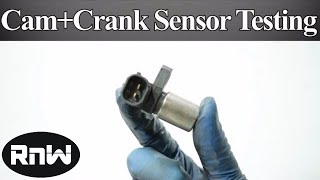
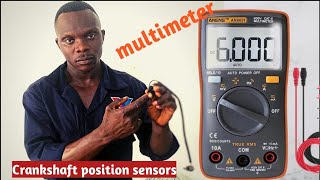
For 2-wire inductive sensors, disconnect the sensor and measure resistance across the two pins. A healthy sensor reads 200-1000 Ohms. A reading of 0 Ohms (short) or OL (open circuit) means the sensor has failed.
Tools: Multimeter, Service Manual (Advanced) - Test CKP Sensor Voltage (Hall-Effect Sensors)
For 3-wire Hall-effect sensors, back-probe the connector with the key on. Verify 5V or 12V reference voltage on the power wire and continuity to ground. The signal wire must pulse between 0V and reference voltage as the engine is cranked by hand.
Tools: Multimeter, Back-probe Kit, Wiring Diagram (Advanced) - Test the CKP Sensor with an Oscilloscope
Back-probe the sensor's signal wire with an oscilloscope. A healthy Hall-effect sensor produces a clean square wave; an inductive sensor produces a sine wave. A noisy, misshapen, or flat-lined waveform confirms sensor failure.
Tools: Oscilloscope, Back-probe Kit, Wiring Diagram (Advanced) - Inspect the Reluctor Ring
If the sensor and wiring pass all tests, visually inspect the reluctor ring through the sensor mounting hole. Look for broken teeth or metallic debris corrupting the magnetic signal.
Tools: Flashlight, Borescope (Advanced)
When This Code Triggers (Freeze-Frame Conditions)
- RPM: 0 or Erratic Value (The TCM records an RPM of 0 or an irrational value, while the actual engine RPM was in a normal driving range (e.g., 1500-2500 RPM).)
- Engine Coolant Temp: 180-205°F (The fault frequently occurs when the engine is fully warmed up and in closed-loop operation, as heat exacerbates electrical resistance.)
- Vehicle Speed: 35-55 mph (The code sets during steady-state cruise or light acceleration when there is a clear mismatch between vehicle speed and the reported engine speed.)
- Engine Load: 20-50% (Occurs under light to moderate engine load, rarely during heavy acceleration or deceleration.)
Related Codes
- P0335 — Crankshaft Position Sensor 'A' Circuit Malfunction. P0725 is a direct symptom of P0335. The ECM sets P0335 when it loses the CKP signal, causing the TCM to set P0725. Diagnose P0335 first.
- P0700 — A general fault code from the TCM indicating it stored a specific fault (like P0725) and requested the Check Engine Light. Focus all diagnosis on the P0725 code.
- P0720 — Output Speed Sensor Circuit Malfunction. If the output shaft shows speed but engine RPM is zero, the fault lies with the engine speed input circuit (P0725).
- U1000 — CAN Communication Error. When paired with P0725 on Nissan/Infiniti vehicles, it strongly suggests a failed TCM rather than a sensor issue.
- P0726 — Engine Speed Input Range/Performance. While P0725 indicates a complete loss of signal, P0726 suggests the signal is present but irrational or erratic.
Climate & Environmental Factors
- High Temperature: Engine bay heat is a primary cause of CKP sensor failure. High temperatures increase electrical resistance, exposing failing sensors or wires, and melt plastic housings.
- Cold Temperature / Humidity: Moisture condenses inside sensor connectors or cracked housings, leading to corrosion or short circuits. Extreme cold makes plastic and wiring brittle and prone to cracking.
How to Talk to a Mechanic About This Code
Say this: "I have a check engine light with a P0725 code. My symptoms are erratic shifting and the tachometer dropping to zero. I'd like to schedule a diagnostic. Please start by checking the live RPM data from the crankshaft sensor, inspecting the wiring harness, and verifying battery voltage before recommending part replacements."
This guides the technician toward a logical diagnostic process. It requests specific, verifiable tests (live data, voltage check) and prevents them from replacing the CKP sensor without confirming it is the actual point of failure.
Avoid saying:
- 'My car is acting weird, can you fix it?' (Too vague, invites an expensive diagnostic process)
- 'I think I need a new crankshaft sensor.' (Leads them to replace the part without proper diagnosis, wasting money if the sensor isn't the problem)
- 'Just do whatever it takes to fix it.' (Gives the shop a blank check)
Questions to ask before authorizing the repair:
- What were the results of the live data test for engine RPM? Did the signal drop out?
- Did you perform a 'wiggle test' on the wiring harness? Was it stable?
- If recommending a sensor replacement, what tests confirmed the old sensor was bad?
- If the repair is for a wiring issue, can you show me the damaged section?
- What is the warranty on the parts and labor for this repair?
Where to Take It: Dealer vs Independent vs Chain
- Dealer:
Recommended for warranty work or Nissan/Infiniti TCM failures. Overkill and overpriced for straightforward sensor or wiring issues.
Best for: Vehicles still under powertrain warranty., Known manufacturer-specific quirks, like TCM failure on Nissans/Infinitis., When complex module replacement and programming is required.
Downsides: Highest labor rates, typically 1.5x to 2x more than independent shops., May recommend complete module replacement when a simpler wiring repair is possible. (Typical cost: +50% vs. baseline) - Independent Shop:
Best fit for most P0725 scenarios. A good independent mechanic easily diagnoses and repairs common causes at a reasonable price.
Best for: Out-of-warranty vehicles where cost is a primary concern., Standard diagnosis and replacement of crankshaft position sensors or wiring repairs., Vehicles without known complex module issues.
Downsides: Quality varies greatly. Vet the shop by checking for ASE certifications., May lack specialized tools needed for module programming on certain brands. (Typical cost: +0% vs. baseline) - Chain Shop:
Use with caution. Acceptable for a simple sensor replacement if you are certain that is the problem. Avoid for initial diagnosis or intermittent electrical problems.
Best for: Getting a second opinion on a quote., Checking battery and alternator output.
Downsides: Technician skill and experience is inconsistent., Focused on high-volume jobs and lacks deep diagnostic expertise for electrical issues., High pressure to upsell services. (Typical cost: -10% vs. baseline)
When to Walk Away From the Repair
If the estimated repair cost exceeds 50% of the car's private-party value, seriously consider selling or trading it in.
- Car worth $4000, fix is $350: Fix it. This is a standard repair cost and well below the threshold.
- Car worth $4000, fix is $1800: Borderline. This repair (likely a TCM) is a significant portion of the car's value. Get a second opinion before proceeding.
- Car worth $2500, fix is $1800: Walk away. The repair costs nearly 75% of the car's value. It is not a sound financial decision.
What Scan Tool You Need for This Code

Minimum: A scanner that reads and graphs live data, specifically the Engine RPM PID.
A basic $20 code reader only tells you P0725 is present. It cannot show the live engine RPM signal. Without live data, you cannot tell if the signal drops out intermittently or is completely gone, leaving you to guess the cause.
Budget: BlueDriver Pro or Foxwell NT301 (~$100) — Reads codes, clears them, and displays live data streams. You can graph the Engine RPM to watch for dropouts or erratic behavior during a wiggle test.
Mid-range: Autel MaxiCOM MK808S or Innova 5610 (~$300) — Offers a faster processor, detailed user interface, and access to manufacturer-specific codes for the TCM, ABS, and SRS modules.
Professional: Autel MS906 Pro or LAUNCH X431 Series (~$600-1200) — Professional-grade tools with bidirectional control. Invaluable for complex cases involving TCM failures, as they perform coding or programming functions.
Rent vs buy: Auto parts stores scan codes for free, but their tools do not offer live data. If diagnosing the issue yourself, you must have a tool with live data capabilities, making a budget pick like BlueDriver a worthwhile investment.
How to Clear the Code After You Fix It
- Use an OBD-II scan tool to clear diagnostic trouble codes.
- Ensure the fuel tank is between 25% and 75% full.
- Perform a complete OBD-II drive cycle to allow readiness monitors to run.
Drive cycle (~30 minutes): Cold start and idle for 3 minutes. Drive at a steady 25-35 mph for 5 minutes. Drive at a steady highway speed (55-65 mph) for 15 minutes. Perform smooth coast-downs without braking. Idle in Drive for 2 minutes before shutting down.
Readiness monitors affected: Catalyst Monitor, Oxygen (O2) Sensor Monitor, EVAP System Monitor, EGR System Monitor
Before emissions retest: drive at least 100 miles to fully set monitors.
Watch out for:
- Clearing the code does not fix the problem; the code returns immediately if the root cause remains.
- Disconnecting the battery clears codes but resets all readiness monitors, requiring a longer drive cycle to pass emissions.
- The EVAP monitor requires specific conditions like an overnight cold soak to set properly.
Will This Fail Emissions / State Inspection?
Yes — this code typically fails an OBD-II emissions inspection.
- California: An active P0725 code with the Check Engine Light on is an automatic failure. After repair, readiness monitors must be complete. A permanent code may remain but will not cause a failure if the light is off and a 200-mile drive cycle is completed.
- New York: The NYS DMV emissions inspection includes an OBD-II scan. An illuminated Check Engine Light for P0725 results in an automatic failure.
- Texas: In the 17 counties requiring emissions testing, a vehicle with an illuminated Check Engine Light fails the OBD-II test, blocking registration renewal.
Most Commonly Affected Vehicles
- Nissan Altima, Maxima, Murano, Rogue, Sentra (2005-2015) — Extremely common. Caused by a failing crankshaft position sensor (P0335 is usually present). Aftermarket sensors are notoriously unreliable; OEM or Hitachi-branded parts are mandatory.
- Infiniti G37, QX56, FX35 (2008-2013) — Frequently appears with code U1000 (CAN Communication Error). The root cause is a faulty TCM located inside the transmission valve body, requiring expensive replacement.
- Chevrolet Silverado, Colorado, Malibu (2007-2014) — Often caused by a faulty crankshaft position sensor or a wiring harness that chafes through its insulation near the engine block or transmission bellhousing.
- Ford F-150, Focus, Fusion (2004-2015) — On F-150s, CKP sensor wiring is prone to heat damage from the exhaust. On Focus and Fusion models, corrosion in main harness connectors causes intermittent signal loss.
- Chrysler/Dodge/Jeep 300, Charger, Grand Cherokee (2005-2014) — On vehicles with the NAG1 5-speed transmission, P0725 is caused by a failed conductor plate housing the speed sensors inside the transmission.
- Hyundai i20, Verna, Elantra (2010-2016) — Typically traced back to a faulty crankshaft position sensor or damage to its wiring harness. A stretched timing chain is a contributing factor on higher-mileage engines.
- Honda Accord, Civic, CR-V (1995-2012) — On 1995-2007 V6 models, a fluctuating tachometer and P0725 are caused by a faulty resistor inside the ignition coil assembly. Later models experience standard CKP sensor failures.
- Subaru Legacy GT, Outback (2005-2009) — Triggered by intermittent alternator failure causing voltage drops during high electrical load, which confuses the control modules.
Manufacturer-Specific Notes

- Nissan/Infiniti: P0725 accompanied by U1000 is a strong indicator of a failing TCM integrated into the valve body. Additionally, Nissan engines are highly sensitive to aftermarket crankshaft sensors; using OEM or Hitachi sensors is critical for a lasting repair.
- Honda: On 1995-2007 Accord and Odyssey V6 models, a fluctuating tachometer and P0725 are caused by a faulty internal resistor within the ignition coil assembly, disrupting the RPM signal sent to the TCM.
- Chrysler/Dodge/Jeep: For vehicles with the NAG1 5-speed automatic, P0725 is a common symptom of a failing conductor plate located on top of the valve body, which houses the speed sensors.
- Ford: A common failure point is the wiring connector rather than the sensor itself. Connectors become brittle from heat cycles, allowing moisture intrusion and pin corrosion.
Real Owner Stories
2013 Nissan Altima at 110K miles
Check engine light illuminated, car hesitated and stalled at stoplights. Tachometer acted erratically. Codes P0725 and P0335 were present.
What they tried:
- Replaced the camshaft position sensor based on a friend's advice, but the problem persisted.
- Took it to a mechanic who diagnosed a faulty crankshaft position sensor.
Outcome: Replaced the crankshaft position sensor with an OEM Hitachi part for $250. The car immediately ran smoothly, and the codes did not return.
Lesson: When P0725 pairs with P0335, the crankshaft position sensor is the culprit. On Nissans, using an OEM or Hitachi sensor is mandatory to avoid premature failure.
2008 Infiniti G37 at 95K miles
Vehicle randomly entered 'limp mode,' locking the transmission in 3rd gear. Codes P0725 and U1000 (CAN Communication Error) were active.
What they tried:
- A general repair shop replaced the crankshaft sensor, but the issue returned within a week.
- Owner researched forums and found the P0725/U1000 combination is a known pattern failure.
Outcome: An Infiniti specialist diagnosed a failed Transmission Control Module (TCM) inside the valve body. Replacing the valve body assembly cost $1,500 and permanently fixed the problem.
Lesson: On Nissan and Infiniti vehicles, P0725 paired with a U-code (like U1000) points directly to a faulty TCM, not a sensor. Seek a brand specialist for diagnosis.
1997 Honda Accord V6 at 160K miles
Tachometer fluctuated wildly or dropped to zero, triggering code P0725. The car otherwise ran and shifted normally.
What they tried:
- AutoZone scan suggested a bad vehicle speed sensor, but the speedometer worked perfectly.
- Owner found a forum post describing this exact issue on older Honda V6 models.
Outcome: The problem was a faulty resistor inside the ignition coil assembly. The owner replaced the entire ignition coil (Part #30520-P0G-A02), fixing the tachometer and clearing the code.
Lesson: On 1995-2007 Honda V6s, the tachometer signal routes through the ignition coil. A failing internal resistor disrupts this signal and triggers P0725.
2006 Chevy Silverado at 140K miles
Intermittent harsh shifting and a standalone P0725 code. The truck ran fine otherwise.
What they tried:
- Mechanic performed a 'wiggle test' on the wiring harness while monitoring live data.
- The RPM signal dropped out when the harness near the transmission bellhousing was moved.
Outcome: A section of the crankshaft sensor wiring harness rubbed through its insulation against a bracket. The mechanic repaired the wires and secured the harness for $180.
Lesson: Intermittent issues are frequently caused by wiring chafing. A simple visual inspection and 'wiggle test' saves the cost of replacing a perfectly good sensor.
How to Prevent This Code From Triggering
- Protect wiring harnesses from heat. (During any under-hood maintenance.) — Engine heat is a primary cause of sensor failure and wire insulation breakdown. Inspect harnesses near the exhaust and add high-temperature wire loom if factory protection is worn.
- Maintain a healthy electrical system. (Annually.) — A failing battery or alternator causes low voltage, leading to erratic behavior and communication errors in control modules that mimic sensor failure. Keep battery terminals clean.
- Keep the engine bay clean. (As needed.) — Oil and fluid leaks degrade wiring insulation and sensor housings over time. A clean engine bay prevents contaminants from destroying electrical connections.
Frequently Asked Questions
What is the most common misdiagnosis for P0725?
The most common mistake is immediately replacing the crankshaft sensor without testing. Technicians must first verify stable system voltage, as a bad alternator mimics sensor failure. Inspecting wiring and checking for a damaged reluctor ring prevents unnecessary part replacements.
Can a bad battery cause a P0725 code?
Yes. A weak battery provides low voltage during engine cranking, causing communication glitches between the ECM and TCM. Always ensure your battery reads above 12.4V before diagnosing sensors.
Does it matter if I use an aftermarket or OEM crankshaft sensor?
Yes, using an OEM or high-quality OEM-equivalent sensor (like Hitachi for Nissan) is critical. Cheap aftermarket sensors frequently fail out of the box or provide incorrect signals. Spending extra on an OEM sensor prevents diagnosing the same problem twice.
Can P0725 cause my engine to not start?
Yes. The crankshaft position sensor's signal dictates spark and fuel injection timing. If the sensor fails completely, the ECM receives no RPM signal and prevents the engine from starting.
My car has P0725 but seems to drive fine. Should I still get it checked?
Yes. The fault is likely intermittent but will worsen rapidly. Ignoring it risks a sudden engine stall in traffic or the transmission entering limp mode without warning.
Will replacing the crankshaft sensor definitely fix a P0725 code?
Not necessarily. While a faulty crankshaft sensor is the most common cause, damaged wiring, an unstable alternator, or a bad control module also trigger this code. Proper diagnosis prevents wasting money on unnecessary parts.
What is a reluctor ring and how does it fail?
A reluctor ring is a toothed wheel that spins with the crankshaft to generate the RPM signal. Failures occur when teeth break off from debris impact or the ring comes loose on the crankshaft. This corrupts the sensor's reading and triggers P0725.
I got a P0725 code right after my transmission was replaced. What could be the cause?
The crankshaft position sensor or its wiring was likely damaged during the transmission installation. Alternatively, the reluctor ring inside the replacement transmission is damaged or incompatible with your vehicle's electronics. Return to the shop that performed the work.
Key Takeaways
- Code P0725 indicates the Transmission Control Module (TCM) is missing the engine RPM signal, which it requires to shift gears correctly.
- A faulty Crankshaft Position Sensor (CKP) causes over 70% of P0725 codes, especially when paired with code P0335.
- Do not drive with an active P0725 code; sudden engine stalling poses a severe safety risk and erratic shifting turns a $150 sensor fix into a $3,000 transmission rebuild.
- Always verify battery voltage (12.4V+ off, 13.2-14.5V running) before replacing parts, as low voltage triggers module communication errors that mimic sensor failures.
Helpful Videos


The information in this article is provided for general reference and educational purposes only. Vehicle specifications, procedures, and part compatibility can vary by production date, trim level, and region. Always consult your vehicle's factory service manual and verify part numbers before purchasing or performing repairs. Safety-critical components such as airbags, seat belts, and braking systems should be installed by a qualified professional.
- 🎬 Helpful Videos
- What Does P0725 Mean?
- Can I Drive With P0725?
- Common Causes
- Symptoms
- Diagnostic Flowchart
- Common Fixes & Costs
- DIY vs Professional
- Used vs. New Parts: Buying Guide
- What Happens If You Wait — Timeline
- Cost of Not Fixing It
- Diagnosis Steps
- When This Code Triggers (Freeze-Frame Conditions)
- Related Codes
- Climate & Environmental Factors
- How to Talk to a Mechanic About This Code
- Where to Take It: Dealer vs Independent vs Chain
- When to Walk Away From the Repair
- What Scan Tool You Need for This Code
- How to Clear the Code After You Fix It
- Will This Fail Emissions / State Inspection?
- Most Commonly Affected Vehicles
- Manufacturer-Specific Notes
- Real Owner Stories
- 2013 Nissan Altima at 110K miles
- 2008 Infiniti G37 at 95K miles
- 1997 Honda Accord V6 at 160K miles
- 2006 Chevy Silverado at 140K miles
- How to Prevent This Code From Triggering
- Frequently Asked Questions
- What is the most common misdiagnosis for P0725?
- Can a bad battery cause a P0725 code?
- Does it matter if I use an aftermarket or OEM crankshaft sensor?
- Can P0725 cause my engine to not start?
- My car has P0725 but seems to drive fine. Should I still get it checked?
- Will replacing the crankshaft sensor definitely fix a P0725 code?
- What is a reluctor ring and how does it fail?
- I got a P0725 code right after my transmission was replaced. What could be the cause?
- Key Takeaways
- 🎟️ Get 5% Off