

P0707 on 2014-2017 Mazda 6: Transmission Range Sensor Circuit Low Causes and Fixes
P0707 on a 2014-2017 Mazda 6 most often means the Transmission Range Sensor (TRS) has failed or its wiring is corroded. This part is on top of the transmission, and replacement by a DIYer is moderately difficult. Expect to pay $50-$150 for the part, with the OEM part number being FW21-21-444.
- P0707 on your Mazda 6 means the Transmission Range Sensor (TRS) circuit has a low voltage fault, which is most often caused by a bad sensor or corroded wiring.
- Do not drive the vehicle, as it can get stuck in gear, fail to start, or shift unpredictably, creating a safety risk.
- The sensor is located on top of the transmission and requires removing the battery and battery tray to access it.
- Before replacing the sensor, always inspect its electrical connector and wiring for corrosion or damage, as this is a common and cheaper fix.
- Due to the diagnostic steps and labor involved in accessing the part, professional service is recommended unless you are an experienced DIYer.
What's Unique About the 2014-2017 Mazda 6
The 2014-2017 Mazda 6 uses the Skyactiv-Drive FW6A-EL automatic transmission. On this specific platform, the Transmission Range Sensor (TRS) is mounted externally on top of the transmission housing. This location makes it somewhat vulnerable to moisture and corrosion from the elements, which can damage the sensor or its electrical connector over time. Accessing the sensor requires removing the battery and its tray, making what could be a simple sensor swap a more involved job.
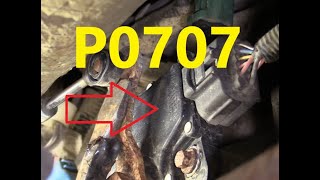
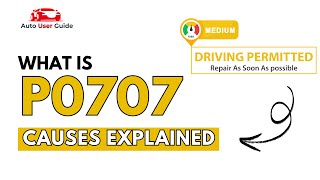
Symptoms You May Notice 🎬 Watch this overview of P0707 causes and fix options
- Check Engine Light and/or the 'AT' (Automatic Transmission) warning light is on
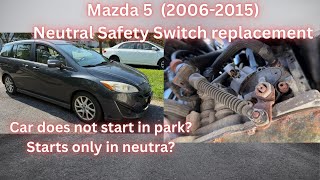
- Vehicle will not start, or only starts in Neutral
- Inability to shift the lever out of Park
- Incorrect gear position displayed on the instrument panel
- Harsh or delayed gear engagement
- Transmission is stuck in 'limp mode' (usually 3rd gear)
- Reverse lights do not turn on
- Sudden stalling when shifting into Drive or Reverse.
- Replacing the transmission valve body or entire transmission when the issue is a simple external sensor or wiring problem.
- Replacing the shifter assembly inside the car; the P0707 code refers to the sensor on the transmission itself, not the in-cabin shifter components. A faulty shifter park switch can cause a no-start but typically sets different codes.
Most Likely Causes
- Failed Transmission Range Sensor (TRS) 🔴 High Probability The sensor is an electronic component exposed to engine bay heat and vibration, and can fail internally over time. Water intrusion into the sensor housing is a common failure mode, causing an internal short.
How to confirm: After confirming the wiring is intact, test the sensor's output voltage with a multimeter while an assistant moves the gear selector. If the voltage is consistently below spec (e.g., <0.5V) or doesn't change correctly, the sensor is bad.
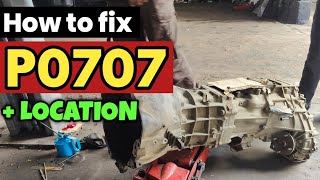
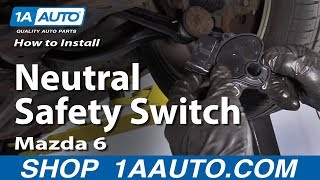
Typical fix: Replace the Transmission Range Sensor. This requires removing the battery and battery tray to access the sensor on top of the transmission. The OEM part number is FW21-21-444. 🎬 See how to replace the transmission range sensor on a Mazda
Est. part cost: $50 - $150 - Corroded or Damaged Wiring/Connector 🟡 Medium Probability The sensor's location on top of the transmission exposes the wiring harness and connector to moisture, road grime, and heat, which can lead to corrosion (green/white powder), frayed wires, or loose pins.
How to confirm: Visually inspect the wiring harness and the electrical connector at the sensor for green/white corrosion, chafed insulation, or bent/broken pins. Perform a continuity test on the wires between the sensor and the Transmission Control Module (TCM) to check for an open or a short to ground.
Typical fix: Clean the connector terminals with electrical contact cleaner and apply dielectric grease. If wiring is damaged, repair the specific wire or replace the connector pigtail.
Est. part cost: $10 - $50 - Misadjusted Transmission Range Sensor ⚪ Low Probability The sensor's position is adjustable and can be knocked out of alignment, though this is uncommon unless it was recently replaced incorrectly or the mounting bolts have loosened.
How to confirm: Use a scan tool to view the live data for the TRS. Ensure the gear position displayed by the scan tool matches the physical gear selector position for all gears. When installing, there are alignment marks on the sensor and the transmission housing that must line up when the vehicle is in Neutral.
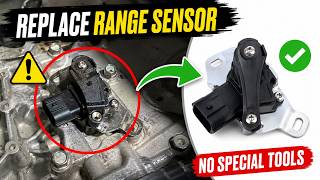
Typical fix: Loosen the sensor's mounting bolts and rotate it slightly until it is properly aligned in the Neutral position. 🎬 Watch a step-by-step guide on replacing a range sensor This often requires an alignment pin or specific service manual procedure.
Est. part cost: $0
Rare But Worth Checking
- Faulty Powertrain or Transmission Control Module (PCM/TCM): This is a very rare cause. The module's internal circuit that reads the sensor voltage can fail. This should only be considered after the sensor and wiring have been exhaustively proven to be good through testing.
- Damaged Shift Linkage: Physical damage to the shift cable or linkage connecting the shifter to the transmission could prevent the sensor from rotating correctly, though this is uncommon.
Diagnosis Steps
- Connect an OBD-II scanner to confirm P0707 is the active code and check for any other transmission-related codes.
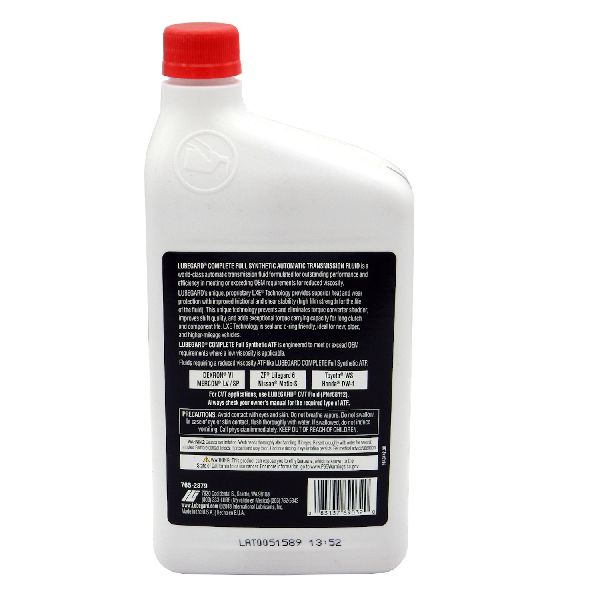
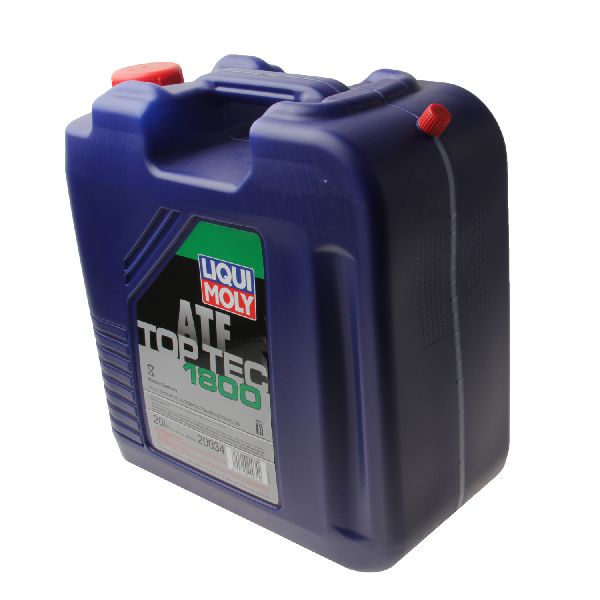
- Check the level and condition of the transmission fluid (Mazda ATF-FZ). While unlikely to be the direct cause, low or burnt fluid indicates other transmission problems.
- Disconnect the battery.
- Remove the engine air intake snorkel, the battery, and the battery tray to gain access to the Transmission Range Sensor, which is located on top of the transmission housing.
- Perform a thorough visual inspection of the TRS connector and its wiring harness. Look for any signs of corrosion, water damage, chafing, or loose pins.
- If the wiring looks good, reconnect the battery. Use a multimeter set to DC volts to back-probe the signal wire at the sensor's connector. The voltage should change as the gear selector is moved. A reading that is consistently below 0.5V confirms a low input condition.
- If the voltage is low at the sensor, disconnect the sensor and check for the proper reference voltage being supplied to the sensor from the TCM. If reference voltage is present, the sensor is faulty.
- If reference voltage is not present, the problem lies in the wiring between the TCM and the sensor, or a faulty TCM (rare).
- If a new sensor is installed, ensure it is correctly aligned (match marks in Neutral) before tightening the mounting bolts.
Parts You'll Likely Need
- Transmission Range Sensor
(OEM #FW21-21-444)— This sensor is the most common point of failure for the P0707 code, either due to internal electronic failure or damage from its exposed location.
Trusted brands: Mazda (OEM), Dorman, Standard Motor Products (SMP)
OEM price range: $100-$180
Aftermarket price range: $50-$120
Technical Service Bulletins (TSBs) & Recalls
- TSB 05-002/19: This TSB addresses a 'whining noise from the automatic transaxle' due to a damaged bearing and is NOT directly related to code P0707. It involves replacing the entire transaxle assembly on affected vehicles, which include the 2014-2017 Mazda 6. No specific TSB for P0707 on this model was found.
Platform-Specific Known Issues
- Owner Experience with No-Start: A user on a Mazda forum with a 2014 Mazda 6 experienced a no-start condition with the AT light on. After confirming the battery and starter were good, the issue was traced to a faulty transmission range sensor. Replacement of the sensor resolved the issue.
- Water Intrusion Reports: Multiple owners of vehicles with the FW6A-EL transmission have noted that water can drip onto the top of the transmission, potentially accelerating corrosion of the TRS connector and sensor housing. Applying dielectric grease to the connector during replacement is highly recommended.
Mechanic-Grade Diagnostic Values
- Transmission Range Sensor 'A' Circuit Voltage — expected: A distinct voltage for each gear position, with all readings above 0.5V. Example values might be Park: 3.1V, Reverse: 2.7V, etc.. Failure: A consistent voltage reading below 0.5V regardless of gear position.
- Transmission Range Sensor Resistance (Bench Test) — expected: Continuity/resistance should change for each gear position as the selector is moved. Specific ohm values are not published, but there should be a clear change between selections, not an open (OL) or shorted (near zero) reading across all positions.. Failure: No change in resistance when the sensor is moved through its range, or a consistent Open Loop (OL) reading.
Scan Tool Commands That Help
- Mazda IDS (Integrated Diagnostic System): TR Sensor Test — This is a specific self-test function within the dealer-level software that can help verify the functionality of the transmission range sensor circuit.
- Professional Bidirectional Scanner: Live Data - Shift Lever Switch / Current Gear — To verify if the TCM's perceived gear position matches the physical gear selector. A mismatch while the sensor voltage is low points directly to a fault in the TRS circuit.
- Mazda IDS or equivalent: Initial Learning Procedure / Clear Transmission Adaptive Tables — After replacing transmission components like the sensor or valve body, this procedure is sometimes required to reset the transmission's learned shift points and ensure smooth operation.
Wiring & Ground Locations
- Transmission Main Ground — A ground wire or strap bolted directly to a bracket on top of the transmission housing, often near the sensor itself.. A poor ground at this location can cause a floating ground reference for the TRS, leading to incorrect and low voltage readings that trigger P0707.
- Chassis Ground Near Battery — Under or near the battery tray, there are several large ground cables bolted directly to the chassis/frame.. Since the TRS is accessed by removing the battery and tray, this primary ground point is often disturbed. Failure to properly clean and tighten it upon reassembly can cause a host of electrical issues, including this code.
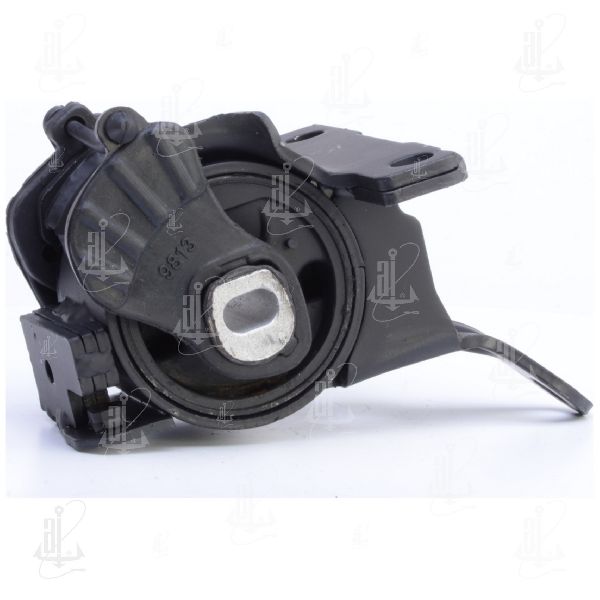
- Passenger Motor Mount Ground — A ground strap is often located on or near the passenger-side motor mount.. This provides a key ground path for the engine/transmission assembly to the chassis. Corrosion or looseness here can contribute to intermittent and hard-to-diagnose electrical faults.
Real Owner Repair Stories
- YouTube video on a Mazda 6 with similar symptoms (Mazda 6 (generation unspecified, but with external TRS)) — Gear indicator on dash not matching the selected gear, delayed engagement.
❌ Tried (didn't work) The owner was about to replace the transmission range sensor.
✅ What actually fixed it The mechanical shift cable connecting the shifter to the transmission lever was rusted and binding. This prevented the lever on the transmission from moving fully into position, so the TRS could not report the correct gear. Freeing up the seized cable resolved all symptoms without replacing any electronic parts. - Ford F-150 Forum thread (2016 Ford F-150 with 54,000 miles (different vehicle, but identical codes and diagnostic logic)) — No-start condition, no gear indicator on dash, codes P0706 and P0707 appeared instantly after clearing.
❌ Tried (didn't work) Clearing codes., Disconnecting the battery for 30 minutes.
✅ What actually fixed it The dealership initially blamed a damaged external wiring harness for $500. The owner questioned this. The final repair was replacing the transmission's internal lead frame assembly, which contains the range sensor on that model. The issue was the connector on the lead frame itself. This highlights that even when an external sensor is the most likely cause, the fault can be at the other end of the circuit.
OEM Part Supersession History
FW21-21-444→FW61-21-444 (potentially)— Part evolution and consolidation.
Heads up: Part number FW61-21-444 is listed for older models like the Tribute and 626, and also shows it replaces 'fwtt21444'. Another number, FN01-21-444, also exists for 'inhibitor switch'. There is potential for part number confusion. It is critical to verify the correct part number for the 2014-2017 Mazda 6 using the vehicle's VIN with a dealer or reliable parts catalog before ordering.
Diagnostic Flowchart
Other Known Issues on This Vehicle
Issues unrelated to this code that are worth knowing about as an owner of this generation:
- Infotainment System Rebooting/Freezing 🟡 Low — Common issue across this generation. Often caused by a faulty navigation SD card or outdated software. (Ref: No recall, but software updates are available from dealers. Many owners report that removing the navigation SD card resolves the rebooting loop.)
- Transmission Whining Noise 🟠 Medium — Affects some vehicles, noticeable at speeds above 10 mph. Caused by a damaged bearing in the transaxle. (Ref: TSB 05-002/19.)
- Carbon Buildup on Intake Valves 🟡 Low — An inherent issue with all Skyactiv-G direct injection engines. Becomes more noticeable at higher mileage (60k+ miles) and can cause reduced performance or rough idle. (Ref: No TSB, as it's considered a maintenance item. Regular cleaning is recommended.)
- Sticky/Melting Dashboard 🟡 Low — More common on the previous generation (2009-2013), but some reports exist for early 3rd gen cars in hot, humid climates. The dash surface becomes sticky and shiny. (Ref: Mazda issued a warranty extension program for the 2009-2013 models, but not officially for the 2014-2017 generation.)
- Premature Wheel Bearing Failure 🟠 Medium — A noted common problem where front or rear wheel bearings fail earlier than expected, causing a humming or grinding noise that changes with speed.
Used vs. New Parts: Buying Guide for This Vehicle
When a used part is the smart pick: For this specific repair, buying a used Transmission Range Sensor is NOT recommended. It is a relatively inexpensive electronic component exposed to significant heat and vibration. The risk of getting a part with limited remaining life or one that is already failing is high, and the labor to access it is significant enough that you don't want to do the job twice.
Donor-vehicle mileage cap: roughly under 30000 miles for the part to have meaningful remaining life.
What to inspect on the donor part:
- If buying used is unavoidable, source from a vehicle with the lowest possible mileage.
- Visually inspect the connector pins for any signs of green or white corrosion.
- Ensure the plastic housing is not cracked or showing signs of heat damage/melting.
- Ask for a warranty, even if it's only 30-90 days.
OEM-only on this vehicle (don't cheap out):
- While not strictly OEM-only, using an OEM Mazda sensor is highly recommended for fitment and reliability. The cost difference between OEM and a quality aftermarket part is often minimal compared to the labor involved.
Aftermarket brands forum-validated for this vehicle:
- Standard Motor Products (SMP)
- Dorman (often provides a cost-effective alternative)
Brands owners have reported issues with on this vehicle:
- No-name, unbranded parts from online marketplaces should be avoided due to inconsistent quality control.
Real Owner Stories
Aggregated from forums and TSBs cited above. Mileages and costs reflect what owners reported in those sources.
2014 Mazda 6 L4 2.5L
Symptoms: Vehicle experienced a no-start condition with the 'AT' (Automatic Transmission) warning light illuminated on the dashboard.
What fixed it: The issue was traced to a faulty transmission range sensor, which was replaced to resolve the no-start and warning light.
Source hint: Owner Experience with No-Start section / mazda6club.com thread '2014-mazda-6-wont-start-at-light-on.443214/'
2014 Mazda 6 L4 2.5L
Symptoms: P0707 code triggered; owner investigated potential water intrusion issues common to the FW6A-EL transmission.
What fixed it: Replacement of the Transmission Range Sensor (TRS) and application of dielectric grease to the connector to prevent future corrosion from water dripping onto the transmission.
Source hint: Water Intrusion Reports section / mazdas247.com thread 'p0707-code-on-2014-mazda-6.123851093/'
Related OBD-II Codes
Frequently Asked Questions
Does TSB 05-002/19 for the 2014-2017 Mazda 6 address the P0707 code?
What is the specific Mazda part number for the Transmission Range Sensor on my 2.5L Skyactiv-G?
Why does my Mazda 6 only start when the shifter is in Neutral?
Can I use a used Transmission Range Sensor from a salvage yard to fix P0707?
Is there a specific transmission fluid I should check while diagnosing this issue?
How do I ensure the new sensor is aligned correctly during installation?
Helpful Videos

Used OEM Parts in Stock


New Aftermarket Parts Available


The information in this article is provided for general reference and educational purposes only. Vehicle specifications, procedures, and part compatibility can vary by production date, trim level, and region. Always consult your vehicle's factory service manual and verify part numbers before purchasing or performing repairs. Safety-critical components such as airbags, seat belts, and braking systems should be installed by a qualified professional.
- Mazda 6:
- 🎬 Helpful Videos
- 🛍️ Shop This Part
- What's Unique About the 2014-2017 Mazda 6
- Symptoms You May Notice
- Most Likely Causes
- Rare But Worth Checking
- Diagnosis Steps
- Parts You'll Likely Need
- Technical Service Bulletins (TSBs) & Recalls
- Platform-Specific Known Issues
- Mechanic-Grade Diagnostic Values
- Scan Tool Commands That Help
- Wiring & Ground Locations
- Real Owner Repair Stories
- OEM Part Supersession History
- Diagnostic Flowchart
- Other Known Issues on This Vehicle
- Used vs. New Parts: Buying Guide for This Vehicle
- Real Owner Stories
- 2014 Mazda 6 L4 2.5L
- 2014 Mazda 6 L4 2.5L
- Related OBD-II Codes
- Frequently Asked Questions
- 🎟️ Get 5% Off