

P0701 on 2007-2010 Hyundai Elantra: Transmission Fault Causes and Fixes
P0701 is a general transmission fault code. On your Elantra, this is often caused by a failing transmission range sensor (inhibitor switch) or input/output speed sensors. The first step is always to check transmission fluid level and condition, then use an advanced scanner to read the transmission module for more specific codes like P0705 or P0717, which will pinpoint the faulty component.
- P0701 is a general alert from your transmission; it is not a diagnosis on its own.
- You MUST scan the Transmission Control Module (TCM) for more specific codes. This is the most important diagnostic step.
- The most likely cause on a 2007-2010 Elantra is a faulty external sensor, such as the transmission range sensor or one of the speed sensors.
- Always check the transmission fluid level and condition first, as low or burnt fluid can cause numerous issues.
- Do not agree to a transmission replacement without first diagnosing these much cheaper and more common potential causes.
What's Unique About the 2007-2010 Hyundai Elantra
The 2007-2010 Elantra (HD generation) uses a conventional 4-speed automatic transmission, model A4CF2, which is generally reliable. However, like many electronically controlled transmissions of this era, its external sensors are a common point of failure. The P0701 code frequently acts as a 'gateway' code, pointing towards underlying issues with components like the transmission range sensor (inhibitor switch) or the input/output speed sensors, which are known to wear out over time on these vehicles.
Symptoms You May Notice
- Check Engine Light is on
- Transmission warning light may be on
- Harsh, jerky, or delayed shifting
- Delayed engagement when shifting from Park to Drive or Reverse
- Vehicle stuck in one gear (limp mode, often 3rd gear)
- Reduced acceleration and power
- Decreased fuel efficiency
- Inability to start the engine in Park or Neutral (if range sensor is the cause)
- PRNDL gear indicator on the dashboard is incorrect or not lit
- Replacing the entire transmission without proper diagnosis. The P0701 code is very often caused by a simple, inexpensive external sensor, and replacing the whole transmission is a costly and unnecessary step if the root cause isn't found first.
- Replacing parts without scanning the TCM for specific codes. P0701 is a general alert; the specific codes stored in the TCM are essential for an accurate diagnosis.
Most Likely Causes
- Faulty Transmission Range Sensor (Inhibitor Switch) 🔴 High Probability This sensor is an external component mounted on top of the transmission, exposed to heat and the elements. It contains moving parts that wear, leading to incorrect gear position signals sent to the TCM. This is a very common failure point across many Hyundai/Kia models.
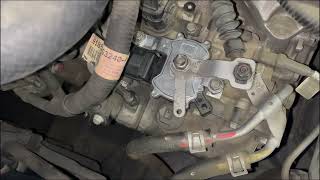
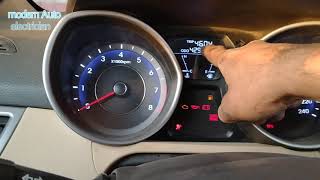
How to confirm: Scan the TCM for codes like P0705, P0706, P0707, or P0708. Symptoms like the car not starting or the gear selector on the dash being blank or incorrect strongly point to this sensor. 🎬 Watch: Diagnosing a P0705 range sensor fault on an Elantra. A technician can also monitor the sensor's live data with a scan tool while shifting gears.
Typical fix: Replace the transmission range sensor. On the A4CF2 transmission, it is located on the top of the transmission case, under the battery and battery tray. The sensor must be correctly aligned in the neutral position during installation.
Est. part cost: $40-$90 - Faulty Input or Output Speed Sensor 🟡 Medium Probability These magnetic sensors are critical for the TCM to calculate gear ratios and control shifting. Over time, they can weaken, fail, or become contaminated with metallic debris, leading to erratic signals. This is a frequent cause of limp mode on this platform.
How to confirm: Scan the TCM for codes related to the input speed sensor (P0715, P0717) or output speed sensor (P0720, P0722). A mechanic can monitor the live data from these sensors with a scan tool to see if they are reading correctly while the vehicle is moving.
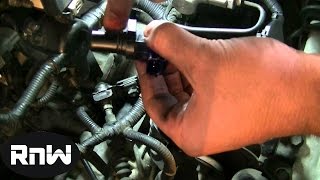
Typical fix: Replace the faulty sensor. There are two sensors located on the exterior of the transmission housing, making them relatively accessible. 🎬 See this walkthrough on replacing input and output speed sensors.
Est. part cost: $30-$80 per sensor - Low or Dirty Transmission Fluid 🟡 Medium Probability This is not specific to the vehicle but is a primary check for any transmission issue. The A4CF2 transmission is sensitive to fluid condition. Low fluid causes poor hydraulic pressure, leading to slipping, overheating, and performance errors.
How to confirm: This model has a transmission fluid dipstick. Check the fluid level with the engine warm and running in Park. The fluid should be bright red and not smell burnt. If it's low, brown, or smells burnt, it's a problem.
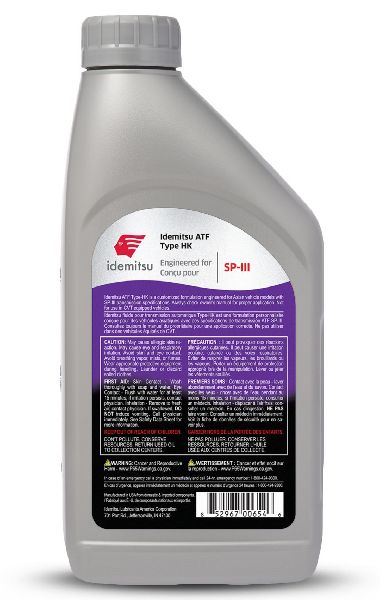
Typical fix: Top off the fluid with the correct type (Hyundai/Kia SP-III). If the fluid is very dirty or burnt, a transmission fluid and filter change is necessary. Do not perform a high-pressure flush on a high-mileage transmission where the fluid has never been changed, as this can dislodge debris and cause more problems.
Est. part cost: $15-$25 for fluid - Damaged Wiring or Connectors ⚪ Low Probability The wiring harness to the transmission, particularly the connectors for the range sensor and speed sensors, can be damaged by engine bay heat, vibration, or corrosion over time.
How to confirm: Visually inspect the wiring harnesses going to the transmission, range sensor, and speed sensors for any breaks, chafing, corrosion, or loose pins at the connectors.
Typical fix: Repair the damaged section of the harness or clean/replace the corroded connector.
Est. part cost: $10-$50 for repair materials
Rare But Worth Checking
- Failing Shift Solenoid or Valve Body: A specific shift solenoid can get stuck or fail electronically. This will almost always be accompanied by a specific solenoid code (e.g., P0750-P0770). A worn valve body is also a known issue on the A4CF2 transmission, causing various shift quality problems like harsh engagement into reverse.
- Faulty Transmission Control Module (TCM): This is rare and should only be considered after all other possibilities (sensors, wiring, fluid) have been exhaustively ruled out. A TCM failure can cause a wide range of erratic behaviors and may require replacement and reprogramming.
Diagnosis Steps
- Check the transmission fluid level and condition using the dipstick. Ensure the engine is warm and running. Top off or change if necessary with Hyundai SP-III fluid.
- Use an advanced OBD-II scanner capable of reading manufacturer-specific codes from the Transmission Control Module (TCM). Do not proceed without this step.
- Record all codes stored in the TCM. The P0701 code is just the starting point; other codes will direct the diagnosis.
- If range sensor codes (P0705-P0708) are present, inspect the sensor, its wiring, and test its operation. 🎬 Watch: How to test and replace the inhibitor switch. This is the most likely culprit.
- If speed sensor codes (P0717, P0722) are present, test the specific sensor and its wiring. Monitoring live sensor data while driving is an effective test.
- If solenoid codes (P0750-P0770) are present, diagnose the specific solenoid circuit as per the service manual.
- If no other codes are present, perform a thorough visual inspection of the main transmission wiring harness and all related connectors for damage, corrosion, or loose pins.
- As a final step, if all sensors and wiring check out, the issue may be with the TCM itself, though this is uncommon.
Parts You'll Likely Need
- Transmission Range Sensor / Inhibitor Switch
(OEM #42700-26500)— This is one of the most common failure points on this transmission that will trigger a P0701 code by sending incorrect gear position data.
Trusted brands: Hyundai OE, Standard Motor Products, Beck/Arnley
OEM price range: $60-$100
Aftermarket price range: $40-$70 - Input Speed Sensor (Pulse Generator A)
(OEM #42620-26010)— Failure of this sensor prevents the TCM from knowing the speed of the transmission's input shaft, leading to shifting errors and a performance code.
Trusted brands: Hyundai OE, Duralast, Beck/Arnley
OEM price range: $50-$80
Aftermarket price range: $30-$60 - Output Speed Sensor (Pulse Generator B)
(OEM #42621-26000)— Failure of this sensor prevents the TCM from knowing the vehicle's actual road speed from the transmission, causing limp mode and erratic shifting.
Trusted brands: Hyundai OE, Duralast, MTE-THOMSON
OEM price range: $50-$80
Aftermarket price range: $30-$60 - Hyundai SP-III Automatic Transmission Fluid
(OEM #00232-19012)— Low or incorrect fluid is a fundamental cause of transmission problems. Using the specified SP-III fluid is critical for the A4CF2 transmission.
Related Codes That Often Appear With This One
- P0705 - P0708 — These codes point directly to a fault in the Transmission Range Sensor (Inhibitor Switch) circuit, which is a very common cause of P0701.
- P0717 / P0722 — These codes indicate a problem with the input or output speed sensors, another frequent trigger for a general performance fault.
- P0700 — P0700 is a similar generic code that simply means 'Transmission Control System (MIL Request)'. Seeing both together strongly indicates a fault has been registered in the TCM and is requesting the Check Engine Light to be turned on.
Technical Service Bulletins (TSBs) & Recalls
- TSB 12-AT-022-1: Addresses DTCs P0705, P0706, P0707 & P0708 related to an improperly adjusted or failing inhibitor switch on 6-speed automatics, but the diagnostic principles are relevant.
- TSB 10-AT-010: Discusses various solenoid diagnostic trouble codes that can lead to the transmission being stuck in 3rd gear, a common symptom seen with P0701.
- Service Campaign TT1 (NHTSA #10118672): While not directly related to the code, this campaign for underbody corrosion prevention in salt-belt states is important context, as corrosion can also affect transmission wiring and connectors.
Platform-Specific Known Issues
- Owner Experience: P0701 and P0705 Fixed by Range Sensor: Multiple owners on forums like Reddit and Hyundai-Forums report experiencing a no-start condition or erratic shifting, accompanied by codes P0701 and P0705. The fix was replacing the inhibitor switch (range sensor) located on top of the transmission. One user noted a dealership quoted $800 for the repair, while the part itself costs under $100 and is a feasible DIY for those comfortable removing the battery and airbox.
- Limp Mode Caused by Speed Sensors: A common complaint for this generation Elantra is the transmission suddenly going into 'fail-safe' or 'limp mode', where it gets stuck in 3rd gear. This is often triggered by a failing input or output speed sensor, which will typically store a corresponding code (like P0717 or P0722) along with the general P0701.
Mechanic-Grade Diagnostic Values
- Shift Control Solenoids (SCSV-A, SCSV-B, SCSV-C, SCSV-D, SCSV-E) Resistance — expected: 3 - 5 Ohms. Failure: A reading outside this range indicates a faulty solenoid coil.
- Transmission Range Sensor (Inhibitor Switch) Continuity Test — expected: Continuity should exist between specific pins depending on the gear selected (P, R, N, D, 2, L). A full continuity chart is available in the ATSG A4CF2 Tech Guide.. Failure: Lack of continuity in a specific gear position indicates a failed switch.
- TCM Ground Circuit Resistance — expected: Near 0 Ohms.. Failure: High resistance indicates a poor ground connection, which can cause erratic TCM behavior.
Scan Tool Commands That Help
- Hyundai GDS (Global Diagnostic System): Resetting Auto Transmission Adaptive Values — This function should be used after replacing major transmission components like the valve body or the entire transmission to reset the learned shift adaptations and start a fresh learning cycle.
- Hyundai GDS (Global Diagnostic System): DTC Analysis — This is the primary function to read the specific, manufacturer-level fault codes from the TCM that are causing the generic P0701 to be set by the ECM.
- Hyundai GDS (Global Diagnostic System): Data Analysis (Live Data) — Used to monitor live data from sensors like the input/output speed sensors and the transmission range sensor to see if their readings are accurate and stable while operating the vehicle.
Wiring & Ground Locations
- TCM (Transmission Control Module) — On this model, the TCM function is integrated into the Powertrain Control Module (PCM). The PCM is located under the dash on the driver's side.. All transmission sensor data is processed here. A bad ground or faulty connection at the PCM/TCM can mimic sensor failures and trigger a P0701.
- Inhibitor Switch Connector — On top of the transmission, under the battery and battery tray.. This connector is a common point for corrosion or pin damage due to its location, which can interrupt the gear position signal and cause P0701 and related P0705-P0708 codes.
- Input/Output Speed Sensor Connectors — On the exterior of the transmission case.. These connectors can become contaminated with dirt and oil or damaged from road debris, leading to intermittent or lost signals from the speed sensors.
Real Owner Repair Stories
- YouTube channel 'jusayin' (2010-2013 Hyundai Elantra) — Intermittent no-start. The car would sometimes start normally and other times fail to crank.
❌ Tried (didn't work) The owner did online research which pointed away from common no-start issues like the battery or starter.
✅ What actually fixed it The problem was solved by replacing the transmission range sensor, which Hyundai calls the 'Switch Inhibitor'. The genuine Hyundai part used was 42700-26700 and cost approximately $46. - Drive.com.au used car review (2006-2010 Hyundai Elantra) — Rough-shifting or noisy automatic gearbox.
❌ Tried (didn't work) Initial checks for low or incorrect transmission fluid.
✅ What actually fixed it The article notes that beyond fluid issues, failed gearbox sensors were a known cause for these symptoms, requiring replacement to fix the shifting problems.
OEM Part Supersession History
42700-26500→42700-26700— This is an updated design for the inhibitor switch (transmission range sensor).
Heads up: The new part 42700-26700 replaces the older -26500 and 42700-26000 numbers and is the correct service part.
Model Year Variations Within This Range
- 2009-2010: A mid-generation refresh occurred for the 2009 model year, but it did not significantly alter the A4CF2 transmission or its core electronic components like the range sensor or speed sensors. The diagnostic process remains the same across the 2007-2010 range.
- 2007: Some early 2007 models may have had issues with solenoid wiring defects from the factory. For any pre-2008 model, a thorough inspection of the solenoid wiring is recommended if solenoid-specific codes are present.
Diagnostic Flowchart
Other Known Issues on This Vehicle
Issues unrelated to this code that are worth knowing about as an owner of this generation:
- Electronic Power Steering (EPS) Failure 🔴 High — Common enough to trigger a recall. The EPS control unit may fail, causing a sudden loss of power steering assist. (Ref: NHTSA Recall 15V100000)
- Faulty Airbag Warning Light / OCS Sensor 🟠 Medium — Widespread issue where the passenger seat Occupant Classification System (OCS) sensor fails, causing the airbag light to illuminate and disabling the passenger airbag. (Ref: NHTSA Recall 08V521000; TSB 11-01-010)
- Malfunctioning Stop Lamp Switch 🟠 Medium — A very common failure that can prevent the brake lights from working, cause the ESC light to come on, and prevent the shifter from moving out of Park. (Ref: NHTSA Recall 13V113000)
- Premature Transmission Problems (General) 🟠 Medium — Owners of 2009-2010 models in particular report a higher incidence of harsh shifting, slipping, and general transmission concerns even outside of specific sensor failures.
- Underbody Corrosion in Salt Belt States 🟠 Medium — Vehicles operated in regions with heavy road salt use are prone to significant rust on the underbody, subframes, and suspension components. (Ref: Service Campaign TT1 (NHTSA #10118672))
Used vs. New Parts: Buying Guide for This Vehicle
When a used part is the smart pick: For this repair, obtaining used external sensors like the inhibitor switch or input/output speed sensors from a reputable auto recycler can be a cost-effective option. These parts are external to the transmission and relatively easy to swap.
Donor-vehicle mileage cap: roughly under 80000 miles for the part to have meaningful remaining life.
What to inspect on the donor part:
- Check for a vehicle with a clear history and lower mileage.
- Inspect the plastic connectors on the sensor for any cracks, brittleness, or signs of heat damage.
- Ensure the metal components and mounting points are free of excessive corrosion.
- Ask the recycler about their return policy in case the part is non-functional.
OEM-only on this vehicle (don't cheap out):
- Transmission Control Module (TCM) / Powertrain Control Module (PCM): Due to the need for potential programming and the high risk of electronic failure, a new or professionally remanufactured unit is strongly recommended over a used one.
Aftermarket brands forum-validated for this vehicle:
- Beck/Arnley
- Standard Motor Products (SMP)
- Dorman OE Solutions
Brands owners have reported issues with on this vehicle:
- No-name, unbranded parts from online marketplaces should be avoided, as their quality control and longevity can be highly questionable, especially for critical sensors.
Real Owner Stories
Aggregated from forums and TSBs cited above. Mileages and costs reflect what owners reported in those sources.
2007-2010 Hyundai Elantra
Symptoms: A no-start condition or erratic shifting, accompanied by codes P0701 and P0705.
What fixed it: Replacing the inhibitor switch (range sensor) located on top of the transmission.
Cost: $800-$800
Source hint: Vehicle Specific Issues: Owner Experience: P0701 and P0705 Fixed by Range Sensor
2007-2010 Hyundai Elantra
Symptoms: The transmission suddenly going into 'fail-safe' or 'limp mode', where it gets stuck in 3rd gear.
What fixed it: Replacing the failing input or output speed sensor.
Source hint: Vehicle Specific Issues: Limp Mode Caused by Speed Sensors
older Elantra
Symptoms: classic limp-mode (stuck in 3rd gear) symptom
What fixed it: The owner identified the likely cause as the input or output speed sensor.
Source hint: Reddit: Hyundai trouble codes and transmission stuck in 3rd gear
Related OBD-II Codes
Frequently Asked Questions
My 2008 Elantra won't start and the PRNDL gear indicator on the dash is blank. Is this related to the P0701 code?
My Elantra is stuck in 3rd gear (limp mode). What specific part is the most likely cause?
Where is the transmission range sensor located on my 2009 Elantra and can I replace it myself?
What kind of transmission fluid should I use for my 2007 Elantra if I'm checking it for a P0701 issue?
I have both P0701 and P0705 codes. What does this combination mean?
A dealership quoted me $800 to fix the P0701 on my Elantra. Is that a normal price?
Helpful Videos

We Have This Part in Stock

The information in this article is provided for general reference and educational purposes only. Vehicle specifications, procedures, and part compatibility can vary by production date, trim level, and region. Always consult your vehicle's factory service manual and verify part numbers before purchasing or performing repairs. Safety-critical components such as airbags, seat belts, and braking systems should be installed by a qualified professional.
- Hyundai Elantra:
- 🎬 Helpful Videos
- 🛍️ Shop This Part
- What's Unique About the 2007-2010 Hyundai Elantra
- Symptoms You May Notice
- Most Likely Causes
- Rare But Worth Checking
- Diagnosis Steps
- Parts You'll Likely Need
- Related Codes That Often Appear With This One
- Technical Service Bulletins (TSBs) & Recalls
- Platform-Specific Known Issues
- Mechanic-Grade Diagnostic Values
- Scan Tool Commands That Help
- Wiring & Ground Locations
- Real Owner Repair Stories
- OEM Part Supersession History
- Model Year Variations Within This Range
- Diagnostic Flowchart
- Other Known Issues on This Vehicle
- Used vs. New Parts: Buying Guide for This Vehicle
- Real Owner Stories
- 2007-2010 Hyundai Elantra
- 2007-2010 Hyundai Elantra
- older Elantra
- Related OBD-II Codes
- Frequently Asked Questions
- 🎟️ Get 5% Off