

P0606 on 2014-2017 Mazda Mazda6 2.5L: PCM Processor Fault Causes and Fixes
This code indicates a failure of the main engine computer (PCM). However, before replacing the expensive PCM, thoroughly check the battery, its connections, and the main power/ground wires, as a simple electrical issue can also trigger this code. PCM replacement is a professional-only job requiring programming.
- P0606 indicates a serious internal fault in the main engine computer (PCM), and the vehicle should not be driven.
- Before spending money on a new PCM, you MUST rule out simpler electrical problems. A weak battery, failing alternator, or corroded ground wire can all trigger this code.
- Diagnosis should follow a specific order: 1) Test battery and charging system, 2) Clean and tighten all grounds, 3) Inspect PCM connectors for corrosion.
- If the PCM does need to be replaced, it is not a DIY job. The new module must be professionally programmed to your car's specific VIN to function.
What's Unique About the 2014-2017 Mazda Mazda6
For Mazda's SKYACTIV-G engines, which rely heavily on precise electronic control, stable voltage and clean connections are critical. While no specific TSB for the P0606 code exists for the 2014-2017 Mazda6, Mazda has issued service alerts for other models (like TSB SA-020/19 for the CX-7) where this exact code was caused by moisture and corrosion in a wiring connector. This history underscores the importance of ruling out external electrical faults before condemning the PCM on this platform. A poor battery or failing alternator can easily fool the PCM into reporting a false internal error during the high-load condition of engine cranking.
Symptoms You May Notice
- Check Engine Light is on
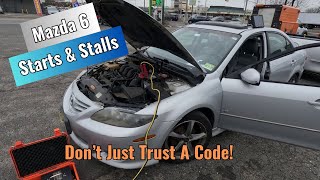
- Engine may stall or shut off while driving 🎬 Watch this diagnostic walkthrough of a Mazda 6 that starts and stalls.
- Engine cranks but will not start, or won't crank at all
- Intermittent no-start condition where the car may work one moment and not the next
- Severely reduced engine power (limp mode)
- Erratic or harsh automatic transmission shifting
- Other warning lights, such as for ABS, Traction Control (DSC), or the AT light, may illuminate simultaneously
- Replacing the PCM without first thoroughly testing the battery, alternator, and all PCM power and ground circuits. An external electrical problem is a common cause and a much cheaper fix.
- Overlooking a simple blown fuse for the ECM/PCM circuit. A fuse can develop high resistance without fully blowing, causing voltage drops under load.
Most Likely Causes
- Faulty Powertrain Control Module (PCM) 🔴 High Probability This code specifically denotes an internal processor self-test failure, making PCM failure the most direct and common cause after external factors are eliminated.
How to confirm: This is a diagnosis of exclusion. If all power, ground, network communication circuits, and PCM software are confirmed to be good, the PCM itself is condemned.
Typical fix: Replace the Powertrain Control Module and program it to the vehicle using dealer-level software.
Est. part cost: $400-$1000 - Low or Unstable System Voltage 🟡 Medium Probability Modern control modules are sensitive to voltage fluctuations. A weak battery or failing alternator can cause the PCM's self-test to fail during the high current draw of engine cranking, incorrectly flagging an internal fault.
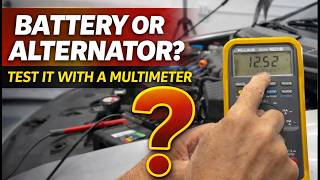
How to confirm: Test the battery with a digital battery analyzer for state of health and cold cranking amps (CCA). With the engine running, use a multimeter to check alternator output at the battery terminals; it should be stable, typically between 13.5 and 14.5 volts. 🎬 See how to test your battery and alternator with a multimeter. A battery voltage below 12.4V at rest indicates a need for charging and testing.
Typical fix: Replace the failing battery or alternator.
Est. part cost: $150-$500 - Poor PCM Power or Ground Connections 🟡 Medium Probability Corrosion on battery terminals, main engine/chassis grounds, or the PCM connectors can create voltage drops that mimic an internal PCM failure. A Mazda TSB for the CX-7 confirms corroded connectors can cause P0606.
How to confirm: Visually inspect all battery terminals, main ground straps, and PCM connectors for looseness, fraying, or corrosion. Perform a voltage drop test on the main power and ground circuits to the PCM to check for high resistance.
Typical fix: Clean all corroded terminals and ground points until they are bright metal. Tighten all connections. If a connector or wire end is severely corroded, it may need to be replaced.
Est. part cost: $5-$100 - Outdated or Corrupt PCM Software ⚪ Low Probability Rarely, a software glitch within the PCM's firmware can cause it to fail its internal self-check, triggering a P0606.
How to confirm: A Mazda dealership or a qualified independent shop with access to Mazda's diagnostic system can check if a software update (reflash) is available for the PCM.
Typical fix: Update or reflash the PCM software. This is a much cheaper first step before considering full replacement.
Est. part cost: $0-$200 (Labor for the reflash)
Rare But Worth Checking
- Shorted Sensor or Actuator: A sensor that is internally shorted can sometimes disrupt the 5-volt reference circuit supplied by the PCM, potentially causing the processor to malfunction and set a P0606 code. This is less common but possible.
Diagnosis Steps
- Verify the code with a quality OBD-II scanner. Note any other codes present.
- Check System Voltage: Test the battery's state of charge and health. It should be above 12.4 volts with the engine off. Start the engine and measure alternator output; it should be stable, between 13.5-14.5 volts. Address any charging system or battery issues first. Vehicles with i-ELOOP have specific battery maintenance requirements outlined in TSB 01-012/17.
- Inspect All Grounds and Power Feeds: Locate and inspect the main battery ground, engine-to-chassis ground straps, and any grounds near the PCM. Check battery terminals for corrosion or looseness. Ensure they are clean and tight.
- Inspect Fuses: Using a multimeter, check the resistance of all fuses related to the PCM/ECM, not just for continuity. A fuse can be damaged and cause a voltage drop under load without being fully blown.
- Inspect PCM Connections: Disconnect the battery. Locate the PCM (typically in the engine bay near the battery) and carefully inspect its electrical connectors for any signs of corrosion, moisture, or bent/damaged pins. This is a known issue on some Mazda vehicles that can trigger a P0606.
- Check for Software Updates: Before condemning the hardware, contact a Mazda dealer or specialist shop to determine if a PCM software update is available for your vehicle's VIN. A reflash can sometimes correct internal logic errors.
- Test Power and Ground at the PCM: Using a wiring diagram for the specific vehicle, use a multimeter to confirm that the PCM is receiving proper battery voltage and has a solid ground connection at the connector pins. A voltage drop test is essential here.
- Condemn the PCM: If all external wiring, power, grounds, and software are confirmed to be good, the P0606 code indicates an internal, non-repairable failure of the PCM.
- Replace and Program: Replace the PCM with a new or remanufactured unit. This step must be followed by programming the module to the car's VIN and immobilizer system using specialized dealer-level equipment.
Parts You'll Likely Need
- Powertrain Control Module (PCM)
(OEM #PE-prefix (e.g., PE07-18-88x, PE21-18-88x). Exact number varies by year, transmission, and emissions. Must match original part.)— This is the most likely failed component if all external electrical tests pass. The code P0606 is a direct report of an internal processor fault.
Trusted brands: Mazda (OEM), Flagship One (Remanufactured), Solo Auto Electronics (Remanufactured)
OEM price range: $800-$1200
Aftermarket price range: $400-$700 (Remanufactured)
Related Codes That Often Appear With This One
- P0601, P0603, P0605 — These are other internal PCM memory or processor error codes. Their presence alongside P0606 further strengthens the diagnosis of a failed PCM.
- U-codes (e.g., U0100, U0420) — If the PCM is failing, it may stop communicating with other modules on the vehicle's network (CAN bus), resulting in communication loss codes.
- P2610 — This code for 'ECM/PCM Internal Engine Off Timer Performance' can sometimes accompany a P0606, indicating a failure in the PCM's ability to perform checks after the vehicle is shut down.
Technical Service Bulletins (TSBs) & Recalls
- SA-020/19: While for a 2010-2012 CX-7, this Mazda Service Alert notes that P0606 can be caused by moisture and corrosion in connector C-31, providing valuable diagnostic context.
- 01-012/17: Provides service information for the i-ELOOP system's special Q-85/T-110 battery, relevant because improper battery maintenance can cause voltage issues that may trigger a P0606.
Platform-Specific Known Issues
- While no widespread P0606 problem is documented for the Mazda6 specifically, its platform mates (Mazda3, CX-5) do experience this code, almost always leading to a diagnosis of a faulty PCM after electrical checks are performed.
- A user on the r/mazda3 subreddit reported a P0606 code that caused an intermittent no-start condition, highlighting the real-world symptoms of this fault on a similar platform.
Mechanic-Grade Diagnostic Values
- PCM Monitoring Condition - Minimum Voltage — expected: 8V or more. Failure: If system voltage is below 8V, the PCM will not perform its self-test, which can lead to other faults but is a critical baseline.
- Battery Voltage (Static, Engine Off) — expected: 12.4V - 12.6V. Failure: A reading below 12.4V indicates a discharged or failing battery that can trigger a false P0606.
- Alternator Output Voltage (Engine Running) — expected: 13.5V - 14.5V. Failure: Voltage that is unstable, below 13.5V, or above 14.5V points to a charging system fault that can cause PCM processor errors.
- Main Ground Connection Voltage Drop — expected: Less than 0.2V. Failure: A reading above 0.2V on the main ground connections (battery-to-chassis, chassis-to-engine) indicates excessive resistance that needs to be corrected.
Scan Tool Commands That Help
- Mazda M-MDS (MDARS): Parameter Reset — This function is required after installing a used or new PCM to synchronize it with the vehicle's immobilizer system. Failure to perform this step will result in a no-start condition.
- Mazda M-MDS (MDARS): Software Update — Used to check for and apply any available firmware updates to the PCM. This should be done before condemning the PCM, as a software glitch can occasionally cause a P0606.
- Mazda M-MDS (MDARS): KOEO/KOER Self Test — Key On, Engine Off or Key On, Engine Running self-tests are used to confirm if the P0606 code returns immediately after clearing, which points towards a hard internal PCM fault.
Wiring & Ground Locations
- PCM Power Input Pins (Connector C-237) — At the main PCM electrical connector, typically in the engine bay near the battery.. A forum post for a similar Mazda platform identified pins 1BA (Red) and 1BE (Green/Orange) as main power inputs. Performing a voltage drop test directly at these pins is the most accurate way to confirm the PCM is receiving stable power, ruling out a wiring issue.
- Connector C-31 — Varies by model, but typically a large harness connector in the engine bay.. A Mazda TSB (SA-020/19) for the CX-7 identified this specific connector as a point of failure due to moisture and corrosion, directly causing a P0606 code. This highlights the need to inspect all major engine harness connectors for water intrusion or corrosion as a primary diagnostic step.
Real Owner Repair Stories
- MazdaSpeeds Forum User (2013 Mazdaspeed 3 (Similar platform, same code principle)) — Intermittent no-power/rough idle (limp mode), headlights staying on, rear hatch inoperative, and P0606 code, all occurring after rainfall.
❌ Tried (didn't work) Replacing the battery., Clearing codes temporarily worked until the next rainfall.
✅ What actually fixed it The root cause was identified as a water leak causing a short circuit. The user noted that after the car dried out for a day, functions returned to normal. The fix involved addressing the water leak into the vehicle, which was shorting out electrical components and causing the PCM to report an internal fault. - Reddit r/WRX User (different vehicle, identical code behavior) (2015+ Subaru WRX) — P0606 code and limp mode appeared immediately after the battery died and the vehicle was jump-started.
❌ Tried (didn't work) Clearing the code while parked; it would return instantly.
✅ What actually fixed it The code was finally cleared by using an OBD2 tool *while driving* at over 30mph. This suggests that for some vehicles, a specific drive cycle or operating condition must be met for the PCM to successfully complete its self-test and clear the fault after a significant voltage event like a dead battery.
OEM Part Supersession History
PE07-18-881E, PE07-18-881G, PE07-18-881H→PE07-18-881M— Standard part revision and update by the manufacturer.
Heads up: While these part numbers are for a similar platform (Mazda 3), they illustrate a common supersession chain. When ordering a replacement PCM, it is critical to provide the VIN to a dealer or use a trusted parts catalog to ensure the latest compatible part number is sourced.
Diagnostic Flowchart
Other Known Issues on This Vehicle
Issues unrelated to this code that are worth knowing about as an owner of this generation:
- Infotainment Screen Delamination / 'Ghost Touch' 🟠 Medium — Very common, especially on 2016-2018 models. Heat and age cause the touch digitizer to fail, leading to phantom inputs or 'spider web' cracks without impact. (Ref: Multiple TSBs issued (e.g., SA-001/23a, SA-008/18) and a class-action lawsuit led to a warranty extension (CSP13) for the Connectivity Master Unit (CMU), though not always the screen itself.)
- Early Production Automatic Transmission Whine 🔴 High — Primarily affects 2014-2015 models. A whining noise that increases with speed, often caused by a defective bearing in the transaxle case due to a manufacturing issue. (Ref: A TSB was issued in 2015 acknowledging the defect for vehicles under warranty.)
- Premature Wheel Bearing Failure 🟠 Medium — Known to become noisy and require replacement at lower mileage than expected across the 2014-2019 model years.
- Carbon Buildup on Intake Valves 🟡 Low — A potential long-term issue for all direct-injection (GDI) engines. While Mazda's SKYACTIV-G design mitigates it better than many competitors, it can still occur over 100,000+ miles, especially with frequent short trips.
- Shifter Assembly Park Switch Failure 🟡 Low — In earlier models, a faulty switch in the shifter assembly can prevent the car from fully turning off, leaving it in accessory mode and draining the battery.
Used vs. New Parts: Buying Guide for This Vehicle
When a used part is the smart pick: A used PCM is a viable option if you have access to a specialized service that can 'clone' your original PCM's data onto the donor unit. This process copies the VIN, immobilizer data, and software, creating a plug-and-play replacement without needing expensive dealer programming. This is often cheaper than buying a new OEM unit and paying for dealer labor.
Donor-vehicle mileage cap: roughly under 150000 miles for the part to have meaningful remaining life.
What to inspect on the donor part:
- Part number MUST be an exact match to the original PCM.
- Source from a vehicle that was not involved in a flood or fire.
- Inspect the connector pins on the used PCM for any signs of corrosion, damage, or being bent.
- If possible, get the VIN of the donor car to check its history.
OEM-only on this vehicle (don't cheap out):
- For a new part, OEM is the only reliable source. There are no 'new' aftermarket PCMs for this vehicle, only remanufactured or used units.
Aftermarket brands forum-validated for this vehicle:
- Flagship One (Remanufactured/Programming Service)
- Solo Auto Electronics (Remanufactured/Programming Service)
Brands owners have reported issues with on this vehicle:
- Unknown eBay/Amazon sellers offering 'unlocked' or 'virgin' PCMs without a clear programming or cloning service and warranty.
Real Owner Stories
Aggregated from forums and TSBs cited above. Mileages and costs reflect what owners reported in those sources.
2010-2012 Mazda CX-7
Symptoms: The vehicle experienced a P0606 code specifically linked to moisture and corrosion in the electrical system.
What fixed it: Addressing corrosion in connector C-31.
Source hint: SA-020/19
2019 Mazda3
Symptoms: The car wouldn't run one day but started the next with a check engine light; an intermittent no-start condition.
What fixed it: Diagnosis of a failing PCM on the shared platform.
Source hint: r/mazda3 (Reddit) thread titled 'P0606 code'
Mazda CX-7
Symptoms: Internal processor self-test failure (P0606).
What fixed it: Replacing the Powertrain Control Module (PCM).
Source hint: Mazdas247.com
Related OBD-II Codes
Frequently Asked Questions
Can a weak battery on my Mazda6 cause a P0606 code even if the PCM is actually fine?
Does TSB 01-012/17 apply to the P0606 code on a Mazda6 with i-ELOOP?
Is there a specific connector I should check for corrosion on my Mazda?
My Mazda6 won't start one day but works the next; is this related to P0606?
Can I just reflash the software instead of buying a $1000 PCM?
Helpful Videos


We Have This Part in Stock



The information in this article is provided for general reference and educational purposes only. Vehicle specifications, procedures, and part compatibility can vary by production date, trim level, and region. Always consult your vehicle's factory service manual and verify part numbers before purchasing or performing repairs. Safety-critical components such as airbags, seat belts, and braking systems should be installed by a qualified professional.
- Mazda Mazda6:
- 🎬 Helpful Videos
- 🛍️ Shop This Part
- What's Unique About the 2014-2017 Mazda Mazda6
- Symptoms You May Notice
- Most Likely Causes
- Rare But Worth Checking
- Diagnosis Steps
- Parts You'll Likely Need
- Related Codes That Often Appear With This One
- Technical Service Bulletins (TSBs) & Recalls
- Platform-Specific Known Issues
- Mechanic-Grade Diagnostic Values
- Scan Tool Commands That Help
- Wiring & Ground Locations
- Real Owner Repair Stories
- OEM Part Supersession History
- Diagnostic Flowchart
- Other Known Issues on This Vehicle
- Used vs. New Parts: Buying Guide for This Vehicle
- Real Owner Stories
- 2010-2012 Mazda CX-7
- 2019 Mazda3
- Mazda CX-7
- Related OBD-II Codes
- Frequently Asked Questions
- 🎟️ Get 5% Off