

P0604 on 2003-2012 Saab 9-3: RAM Error, Causes, and Fixes
On a 2003-2012 Saab 9-3, P0604 almost always means the Engine Control Module (ECM) is failing, often due to heat and vibration. The most reliable fix is to have your original ECM rebuilt by a specialist, which costs several hundred dollars but avoids the need for dealer reprogramming. This is a very common failure for the Trionic 8 (T8) ECU.
- P0604 on a 2003-2012 Saab 9-3 almost always points to a failed Trionic 8 Engine Control Module (ECM).
- The failure is caused by the ECM's location on top of the engine, leading to damage from heat and vibration.
- Symptoms include no-start, stalling when hot, and sudden power loss.
- The best fix is sending the original ECM to a specialist for a rebuild, which preserves programming and is more cost-effective than a new unit.
- Checking the battery and ground connections is a crucial first step, but the ECM is the most likely culprit.
- Installing a heat shield or an ECM relocation kit is highly recommended to prevent future failures.
What's Unique About the 2003-2012 Saab 9-3
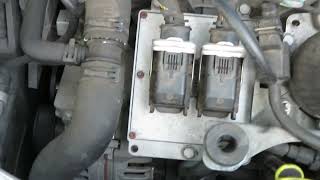
The 2003-2012 Saab 9-3, particularly models equipped with the Trionic 8 (T8) engine management system, is known for a high rate of ECM failure. The primary reason is the ECM's location: it is mounted directly on top of the engine's intake manifold. This placement subjects the delicate electronics, specifically the internal flexible printed circuit board (flex PCB), to constant, intense heat cycles and engine vibrations. This thermal and mechanical stress can degrade internal components and solder joints over time, leading to codes like P0604. This design flaw is so well-known that many owners and specialists proactively install ECM relocation kits to move the unit to a cooler, more protected area on the firewall or near the radiator support.
Symptoms You May Notice
- Engine will not start (cranks but does not fire)
- Engine stalls immediately after starting
- Engine cuts out or stalls while driving, often when hot, and will not restart until cooled down
- Complete loss of power while driving 🎬 Watch: Real-world example of a total ECM power loss failure
- Check Engine Light is illuminated
- Erratic engine performance, such as hesitation or misfires
- ABS/Traction Control light may also illuminate
- Replacing spark plugs, ignition coils, or fuel injectors. While these can cause misfires or no-starts, they will typically set other codes (like P030x or P020x). The P0604 code specifically points to an internal computer memory error, which is the root cause, not the downstream components.
Most Likely Causes
- Internal Engine Control Module (ECM) Failure 🔴 High Probability The ECM (specifically the Trionic T8 models) is mounted directly on the engine, exposing it to extreme heat and vibration, which leads to premature failure of internal components and solder joints on its flex PCB.
How to confirm: After confirming stable power (12.6V+ off, 13.5-14.8V running) and clean, tight ground connections to the ECM, the presence of P0604 strongly indicates an internal ECM fault. Specialized companies can test the unit on a bench simulator or even on a dedicated test vehicle to confirm the failure.
Typical fix: The most common and reliable solution is to remove the original ECM and send it to a specialist for rebuilding and cloning. This retains the vehicle's specific programming, making the repaired unit plug-and-play. Alternatively, a new or pre-programmed replacement ECM can be installed, often with an added heatshield.
Est. part cost: $200-$600 for a rebuild service, $500-$1200 for a replacement ECM. - Low Battery Voltage or Charging System Fault 🟡 Medium Probability Like any modern vehicle with complex electronics, the Saab 9-3's control modules are sensitive to voltage fluctuations. A weak battery or failing alternator can cause data corruption in the ECM's RAM during startup, triggering a P0604 code that may be temporary.
How to confirm: Test the battery voltage with the car off (should be ~12.6V) and while running to check alternator output (should be 13.5-14.8V). Perform a load test on the battery. Ensure voltage does not drop significantly (e.g., below 10V) during cranking.
Typical fix: Charge or replace the battery. If the charging voltage is incorrect, diagnose and replace the alternator.
Est. part cost: $150-$300 for a new battery, $300-$600 for a new alternator. - Poor Power or Ground Connections to ECM ⚪ Low Probability
How to confirm: Visually inspect the ECM connectors for corrosion, moisture, or loose pins. Check the main engine and chassis ground straps for corrosion and tightness. Use a multimeter to perform a voltage drop test on the power and ground circuits to the ECM to ensure there is no excessive resistance.
Typical fix: Clean or repair the ECM connector pins. Clean, tighten, or replace corroded battery terminals and ground straps.
Est. part cost: $10-$50 for cleaning supplies or new cables.
Rare But Worth Checking
- Corrupted ECM Software: Sometimes, a software glitch or a failed programming attempt can cause this code. Before replacing the ECM, it's worth checking with a specialist if a software reflash is possible. A recall for stalling (04V540000) was addressed with a software update, indicating that software can cause severe drivability issues.
Diagnosis Steps
- Check Battery and Charging System: Ensure the battery is fully charged (12.6V+) and the alternator is working correctly (13.5-14.8V while running). A weak battery or unstable voltage is a common cause of memory-related codes.
- Verify Power and Grounds: Inspect all power and ground connections to the ECM. Ensure they are clean, tight, and free of corrosion. Perform a voltage drop test on the main power and ground wires to the ECM. A ground resistance reading should be below 0.1 Ω.
- Scan for Other Codes: Check for other codes that may be present. Codes like P0601 or P0606 further confirm an internal ECM failure. Note other codes but recognize they may be symptoms of the ECM failure, not separate problems.
- Check for Software Updates: In rare cases, a software glitch can cause this code. Check with a dealer or specialist if any software updates (reflashes) are available for the ECM.
- Tap Test / Heat Test: With the engine running (if possible), carefully tap on the ECM to see if it causes the engine to stumble or stall, indicating a bad internal connection. Similarly, one can carefully apply heat (with a heat gun) to the ECM to see if it replicates the common 'stalls when hot' symptom. This can help confirm a heat-related internal failure.
- Condemn the ECM: If all external factors (power, grounds, software) are ruled out, the ECM itself is faulty.
- Repair or Replace ECM: The recommended fix is to have the original ECM rebuilt to retain programming. If replacing, ensure the new unit is correctly programmed to your vehicle's VIN and immobilizer system. Consider installing a heat shield or relocation kit with the new unit.
Parts You'll Likely Need
- Engine Control Module (ECM)
(OEM #55352571, 55352688, 55353231, 55565020, 55567225, 55569738, 12800388)— This is the most common cause of a P0604 code on this platform, due to its mounting location causing heat and vibration damage to the internal flex PCB.
Trusted brands: Bosch (OEM), Specialized rebuilders (e.g., ECU Testing, Xemodex, KM-Tronics, SPARTS)
OEM price range: $800-$1200
Aftermarket price range: $200-$600 (for a rebuild service)
Related Codes That Often Appear With This One
- P0601 — P0601 is 'Internal Control Module Checksum Error,' another code indicating a fatal internal ECM fault. They often appear together as they both point to a failing computer.
- P0606 — P0606 is 'ECM/PCM Processor Fault.' Like P0601 and P0604, this points directly to a catastrophic failure inside the engine control module.
Technical Service Bulletins (TSBs) & Recalls
- GM/Saab Customer Satisfaction No. CSC 15419 / NHTSA 04V540000: While not for P0604 specifically, this campaign involved updating the engine management software to fix issues with engine hesitation and stalling.
- Saab was aware of connection issues with the H42-2 connector under the battery box, which could cause poor connectivity and lead to various electrical faults.
- Manufacturer TSB Bulletin #05-06-04-060A notes that control module Diagnostic Trouble Code P0604, along with P0601 and P0606, can be shared across multiple modules within the electrical system.
Platform-Specific Known Issues
- The Trionic 8 (T8) ECM, used in many 2003+ 9-3 models, is notoriously prone to failure due to being mounted on the hot, vibrating intake manifold. This often manifests as heat-related stalling, where the car dies when hot and will not restart until it has cooled down significantly, which can take anywhere from 20 minutes to 2 hours.
- Enthusiasts have developed ECM relocation kits that move the T8 unit to a cooler location, such as the firewall or behind the front bumper, to prevent repeat failures. These kits are available from companies like Maptun and KM-tronics.
Mechanic-Grade Diagnostic Values
- ECM Ground Circuit Resistance — expected: Below 0.1 Ω. Failure: A reading higher than 0.1 Ω indicates excessive resistance in the ground circuit, which can cause voltage irregularities and trigger memory faults.
- ECM Power Supply Voltage (Key On) — expected: Approximately 12V (Battery Voltage). Failure: A significant voltage drop (more than 0.5V) compared to battery voltage points to a problem in the power supply wiring or fuse block.
Scan Tool Commands That Help
- Saab Tech 2: Add/Remove Control Module — This function is essential when replacing the ECM. A used ECM must first be 'divorced' from the donor car. The replacement (new or divorced used) must then be 'added' (married) to the recipient car to link it with the immobilizer system (stored in the CIM) and VIN.
- Saab Tech 2: Read All DTC Information — Before condemning the ECM, use this to check for communication faults with other modules (e.g., CIM, TCM, ABS). A loss of communication with multiple modules could point to a CAN bus issue or a failing CIM rather than just the ECM.
- Trionic CAN Flasher (PC Software): Read/Write ECU Flash — This is an advanced, non-dealer tool used by enthusiasts to clone a failing ECM. It can read the entire software (including immobilizer data) from the original T8 ECU and write it to a compatible used unit, creating a plug-and-play replacement without needing a Tech 2 for marrying.
Wiring & Ground Locations
- G7 — On the engine control module's top right attachment lug (for Trionic 8 systems).. This is a primary ground point for the ECM itself. Corrosion or a loose connection here can directly cause unstable operation and internal faults like P0604.
- G25 — Main battery ground cable connection point on the left-hand engine mounting or gearbox.. This is a critical chassis ground. A poor connection here affects the entire vehicle's electrical system, including the stability of the power supplied to the ECM.
- G2 — Located on the side of the left-hand structural member, near the connector bracket by the battery.. This is another main battery and chassis ground point. Verifying its integrity is a key step in ruling out system-wide voltage issues.
- BDM Port — A set of 10 pads on the Trionic 8 ECU's internal circuit board.. BDM (Background Debug Mode) is a direct interface to the ECU's processor and memory. It is used by specialists to recover a 'bricked' ECU after a failed software flash or to read out the firmware when CAN-bus methods fail. This is a last resort recovery method.
Real Owner Repair Stories
- YouTube user comment on Auto Autopsy video (2003 Saab 9-3) — Car would not start, no fuel pump prime, no starter engagement. Turning the key did nothing.
❌ Tried (didn't work) Attempting to program a replacement ECM with a Tech 2 was prohibitively expensive.
✅ What actually fixed it The owner used the Trionic CAN Flasher software with an OBDII cable to clone the original, faulty ECM to a junkyard replacement. The original ECM was bricked for operation but could still have its immobilizer data read. The software saved the vehicle ID file, allowing the owner to create a plug-and-play replacement.
OEM Part Supersession History
Multiple (e.g., 55352571, 55352688)→Multiple (e.g., 55567225, 55569738)— Revisions and updates by Bosch/Saab over the production run.
Heads up: While many Trionic 8 ECUs are physically interchangeable, they are not plug-and-play. The software is specific to the engine, transmission, and market. A replacement ECU must be either cloned from the original or programmed to the car with a Tech 2. Some tuners state that with their cloning process, the original part number does not matter as long as it is a T8 unit.
Model Year Variations Within This Range
- 2003-2011 (4-Cylinder Petrol): These models use the Saab Trionic 8 (T8) ECU, which is mounted on the engine and is highly prone to heat/vibration failure leading to P0604.
- 2006-2009 (V6 2.8L Turbo): These models (engine codes B284L, B284R) use a Bosch Motronic ME9.6 engine computer, not a Trionic 8. While the ME9.6 can also fail, it is for different reasons (often internal ceramic board issues) and is less commonly associated with P0604, showing other codes like P020x (injector) or U2105 (communication) more frequently.
Diagnostic Flowchart
Used vs. New Parts: Buying Guide for This Vehicle
When a used part is the smart pick: A used ECM from a junkyard is a viable and cost-effective option ONLY if you have a way to program it. This requires either access to a Saab Tech 2 scanner to 'divorce' the unit from its donor and 'marry' it to your car, or the ability to clone your original ECM's data onto the used unit using software like Trionic CAN Flasher.
Donor-vehicle mileage cap: roughly under 120000 miles for the part to have meaningful remaining life.
What to inspect on the donor part:
- Verify the part number is compatible, although cloning can often bypass this.
- Inspect the connectors for any signs of corrosion, moisture damage, or bent pins.
- Ask the seller if the ECM was properly 'divorced' with a Tech 2 before removal. If not, it will be locked to the donor car's VIN and immobilizer.
- Choose a donor from a vehicle that was not in a severe front-end collision.
OEM-only on this vehicle (don't cheap out):
- Engine Control Module (ECM): While a used OEM unit is common, it must be an original Bosch/Saab part. There are no third-party 'new' aftermarket ECMs; options are new OEM, used OEM, or a rebuilt original OEM unit.
Aftermarket brands forum-validated for this vehicle:
- For rebuild services: Xemodex, SPARTS, KM-Tronics, and various eBay/online specialists have positive reviews in Saab forums for cloning and repair services.
Brands owners have reported issues with on this vehicle:
- Avoid any 'new' non-OEM ECMs, as they do not exist for this platform. Also be wary of generic repair services that are not specialists in Saab Trionic or Bosch Motronic ECUs.
Related OBD-II Codes
Frequently Asked Questions
My 2005 Saab 9-3 stalls when it gets hot and then won't restart for a while. Is this related to the P0604 code?
Is the P0604 code always a bad ECM, or should I check other things first?
If I need to replace my ECM, can I just buy a used one from a junkyard?
I've heard about relocating the ECM to prevent another failure. Is that a recommended fix?
What is a reasonable cost to fix a P0604 code on my Saab 9-3?
Along with the Check Engine Light, my ABS and Traction Control lights are also on. Is this related?
Helpful Videos
We Have This Part in Stock



The information in this article is provided for general reference and educational purposes only. Vehicle specifications, procedures, and part compatibility can vary by production date, trim level, and region. Always consult your vehicle's factory service manual and verify part numbers before purchasing or performing repairs. Safety-critical components such as airbags, seat belts, and braking systems should be installed by a qualified professional.
- Saab 9-3:
- 🎬 Helpful Videos
- 🛍️ Shop This Part
- What's Unique About the 2003-2012 Saab 9-3
- Symptoms You May Notice
- Most Likely Causes
- Rare But Worth Checking
- Diagnosis Steps
- Parts You'll Likely Need
- Related Codes That Often Appear With This One
- Technical Service Bulletins (TSBs) & Recalls
- Platform-Specific Known Issues
- Mechanic-Grade Diagnostic Values
- Scan Tool Commands That Help
- Wiring & Ground Locations
- Real Owner Repair Stories
- OEM Part Supersession History
- Model Year Variations Within This Range
- Diagnostic Flowchart
- Used vs. New Parts: Buying Guide for This Vehicle
- Related OBD-II Codes
- Frequently Asked Questions
- 🎟️ Get 5% Off