

P0463 on 2013-2020 Subaru BRZ: Fuel Level Sensor 'A' Circuit High Causes and Fixes
P0463 on a Subaru BRZ almost always means the primary fuel level sending unit has failed. This causes the fuel gauge to read incorrectly, often stuck on full. The sensor is inside the fuel tank, accessible from under the rear seat, and costs about $75-$115 for the OEM part. The issue is shared with its platform mates, the Scion FR-S and Toyota 86.
- P0463 on a 2013-2020 BRZ points directly to a problem with the primary fuel level sensor (or its circuit) on the passenger side of the fuel tank.
- The most common fix is to replace the fuel level sending unit, part number 42081CA030.
- The car is safe to drive, but you must track your fuel consumption manually to avoid running out of gas.
- The repair can be done by a DIYer with moderate skills, as it involves removing the back seat but not dropping the entire fuel tank.
- Always check the wiring and connector for damage before replacing the sensor, as a bad connection can mimic a failed sensor.
- Use of E85 fuel or certain fuel additives may be correlated with a higher rate of failure for the sending unit.
What's Unique About the 2013-2020 Subaru BRZ
Like many rear-wheel-drive cars, the Subaru BRZ (and its twins, the Scion FR-S and Toyota 86) uses a saddle-shaped fuel tank to make room for the driveshaft. This design requires two separate fuel level sensors: a primary one (Sensor 'A') with the fuel pump on the passenger side, and a secondary 'sub-level' sensor on the driver's side. The P0463 code specifically points to a problem with the primary sensor or its circuit. Some owners on forums have reported this code appearing intermittently when the fuel level is very low, though a persistent code usually indicates a hard failure. There is also a strong correlation reported by owners between the use of E85 fuel and premature failure of the sending units.
Symptoms You May Notice
- Check Engine Light is on
- Fuel gauge reads full all the time
- Fuel gauge fluctuates wildly or drops to empty
- Fuel gauge gets stuck at a partial reading (e.g., 1/3 tank) even after filling up
- Low fuel light may flash, even with a full tank
- Cruise control is disabled (a standard Subaru feature when the Check Engine Light is active)
- Replacing the entire fuel pump assembly when only the sending unit has failed. The sensor can often be purchased and replaced separately.
- Replacing the wrong (driver's side) fuel level sensor. P0463 specifically points to the primary 'A' sensor, which is on the passenger side.
Most Likely Causes
- Faulty Primary Fuel Level Sending Unit 🔴 High Probability The sending unit's internal variable resistor can wear out or develop an open circuit over time, which is a common failure mode for this type of sensor. Forum discussions strongly suggest that frequent use of E85 fuel may accelerate this wear or cause the float material to fail.
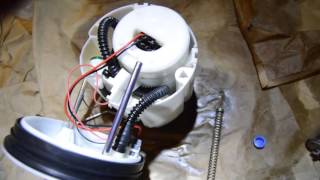
How to confirm: Access the fuel pump assembly under the rear passenger seat. Disconnect the sensor and measure its resistance with a multimeter while moving the float arm. An infinite resistance reading (OL) confirms failure. 🎬 Watch a practical fix walkthrough for the P0463 code. According to service manual information shared on forums, the primary sender should read approximately 6.5-172 ohms.
Typical fix: Replace the primary fuel level sensor. It is located on the main fuel pump assembly but can be purchased and replaced separately.
Est. part cost: $75-$115 - Wiring or Connector Issue 🟡 Medium Probability The connector on top of the fuel pump assembly can become corroded or the wiring can be damaged, leading to an open or high-resistance circuit. This can also occur if pins are not seated correctly after an aftermarket fuel pump installation.
How to confirm: Visually inspect the wiring harness and connector at the top of the fuel tank for corrosion, loose pins, or obvious damage. Test for continuity and proper voltage from the ECM to the connector.
Typical fix: Clean the connector terminals or repair the damaged section of the wiring harness.
Est. part cost: $5-$50 - Aftermarket Tune/Flex Fuel Kit Issue ⚪ Low Probability For cars with aftermarket tunes (e.g., EcuTek for flex fuel), an incorrect voltage range configured in the tune can conflict with the sensor's output, falsely triggering a P0463 code.
How to confirm: This is a software issue. If the code appeared immediately after a new tune was flashed, this is a likely cause. Consult with your tuner to verify the voltage settings for the fuel level sensor.
Typical fix: The tuner must correct the voltage range in the tune file and re-flash the ECU.
Est. part cost: $0-$150 (for tuner time)
Rare But Worth Checking
- Stuck Float Arm: The float arm on the sending unit can become mechanically stuck in the 'full' position, although this is less common than an electrical failure. This might happen if the vehicle has been sitting for a long time or if there are deposits in the fuel tank, sometimes associated with certain fuel types.
- Faulty Instrument Cluster or ECM: In very rare cases, the instrument cluster that displays the gauge reading or the Engine Control Module (ECM) itself can fail. This should only be considered after the sensor and wiring have been thoroughly tested and confirmed to be good.
Diagnosis Steps
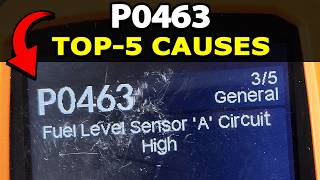
- Read the code with an OBD-II scanner to confirm P0463 is present. 🎬 Watch this guide on diagnosing code P0463.
- Observe the fuel gauge. Note if it is stuck on full, empty, or behaving erratically.
- If the car is modified with a flex fuel kit or aftermarket tune, check with the tuner about known issues or incorrect voltage configurations for the fuel level sensor.
- Gain access to the top of the fuel tank by removing the rear seat cushion. The primary fuel pump assembly is under a cover on the passenger side. 🎬 See how to access and remove the BRZ fuel pump assembly.
- Visually inspect the electrical connector on top of the fuel pump assembly for any signs of corrosion, damage, or loose wires.
- Using a scan tool with live data, monitor the voltage from 'Fuel Level Sensor A'. A reading that is stuck high (e.g., near 5 volts) points towards an open circuit.
- Disconnect the connector and use a multimeter set to Ohms (Ω) to test the resistance of the sending unit. According to forum-cited service data, the primary sensor should read between ~6.5 and 172 Ohms from empty to full. An open circuit (infinite resistance or 'OL') indicates a failed sensor.
- If the sensor tests good, check for a 5V reference signal and a good ground at the connector coming from the ECM.
- If the sensor and wiring are confirmed to be good, the issue may be with the instrument cluster or ECM, which requires more advanced diagnostics.
Parts You'll Likely Need
- Fuel Gauge Sending Unit (Main)
(OEM #42081CA030)— This is the primary fuel level sensor and the most common failure point for code P0463 on the BRZ. It is also listed under Toyota part number SU003-01106 for the 86/FR-S.
Trusted brands: Subaru (OEM), Toyota (OEM)
OEM price range: $75-$115
Aftermarket price range: $50-$90
Platform-Specific Known Issues
- Fuel Pump Recall (WRG-21 / NHTSA 21V587): Subaru issued a recall for certain 2018-2019 BRZ models due to a low-pressure fuel pump that could fail, potentially causing the engine to stall. The recall involves replacing the low-pressure fuel pump impeller. While this recall is for the pump itself and not the level sensor, some owners have reported incorrect fuel gauge readings after the recall service was performed, possibly due to improper reinstallation of the sending unit or related components.
- Intermittent Code on Low Fuel: Several owners on ft86club.com have reported that the P0463 code appears only when the fuel tank is nearly empty and the low fuel light comes on. In some of these cases, clearing the code and keeping the tank above 1/4 full prevents the code from returning. This may indicate a worn spot on the sensor's resistor that is only read at the lowest float position.
Mechanic-Grade Diagnostic Values
- Primary Fuel Level Sender (Sensor 'A', Passenger Side) Resistance — expected: 6.5-8.5 Ω at Full, 168-172 Ω at Empty. Failure: A reading of infinite resistance (OL) or a value that does not change smoothly as the float arm is moved.
- Secondary Fuel Level Sender (Driver's Side) Resistance — expected: 5.5-9.5 Ω at Full, 236-244 Ω at Empty. Failure: Although not the direct cause of P0463, a fault here can affect the combined reading. An OL reading indicates failure.
- Combined Fuel Sender Resistance (at Instrument Cluster) — expected: Under 18 Ω at Full, over 404 Ω at Empty. Failure: A reading that doesn't correspond to the sum of the two individual senders, indicating a wiring issue between the tank and cluster.
- Fuel Pump Trigger Wire Voltage (at pump connector) — expected: ~5 Volts (PWM Signal). Failure: This is a Pulse Width Modulated (PWM) circuit controlled by the Fuel Pump Control ECU. A simple multimeter may show ~5V, not 12V. This is normal operation; an oscilloscope is needed to properly diagnose the signal waveform.
Scan Tool Commands That Help
- Combination Meter Self-Diagnosis: Instrument Cluster Test Mode — To verify the functionality of the instrument cluster gauges, lights, and LCDs independently of the sensor inputs. This helps rule out a faulty cluster. It can be initiated by a specific sequence of turning the ignition and lighting switch and pressing the trip meter knob.
- Subaru Select Monitor (SSM) or equivalent: Test Mode Activation — Connecting the green 'test mode' connectors under the dash forces the ECU into a diagnostic mode. This cycles the fuel pump and radiator fans and allows for ECU reflashing on non-CANbus models. While not a direct fix for P0463, it confirms the fuel pump is receiving power and can be useful during broader fuel system diagnostics.
Wiring & Ground Locations
- Fuel Pump Control ECU — Behind the right-hand side quarter panel in the trunk area.. This module controls the fuel pump speed via a PWM signal. While not directly reading the level sensor, its wiring is co-located with the fuel system harness, making it a relevant landmark for troubleshooting.
- G1 (Ground Point) — Behind the right-hand side quarter panel, near the Fuel Pump Control ECU.. This is a chassis ground point for components in the rear of the vehicle. A poor connection here could potentially affect the fuel pump and sensor circuits that may share a common ground path further down the harness.
- Engine Ground Straps — There are three main engine grounds: one on the bottom of each cylinder head to the frame rail, and one from the top-rear of the transmission to the transmission tunnel.. While not a primary cause, a loose or corroded main engine or transmission ground can cause a variety of floating ground issues and unpredictable electrical problems throughout the vehicle, including strange sensor readings.
- Fuel Pump / Sender Connector (R58) — Top of the fuel pump assembly, passenger side, under the rear seat.. This is the main connector where all circuit testing for the primary sender (P0463) and fuel pump begins. The pins for the level sensor must be identified here for resistance testing.
OEM Part Supersession History
42081CA030→42081CA030 (current)— No supersession found. This part number appears to be consistent for the entire 2013-2020 model year range.
Heads up: This part is for the primary (passenger side) unit only. It is cross-compatible with Toyota part number SU003-01106.
Model Year Variations Within This Range
- 2017-2020: The 2017 model year facelift included minor engine and suspension changes, as well as a revised instrument cluster for the Limited trim which added a 4.2-inch LCD multifunction display. While the fuel sending unit part number remained the same, the way the data is processed and displayed by the cluster is different on these higher-trim models. However, there is no evidence this change affects the diagnosis of P0463.
- 2017-2020: For cars with aftermarket flex fuel kits, the 2017+ models required a revised kit from some manufacturers (like Delicious Tuning) due to factory design revisions to the intake manifold, valvetrain, and cam sensors. This is a critical distinction for owners of modified cars, as an older, incompatible flex fuel tune or hardware could potentially cause electrical issues.
Diagnostic Flowchart
Other Known Issues on This Vehicle
Issues unrelated to this code that are worth knowing about as an owner of this generation:
- Valve Spring Fracture (2013 Models) 🔴 High — Affected the entire 2013 model year run. Failures can occur at any mileage. (Ref: Subaru Recall WTY-84 / Toyota Recall J02 (NHTSA 18V772). Botched recall repairs by dealers have led to subsequent engine failures.)
- Noisy or Failed Throw-Out Bearing 🟠 Medium — Common across all years, especially early models. Often becomes noisy around 30k-50k miles. (Ref: No recall, but a common warranty claim. Aftermarket solutions like the Verus clutch fork and revised OEM bearings are popular fixes.)
- Direct Injector Seal Failure / 'Crickets' 🟠 Medium — More common on early (2013) models but can occur on later years, especially when modified. The 'cricket' or 'chirping' noise from the high-pressure fuel pump is considered normal, but a popping sound can indicate a failing DI seal. (Ref: Subaru TSB 11-130-13 addresses related misfire codes.)
- Tail Light Condensation 🟡 Low — Very common across all model years. Moisture enters the housing due to a poor gasket seal. (Ref: Subaru TSB 07-89-14R addresses this by providing an improved gasket kit.)
- Low-Pressure Fuel Pump Failure (2018-2019 Models) 🔴 High — Affected a specific production range of 2018-2019 models, leading to a recall. (Ref: Subaru Recall WRG-21 (NHTSA 21V587).)
Used vs. New Parts: Buying Guide for This Vehicle
When a used part is the smart pick: A used part is generally not recommended for this repair. The failure is due to electrical wear on a resistor and potential material degradation from fuel (especially E85). A used part carries a high risk of having the same wear or failing shortly after installation.
Donor-vehicle mileage cap: roughly under 30000 miles for the part to have meaningful remaining life.
What to inspect on the donor part:
- Verify the part is from a vehicle that was not run on E85.
- Inspect the float for any signs of saturation, cracking, or degradation.
- If possible, test the resistance of the used part before purchase to ensure it reads within spec (~6.5-172 Ohms) and sweeps smoothly.
- Check the electrical connector pins for any corrosion or damage.
OEM-only on this vehicle (don't cheap out):
- Fuel Level Sending Unit
Aftermarket brands forum-validated for this vehicle:
- No specific aftermarket brands are consistently recommended over OEM on forums. Given the critical function and moderate difficulty of replacement, OEM (Subaru or Toyota) is the safest choice.
Brands owners have reported issues with on this vehicle:
- Unbranded, low-cost parts from online marketplaces should be avoided, as their quality and resistance range may not match OEM specifications, leading to inaccurate readings or a quick repeat failure.
Real Owner Stories
Aggregated from forums and TSBs cited above. Mileages and costs reflect what owners reported in those sources.
2013 Scion FR-S FA20
Symptoms: Fuel gauge stuck at 1/3 tank even after filling up; recurring P0463 code. Owner noted they run E85 fuel almost exclusively.
What fixed it: The owner suspected the sending units were failing due to E85 use, having replaced them previously.
Source hint: ft86club.com - 'Fuel Gauge Woes/P0463'
2015 Subaru BRZ FA20
Symptoms: The P0463 code triggers specifically when the low fuel light illuminates.
What fixed it: One user noted the problem stopped after they discontinued use of an octane booster; others found that keeping the tank above 1/4 full prevented the code from returning.
Source hint: ft86club.com - 'Keep throwing P0463 codes on low gas'
2013 Toyota 86 FA20
Symptoms: Check Engine Light and P0463 appeared immediately after the low fuel light came on.
What fixed it: The code returned after being cleared, confirming a fault triggered by low fuel levels.
Source hint: reddit.com/r/MechanicAdvice - '2013 Toyota 86 CEL and error code P0463'
Related OBD-II Codes
Frequently Asked Questions
Is there a recall for the fuel level sensor on my 2018-2019 Subaru BRZ?
Why does my BRZ's cruise control stop working when the P0463 code appears?
Can running E85 fuel cause the P0463 code on my BRZ?
My fuel gauge only acts up when the tank is low; do I need a new sensor?
I have an EcuTek flex fuel tune and just got a P0463; is the sensor actually broken?
Where is the primary fuel level sending unit located on the BRZ?
Helpful Videos
We Have This Part in Stock


The information in this article is provided for general reference and educational purposes only. Vehicle specifications, procedures, and part compatibility can vary by production date, trim level, and region. Always consult your vehicle's factory service manual and verify part numbers before purchasing or performing repairs. Safety-critical components such as airbags, seat belts, and braking systems should be installed by a qualified professional.
- Subaru BRZ:
- 🎬 Helpful Videos
- 🛍️ Shop This Part
- What's Unique About the 2013-2020 Subaru BRZ
- Symptoms You May Notice
- Most Likely Causes
- Rare But Worth Checking
- Diagnosis Steps
- Parts You'll Likely Need
- Platform-Specific Known Issues
- Mechanic-Grade Diagnostic Values
- Scan Tool Commands That Help
- Wiring & Ground Locations
- OEM Part Supersession History
- Model Year Variations Within This Range
- Diagnostic Flowchart
- Other Known Issues on This Vehicle
- Used vs. New Parts: Buying Guide for This Vehicle
- Real Owner Stories
- 2013 Scion FR-S FA20
- 2015 Subaru BRZ FA20
- 2013 Toyota 86 FA20
- Related OBD-II Codes
- Frequently Asked Questions
- 🎟️ Get 5% Off