

P0463 on 2014-2020 Mitsubishi Outlander: Fuel Level Sensor Circuit High Input Causes and Fixes
On a 2014-2020 Mitsubishi Outlander, code P0463 usually means the fuel level sending unit has failed, requiring replacement of the fuel pump module. Before replacing parts, check if the code was triggered by running the tank extremely low; simply adding fuel and clearing the code may be the only fix needed, as documented in a Mitsubishi Technical Tip.
- First, if your Check Engine Light came on when the tank was nearly empty, add fuel and clear the code before attempting any repairs, as this is a known quirk for this vehicle.
- The most likely hardware failure is the fuel level sending unit, which is part of the fuel pump module and requires replacement as a single assembly.
- While you can continue to drive with a P0463 code, your fuel gauge will be unreliable, creating a risk of running out of gas unexpectedly.
What's Unique About the 2014-2020 Mitsubishi Outlander
A unique characteristic of the Mitsubishi Outlander (and its platform-mate, the Outlander Sport/RVR) is that the P0463 code can sometimes be triggered simply by running the fuel tank to an extremely low level. According to a manufacturer technical tip, TT-16-13-001, if the vehicle runs out of gas or is close to it (no bars on the fuel gauge), the sensor can send a signal that the computer interprets as a fault. In these specific cases, adding fuel and clearing the code may resolve the issue without needing any parts. This should always be the first check before beginning a more complex diagnosis. Additionally, All-Wheel Drive (AWD) models use a saddle-style fuel tank with two separate fuel level sending units (main and sub), adding a second potential point of failure compared to FWD models.
Symptoms You May Notice
- Check Engine Light is on
- Fuel gauge is inaccurate, often stuck on 'Full' regardless of the actual fuel level
- Fuel gauge fluctuates erratically
- Low fuel warning light may be on constantly or flashing
- In some rare cases, may be associated with a failed emissions test
- Replacing the fuel pump module without first checking if the code was simply caused by an extremely low fuel level. Always add fuel and try to clear the code first if the tank was empty.
- On AWD models, replacing the main fuel pump assembly when the actual fault is with the secondary (sub) sending unit or its wiring on the other side of the tank.
Most Likely Causes
- Faulty Fuel Level Sending Unit 🔴 High Probability The sending unit is a moving part with a resistor strip that can wear out or corrode over time, leading to an open circuit or incorrect resistance reading. This is the most common point of failure for this code. On AWD models, there are two sending units (main and sub), doubling the chance of failure.
How to confirm: Test the resistance of the sending unit with a multimeter while moving the float arm. Compare the readings to the manufacturer's specifications. An infinite resistance (OL) or a reading over 186 ohms confirms failure.
Typical fix: Replace the fuel level sending unit. On the Outlander, this is sold as part of the complete fuel pump module assembly. On AWD models, determine which of the two senders has failed.
Est. part cost: $250-$750 - Damaged Wiring or Connectors 🟡 Medium Probability The wiring harness leading to the fuel tank is exposed to the elements under the vehicle, making it susceptible to corrosion, moisture intrusion, or physical damage from road debris or rodents. The connector on top of the fuel pump module is a common spot for corrosion or broken wires, which will cause an open circuit and trigger P0463.
How to confirm: Visually inspect the wiring harness and the connector on top of the fuel tank for any signs of corrosion (green or white powder), broken wires, or loose pins. Perform a voltage and continuity test on the signal wire from the pump to the combination meter.
Typical fix: Repair the damaged section of the harness or clean/replace the corroded connector.
Est. part cost: $10-$50 - Extremely Low Fuel Level ⚪ Low Probability As documented in Mitsubishi Technical Tip TT-16-13-001, the sensor's reading at the very bottom of the tank can be misinterpreted by the ECM as a fault. This has been reported by owners and technicians at Pre-Delivery Inspection (PDI).
How to confirm: If the Check Engine Light appeared immediately after running low on fuel, add at least a few gallons of gas, clear the code with a scan tool, and drive the vehicle to see if the code returns. If it doesn't, the issue is resolved.
Typical fix: Add fuel and clear the diagnostic trouble code.
Est. part cost: $0
Rare But Worth Checking
- Faulty Instrument Cluster (Combination Meter): The cluster processes the sensor signal before sending it to the ECM. A failure in its internal circuitry could alter the signal, but this is uncommon and should be considered only after ruling out the sensor and wiring. The official Mitsubishi diagnostic tree lists this as a potential cause.
- Stuck Fuel Level Float Arm: If a vehicle sits for a long period, the float arm can become stuck due to rust or fuel varnish. This would cause a constant reading that the ECM might interpret as a fault. This is less common than outright sensor failure but is possible.
- Faulty Engine Control Module (ECM): While the ECM is listed as a potential cause in service literature, it is extremely rare for it to be the source of this specific code. All other possibilities should be exhausted before considering ECM replacement.
Diagnosis Steps
- Check for the Mitsubishi Technical Tip: If the vehicle was recently run very low on fuel, add several gallons of gas, clear the code with a scan tool, and perform a drive cycle to see if the code returns. If it does not, no further action is needed.
- Scan Tool Data: Use an OBD-II scanner to view the live data for the fuel level sensor. A P0463 code is often accompanied by a reading that is stuck at 100% or shows an erratic/invalid value. On AWD models, check readings for both the main and sub sensors if available.
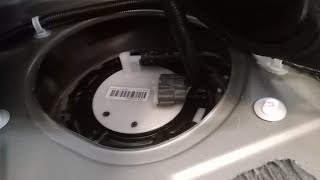
- Visual Inspection: Inspect the wiring harness and connector at the top of the fuel tank. Access is typically under the rear seat. On AWD models, there are two access ports and two connectors to inspect. Look for any signs of corrosion, damage, or loose connections.
- Circuit Test: With the key on, engine off, back-probe the signal wire at the fuel pump connector. 🎬 Watch this video on diagnosing and fixing a P0463 code A high voltage reading (typically near 5V or even battery voltage) points towards an open circuit in the sensor or a short to power.
- Sensor Resistance Test: Disconnect the fuel pump module. Access the fuel level sensor terminals and measure the resistance with a multimeter. The resistance should change smoothly as you move the float arm. If the reading is infinite (OL) or doesn't change, the sending unit is faulty. The code sets when resistance is >186 ohms. A reading of ~250 ohms indicates a complete open circuit. A good sensor should read between approximately 10-20 ohms (Full) and 150-180 ohms (Empty).
- Ground Check: Verify that the ground circuit for the fuel pump module has a solid connection to the chassis. A poor ground can cause high resistance readings.
- If the sensor and wiring test good, the issue may lie within the combination meter (instrument cluster), which is a much less common failure.
Parts You'll Likely Need
- Fuel Pump Module Assembly
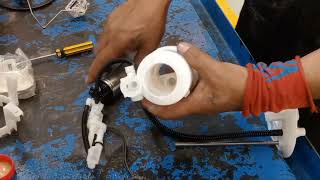
(OEM #1760A606 (AWD, 2.4L, 2018-2020), 1760A322 (FWD, 2.4L))— This is the most common failure. The fuel level sending unit that causes the code is almost always integrated into the main fuel pump module and not sold separately by the OEM. 🎬 See how to remove and dismantle the fuel pump assembly Part numbers vary by configuration; always confirm with VIN.
Trusted brands: Mitsubishi Genuine, Delphi, Denso, Carter
OEM price range: $500-$750
Aftermarket price range: $250-$450
Technical Service Bulletins (TSBs) & Recalls
- TT-16-13-001 (May 2016): This is a Technical Tip, not a formal TSB. It notes that DTC P0463 may be set on 2007-2016 Outlanders and 2011-2016 Outlander Sport/RVR models when the fuel level is extremely low, and that adding fuel and clearing the code is the first diagnostic step.
Platform-Specific Known Issues
- A known issue documented by Mitsubishi in Technical Tip TT-16-13-001 is that this code can be set by simply having an extremely low fuel level. This is not a part failure but a characteristic of the system's monitoring strategy.
- All-Wheel Drive (AWD) models feature a saddle-style tank with two fuel level sensors (main and sub). A P0463 code can be caused by a failure in either sensor or their respective wiring, requiring more specific diagnosis to isolate the fault.
Mechanic-Grade Diagnostic Values
- Fuel Level Sensor Resistance — expected: Approx. 10-20 Ohms (Full) to 150-180 Ohms (Empty). Resistance should change smoothly when moving the float arm.. Failure: A reading greater than 186 Ohms for two seconds triggers the code. An open circuit will read very high (e.g., 250 Ohms) or infinite (OL).
Scan Tool Commands That Help
- Mitsubishi MUT-III: Data List — To read the live resistance/voltage values from the main and sub (on AWD models) fuel level sensors as seen by the combination meter and ECM. This helps determine if the fault is present and which sensor is affected without disassembly.
Wiring & Ground Locations
- D-106 — On top of the main fuel pump and gauge unit assembly, inside the fuel tank, accessible from under the rear seat.. This is the primary connector for the fuel pump and the main fuel level sensor. Corrosion or a broken wire at this connector will cause an open circuit and trigger P0463.
- D-119 — On top of the sub fuel gauge unit, on the opposite side of the fuel tank from the main pump. Only present on 4WD models.. This is the connector for the secondary fuel level sensor in AWD models. A fault here will also trigger P0463, making it a critical check point that can be easily missed.
- C-206 — At the back of the instrument cluster (combination meter).. The fuel level sensor signals run through this connector. If the sensor and its wiring at the tank test good, a continuity check to this connector can help isolate a wiring break between the tank and the dash.
Real Owner Repair Stories
- YouTube channel 'Колхозный Автоэлектрик 22' (Mitsubishi Outlander (3rd Gen)) — Flashing low fuel light, fuel gauge inoperative.
❌ Tried (didn't work) A previous shop had replaced the fuel tank and claimed to have repaired the wiring, but the fault returned.
✅ What actually fixed it The technician diagnosed an open circuit (250 ohms) on one of the two fuel senders (AWD model). He accessed the connector for the sub-sender unit under the rear seat and found a wire had broken off right at the connector pin. After repairing the broken wire, the resistance reading dropped to a normal 14 ohms and the fuel gauge began working correctly.
Model Year Variations Within This Range
- 2014-2020: All-Wheel Drive (AWD) models use a saddle-style fuel tank with two fuel level sensors: a main unit integrated with the fuel pump, and a separate 'sub' unit on the other side. Front-Wheel Drive (FWD) models have a single fuel level sensor. This fundamentally changes the diagnosis, as there are two potential sensors and wiring harnesses to check on AWD vehicles.
Diagnostic Flowchart
Other Known Issues on This Vehicle
Issues unrelated to this code that are worth knowing about as an owner of this generation:
- Premature CVT Transmission Failure 🔴 High — Widespread reports, with issues like shuddering, hesitation, whining, or complete failure sometimes appearing between 80,000 and 120,000 km. Regular CVT fluid changes (every 30,000 miles) are highly recommended to prolong life. (Ref: Multiple TSBs exist for shudder/surge conditions, often involving software updates.)
- Corroding Rear Brake Caliper Shafts 🟠 Medium — Common enough to warrant a recall, especially in regions using road salt. The parking brake actuator shaft can corrode and bind. (Ref: Recall 19V689000 (NHTSA ID) for 2014-2016 Outlander models.)
- Failing Liftgate Gas Struts 🟡 Low — The gas springs for the rear liftgate can corrode and lose pressure, causing the liftgate to fall unexpectedly or, in rare cases, rupture. (Ref: Recall 22V507000 (NHTSA ID) affects 2014-2020 Outlander models.)
- Erratic Forward Collision Mitigation (FCM) / Adaptive Cruise Control (ACC) 🟠 Medium — Some early models (around 2013-2014) were recalled for software issues where the system could misidentify objects (like tunnel walls) and brake unnecessarily. (Ref: Recall issued for early 3rd-gen models (e.g., 2013) to update system software.)
Used vs. New Parts: Buying Guide for This Vehicle
When a used part is the smart pick: A used wiring harness pigtail is a smart choice if only the connector is damaged. A complete fuel pump module from a junkyard is risky due to unknown pump motor wear, but can be a cost-saving option if it's from a low-mileage, non-corroded donor vehicle and you are primarily trying to solve the sending unit fault.
Donor-vehicle mileage cap: roughly under 60000 miles for the part to have meaningful remaining life.
What to inspect on the donor part:
- Inspect connector pins for any green or white corrosion powder.
- Ensure the plastic housing of the connector and pump top hat is not brittle or cracked.
- Verify the float arm is present, moves freely, and is not bent or damaged.
- If possible, check the resistance of the sending unit on the donor part before purchasing.
Aftermarket brands forum-validated for this vehicle:
- Denso
- Delphi
- Carter
Real Owner Stories
Aggregated from forums and TSBs cited above. Mileages and costs reflect what owners reported in those sources.
2016 Mitsubishi Outlander Sport / RVR
Symptoms: The Check Engine Light (DTC P0463) was recorded in the PCM and the fuel gauge stopped registering correctly.
What fixed it: Following the guidance in Technical Tip TT-16-13-001, the fuel level was found to be extremely low; adding fuel and clearing the code resolved the issue.
Source hint: Technical Tip TT-16-13-001 (May 2016) via NHTSA's website
2014 Mitsubishi Outlander AWD
Symptoms: The fuel gauge was stuck on 'Full' regardless of the actual fuel level and the Check Engine Light was illuminated.
What fixed it: Replaced the fuel pump module assembly after testing the sending unit and finding resistance over 186 ohms (open circuit).
Source hint: vehicle_specific_issues and common_causes
Related OBD-II Codes
Frequently Asked Questions
I ran my Outlander almost out of gas and now the Check Engine Light is on with code P0463. Do I need a new fuel pump?
My 2015 Outlander AWD fuel gauge is acting crazy. Why are there two sensors mentioned for this repair?
Is there a specific resistance value I should look for when testing the fuel sender on my 2014-2020 Outlander?
Can I just replace the sensor, or do I have to buy the whole fuel pump assembly?
Where is the access point to inspect the wiring for the fuel sensors on this vehicle?
Could my P0463 code be related to the rear brake or liftgate recalls on my 2016 Outlander?
Helpful Videos
Used OEM Parts in Stock


New Aftermarket Parts Available


The information in this article is provided for general reference and educational purposes only. Vehicle specifications, procedures, and part compatibility can vary by production date, trim level, and region. Always consult your vehicle's factory service manual and verify part numbers before purchasing or performing repairs. Safety-critical components such as airbags, seat belts, and braking systems should be installed by a qualified professional.
- Mitsubishi Outlander:
- 🎬 Helpful Videos
- 🛍️ Shop This Part
- What's Unique About the 2014-2020 Mitsubishi Outlander
- Symptoms You May Notice
- Most Likely Causes
- Rare But Worth Checking
- Diagnosis Steps
- Parts You'll Likely Need
- Technical Service Bulletins (TSBs) & Recalls
- Platform-Specific Known Issues
- Mechanic-Grade Diagnostic Values
- Scan Tool Commands That Help
- Wiring & Ground Locations
- Real Owner Repair Stories
- Model Year Variations Within This Range
- Diagnostic Flowchart
- Other Known Issues on This Vehicle
- Used vs. New Parts: Buying Guide for This Vehicle
- Real Owner Stories
- 2016 Mitsubishi Outlander Sport / RVR
- 2014 Mitsubishi Outlander AWD
- Related OBD-II Codes
- Frequently Asked Questions
- 🎟️ Get 5% Off