

P0462 on 2015-2024 Audi Q7: Fuel Level Sensor Circuit Low Causes and Fixes
On a 2015-2024 Audi Q7, code P0462 almost always indicates a failed fuel level sensor or sending unit inside the fuel tank. This results in an inaccurate or empty fuel gauge. The sensor is part of the fuel pump module, and replacement can be a moderately difficult DIY job. On TDI models, this fault can disrupt DPF regeneration cycles, making a timely repair more critical.
- P0462 on an Audi Q7 points to a low voltage signal from the primary fuel level sensor, designated 'Sensor 1' or 'G'.
- The most common symptom is an inaccurate or non-functional fuel gauge.
- The most likely cause is a failed fuel level sending unit, which is usually part of the fuel pump assembly located under the right rear seat.
- On TDI models, this fault can negatively impact the DPF regeneration cycle, leading to a clogged DPF and limp mode, making a timely repair more critical.
- Always verify wiring and connectors, especially for chafing near the tank access panel, before replacing the entire fuel pump module.
What's Unique About the 2015-2024 Audi Q7
The Audi Q7, especially with its Quattro all-wheel-drive system, uses a saddle-shaped fuel tank that straddles the driveshaft. This design requires two separate fuel level sensors to provide an accurate reading. P0462 specifically points to a problem with the primary sensor, designated as 'Sensor 1' or 'G', which is typically on the passenger side. The secondary sensor is known as 'Sensor 2' or 'G169'. A failure of one of these sensors is a known issue. A significant concern for TDI models is that the engine control module uses fuel level data to initiate Diesel Particulate Filter (DPF) regeneration. An incorrect or empty reading can prevent regeneration, leading to soot accumulation, 🎬 Watch: Tips to prevent a blocked TDI DPF limp mode, and additional fault codes.
Generation note: The 2015-2024 year range covers two generations of the Audi Q7: the end of the first generation (4L, up to 2015) and the second generation (4M, 2015/2017-present). While the P0462 code has the same meaning for both, the specific part numbers for the fuel level sensor and fuel pump assembly will differ. The diagnostic process remains largely the same for both generations. The 4M generation is the primary focus of this article.
Symptoms You May Notice
- Check Engine Light is on
- Fuel gauge reads empty or is inaccurate
- Fuel gauge fluctuates erratically
- Low fuel warning light comes on even with a full tank
- DPF warning light may illuminate on TDI models due to failed regeneration cycles
- Replacing the fuel pump when only the sending unit has failed. While they are often part of the same assembly, it's important to confirm the pump itself is faulty before replacing the entire unit if they can be serviced separately.
- Replacing the DPF on TDI models without addressing the root cause. A clogged DPF can be a symptom of the P0462 code preventing regeneration, not the cause of the problem itself.
Most Likely Causes
- Failed Fuel Level Sensor 🔴 High Probability The fuel level sensor is a moving part (a float on an arm) that operates constantly within the fuel tank. Over time, the variable resistor's contacts can wear out, or the float mechanism can fail, leading to incorrect readings. This is a common failure point on many vehicles, including the Q7.
How to confirm: Access the top of the fuel tank and disconnect the sensor. Use a multimeter to measure the resistance of the sensor while manually moving the float arm. For Sensor 1 ('G'), the resistance should change smoothly from approximately 295-305 Ohms when empty to 56-68 Ohms when full. If the reading is erratic, shows an open circuit (infinite resistance), or a short circuit (near zero resistance), the sensor is bad.
Typical fix: Replace the fuel level sending unit. On the Audi Q7, this sensor is typically integrated into the fuel pump module, so the entire module is often replaced. Access is under the rear passenger-side seat. 🎬 Watch: Access the fuel pump without unbolting the seat
Est. part cost: $150 - $450 - Wiring Issues 🟡 Medium Probability Wires leading to the fuel tank can be susceptible to damage from road debris or corrosion. A short to ground in the signal wire is a common cause for a 'Circuit Low' code. A TSB for other Audi models (A8) notes that the wiring harness can rub through on the service opening for the fuel tank, causing a short. This is a plausible failure point to inspect on the Q7 as well.
How to confirm: Perform a visual inspection of the wiring harness going to the fuel tank, particularly where it passes through the body near the access panel under the rear seat. With the sensor disconnected, check for continuity to ground on the signal wire. There should be no continuity. Also, check for proper voltage and ground at the connector.
Typical fix: Repair the damaged section of the wiring harness. This could involve fixing a chafed wire, cleaning a corroded connector, or repairing a broken wire. If chafing is found, reroute the harness and apply protective tape.
Est. part cost: $10 - $50
Rare But Worth Checking
- Faulty Instrument Cluster: While rare, the instrument cluster itself can fail, causing it to misinterpret the signal from a perfectly good fuel level sensor. This is usually accompanied by other gauge-related issues. Some older Audi TSBs mention recalibrating the cluster via adaptation channels as a potential fix for inaccurate readings.
- Powertrain Control Module (PCM) Malfunction: This is a very uncommon cause. Before condemning the PCM, all other possibilities, including the sensor and wiring, must be thoroughly ruled out.
- Faulty Fuel Pump Control Module (J538): The J538 module, located under the rear seat bench, regulates power to the fuel pump. While a failure typically causes no-start or stalling issues, electrical faults within the module or its connector could potentially affect the sensor circuit that shares the same harness, leading to codes like P0462.
Diagnosis Steps
- Scan the vehicle's computer for any other stored trouble codes, paying attention to both engine (PCM) and body/comfort control modules.
- Use a scan tool to observe the live data from the fuel level sensors (Sensor 1/G and Sensor 2/G169). Check if the reading corresponds to the approximate amount of fuel in the tank.
- Perform a visual inspection of the fuel tank, wiring harness, and connectors for any signs of damage, corrosion, or loose connections. Pay close attention to the harness near the service opening under the rear seat.
- Gain access to the fuel pump/sensor module connector at the top of the fuel tank (typically under the right rear seat).
- With the key on, use a multimeter to check for the correct reference voltage and a good ground at the connector.
- Disconnect the connector and measure the resistance of the fuel level sensor. 🎬 See how to test and replace the pump assembly For Sensor 1 ('G'), compare the reading to the manufacturer's specifications: approx. 295-305 Ohms (empty) to 56-68 Ohms (full).
- If the resistance is out of specification or if it doesn't change smoothly when the fuel level changes (or when the float is manually moved, if the unit is removed), the sending unit is faulty.
- If the sensor tests good, check the signal wire for a short to ground between the sensor connector and the PCM.
Parts You'll Likely Need
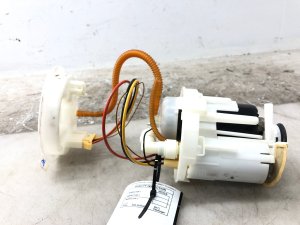
- Fuel Pump and Sending Unit Assembly
(OEM #7L8919673C (Example for 4L Gen, verify for 4M))— The fuel level sensor (sending unit) is the most common cause of P0462. On the Audi Q7, it is typically integrated with the in-tank fuel pump as a single module.
Trusted brands: Bosch, VDO, Continental, Genuine Audi
OEM price range: $300-$500
Aftermarket price range: $150-$350
Related Codes That Often Appear With This One
- P0463 — This code means "Fuel Level Sensor 'A' Circuit High". Seeing it alongside P0462 could indicate an intermittent wiring problem where the signal is fluctuating between being too low (shorted) and too high (open circuit).
- P2463 — On TDI models, this code for "Diesel Particulate Filter Restriction - Soot Accumulation" can sometimes be triggered by a faulty fuel level sensor. The engine management system uses fuel level data in its calculations for DPF regeneration cycles. An incorrect fuel level reading can disrupt this process.
- B103E1A — This is a body control module code for 'Fuel gauge sensor 1 Resistance too low', which is the manufacturer-specific equivalent of P0462 and directly points to the same issue.
Technical Service Bulletins (TSBs) & Recalls
- TSB 97 20 75 (2056234/3) for 2018-2020 Audi A8: While not for the Q7, this TSB is highly relevant as it addresses identical fault codes (B103E1A - Resistance too low) caused by the fuel tank sender wiring rubbing through on the service opening. This suggests a potential design pattern and a key area to inspect for wiring faults on the Q7.
- TSB 2019804/3 (or 90 15 53) for older Audis: Addresses inaccurate fuel gauge displays by recommending a recalibration of the instrument cluster adaptation values. This is a less likely fix for a 'Circuit Low' code but is worth noting if symptoms are purely gauge inaccuracy without a hard fault.
Platform-Specific Known Issues
- On the 3.0L TDI engine, an inaccurate fuel level reading can interfere with the Diesel Particulate Filter (DPF) regeneration process, potentially leading to DPF soot accumulation and additional fault codes like P2463. A user on the Ross-Tech forums detailed this exact scenario on a 2018 Q7 4M, where a failing sensor led to DPF values running 'riot' and forcing the vehicle into limp mode, requiring dealer intervention.
Mechanic-Grade Diagnostic Values
- Fuel Level Sensor 1 (G) Resistance — expected: Approx. 295-305 Ohms (empty) to 56-68 Ohms (full). Failure: Near zero Ohms (short), infinite Ohms (open), or erratic readings when float is moved.
- Fuel Level Sensor 2 (G169) Resistance — expected: Approx. 275-296 Ohms (empty) to 47-65 Ohms (full). Failure: Readings outside of the expected range, indicating a fault in the secondary sensor.
- Live Data - Fuel Level (VCDS) — expected: Value in liters should correspond to the estimated amount of fuel in the tank for both sensors.. Failure: A reading of 0L or a value that does not change after refueling points to a sensor or circuit fault.
Hidden / Shadow Codes Worth Checking
- B103E1A: Fuel gauge sensor 1: Resistance too low. This is the manufacturer-specific code logged in the Comfort System Central Control Module (J393, Address 46) that corresponds directly to the generic P0462 code. (see via Advanced scan tools like VCDS (VAG-COM) or ODIS are required to read codes from the body/comfort modules.)
- B103E1B: Fuel gauge sensor 1: Resistance too high. This code indicates an open circuit and may appear intermittently with B103E1A if there is a loose connection or failing sensor. (see via Advanced scan tools like VCDS (VAG-COM) or ODIS.)
Scan Tool Commands That Help
- VCDS (VAG-COM): Controller 17 (Instruments) -> Measuring Value Blocks (MVB) — Use this function to view the live, raw data from both Fuel Level Sensor 1 (G) and Sensor 2 (G169) simultaneously. This is the most effective way to confirm if the sensor is sending an illogical signal (e.g., 0 liters) that is causing the fault code, without having to physically access the tank.
- VCDS (VAG-COM): Controller 17 (Instruments) -> Adaptation -> Channel 30 — This allows for adjustment of the fuel gauge calibration. It is generally not a fix for a 'Circuit Low' fault, but can be useful for minor inaccuracies if the sensor and wiring are confirmed to be good. Use with caution and refer to a service manual.
Wiring & Ground Locations
- Fuel Pump Control Module (J538) Ground — A wiring diagram for the 4M Q7 indicates the ground connection (Terminal 31) for the J538 module is located on the right C-pillar.. A poor or corroded ground at this location can cause a variety of fuel delivery issues, and since the sensor wiring is in the same harness, it could potentially introduce voltage irregularities that trigger a P0462 code.
- Service Opening Harness Chafe Point — Under the rear seat bench at the service opening for the fuel tank.. A TSB for the Audi A8 with the same fault code identifies a common issue where the fuel tank sender wiring rubs through on the metal edge of the service opening, causing a short to ground. This is a high-probability inspection point for the Q7.
Real Owner Repair Stories
- Ross-Tech Forums user 'Milez' (2018 Audi Q7 4M 3.0 TDI at 54,000 miles) — Fuel gauge suddenly showed empty after a full fill-up. Shortly after, the DPF warning light came on, followed by the main MIL (Check Engine Light) and the vehicle entering limp mode.
❌ Tried (didn't work) Clearing the codes with VCDS did not resolve the issue. The DPF soot mass was too high (46.12g) to initiate a normal regeneration.
✅ What actually fixed it The immediate issue (limp mode) was resolved by a forced DPF regeneration at an Audi dealer. The root cause was identified as the failing fuel level sensor (logging code B103E 1B), which needed to be replaced to prevent the DPF issue from reoccurring. The forum post confirms the direct link between the fuel sensor failure and the DPF system entering a fault state.
OEM Part Supersession History
4M0919087F→4M0919087H, 4M0919087R, 4M0919087S (and others, always verify with VIN)— Revisions are common to improve reliability or accommodate minor manufacturing changes.
Heads up: It is critical to match the part number to the vehicle's VIN and specific PR codes. Using the wrong revision, even if it fits physically, can result in incorrect fuel level readings or communication errors with the vehicle's control modules.
Model Year Variations Within This Range
- 2016-2019 (Pre-Facelift) vs. 2020-2024 (Facelift): While the fundamental design of the saddle tank and dual-sender system is the same, the specific part numbers for the fuel pump and sender assembly may differ between the pre-facelift (4M) and facelift (4M.5) models. Always confirm the part number with the vehicle's VIN before ordering.
Diagnostic Flowchart
Other Known Issues on This Vehicle
Issues unrelated to this code that are worth knowing about as an owner of this generation:
- Oil Cooler & Valley Leaks 🔴 High — Very common, often occurs between 60,000 and 120,000 miles. Seals for the oil cooler and related components in the 'V' of the engine fail, causing oil and/or coolant to pool there.
- Coolant Leaks (Water Pump/Thermostat Housing) 🟠 Medium — Common failure point. The water pump and associated plastic coolant pipes can become brittle and leak. Often repaired at the same time as the oil cooler seals. (Ref: Audi has faced class-action lawsuits for premature water pump failures on various models.)
- Timing Chain Tensioner Wear 🔴 High — Less common than leaks but very serious. Can manifest as a rattling noise on startup. The hydraulic tensioners can fail, potentially leading to the chain jumping teeth. Repair is extremely labor-intensive as the chains are at the rear of the engine.
- Carbon Buildup on Intake Valves 🟠 Medium — A known issue with direct-injection engines, including the TDI. Carbon deposits can build up in the intake manifold and on the valves, restricting airflow and affecting performance.
- High-Pressure Fuel Pump (HPFP) Failure 🔴 High — While not specific to just the TDI, HPFP failure can occur, leading to stalling, loss of power, and codes like P0087. On some models, failure of the in-tank pump can send debris that destroys the HPFP.
Used vs. New Parts: Buying Guide for This Vehicle
When a used part is the smart pick: For this repair, a used part is generally not recommended for the fuel pump/sender assembly itself. The labor to access the unit is significant, and a used part carries an unknown lifespan. A used wiring harness pigtail or a used Fuel Pump Control Module (J538) could be a sensible cost-saving measure if those specific components are diagnosed as faulty.
Donor-vehicle mileage cap: roughly under 50000 miles for the part to have meaningful remaining life.
What to inspect on the donor part:
- For a control module, ensure the part number is an exact match.
- For a wiring connector, inspect for any signs of corrosion, melted plastic, or brittle wires.
- Verify the donor vehicle was not involved in a rear-end collision or flood.
- Obtain the VIN of the donor car to cross-reference its production date and options.
OEM-only on this vehicle (don't cheap out):
- Fuel Pump and Sending Unit Assembly: Due to the critical nature of fuel delivery and the high labor cost for replacement, using a Genuine Audi, VDO, or Bosch (often the OEM supplier) part is strongly advised to ensure longevity and proper function.
Aftermarket brands forum-validated for this vehicle:
- Bosch
- VDO
- Continental
Brands owners have reported issues with on this vehicle:
- Generic, unbranded "white-box" parts from online marketplaces should be avoided. Forum discussions frequently highlight premature failures and inaccurate readings from low-quality aftermarket sending units.
Real Owner Stories
Aggregated from forums and TSBs cited above. Mileages and costs reflect what owners reported in those sources.
2018 Audi Q7 4M 3.0 TDI
Symptoms: The fuel level sensor (B103E 1B) failed, causing the DPF values to run 'riot' and preventing the car from performing normal regeneration cycles. This eventually forced the vehicle into limp mode.
What fixed it: The owner required a dealer-performed forced regeneration of the DPF after addressing the fuel sensor issue.
Source hint: Ross-Tech Forums thread titled '3.0 TDI DPF-related fault codes and limp mode' (https://forums.ross-tech.com/index.php?threads/34323/)
Related OBD-II Codes
Frequently Asked Questions
Can a faulty fuel sensor on my Q7 TDI cause issues with the Diesel Particulate Filter (DPF)?
Where is the fuel level sensor located on the Audi Q7, and how do I get to it?
What are the specific resistance values I should look for when testing Sensor 1 (G)?
Does TSB 97 20 75 apply to the Q7 wiring issues?
Is there a way to fix the fuel gauge without replacing parts?
Why is my Q7 showing a 'Circuit Low' code for the fuel sensor?
Helpful Videos
Used OEM Parts in Stock




New Aftermarket Parts Available

The information in this article is provided for general reference and educational purposes only. Vehicle specifications, procedures, and part compatibility can vary by production date, trim level, and region. Always consult your vehicle's factory service manual and verify part numbers before purchasing or performing repairs. Safety-critical components such as airbags, seat belts, and braking systems should be installed by a qualified professional.
- Audi Q7:
- 🎬 Helpful Videos
- 🛍️ Shop This Part
- What's Unique About the 2015-2024 Audi Q7
- Symptoms You May Notice
- Most Likely Causes
- Rare But Worth Checking
- Diagnosis Steps
- Parts You'll Likely Need
- Related Codes That Often Appear With This One
- Technical Service Bulletins (TSBs) & Recalls
- Platform-Specific Known Issues
- Mechanic-Grade Diagnostic Values
- Hidden / Shadow Codes Worth Checking
- Scan Tool Commands That Help
- Wiring & Ground Locations
- Real Owner Repair Stories
- OEM Part Supersession History
- Model Year Variations Within This Range
- Diagnostic Flowchart
- Other Known Issues on This Vehicle
- Used vs. New Parts: Buying Guide for This Vehicle
- Real Owner Stories
- 2018 Audi Q7 4M 3.0 TDI
- Related OBD-II Codes
- Frequently Asked Questions
- 🎟️ Get 5% Off