

P0461 on 2016-2024 Mazda MX-5: Fuel Level Sensor Circuit Explained
This code means your MX-5's computer has detected a problem with the fuel level sensor in the gas tank. The most common fix is replacing the fuel level sending unit, which is part of the fuel pump module. Expect to pay around $45-$65 for the OEM sensor itself.
- P0461 on your MX-5 means the fuel gauge reading isn't dropping as you drive, pointing to a faulty fuel level sensor.
- The most likely cause is a failed fuel level sending unit (OEM Part #: N270-60-960), which is a relatively inexpensive part.
- Before replacing parts, check the wiring and connector at the fuel tank for damage or corrosion.
- While you can drive with this code, the unreliable fuel gauge means you risk running out of gas. Use your trip meter to track fuel usage as a backup.
- Be aware that 2018-2019 models had a fuel pump recall, and early 2016-2017 manual transmission cars had known issues.
What's Unique About the 2016-2024 Mazda MX-5
The ND generation MX-5 (2016-2024) has a specific, logic-based trigger for this code based on fuel consumption versus sensor output, making it less prone to false positives from fuel sloshing. While this code itself is not exceptionally common, some 2018-2019 MX-5 models were part of a major recall (NHTSA 21V875) for faulty low-pressure fuel pump impellers. Although that recall addressed stalling issues and not the sending unit directly, it highlights that the in-tank fuel pump module, which houses the sending unit, has been a point of failure on this platform. The issue is also present on its chassis-mate, the Fiat 124 Spider.
Symptoms You May Notice
- Check Engine Light is on
- Fuel gauge behaves erratically (e.g., jumps from half to empty)
- Fuel gauge is stuck on full or empty.
- Low fuel warning light stays on even with a full tank.
- Replacing the entire fuel pump assembly when only the sending unit has failed. The sending unit is often available as a separate, much cheaper part.
- Replacing the instrument cluster without first testing the sending unit and wiring, which are the more probable causes.
Most Likely Causes
- Faulty Fuel Level Sending Unit 🔴 High Probability The sending unit is a mechanical component with a float and a variable resistor (potentiometer) that can wear out over time, causing dead spots or incorrect readings. This is the most commonly reported fix in owner forums.
How to confirm: Access the fuel pump module and test the sending unit's resistance with a multimeter while moving the float arm. 🎬 Watch how to test a fuel level sending unit The resistance should change smoothly without any jumps or open circuits.
Typical fix: Replace the fuel level sending unit. It is sold separately but is attached to the main fuel pump assembly inside the tank.
Est. part cost: $45-$65 - Wiring or Connector Issue 🟡 Medium Probability The wiring harness leading to the fuel tank can be susceptible to damage or corrosion, especially at the connector on top of the fuel pump module. Vibration and exposure can lead to intermittent connections.
How to confirm: Visually inspect the wiring harness for any signs of damage, chafing, or corrosion. Check for a solid connection at the fuel pump module. Perform a continuity test on the signal and ground wires between the PCM and the sensor connector.
Typical fix: Repair the damaged section of wire or clean/replace the corroded connector.
Est. part cost: $5-$50
Rare But Worth Checking
- Instrument Cluster Malfunction: The instrument cluster processes the signal from the PCM to display the fuel level. A fault in the cluster's internal circuitry can cause incorrect gauge readings, though it's less common than a sensor failure. The Mazda factory manual lists this as a possibility.
- Powertrain Control Module (PCM) Fault: This is extremely rare, but a fault in the PCM's internal processing can lead to misinterpretation of the fuel level signal. This should only be considered after all other possibilities have been exhaustively ruled out.
Diagnosis Steps
- Read the code with an OBD-II scanner and check for any other stored codes.
- Record the freeze frame data to see the conditions under which the code was set.
- Use a scan tool with live data to monitor the 'Fuel Level Sensor' parameter. Observe if the reading is stuck or behaves erratically.
- Visually inspect the wiring harness and connector at the top of the fuel tank for any obvious damage, corrosion, or loose connections.
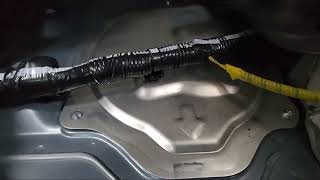
- If wiring appears okay, gain access to the fuel pump module. This is done through an access panel under the carpet behind the passenger's seat.
- Disconnect the fuel pump unit connector. Test the resistance between terminals C and D of the fuel pump unit connector. 🎬 See how to test a fuel sensor without removing the pump
- Manually move the float arm from its lowest to highest position. The resistance should change smoothly and consistently. Per the Mazda factory service manual, the specification is approximately 772-778 ohms at Empty and 5-7 ohms at Full. Any sudden jumps or infinite readings indicate a faulty sender.
- If the sender tests good, the issue likely lies with the wiring, instrument cluster, or PCM, requiring more advanced electrical diagnostics.
Parts You'll Likely Need
- Fuel Tank Sending Unit
(OEM #N270-60-960)— This is the sensor that directly measures the fuel level. Its mechanical and electrical components are the most common failure point for this code.
Trusted brands: Mazda (OEM)
OEM price range: $45-$65
Aftermarket price range: $30-$50 - Fuel Pump and Sender Assembly
(OEM #P59W-13-35XA)— Some mechanics or owners may choose to replace the entire fuel pump module, which includes the pump, filter, and sending unit, to prevent future failures of other components in the module. Always verify the part number with your vehicle's VIN.
Trusted brands: Mazda (OEM), Denso
OEM price range: $250-$350
Aftermarket price range: $150-$250
Technical Service Bulletins (TSBs) & Recalls
- TSB 05-007/16 & 05-001/17: While not related to P0461, this TSB addresses significant manual transmission issues in early 2016-2017 models, a critical issue for potential owners to be aware of.
Platform-Specific Known Issues
- Fuel Pump Recall (NHTSA Campaign Number: 21V875000, Mazda Recall No. 5321K): A recall was issued for 2018-2019 Mazda MX-5 models due to a faulty low-pressure fuel pump impeller that could deform and cause the engine to stall. While this defect causes stalling rather than the P0461 code, it indicates known issues with the in-tank fuel pump module assembly for these model years.
Mechanic-Grade Diagnostic Values
- Fuel Level Sender Resistance — expected: Approximately 5-7 Ω at Full, 772-778 Ω at Empty.. Failure: Readings outside this range, infinite resistance (open), or resistance that does not change smoothly when moving the float arm.
- Resistance Test Point — expected: Test should be performed at the fuel pump unit connector, between terminals C and D.. Failure: N/A - This is a procedural note.
Wiring & Ground Locations
- GND13 — Main ground point for the rear harness, which includes the fuel pump and sender unit.. A corroded or loose GND13 can cause an unstable ground reference for the fuel level sender, leading to erratic readings and the P0461 code. The factory wiring diagram specifies this as the ground for the fuel pump unit.
- Left/Right Rear Strut Tower Grounds — Located on the left and right rear strut towers in the trunk area.. While not the primary ground for the sender, a service update for the Global MX-5 Cup Car highlights these as critical chassis grounds in the vicinity of the fuel tank. Poor contact at these points can contribute to general electrical noise and unstable sensor readings in the rear of the vehicle.
- Fuel Pump Connector — On top of the fuel pump access panel, under the carpet behind the seats.. This is the main connection point for the entire fuel pump assembly. The two smaller gauge wires are for the fuel level sensor. Corrosion or damage here is a common cause of failure before the signal even reaches the PCM.
OEM Part Supersession History
p59w1335x→P59W-13-35XA— Standard part revision or change in supplier.
Model Year Variations Within This Range
- 2019-2024 ('ND2'): The 2019 model year introduced the 'ND2' revision with a significantly updated engine (181 hp vs 155 hp) and other improvements like a telescoping steering wheel. However, the fuel system, including the tank, pump assembly, and sending unit part numbers, appear to be identical to the 2016-2018 'ND1' models. Therefore, diagnosis for P0461 remains the same across the entire 2016-2024 range.
Diagnostic Flowchart
Other Known Issues on This Vehicle
Issues unrelated to this code that are worth knowing about as an owner of this generation:
- Early Manual Transmission Failure (ND1) 🔴 High — Primarily affects early 2016 and some 2017 models, especially those driven aggressively or on track. Failures can occur at low mileage (under 30,000 miles). Mazda revised the transmission design in later production. (Ref: TSB 05-007/16 (later superseded by 05-001/17) was issued for grinding noises and difficulty shifting into 2nd/3rd gear.)
- Infotainment 'Ghost Touch' and Delamination 🟠 Medium — Common across many Mazda models from this era, including the MX-5. The touchscreen registers phantom inputs, making the system difficult to use. It is often caused by heat and degradation of the touch digitizer layer. (Ref: Mazda issued a Customer Service Program (CSP13) extending the warranty for some infotainment issues, primarily related to the Connectivity Master Unit (CMU), not the screen itself.)
- Soul Red Crystal Paint Chipping 🟡 Low — The multi-layer 'Soul Red Crystal' (paint code 46V) is widely reported by owners to be thinner and more susceptible to chipping from minor road debris compared to other colors.
- Automatic Transmission Unexpected Downshift 🟠 Medium — Affected certain 2016-2019 models with automatic transmissions. A software error could cause an abrupt, unexpected downshift while driving. (Ref: NHTSA Recall 19V-072 (Mazda Campaign 3019A) was issued to reprogram the Transmission Control Module (TCM).)
Used vs. New Parts: Buying Guide for This Vehicle
When a used part is the smart pick: A used part is generally not recommended for this repair. However, if you can source a complete fuel pump assembly from a verified low-mileage wreck (e.g., under 20,000 miles), it could be a cost-effective alternative to a new OEM assembly.
Donor-vehicle mileage cap: roughly under 30000 miles for the part to have meaningful remaining life.
What to inspect on the donor part:
- Verify the mileage of the donor vehicle.
- Inspect the electrical connector for any signs of corrosion, melting, or damaged pins.
- Ensure the plastic housing of the pump assembly is not cracked or damaged.
- If possible, check the resistance of the sender on the used part before purchase to ensure it's within spec.
OEM-only on this vehicle (don't cheap out):
- Fuel Level Sending Unit (N270-60-960): Given the low cost of a new OEM sender ($45-$65) and the fact that it is a wear item, there is little financial or reliability incentive to buy this part used or from an unproven aftermarket brand.
Aftermarket brands forum-validated for this vehicle:
- Denso: If replacing the entire fuel pump assembly, Denso is a highly reputable brand and is often the original equipment manufacturer for many Japanese vehicles.
Brands owners have reported issues with on this vehicle:
- Avoid generic, no-name brands from online marketplaces. While they may be cheaper, they often have high failure rates, inaccurate sender readings, and may not meet the specific pressure/flow requirements of the SKYACTIV engine.
Real Owner Stories
Aggregated from forums and TSBs cited above. Mileages and costs reflect what owners reported in those sources.
2019 Mazda MX-5 RF
Symptoms: Check engine light P0461 appeared on the dashboard.
What fixed it: The dealership diagnosed and replaced the fuel gauge sending unit under warranty.
Source hint: Miata.net Forum - 'Check engine light P0461'
2017-2020 Fiat 124 Spider
Symptoms: Erratic or non-functional fuel gauge accompanied by the P0461 code.
What fixed it: Replacement of the fuel level sender.
Source hint: 124spider.org Forum - 'P0461 Fuel Level Sensor A Circuit Range/Performance'
Related OBD-II Codes
Frequently Asked Questions
Where is the fuel level sending unit located on the 2016-2024 Mazda MX-5?
Does the fuel pump recall (NHTSA 21V875000) cause the P0461 code?
What are the specific resistance values for a healthy MX-5 fuel sender?
Can I buy the fuel level sending unit separately from the expensive fuel pump assembly?
Is the P0461 issue common on the Fiat 124 Spider as well?
Should I use an aftermarket fuel pump if I need to replace the whole unit?
Helpful Videos


We Have This Part in Stock


The information in this article is provided for general reference and educational purposes only. Vehicle specifications, procedures, and part compatibility can vary by production date, trim level, and region. Always consult your vehicle's factory service manual and verify part numbers before purchasing or performing repairs. Safety-critical components such as airbags, seat belts, and braking systems should be installed by a qualified professional.
- Mazda MX-5:
- 🎬 Helpful Videos
- 🛍️ Shop This Part
- What's Unique About the 2016-2024 Mazda MX-5
- Symptoms You May Notice
- Most Likely Causes
- Rare But Worth Checking
- Diagnosis Steps
- Parts You'll Likely Need
- Technical Service Bulletins (TSBs) & Recalls
- Platform-Specific Known Issues
- Mechanic-Grade Diagnostic Values
- Wiring & Ground Locations
- OEM Part Supersession History
- Model Year Variations Within This Range
- Diagnostic Flowchart
- Other Known Issues on This Vehicle
- Used vs. New Parts: Buying Guide for This Vehicle
- Real Owner Stories
- 2019 Mazda MX-5 RF
- 2017-2020 Fiat 124 Spider
- Related OBD-II Codes
- Frequently Asked Questions
- 🎟️ Get 5% Off