

P0461 on 2011-2016 Kia Optima Hybrid: Fuel Gauge Problems and Fixes
This code means your fuel gauge is providing an erratic or incorrect reading. The most common cause is a failing fuel level sensor, which is located inside the fuel tank. Before replacing the sensor, check for loose wiring connections as noted in a Kia technical tip. In some cases on related models, a faulty instrument cluster has been the root cause after the sensor and wiring were confirmed to be good.
- P0461 on a Kia Optima Hybrid points to a problem with the fuel level sensor circuit, causing an unreliable fuel gauge.
- The most likely culprit is the fuel level sending unit itself, which is located in the fuel tank.
- Before replacing any parts, follow Kia's own technical advice and thoroughly inspect the wiring connectors between the sensor and the computer for any loose pins or damage.
- This is a manageable DIY repair for those comfortable with accessing the fuel tank, which is usually done from under the rear seat.
- If the sensor and wiring check out, do not overlook the instrument cluster as a potential, though rare, cause of the fault.
What's Unique About the 2011-2016 Kia Optima
For the Optima Hybrid, this issue is typically electrical. Kia issued a Tech Tip advising technicians to first check for backed-out pins or loose connections at the fuel sender and specific harness connectors (EMll, ECll, MFll) before replacing parts. This suggests that wiring issues can be a primary cause, not just a faulty sensor. The fuel level sensor itself is integrated into the fuel pump sender assembly inside the tank. The platform-mate Hyundai Sonata Hybrid experiences the same issue, and in some documented cases, the final culprit was a faulty instrument cluster, not the sending unit.
Generation note: The 2011-2016 range covers the third generation (TF) Optima Hybrid (2011-2016). The non-hybrid Optima moved to the fourth generation (JF) for the 2016 model year, but the Hybrid model was a carryover of the third generation. The causes and fixes are consistent for the TF generation hybrid. The related Hyundai Sonata Hybrid of the same era (2011-2015) shares the same powertrain and fuel system components and is also prone to this issue.
Symptoms You May Notice
- Check Engine Light is illuminated.
- Fuel gauge behaves erratically, fluctuating wildly or getting stuck on full or empty.
- Distance-to-empty display is inaccurate or shows dashes.
- Low fuel warning light may stay on even when the tank is full.
- Fuel gauge reading does not change after filling the tank.
- Replacing the entire fuel pump assembly when only the sending unit has failed (though they are often sold together).
- Replacing the instrument cluster before thoroughly testing the fuel level sensor and its wiring circuit.
- Replacing the fuel level sensor when the actual problem is a poor connection at a harness connector, as highlighted by Kia's Tech Tip.
Most Likely Causes
- Faulty Fuel Level Sensor (Sending Unit) 🔴 High Probability The variable resistor on the sensor's float arm can wear out over time from constant movement, leading to dead spots or an open circuit. Contamination in the fuel can also accelerate wear on the sensor's contact points.
How to confirm: Access the top of the fuel tank (usually under the rear seat). Disconnect the sensor and measure its resistance with a multimeter while manually moving the float arm. The resistance should change smoothly without any jumps or dropouts. You can also rock the vehicle to slosh fuel around and see if the resistance reading changes.
Typical fix: Replace the fuel level sending unit. This part is often sold as part of the complete fuel pump sender assembly, but can be purchased separately.
Est. part cost: $75-$120 - Wiring or Connector Issue 🟡 Medium Probability A Kia Tech Tip specifically calls out the possibility of backed-out pins or poor connections at the fuel sender connector or main wiring harness connectors (EMll, ECll, MFll). The harness leading to the fuel tank is also susceptible to corrosion or damage from road debris.
How to confirm: Visually inspect the wiring harness running to the fuel tank. Disconnect and inspect the connectors mentioned in the tech tip for any corrosion, damage, or pins that are not fully seated. Perform a voltage drop test to check for excessive resistance in the circuit.
Typical fix: Clean and reseat the connectors. If a wire is broken or a pin is damaged, the connector or a section of the harness will need to be repaired.
Est. part cost: $0-$50
Rare But Worth Checking
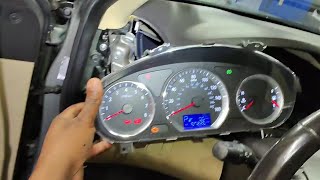
- Faulty Instrument Cluster: If the sensor and wiring test perfectly, the problem could be with the physical gauge or the internal circuitry of the instrument cluster. This is uncommon but has been documented as the definitive fix for P0461 on the platform-mate Hyundai Sonata after other parts were replaced. 🎬 Watch: Diagnose a Sonata with this exact issue Symptoms can include multiple gauges acting erratically or the cluster losing power intermittently.
- Faulty Powertrain Control Module (PCM): This is extremely rare. The PCM's internal circuit for interpreting the fuel level signal could fail, but all other possibilities should be exhausted before considering PCM replacement. Sometimes a software glitch can be the cause, which would require a reflash by a dealer.
Diagnosis Steps
- Scan the vehicle for the P0461 code and any other related codes like P0462 or P0463.
- Using a scan tool with live data, observe the fuel level percentage or voltage reported by the PCM. See if it corresponds to the approximate fuel level and if it changes when the vehicle is rocked side-to-side.
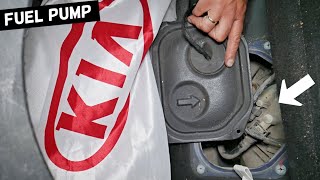
- Gain access to the fuel pump/sender assembly connector, located under the rear seat cushion. 🎬 See this step-by-step fuel pump removal tutorial
- Per the Kia Tech Tip, carefully inspect the fuel sender connector and harness connectors EMll, ECll, and MFll to ensure they are fully seated. Check for any backed-out pins or signs of corrosion.
- If connectors are secure, test the sensor's resistance. Disconnect the connector and use a multimeter set to Ohms to measure the resistance across the two pins for the sending unit. The reading should be within the manufacturer's specified range.
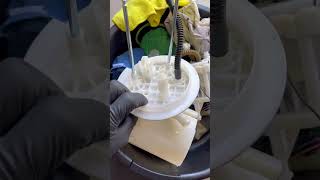
- To test the range of motion, remove the sending unit and manually sweep the float arm from empty to full, watching for a smooth, consistent change in resistance on the multimeter. Any dropouts or spikes indicate a faulty sensor.
- If the sensor tests good, check for continuity and voltage on the wiring harness between the sender and the PCM. Check for a good ground connection at the fuel tank grounding strap.
- If both the sensor and wiring are confirmed to be good, the issue may lie with the instrument cluster. A diagnostic test involves grounding the sender signal wire to see if the gauge sweeps to full or empty, which can help isolate the fault to the cluster.
Parts You'll Likely Need
- Fuel Level Sensor (Sender Assembly)
(OEM #94460-4R000)— This is the most common failure point. The integrated fuel level sensor wears out, causing erratic readings.
Trusted brands: Kia (OEM), Hyundai (OEM)
OEM price range: $75-$115
Aftermarket price range: $60-$100
Related Codes That Often Appear With This One
- P0462 (Fuel Level Sensor 'A' Circuit Low)
- P0463 (Fuel Level Sensor 'A' Circuit High)
Technical Service Bulletins (TSBs) & Recalls
- Kia Tech Tip TT062 (April 2014): Advised checking for backed out pins in connectors EMll, ECll, MFll and the PCM/Cluster connections before replacing parts for a P0461 code.
- TSB Bulletin #TSB-FUE027R1: While specifically for the Forte, this bulletin describes an ECM software upgrade to address a MIL ON with DTC P0461, highlighting that software logic can sometimes trigger this code.
- TSB Bulletin #TSBENG146R1: A manufacturer bulletin for related models notes that an ECM software upgrade may be required to resolve P0461 and other emission-related codes.
- TSB Bulletin #TSB-ENG118R2: This combined TSB and Service Action (SA152) provides information regarding an ECM software upgrade for vehicles experiencing a MIL ON with DTC P0461.
Mechanic-Grade Diagnostic Values
- Fuel Level Sensor Resistance — expected: A smooth, changing resistance value as the float arm is moved. While exact OEM specs are not published widely, typical Hyundai/Kia sensors of this era operate in a range similar to 10 Ohms (Full) to 180 Ohms (Empty).. Failure: An infinite resistance reading (open circuit), zero resistance (short), or readings that jump erratically or have dead spots as the float arm is moved.
- Fuel Level Sensor Signal Voltage — expected: A steady voltage between approximately 0.5V (Empty) and 4.5V (Full) when viewed on a scan tool's live data stream.. Failure: Voltage is stuck at 0V or 5V, or fluctuates wildly without corresponding changes in fuel level.
Scan Tool Commands That Help
- Kia GDS (Global Diagnostic System): Current Data / Live Data Analysis — To observe the real-time voltage and fuel level percentage being reported by the fuel level sensor to the PCM. This is the first step to see if the computer is receiving an erratic, stuck, or out-of-range signal.
- Kia GDS (Global Diagnostic System): Vehicle S/W Management > Resetting Adaptive Values — After replacing a component like the fuel level sensor or repairing a wiring issue, this function can be used to clear learned values in the PCM, which may help the system recognize the new, correctly functioning part more quickly.
- Advanced Scan Tool / Jumper Wire: Instrument Cluster Sweep Test — If the sensor and wiring to the cluster are suspected to be good, this test can confirm if the gauge itself is functional. By grounding the signal wire at the tank connector with a jumper, the gauge should sweep to one extreme (e.g., Full). When the jumper is removed (creating an open circuit), it should sweep to the other extreme (e.g., Empty). If the gauge does not respond, the fault is likely in the instrument cluster or its wiring.
Wiring & Ground Locations
- EM11 Connector — Located in the engine compartment, often a large black or white 46-pin connector. It serves as a major intersection for engine and chassis wiring.. This is one of the specific connectors Kia's Tech Tip (TT062) advises technicians to inspect for backed-out pins or poor connections when diagnosing P0461, as the fuel level sensor signal passes through it.
- Fuel Pump Assembly Connector — On top of the fuel tank, accessible by removing the rear seat cushion.. This is the primary connection point for the fuel level sensor. Corrosion or loose pins here are a common cause of signal interruption, leading to the P0461 code.
- Fuel Tank Ground Strap — A wire or strap connecting the fuel tank or fuel pump assembly mounting flange to the vehicle's chassis.. A poor or corroded ground can cause incorrect resistance readings from the fuel level sensor, leading to erratic gauge behavior and triggering the P0461 code.
Real Owner Repair Stories
- YouTube video from '99-2000-G-20' (Hyundai Sonata (platform mate)) — Check engine light on with codes P0461 and P0462. The fuel gauge was not working.
❌ Tried (didn't work) The technician first tested the fuel level sensor with a multimeter and confirmed it was working to specifications.
✅ What actually fixed it The instrument cluster was faulty and had to be replaced to resolve the codes and restore fuel gauge function.
OEM Part Supersession History
94460-4R000→N/A— This part number appears to be consistent for the 2011-2013 Optima Hybrid. Some parts catalogs show different numbers for later years, but 94460-4R000 is the primary replacement for the early part of the generation.
Heads up: While other sensors for non-hybrid Optimas may look similar, only the part specified for the Hybrid model should be used.
Diagnostic Flowchart
Other Known Issues on This Vehicle
Issues unrelated to this code that are worth knowing about as an owner of this generation:
- Theta II Engine Failure 🔴 High — Widespread issue across multiple Hyundai/Kia models with this engine, leading to class-action lawsuits. Can occur at various mileages. (Ref: Subject of multiple recalls (e.g., NHTSA 20V750, 21V844) and a class-action settlement extending the warranty to 15 years/150,000 miles for certain failures.)
- Hybrid Brake Actuator Failure 🔴 High — A known issue on hybrid models where the brake actuator fails, leading to a hard pedal, warning lights (ABS, Brake), and reduced braking performance.
- Main Power Relay Failure 🟠 Medium — Can cause a no-start condition or intermittent stalling. While not extremely common, it has been reported by owners.
- Cracked Rear Lower Control Arms 🟠 Medium — A service action (SA172) was issued for some Optima models where a crack could form on the rear lower arm, causing a clunking noise. (Ref: SA172)
Used vs. New Parts: Buying Guide for This Vehicle
When a used part is the smart pick: A used instrument cluster can be a cost-effective option if it's diagnosed as the root cause, provided you can find a reputable service to program the mileage. Used wiring harness connectors (pigtails) are also a good choice for repairing damaged connectors.
Donor-vehicle mileage cap: roughly under 75000 miles for the part to have meaningful remaining life.
What to inspect on the donor part:
- For a fuel level sensor, seek a donor with the lowest possible mileage, as it is a wear item.
- For an instrument cluster, ensure the clear plastic lens is not scratched or faded and that all mounting tabs are intact.
- For any used electronic part, verify the part number matches your original part exactly. Hybrid and non-hybrid clusters are not interchangeable.
OEM-only on this vehicle (don't cheap out):
- Fuel Level Sensor: While aftermarket sensors are available, the OEM part is recommended for best accuracy and longevity, and the price difference is often minimal.
Brands owners have reported issues with on this vehicle:
- Generic, unbranded fuel level sensors from online marketplaces may have poor quality control and fail prematurely.
Real Owner Stories
Aggregated from forums and TSBs cited above. Mileages and costs reflect what owners reported in those sources.
2011-2015 Hyundai Sonata Hybrid 2.4L
Symptoms: The vehicle was throwing codes P0462 and P0461, indicating issues with the fuel level sensor circuit.
What fixed it: After the fuel level sensor tested good, the instrument cluster was identified as the ultimate cause of the problem and required replacement.
Source hint: YouTube video titled 'Hyundai Sonata P0462 P0461 - Not Fuel Level Sensor'
Related OBD-II Codes
Frequently Asked Questions
I have a 2011 Kia Optima Hybrid with P0461; is there a specific technical tip I should tell my mechanic about?
My fuel gauge is stuck on empty and showing dashes for distance-to-empty. Could this be related to the Theta II engine issues?
Can I use an instrument cluster from a standard gas Optima to fix my 2013 Optima Hybrid's fuel gauge issue?
Where are the connectors EMll, ECll, and MFll located on my 2011-2016 Optima?
Is the fuel level sensor on the 2.4L Theta II HEV sold separately or do I need a whole pump?
My 2015 Optima Hybrid has P0461 and the brake pedal feels hard. Are these related?
Helpful Videos
We Have This Part in Stock


The information in this article is provided for general reference and educational purposes only. Vehicle specifications, procedures, and part compatibility can vary by production date, trim level, and region. Always consult your vehicle's factory service manual and verify part numbers before purchasing or performing repairs. Safety-critical components such as airbags, seat belts, and braking systems should be installed by a qualified professional.
- Kia Optima:
- 🎬 Helpful Videos
- 🛍️ Shop This Part
- What's Unique About the 2011-2016 Kia Optima
- Symptoms You May Notice
- Most Likely Causes
- Rare But Worth Checking
- Diagnosis Steps
- Parts You'll Likely Need
- Related Codes That Often Appear With This One
- Technical Service Bulletins (TSBs) & Recalls
- Mechanic-Grade Diagnostic Values
- Scan Tool Commands That Help
- Wiring & Ground Locations
- Real Owner Repair Stories
- OEM Part Supersession History
- Diagnostic Flowchart
- Other Known Issues on This Vehicle
- Used vs. New Parts: Buying Guide for This Vehicle
- Real Owner Stories
- 2011-2015 Hyundai Sonata Hybrid 2.4L
- Related OBD-II Codes
- Frequently Asked Questions
- 🎟️ Get 5% Off