

P0455 on 2007-2015 Mazda CX-9: EVAP Large Leak Causes and Fixes
For a 2007-2015 Mazda CX-9, code P0455 is most often caused by a loose or faulty gas cap. Before buying any parts, tighten your gas cap until it clicks multiple times and clear the code. If it returns, a new OEM gas cap (Part No. GS3L-42-250B) is an inexpensive first step (~$25-$40). If that doesn't work, the next most likely culprit is the purge solenoid valve in the engine bay.
- Always check that your gas cap is tightened until it clicks multiple times before performing any repairs.
- If the code returns, the most cost-effective first step is to replace the gas cap with an OEM part.
- A P0455 code will cause an automatic failure on an emissions test.
- If the gas cap doesn't fix the issue, the next most likely culprits are the purge valve (in the engine bay) or the vent valve (at the rear of the car).
- A professional smoke test is the fastest and most accurate way to find the leak if it's not the gas cap.
What's Unique About the 2007-2015 Mazda CX-9
On the first-generation Mazda CX-9, the P0455 code is a very common issue that owners encounter, but it rarely points to a complex or platform-specific defect. The root cause is overwhelmingly simple: the gas cap. Mazda has issued multiple Technical Service Bulletins (TSBs) for EVAP leaks across its vehicle lineup, including the CX-9, noting that the most frequent cause is the driver not tightening the fuel cap sufficiently after refueling. The CX-9 shares its 3.7L V6 engine and EVAP system architecture with the Ford Edge and Lincoln MKX, which experience similar common failures like the purge solenoid valve.
Symptoms You May Notice
- Check Engine Light is on.
- A dedicated "loose gas cap" warning light may appear on the instrument cluster.
- A faint smell of gasoline, especially around the rear of the vehicle after it has been parked.
- In some cases, difficulty refueling where the gas pump nozzle clicks off repeatedly. This can point to a clogged canister or a stuck vent valve.
- After filling the gas tank, the engine may be hard to start or run rough for a moment. This is a classic symptom of a purge valve stuck open, allowing raw fuel vapor to flood the intake manifold.
- Replacing the charcoal canister when only a valve has failed. The canister is often the most expensive part of the system, while the purge or vent valves are more common failure points and much cheaper to replace.
- Immediately assuming a complex leak exists before thoroughly checking and replacing the gas cap with an OEM part. Many owners chase this code after an aftermarket cap fails to seal properly.
Most Likely Causes
- Loose or Faulty Gas Cap 🔴 High Probability Mazda has issued TSBs (01-005/19) directly addressing EVAP leaks, stating the most likely cause is user error (not tightening enough). The cap's rubber seal also wears out over time, preventing a proper seal. Aftermarket caps are a frequent source of repeat codes.
How to confirm: Ensure the cap is tightened until it clicks several times. Inspect the rubber O-ring on the cap for cracks, stiffness, or damage. If the seal looks worn, it's best to replace it. A Reddit user with a 2010 CX-9 reported the code and 'gas cap off' light persisted until they replaced the cap.
Typical fix: Tighten the existing cap correctly. If that fails, replace the gas cap with a new OEM part (Part No. GS3L-42-250B) to ensure a perfect seal.
Est. part cost: $25-$40 - Failed Purge Solenoid Valve 🟡 Medium Probability This is a common failure part on many modern vehicles, including the CX-9 with the 3.7L V6. The valve is constantly working while the engine runs and can become stuck open, creating a permanent leak path that the system detects during its self-test. A Reddit user with a 2011 CX-9 had the purge valve replaced twice under warranty.
How to confirm: The valve is located in the engine bay. With the engine running, you can sometimes hear or feel it clicking. It is a normally-closed valve; disconnect it and try to blow air through it. If air passes, it has failed while stuck open. You can also test it by applying vacuum to the tank side; if it pulls vacuum with the engine running, the valve is leaking.
Typical fix: Replace the purge solenoid valve. On the 3.7L V6, Mazda sells the entire assembly (Part No. CA41-20-370) for over $150. However, a Reddit user documented a successful DIY repair by carefully removing just the solenoid from the assembly and replacing it with a compatible Ford part for around $20, a repair that was still holding two years later.
Est. part cost: $40-$90 (aftermarket solenoid), $150-$220 (OEM assembly) - Failed Canister Vent Valve/Solenoid 🟡 Medium Probability Located near the charcoal canister at the rear of the vehicle, this valve is exposed to road debris and moisture, which can cause it to fail. It can get stuck open, causing a large leak code.
How to confirm: This is a normally-open valve. It should allow air to pass when unpowered and close when 12V is applied. A smoke test is the most reliable way to confirm if it's leaking when it should be closed. Be aware that during a smoke test, smoke will exit this valve unless it is commanded closed with a scan tool.
Typical fix: Replace the canister vent valve. It is sometimes sold as an assembly with the charcoal canister.
Est. part cost: $50-$120 - Cracked or Damaged EVAP Hoses ⚪ Low Probability Over time, the rubber and plastic hoses that make up the EVAP system can become brittle from age and heat cycles, leading to cracks.
How to confirm: Visually inspect all accessible EVAP lines running from the engine bay to the fuel tank. The most reliable method is to have a professional perform a smoke test, which will make any cracks or leaks visible.
Typical fix: Replace the specific section of cracked hose.
Est. part cost: $10-$50
Rare But Worth Checking
- Cracked Charcoal Canister: The canister itself (OEM Part CY01-13-96ZD) can be damaged by road debris or develop cracks from age, creating a large leak. This is less common than valve failures but should be inspected if other causes are ruled out.
- Damaged Fuel Filler Neck: Rust or damage to the metal filler neck where the gas cap seals can prevent even a new cap from sealing properly. Inspect this area for corrosion or deformity when checking the cap. NHTSA ODI #11331433 notes a case where a gas filler neck gross EVAP leak was identified alongside P0455 and P0457 codes.
- Fuel Pump Lock Ring: Although reported on a different Mazda model, NHTSA ODI #11439442 describes a failed fuel pump lock ring causing P0455 and a strong smell of gasoline fumes around the rear of the car.
Diagnosis Steps
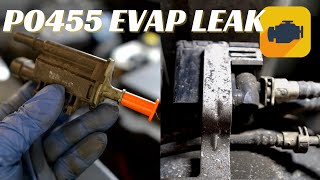
- Check the gas cap. Remove it, inspect the seal for damage, and reinstall it, ensuring you turn it until it clicks at least 1-3 times. 🎬 See these simple DIY checks for finding a large leak.
- Clear the P0455 code with an OBD-II scanner and drive for a few days to see if the light returns. If it doesn't, the cap was likely just loose.
- If the light returns, replace the gas cap with a new OEM part (GS3L-42-250B). This is the cheapest and most likely fix.
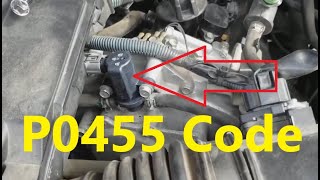
- If the code persists, visually inspect the EVAP purge valve in the engine bay and the hoses connected to it for any obvious cracks or damage. Listen for a clicking sound with the engine running.
- Test the purge valve. With the vehicle off, disconnect the valve and try blowing through it. If air passes, it's stuck open and needs replacement.
- Raise the vehicle and inspect the charcoal canister (near the fuel tank) and the vent valve and hoses for any visible damage or cracks. NHTSA ODI #10096503 mentions a large EVAP leak (P0455) occurring after a vehicle lacked a metal skid pad, potentially exposing components to damage.
- The most definitive diagnostic step is to have a smoke test performed. A mechanic will inject pressurized smoke into the EVAP system. The smoke will escape from the point of the leak, making it easy to identify, whether it's a hose, valve, or the canister itself.
Parts You'll Likely Need
- Fuel Cap
(OEM #GS3L-42-250B (supersedes GS3L-42-250, GS3L-42-250A, TD11-42-250A/B))— This is the most common cause of P0455 on a Mazda CX-9, as confirmed by owner experiences and Mazda TSBs. The seal wears out over time.
Trusted brands: Mazda OE
OEM price range: $25-$40
Aftermarket price range: $15-$30 - Vapor Canister Purge Valve (Solenoid)
(OEM #CA41-20-370 (Full Assembly))— A common failure point that gets stuck open, creating a leak. It's located in the engine bay and is relatively easy to replace.
Trusted brands: Bosch, Dorman, Mazda OE
OEM price range: $150-$220
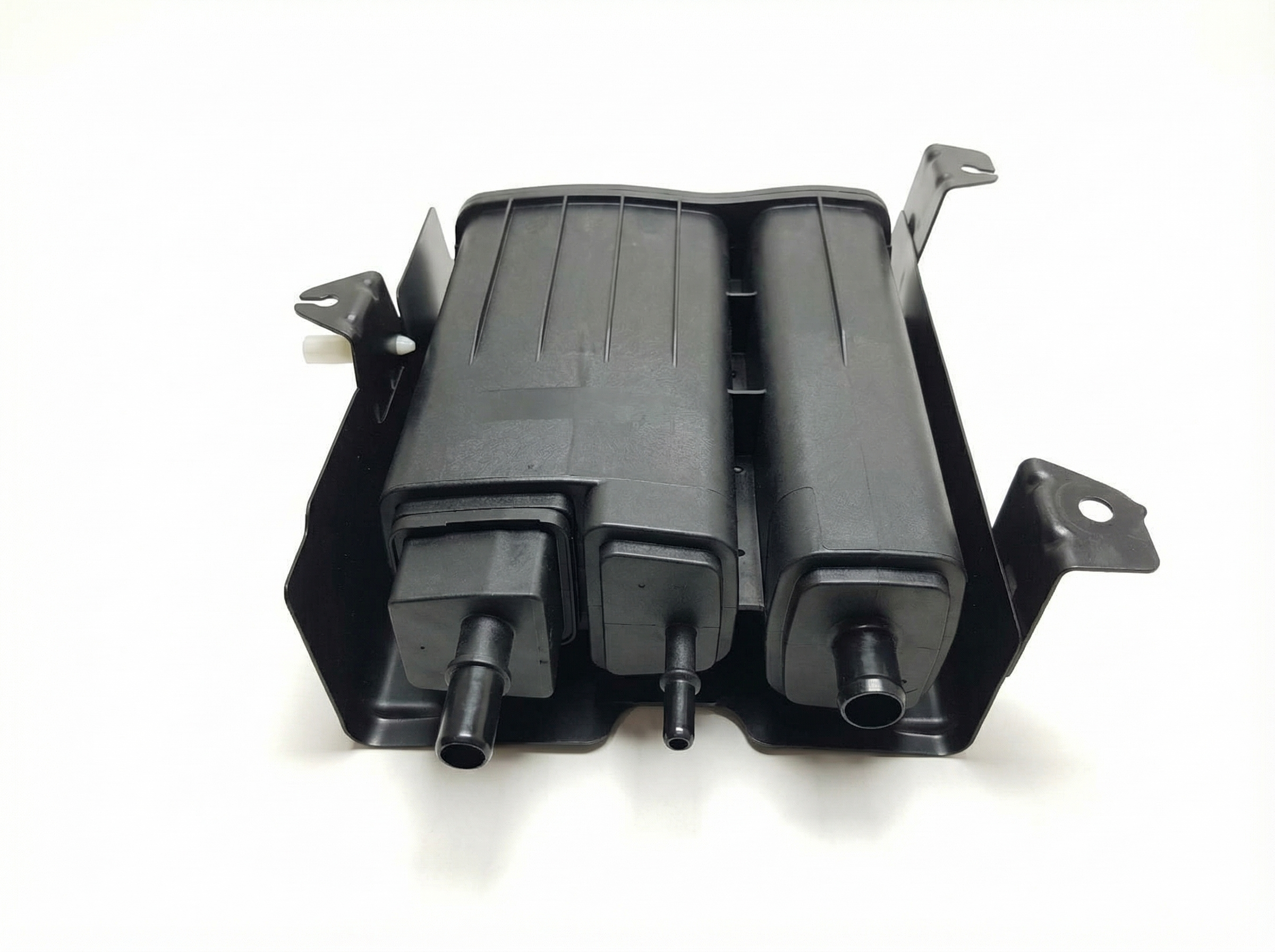
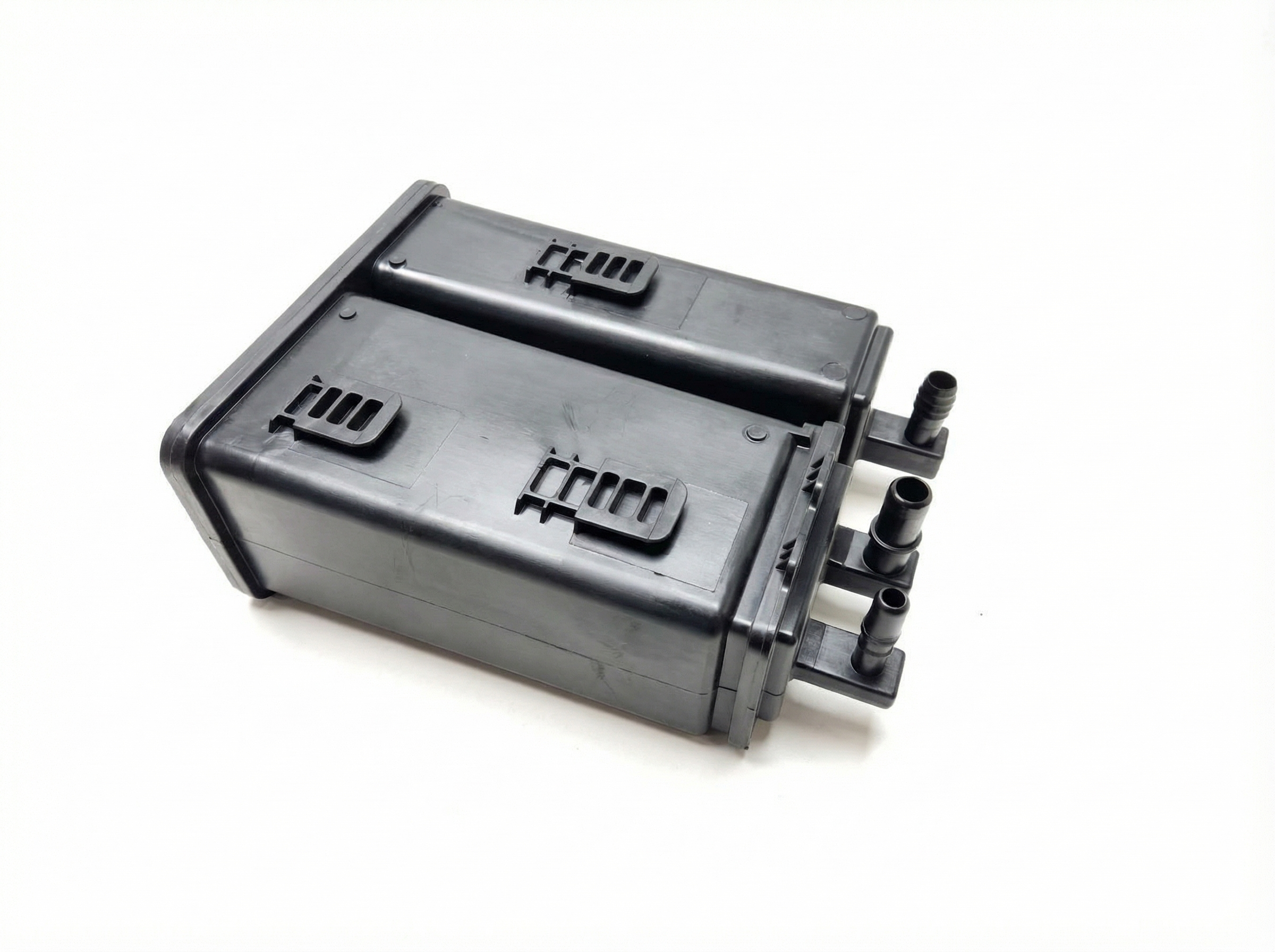
Aftermarket price range: $40-$90 - Vapor Canister
(OEM #CY01-13-96ZD)— The canister can crack from age or road debris, causing a large leak. This part number fits all 2007-2015 models.
Trusted brands: Mazda OE
OEM price range: $180-$250
Aftermarket price range: $120-$200
Related Codes That Often Appear With This One
- P0456 — P0456 indicates a 'very small leak'. You might see this code intermittently before the leak worsens and triggers the 'large leak' P0455 code. The underlying cause is often the same, and Mazda TSB 01-005/19 for P0456 on the CX-9 points directly to the gas cap.
- P0442 — P0442 indicates a 'small leak'. Similar to P0456, it represents a leak of a different size but from the same system. The underlying cause is often the same.
- P0457 — P0457 indicates an 'Evaporative Emission System Leak Detected (Fuel Cap Loose/Off)'. This code is often seen alongside P0455 and strongly points to the gas cap as the primary issue.
Technical Service Bulletins (TSBs) & Recalls
- TSB 01-005/19: Addresses P0456 (very small leak) but is relevant as it states the most likely cause is the fuel cap not being completely closed on 2007-2019 CX-9 models.
- TSB 01-020/10: Mentioned in diagnostic procedures for P0455, advising replacement of the fuel cap with an improved part.
- TSB 01-002/18: A general EVAP leak diagnostic procedure that includes P0455, providing a flowchart for technicians.
- Bulletin #01-002-18-3417: Notes that some vehicles may have a MIL illumination with DTCs P0441, P0442, P0455, or P0456 stored in memory and provides a repair procedure to determine the leak location.
Mechanic-Grade Diagnostic Values
- Purge Solenoid Valve Coil Resistance — expected: 22 - 30 Ohms. Failure: A reading of infinite resistance (open circuit) or a value significantly outside this range indicates a failed coil.
- Canister Vent Valve Solenoid Coil Resistance — expected: 20 - 50 Ohms. Failure: A reading outside this range suggests the solenoid coil winding is damaged.
- Fuel Tank Pressure (FTP) Sensor Voltage (Key On, Engine Off) — expected: Approximately 1.3V to 1.7V at atmospheric pressure.. Failure: A reading stuck near 5V (short to power) or near 0V (short to ground/open circuit) indicates a faulty sensor or wiring issue.
Scan Tool Commands That Help
- Mazda IDS / FORScan: EVAP System Leak Test (Manual) — This is a guided, active test that commands the vent solenoid closed to seal the system. The scan tool then monitors the FTP sensor for a pressure/vacuum drop, confirming a leak exists before performing a time-consuming smoke test.
- Mazda IDS / FORScan / Bidirectional Scanner: Canister Vent (CV) Solenoid ON/OFF — Use this to functionally test the normally-open vent valve. Command it 'ON' (closed) and listen for a click. This is essential during a smoke test to seal the system; if smoke still exits the vent with the valve commanded ON, the valve is faulty.
Wiring & Ground Locations
- G10 / G11 — Behind the left side of the dashboard, near the kick panel.. These are major ground points for circuits controlled by the PCM and BCM. A poor connection at these grounds can cause erratic behavior of computer-controlled components, including the EVAP purge and vent solenoids, leading to false codes or testing failures.
- Fuel Tank Pressure (FTP) Sensor Location — On the fuel tank, often accessible by removing the rear seat.. Knowing the physical location is critical for testing the sensor's voltage and wiring harness integrity, which can be a cause of the P0455 code, especially if seen with a P0452 code.
Real Owner Repair Stories
- Reddit r/MechanicAdvice (2010 Mazda CX-9, 199k miles) — P0455 code and 'your gas cap is off' light on the dash.
❌ Tried (didn't work) Cleaning the original gas cap., Replacing the gas cap with a new OEM part.
✅ What actually fixed it The owner reported that even after replacing the OEM gas cap, the code did not go away. This is a key data point showing the gas cap is not always the fix, and the next step would be to test the purge and vent valves. - Reddit r/MazdaCX9 (Mazda CX-9 (year not specified)) — P0455 DTC.
❌ Tried (didn't work) Initial diagnosis pointed towards common EVAP issues.
✅ What actually fixed it The owner replaced the gas cap with an aftermarket 'Stant' brand cap, which resolved the code. - NHTSA ODI #11128161 — An owner reported the check engine light coming on every few weeks with various codes including P0455. The selling dealer replaced the filler cap twice and a sensor, but the issue persisted.
"I Checked Everything" — The Actual Cause
- A 2011 CX-9 owner on Reddit reported persistent P0455 and P0457 codes despite having a brand new OEM gas cap and a smoke test that found no leaks. The purge valve had also been replaced twice under warranty. The owner noted an intermittent P1450 code ('Unable to Bleed Up Fuel Tank Vacuum') also appeared. This combination strongly suggests a functional failure rather than a static leak. The most likely cause in this scenario is a canister vent valve that is not closing properly when commanded by the PCM during the EVAP self-test, even though it may appear sealed during a low-pressure smoke test.
When the Usual Fixes Don't Work
- While the gas cap is the most common fix, it is not a guaranteed solution. A Reddit user with a 2010 CX-9 at 199,000 miles reported that replacing their gas cap with a brand new OEM part did not resolve their P0455 code and 'gas cap off' warning light. This indicates that for high-mileage vehicles, failure of other components like the purge or vent solenoid becomes more probable and should be the next diagnostic step if a new OEM cap does not work.
OEM Part Supersession History
CY0118740, CY0118740A→CA41-20-370 (Assembly)— Engine Change
Heads up: The purge valve for the 2007 3.5L V6 (CY0118740) is a different part from the assembly used on the 2008-2015 3.7L V6 (CA41-20-370). They are not interchangeable.Mazda CA41-20-370 (Assembly)→Ford AU5Z-9C915-B / Dorman 911-222 (Solenoid Only)— Cost-Saving Repair
Heads up: Mazda only sells the full purge valve assembly for the 3.7L. However, the electrical solenoid itself is a common Ford part. Tech-savvy owners can separate the solenoid from the Mazda-specific hoses and replace only the failed electrical component with the much cheaper Ford equivalent. The solenoid is sometimes marked with K5T46696.
Model Year Variations Within This Range
- 2007: The 2007 model used a 3.5L V6 engine. Its purge solenoid (Part No. CY0118740) is different from the later models.
- 2008-2015: These models use a 3.7L V6 engine. The purge solenoid is sold as a complete assembly (Part No. CA41-20-370), but the solenoid itself is a common Ford part that can be swapped independently.
Diagnostic Flowchart
Other Known Issues on This Vehicle
Issues unrelated to this code that are worth knowing about as an owner of this generation:
- Internal Water Pump Failure 🔴 High — Common at higher mileage (typically 80,000-120,000 miles). Failure allows coolant to mix with engine oil, leading to catastrophic engine damage if not caught immediately. (Ref: No recall, but a widely known issue. Repair is extremely labor-intensive (12-15 hours) as the pump is driven by the timing chain inside the engine.)
- AWD Transfer Case (PTO) Failure 🔴 High — Commonly reported between 75,000 and 120,000 miles. The unit is considered 'sealed' with no drain plug, leading to oil breakdown and overheating, causing failure. (Ref: Mazda issued a warranty extension (SSP 92) to 90,000 miles for this part due to the high failure rate, but many failures occur outside this window.)
- Power Brake Booster Failure 🟠 Medium — Can occur at various mileages, characterized by a hard brake pedal and a hissing sound from the pedal area. (Ref: Mazda issued a Special Service Program (SSP 93) extending warranty coverage for the brake booster to 7 years or 90,000 miles for 2007-2013 models.)
- Transmission Shifting Issues 🟠 Medium — Owners report hard shifts or hesitation, particularly when the transmission is warm. (Ref: Sometimes resolved with a PCM reprogram at the dealership. In other cases, it can be an early sign of internal transmission wear or failure.)
Used vs. New Parts: Buying Guide for This Vehicle
When a used part is the smart pick: A used purge valve assembly from a verified low-mileage (under 80,000 miles) donor vehicle can be a cost-effective alternative to the expensive new OEM assembly. Likewise, a used charcoal canister is acceptable if it is visually inspected for cracks and comes from a vehicle in a dry climate without rust.
Donor-vehicle mileage cap: roughly under 80000 miles for the part to have meaningful remaining life.
What to inspect on the donor part:
- For solenoids, ensure connectors are not corroded or cracked.
- For canisters, check the plastic housing for any hairline cracks, especially around the hose ports.
- Avoid parts from vehicles in the salt belt, as corrosion can seize the valves or damage electrical connections.
OEM-only on this vehicle (don't cheap out):
- Fuel Cap - Aftermarket caps are a well-documented cause of persistent EVAP codes on this platform. Always use a genuine Mazda OEM cap (GS3L-42-250B) to ensure a proper seal.
Aftermarket brands forum-validated for this vehicle:
- Purge/Vent Solenoids: Dorman (e.g., 911-222 for the purge solenoid), Standard Motor Products (SMP), and Bosch are reputable alternatives.
- Gas Cap: Stant has been reported by at least one owner to work successfully.
Brands owners have reported issues with on this vehicle:
- Generic, no-name fuel caps from online marketplaces should be avoided as they frequently fail to seal correctly.
Real Owner Stories
Aggregated from forums and TSBs cited above. Mileages and costs reflect what owners reported in those sources.
2010 Mazda CX-9
Symptoms: The P0455 code and 'gas cap off' light persisted even after checking the cap.
What fixed it: Replacing the gas cap with a new unit.
Source hint: Common Causes section reference to Reddit user
2011 Mazda CX-9 3.7L V6
Symptoms: EVAP system failure leading to purge valve replacement.
What fixed it: The purge valve was replaced twice under warranty.
Source hint: Common Causes section reference to Reddit user
2011-2015 Mazda CX-9 3.7L V6
Symptoms: Large EVAP leak code P0455.
What fixed it: Carefully removing just the solenoid from the purge valve assembly and replacing it with a compatible Ford part.
Cost: $20-$20
Source hint: Reddit (r/mazda) thread by user 'db130' titled 'EVAP purge valve replacement on 2011-2015 CX-9'
Related OBD-II Codes
Frequently Asked Questions
Does TSB 01-005/19 apply to my 2007-2015 Mazda CX-9 regarding the P0455 code?
What is the specific Mazda part number for a replacement gas cap for my CX-9?
I heard the purge valve repair is expensive on the 3.7L V6; is there a cheaper way to fix it?
Why does my CX-9 have trouble starting only after I fill up the gas tank?
Is there a TSB that provides a diagnostic flowchart for P0455 on the CX-9?
Could my P0455 code be related to the 'loose gas cap' light on my dashboard?
Helpful Videos

Used OEM Parts in Stock
New Aftermarket Parts Available


The information in this article is provided for general reference and educational purposes only. Vehicle specifications, procedures, and part compatibility can vary by production date, trim level, and region. Always consult your vehicle's factory service manual and verify part numbers before purchasing or performing repairs. Safety-critical components such as airbags, seat belts, and braking systems should be installed by a qualified professional.
- Mazda CX-9:
- 🎬 Helpful Videos
- 🛍️ Shop This Part
- What's Unique About the 2007-2015 Mazda CX-9
- Symptoms You May Notice
- Most Likely Causes
- Rare But Worth Checking
- Diagnosis Steps
- Parts You'll Likely Need
- Related Codes That Often Appear With This One
- Technical Service Bulletins (TSBs) & Recalls
- Mechanic-Grade Diagnostic Values
- Scan Tool Commands That Help
- Wiring & Ground Locations
- Real Owner Repair Stories
- "I Checked Everything" — The Actual Cause
- When the Usual Fixes Don't Work
- OEM Part Supersession History
- Model Year Variations Within This Range
- Diagnostic Flowchart
- Other Known Issues on This Vehicle
- Used vs. New Parts: Buying Guide for This Vehicle
- Real Owner Stories
- 2010 Mazda CX-9
- 2011 Mazda CX-9 3.7L V6
- 2011-2015 Mazda CX-9 3.7L V6
- Related OBD-II Codes
- Frequently Asked Questions
- 🎟️ Get 5% Off