

P0455 on 2007-2017 Jeep Patriot: EVAP Large Leak Causes and Fixes
On a 2007-2017 Jeep Patriot, code P0455 is most often caused by a loose or faulty gas cap. If the cap is secure, the next most likely causes are a cracked EVAP purge valve in the engine bay or a rotted fuel filler neck. A new gas cap is under $25, while other repairs can range from $100 to over $400.
- Always check your gas cap first for code P0455. Make sure it's tight and the seal isn't cracked.
- If the gas cap isn't the issue, the most likely culprits on a Patriot are the purge valve in the engine bay or a rusted fuel filler neck.
- You can safely drive with this code, but you will fail an emissions test and are releasing excess pollutants.
- A smoke test is the most effective professional method to find the exact source of a leak if it's not obvious from a visual inspection.
What's Unique About the 2007-2017 Jeep Patriot
The Jeep Patriot, and its platform mates the Jeep Compass and Dodge Caliber, use a component for leak testing often called a Leak Detection Pump (LDP) but more accurately named an Evaporative System Integrity Module (ESIM) on this specific platform. This module is a known high-failure item. Beyond the ESIM, owners frequently report that the most common culprits for a P0455 code are simple mechanical failures like a bad gas cap, a cracked purge valve solenoid in the engine bay, or a fuel filler neck that has rusted out—a very common issue in regions that use road salt, with numerous owner reports online.
Symptoms You May Notice
- Check Engine Light is on
- A faint smell of gasoline, especially near the rear of the vehicle or after refueling.
- Difficulty filling the fuel tank without the pump shutting off repeatedly (if the charcoal canister is clogged or the vent is blocked).
- A "gas cap" message may appear on the dashboard, even if the cap is tight.
- Replacing the O2 sensors. P0455 is strictly an EVAP system code and has no connection to the oxygen sensors.
- Replacing the fuel pump. While the fuel pump assembly has a seal that can leak, it is a much less common failure point than the gas cap, purge valve, ESIM, or filler neck for this specific code.
Most Likely Causes


- Loose, Damaged, or Incorrect Gas Cap 🔴 High Probability The gas cap seal is a simple rubber component that degrades over time, and it is the most common point of failure for the EVAP system. Aftermarket caps are also frequently reported as not sealing as well as the OEM Mopar part.
How to confirm: Check if the gas cap is tight (clicks at least once). Visually inspect the rubber seal on the cap for cracks, stiffness, or damage. Ensure it is the correct OEM or equivalent cap.
Typical fix: Tighten or replace the gas cap. An OEM Mopar cap is recommended.
Est. part cost: $15-$35 - Cracked or Rusted Fuel Filler Neck 🟡 Medium Probability The metal fuel filler neck is highly susceptible to rust and corrosion, especially in areas with road salt, leading to pinholes or large cracks that cause a significant EVAP leak. This is a widely documented failure on Patriot/Compass forums.
How to confirm: Remove the driver's side rear wheel and wheel well liner to visually inspect the entire length of the filler neck for rust, holes, or wet spots from fuel. A smoke test will definitively show leaks from this area.
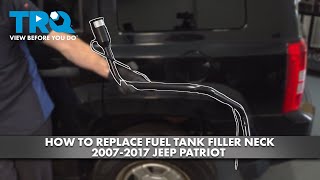
Typical fix: Replace the fuel filler neck assembly. Aftermarket parts from brands like TRQ and Dorman are widely available. 🎬 Watch: Step-by-step guide to replacing a rusted fuel filler neck.
Est. part cost: $70-$150 - Faulty EVAP Purge Valve/Solenoid 🟡 Medium Probability This solenoid, located in the engine bay, cycles frequently and can fail by getting stuck open, creating a constant leak path from the EVAP system to the engine intake. This can sometimes trigger a P0441 code as well.
How to confirm: The purge valve is located on the driver's side of the engine bay near the firewall. With the engine off, disconnect the hose leading to the intake manifold and try to blow through the valve. If air passes through, it is stuck open and needs replacement.
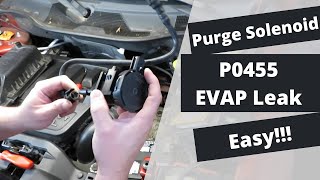
Typical fix: Replace the canister purge valve. This is a relatively simple repair documented in several DIY videos. 🎬 See how to replace the purge solenoid to fix a P0455.
Est. part cost: $40-$85 - Cracked or Disconnected EVAP Hoses ⚪ Low Probability Rubber hoses and plastic lines, particularly in the engine bay and around the charcoal canister, become brittle over time due to heat and age and can develop cracks.
How to confirm: Visually inspect all accessible EVAP lines in the engine bay and around the charcoal canister for obvious cracks, breaks, or loose connections. A smoke test is the most effective way to find a small crack in a hose.
Typical fix: Replace the damaged section of hose.
Est. part cost: $10-$50 - Damaged EVAP (Charcoal) Canister ⚪ Low Probability The canister is a plastic box located behind the driver's side rear wheel, making it susceptible to damage from road debris or cracking with age.
How to confirm: Visually inspect the canister for any physical cracks or damage. If you have difficulty filling the gas tank, it may indicate the canister is saturated with fuel and needs replacement.
Typical fix: Replace the EVAP canister. This involves removing the driver's side rear wheel and liner for access.
Est. part cost: $120-$250
Rare But Worth Checking
- Faulty Leak Detection Pump (LDP) / ESIM: On this platform, the component is often called an Evaporative System Integrity Module (ESIM). It is mounted on the charcoal canister and is responsible for testing the system. The module itself or its seal can fail, causing it to report a leak when there isn't one, or creating a leak itself. A rattling sound when shaking the removed ESIM is a common sign of failure.
Diagnosis Steps

- Check the gas cap. Ensure it is tight and the seal is not cracked or worn. This is the most common fix. Replacing with an OEM Mopar cap is often recommended over aftermarket.
- If the gas cap is good, clear the code and drive for a few days to see if it returns. The EVAP monitor runs only under specific conditions, sometimes requiring several drive cycles.
- If the code returns, perform a thorough visual inspection of all visible EVAP hoses in the engine bay, especially near the purge valve, for cracks or disconnections.
- Inspect the purge valve in the engine bay. Disconnect it and check if it's stuck open by blowing through it. If air passes, it has failed.
- Visually inspect the fuel filler neck for severe rust or damage. This requires removing the rear driver's side wheel and liner for a clear view. This is a very common failure point.
- If no obvious issues are found, the most reliable method for finding the leak is to have a professional perform a smoke test. This involves filling the EVAP system with a harmless, visible smoke and watching where it escapes.
Parts You'll Likely Need

- Fuel Cap
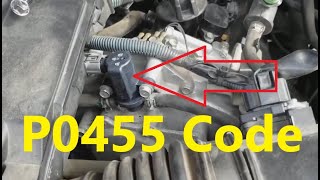
(OEM #52030377AB)— This is the most frequent cause of P0455 due to its seal wearing out over time. It's the first and cheapest part to check 🎬 Watch: A helpful overview of P0455 causes and common fixes. and replace.
Trusted brands: Mopar, Gates, Stant
OEM price range: $20-$35
Aftermarket price range: $15-$25 - Canister Purge Valve / Solenoid
(OEM #4891741AC (supersedes 4891741AA))— This valve is a common failure point that gets stuck open, creating a large, permanent leak in the system.
Trusted brands: Mopar, Dorman, Standard Motor Products
OEM price range: $55-$85
Aftermarket price range: $30-$60 - Fuel Filler Neck
(OEM #5105806AD)— Prone to rusting through, especially in northern climates, creating a large leak that is a very common cause for P0455 on this vehicle.
Trusted brands: Mopar, TRQ, Dorman
OEM price range: $150-$250
Aftermarket price range: $70-$150 - EVAP Leak Detection Pump / ESIM
(OEM #W0133-3117675 (Mopar))— Also called the Evaporative System Integrity Module (ESIM), this component is a known weak point on the platform. It can fail internally or its seal can leak, triggering EVAP codes. The Dorman 310-215 is a popular aftermarket replacement.
Trusted brands: Mopar, Dorman, Standard Motor Products
OEM price range: $90-$120
Aftermarket price range: $20-$50 - EVAP Vapor Canister
(OEM #68368140AC (supersedes 5147060AB))— Can be cracked by road debris or become saturated with fuel if the tank is habitually overfilled, leading to EVAP codes and refueling issues.
Trusted brands: Mopar, Bosch
OEM price range: $140-$210
Aftermarket price range: $120-$200
Related Codes That Often Appear With This One
- P0456 — This code indicates a 'small' EVAP leak. It can appear alongside P0455 if a component is failing intermittently or if the leak size is on the borderline between the computer's definitions.
- P0441 — This code means 'Incorrect Purge Flow'. A large leak from a stuck-open purge valve or a major hose break can disrupt the system's ability to draw a proper vacuum, triggering this code along with P0455.
- P0457 — This code specifically indicates 'EVAP Leak Detected (Fuel Cap Loose/Missing)'. It can appear if the gas cap is the definitive cause of the large leak.
Technical Service Bulletins (TSBs) & Recalls
- TSB #18-048-16: A Technical Service Bulletin for the 2015-2016 Compass/Patriot included a PCM software update that could resolve issues setting a P0456 code, which is related to P0455. While not a direct fix for a physical leak, it indicates that software updates can be part of the diagnostic path.
Platform-Specific Known Issues
- There was a recall for the 2008 model year concerning a fuel tank roll-over valve that could have been damaged during assembly, pote
Scan Tool Commands That Help
- wiTECH or equivalent professional scan tool: EVAP Purge Solenoid Actuation — This bidirectional control allows a technician to command the purge solenoid open and closed to check for correct mechanical and electrical operation. It can be used to see if the solenoid clicks and to seal the front part of the EVAP system during a smoke test.
- wiTECH or equivalent professional scan tool: EVAP System Test — This is an automated test routine initiated by the scan tool that directs the PCM to run its internal EVAP leak monitor procedure. This can help verify a fix without waiting for multiple natural drive cycles.
- N/A - Command Does Not Exist: EVAP Vent Solenoid / ESIM Actuation — It is critical to know that on the Jeep Patriot platform, the vent side of the canister is sealed by a mechanical Evaporative System Integrity Module (ESIM), not an electronic solenoid. Therefore, there is no bidirectional scan tool command to open or close the vent valve, which can confuse technicians. The system must be sealed manually at the ESIM for testing.
Wiring & Ground Locations
- G200 — Inside the vehicle, at the base of the driver's side (left) A-pillar, near the kick panel.. A 2014 wiring diagram explicitly lists G200 as the ground point for the 'Evap system monitor switch,' which is the ESIM. A poor connection at this ground can cause the ESIM to send incorrect data to the PCM, triggering a false EVAP code even with no physical leak.
- ECU Harness Ground — On the engine air filter box, where the main engine control unit (ECU/PCM) wiring harness is located.. A real-world repair case confirmed that a bad ground connection in this area was the sole cause of a persistent EVAP code after the gas cap and purge valve were replaced. This ground is critical for the PCM and its sensor inputs.
- G112 — In the engine compartment, on the left front inner fender.. This is a primary engine bay ground point. While not directly tied to a specific EVAP component in documentation, poor grounding here can cause a range of sensor and solenoid issues, including for the purge solenoid.
Real Owner Repair Stories
- Reddit user FaithlessnessSoggy79 on r/JeepPatriot (2015 Jeep Patriot) — Check engine light with an EVAP code was on for two years; needed to pass a vehicle inspection.
❌ Tried (didn't work) Replacing the gas cap, Replacing the purge solenoid canister
✅ What actually fixed it The problem was a ground issue. The user fixed the ground wire on the ECU cables located on top of the engine air filter box, and the code did not return after a 300km drive. - YouTube channel 'CARMEDIX' (2017 Jeep Patriot) — Check Engine Light with code P0456 (small leak, but diagnosis is identical for P0455).
❌ Tried (didn't work) Initial smoke test showed a leak from the rear fender liner area.
✅ What actually fixed it After isolating the ESIM by clamping its hose, the rest of the system held smoke perfectly. The ESIM itself was not leaking smoke but was diagnosed as faulty by removing it and shaking it; a loud rattle from the internal plunger (compared to a silent new part) confirmed it was broken. Replacing the ESIM fixed the issue.
"I Checked Everything" — The Actual Cause
- A smoke test may show the system is perfectly sealed, yet the P0455 code persists. This often points to an electrical issue rather than a physical leak. A confirmed fix was a faulty ground wire for the ECU, which caused the computer to receive bad data from the EVAP system sensors and falsely report a leak.
- The Evaporative System Integrity Module (ESIM) itself can fail internally without causing an external smoke leak. In one documented case, the system passed a smoke test after the ESIM was isolated. The ESIM was condemned because its internal plunger was broken and rattled when shaken. This is a mechanical/electrical failure of the test component itself, not a leak in the hoses or tank it is designed to monitor.
OEM Part Supersession History
Multiple (e.g., 5278632aa, 52030377aa)→52030377AB— Standard part consolidation and design updates by Mopar over many years and vehicle platforms.
Heads up: The Mopar part 52030377AB is the current recommended OEM replacement and has a long list of superseded numbers it replaces, including 4578235ab, 52030377aa, 5278632aa, 5278632ac, 5278632ad, 5278632ae, 5278632af, and 5278632ag. Using a non-OEM cap is a frequent cause of repeat P0455 codes.
Model Year Variations Within This Range
- 2007-2017: Unlike many other vehicles (including other Chrysler products) that use an electronically controlled vent solenoid, the entire Jeep Patriot generation uses a mechanical, non-commandable Evaporative System Integrity Module (ESIM) to seal the canister vent. This is a critical diagnostic difference, as a technician cannot use a scan tool's bidirectional controls to close the vent for a smoke test; it must be done manually.
Diagnostic Flowchart
Real Owner Stories
Aggregated from forums and TSBs cited above. Mileages and costs reflect what owners reported in those sources.
2011 Jeep Patriot 2.0L CVT
Symptoms: Check engine light with codes P0455, P0456, and P0457. Changed the gas cap, which worked for a week, then changed the purge valve, but the code did not clear.
What fixed it: Replaced the EVAP emission detector (leak detection pump) with Dorman part #310-215.
Source hint: Reddit r/JeepPatriot
2007-2017 Jeep Patriot/Compass
Symptoms: Recurring 'gas cap' light on the dash that a new gas cap did not fix.
What fixed it: Replaced the Evap System Integrity Module (ESIM / Leak Detection Pump) using Dorman part 310-215.
Source hint: YouTube video 'Evap System Integrity Module replacement 07-17 Jeep Compass and Patriot'
Jeep Liberty (KJ/KK)
Symptoms: P0455 code present after checking hoses and the gas cap.
What fixed it: Replaced the leak detection pump.
Source hint: Jeep KJ and KK Liberty Forum thread 'Check Engine: P0455'
Related OBD-II Codes
Frequently Asked Questions
Is there a recall for the Jeep Patriot that causes the P0455 code?
My 2015 Patriot has a P0455 and P0456 code. Is there a software fix?
Why does my Patriot dashboard say 'gas cap' even when I know it is tight?
Where is the EVAP charcoal canister located on my 2007-2017 Patriot?
How can I test the purge valve on my Jeep Patriot?
Why is it so hard to put gas in my Patriot without the pump shutting off constantly?
Helpful Videos
Used OEM Parts in Stock



New Aftermarket Parts Available


The information in this article is provided for general reference and educational purposes only. Vehicle specifications, procedures, and part compatibility can vary by production date, trim level, and region. Always consult your vehicle's factory service manual and verify part numbers before purchasing or performing repairs. Safety-critical components such as airbags, seat belts, and braking systems should be installed by a qualified professional.
- Jeep Patriot:
- 🎬 Helpful Videos
- 🛍️ Shop This Part
- What's Unique About the 2007-2017 Jeep Patriot
- Symptoms You May Notice
- Most Likely Causes
- Rare But Worth Checking
- Diagnosis Steps
- Parts You'll Likely Need
- Related Codes That Often Appear With This One
- Technical Service Bulletins (TSBs) & Recalls
- Platform-Specific Known Issues
- Scan Tool Commands That Help
- Wiring & Ground Locations
- Real Owner Repair Stories
- "I Checked Everything" — The Actual Cause
- OEM Part Supersession History
- Model Year Variations Within This Range
- Diagnostic Flowchart
- Real Owner Stories
- 2011 Jeep Patriot 2.0L CVT
- 2007-2017 Jeep Patriot/Compass
- Jeep Liberty (KJ/KK)
- Related OBD-II Codes
- Frequently Asked Questions
- 🎟️ Get 5% Off