

P0449 on 2003-2026 Chevrolet Express: EVAP Vent Circuit Malfunction Causes and Fixes
On a Chevy Express, P0449 almost always points to a faulty EVAP canister vent solenoid or its wiring. This part is located under the van on the driver's side frame rail near the fuel tank. Expect to pay $30-$60 for an aftermarket solenoid (like ACDelco 214-2149 or Dorman 911-030) and about an hour for DIY replacement. Corrosion of the part and its wiring is the primary driver of this failure.
- P0449 is an electrical circuit code, not a leak code. Don't start by replacing the gas cap.
- The most likely culprit is the EVAP vent solenoid located near the gas tank.
- Inspect the wiring and connector for corrosion or damage before replacing the solenoid, as this is also a common point of failure.
- This is a very common and straightforward DIY repair that usually takes less than an hour with basic tools.
- The part is relatively inexpensive, typically costing between $30 and $70.
What's Unique About the 2003-2026 Chevrolet Express
The Chevrolet Express, being a body-on-frame van based on a truck platform, has its EVAP components located underneath the vehicle, typically on the driver's side frame rail near the fuel tank. This location exposes the vent solenoid and its wiring to road salt, moisture, and debris, leading to heavy corrosion and frequent failures of both the solenoid itself and the electrical connector/wiring. This is a well-documented issue across GM trucks and vans that share this design. A technical service bulletin for similar Chevrolet trucks even notes that dust intrusion can cause this code.
Generation note: The 2003-2026 year range covers a single long-running generation of the Chevrolet Express. While there have been engine and electronic updates, the location and function of the EVAP vent solenoid remain consistent, making the diagnosis and repair process very similar across these model years. Early models (approx. 2003-2010) commonly use part ACDelco 214-2149.
Symptoms You May Notice
- Check Engine Light is on.
- Possible difficulty filling the fuel tank if the valve is stuck closed.
- Possible fuel odor around the vehicle.
- Slightly reduced fuel economy.
- Vehicle will fail an emissions test.
- Replacing the gas cap. A bad gas cap typically causes a large leak code (P0455), not a circuit code like P0449.
- Replacing the EVAP purge solenoid/valve. The purge solenoid is located in the engine bay and has its own set of diagnostic codes (e.g., P0443). P0449 specifically refers to the vent solenoid circuit near the tank.
Most Likely Causes
- Faulty EVAP Canister Vent Solenoid 🔴 High Probability The solenoid is mounted under the van, exposed to weather and road debris, which causes internal corrosion and electrical failure. The metal body of the solenoid can crack from corrosion, allowing moisture inside and destroying the coil. This is the most common cause for P0449 on GM trucks and vans.
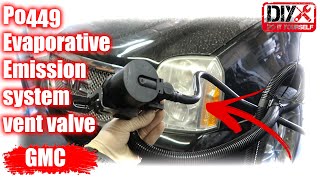
How to confirm: Locate the solenoid near the fuel tank. Apply 12V directly to its pins; a healthy solenoid will make an audible click. If it doesn't click, it has failed. A capable scan tool can also command the valve to close to test its function. 🎬 Watch this guide on fixing code P0449 on GM trucks and SUVs A multimeter can test the solenoid's internal resistance; an open circuit (infinite ohms) or a reading outside the 20-40 ohm range indicates failure.
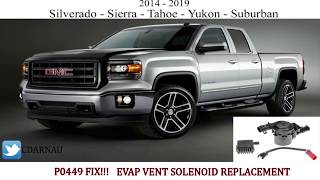
Typical fix: Replace the EVAP canister vent solenoid. It typically slides or twists off its bracket after disconnecting the electrical connector and hose. 🎬 Watch this step-by-step GM vent solenoid replacement tutorial
Est. part cost: $30-$70 - Damaged or Corroded Wiring/Connector 🟡 Medium Probability The wiring harness leading to the vent solenoid is also exposed to the elements. Wires can break inside the insulation (often near the connector), and the connector pins can fill with green corrosion, causing an open or short in the circuit. An owner complaint for a similar GM vehicle cited this exact issue.
How to confirm: Visually inspect the wiring harness and connector for any signs of damage, green corrosion, or broken wires. Use a multimeter or test light to check for 12V power at the connector (often a red or pink/orange wire) with the key on. If power is present, check the ground control wire for continuity back to the PCM. A break is often found within a foot or two of the connector.
Typical fix: Repair the broken wire by splicing in a new section with heat-shrink butt connectors. If the connector itself is damaged, replace it with a new pigtail (e.g., ACDelco PT2160).
Est. part cost: $10-$30 - Blown Fuse ⚪ Low Probability A short circuit in the vent solenoid or its wiring can cause the associated fuse to blow, cutting power to the circuit.
How to confirm: Consult the owner's manual or a fuse diagram for the under-hood fuse box. Locate the fuse for the EVAP system (may be labeled 'CNSTR VENT' or similar). Visually inspect the fuse or test it for continuity.
Typical fix: Replace the blown fuse. If the new fuse blows immediately, a short circuit is present and must be diagnosed.
Est. part cost: $1-$5
Rare But Worth Checking
- Failed Fuel Tank Pressure (FTP) Sensor: While less common for a P0449 circuit code, some mechanics report that a faulty FTP sensor can sometimes trigger this code on GM vehicles. This is more likely if other EVAP codes are also present.
- Faulty Powertrain Control Module (PCM): This is extremely rare. The PCM's internal driver for the vent solenoid circuit can fail, but all other possibilities should be exhausted before considering PCM replacement.
Diagnosis Steps
- Read the code with an OBD-II scanner to confirm P0449 is present.
- Check the fuse for the EVAP system in the under-hood fuse block (e.g., 'CNSTR VENT' fuse). Replace if blown.
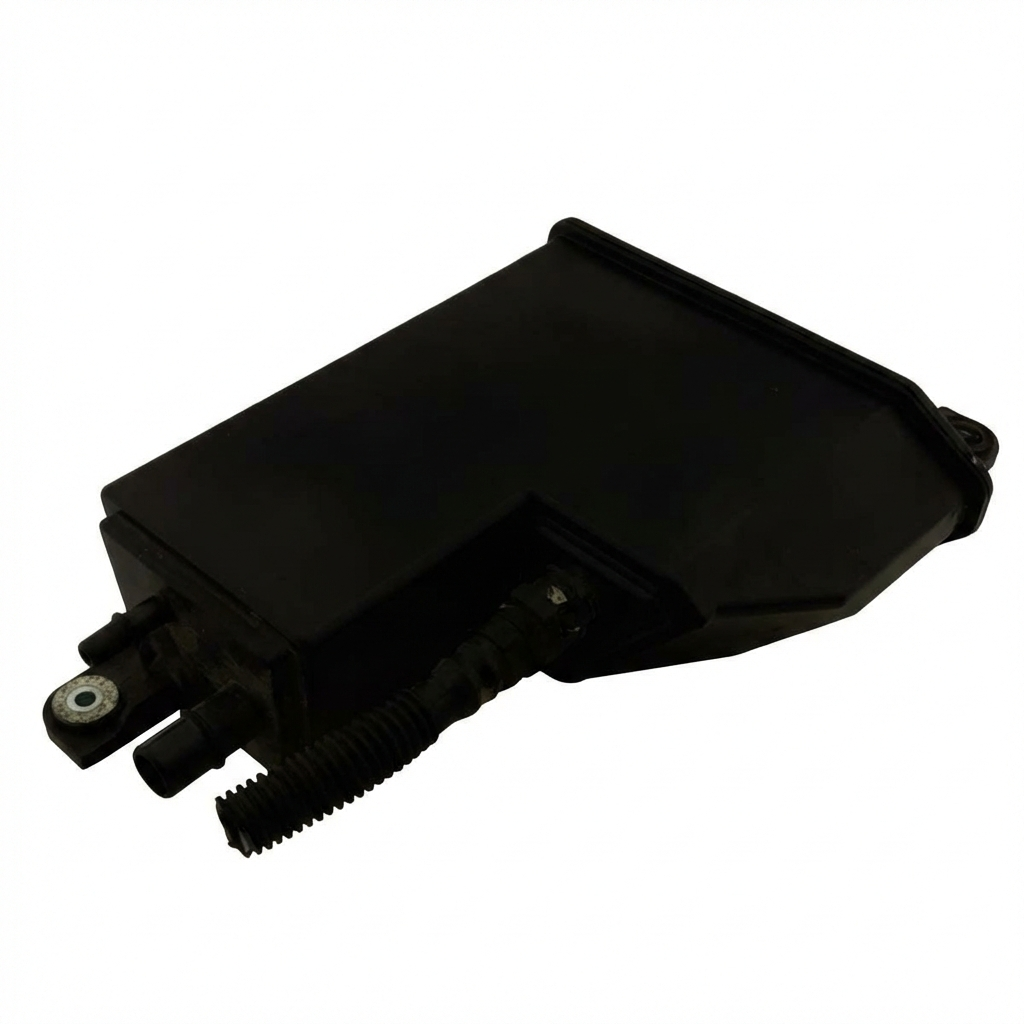
- Locate the EVAP canister vent solenoid under the van, usually on the driver's side frame rail near the fuel tank. It's a black plastic component with an electrical connector and one or two hoses.
- Inspect the electrical connector and wiring harness for any visible damage, green corrosion, or loose connections. Pay close attention to the area where wires enter the connector.
- With the ignition on, use a multimeter or 12V test light to confirm there is battery voltage on one of the wires at the connector (often pink or orange).
- If power is present, command the vent solenoid closed 🎬 See how to repair a P0449 code on a late-model Chevy (to a 'Not Venting' state) using a capable scan tool. Listen for a click and watch for the control wire voltage to drop to near 0V.
- If you don't have a scan tool, you can remove the solenoid and apply 12V and ground directly to its pins to test for a click. No click means the solenoid is internally failed.
- If the solenoid clicks with direct power but not via the harness (and power is confirmed at the harness), the problem is likely in the ground control wire going back to the PCM or the PCM driver itself.
- If there is no power at the connector and the fuse is good, there is a break in the power wire between the fuse box and the solenoid. A user on ChevroletForum.com found such a break about a foot and a half from the solenoid.
Parts You'll Likely Need
- EVAP Canister Vent Solenoid
(OEM #ACDelco 214-2149 (also GM 25932571))— This is the most frequent failure point for code P0449 due to its exposed location under the vehicle, leading to internal electrical failure from corrosion and cracking.
Trusted brands: ACDelco, Dorman (911-030), Standard Motor Products
OEM price range: $40-$70
Aftermarket price range: $30-$50 - EVAP Vent Solenoid Connector Pigtail
(OEM #ACDelco PT2160)— Often the connector itself corrodes beyond repair or the wires break right at the connector, requiring a new pigtail to be spliced in.
Trusted brands: ACDelco, Dorman
OEM price range: $20-$35
Aftermarket price range: $10-$25
Related Codes That Often Appear With This One
- P0455 — A large leak is detected. This can occur if the vent solenoid fails in the open position, which the PCM interprets as a large leak during system self-tests.
- P0442 — A small leak is detected. Similar to P0455, a malfunctioning vent solenoid can cause the system to fail its leak test, sometimes resulting in a small leak code.
- P0498 — Indicates low voltage in the vent valve control circuit, which is a more specific version of the general circuit malfunction reported by P0449.
Technical Service Bulletins (TSBs) & Recalls
- 23-NA-073: Notes that P0449 can be caused by dust intrusion into the evaporative canister on related Chevrolet models.
Platform-Specific Known Issues
- A GM Technical Service Bulletin (#23-NA-073) for similar truck platforms indicates that dust intrusion into the EVAP canister can cause P0449, suggesting that replacing the canister or adding a filter kit may be necessary in dusty environments.
- Owner complaints frequently cite failure of the wiring harness due to insufficient protection from the elements, leading to a P0449 code. A real-world repair on ChevroletForum.com documented finding a corroded-through power wire about 1.5 feet from the solenoid connector.
Mechanic-Grade Diagnostic Values
- EVAP Vent Solenoid Coil Resistance — expected: 20 - 40 Ohms. Failure: An open circuit (infinite resistance) or a reading far outside the expected range indicates a failed solenoid coil.
- Voltage at Solenoid Connector Power Wire (Key On) — expected: ~12V (Battery Voltage). Failure: A reading below 10V suggests a problem with the power supply wire or a blown fuse.
- Voltage at Solenoid Connector Control Wire (Key On, Solenoid OFF) — expected: ~12V (Battery Voltage). Failure: A reading of 0V indicates a short to ground in the control wire or a failed PCM driver.
- Voltage at Solenoid Connector Control Wire (Commanded ON with Scan Tool) — expected: Near 0V. Failure: A reading that stays at 12V indicates an open in the control wire, a failed PCM driver, or a bad ground for the PCM.
- Solenoid Current Draw (Commanded ON) — expected: 0.5 - 1.0 Amps (older models), ~300 Milliamps (newer models). Failure: No current draw indicates an open circuit; excessive draw indicates a short.
Scan Tool Commands That Help
- Tech2, GDS2, or equivalent bidirectional scanner: EVAP Vent Solenoid ON/OFF or Venting/Not Venting — This command is used to test the entire control side of the circuit. By commanding the solenoid on and off, a technician can check for an audible click from the solenoid and verify the control wire voltage switches from ~12V to ~0V, confirming the PCM driver and wiring integrity.
Wiring & Ground Locations
- EVAP Vent Solenoid Connector — Under the vehicle on the driver's side, attached to the vent solenoid which is mounted near the charcoal canister, forward of the fuel tank.. This connector and the adjacent wiring are the most common failure points due to corrosion and wire fatigue from exposure to the elements. P0449 is often caused by a break in the power (Pink/Orange) or control (White) wire right at the connector.
- PCM (Powertrain Control Module) — Typically located in the engine bay.. The PCM provides the switched ground signal to activate the vent solenoid. A failure of the internal driver circuit within the PCM can cause P0449, though this is rare. The control wire runs from this module to the solenoid.
Real Owner Repair Stories
- Reddit user comment (2010 Chevrolet Express 2500 4.8L) — P0449 code along with a no-start condition where the fuel pump would not prime.
❌ Tried (didn't work) Replacing the EVAP vent solenoid by the fuel tank., Replacing the pigtail harness for the solenoid.
✅ What actually fixed it The P0449 was a separate issue from the no-start. A commenter noted that for a crank/no-start on G-vans, a common culprit is the main chassis/engine ground at the right front frame rail, which should be inspected. The P0449 itself was not resolved in the thread, but the related advice is valuable. - Reddit user post (2005 Chevrolet Express 3500 (Motorhome chassis)) — Initially a pending P0446 (EVAP Vent System Performance).
❌ Tried (didn't work) Replacing the gas cap., Replacing the vapor canister purge valve with an aftermarket (Standard Motor Products) part.
✅ What actually fixed it After replacing the purge valve with an aftermarket part, the code changed to P0496 (EVAP System High Purge Flow). A commenter suggested the aftermarket valve was likely faulty and that using only OEM (GM) purge valves is recommended to avoid such issues. The final resolution was to install an OEM purge valve.
"I Checked Everything" — The Actual Cause
- P0449 is an electrical circuit malfunction code, not a leak code. Technicians may perform a smoke test out of habit when dealing with EVAP system faults, which is the correct procedure for codes like P0442 (small leak) or P0455 (large leak). For P0449, the smoke test will almost always pass (show no leaks) because the fault lies in the wiring, the solenoid's coil, or the PCM driver, none of which can be found with smoke. The actual cause must be found by testing the electrical circuit with a multimeter and scan tool.
OEM Part Supersession History
10382105, 15750484, 22728634→GM 25932571 (ACDelco 214-2149)— Part consolidation and design updates by the manufacturer.
Model Year Variations Within This Range
- 2003-2010 (approx.): These earlier models are explicitly listed as compatible with the common ACDelco 214-2149 / GM 25932571 vent solenoid.
- 2011-onward (approx.): While the function and location are similar, later model year vans may use a different part number. A technician noted that a 2018 Express vent solenoid had a much lower amperage draw (~300mA) than older styles, suggesting an internal design change. Always verify the part number for your specific VIN.
Diagnostic Flowchart
Other Known Issues on This Vehicle
Issues unrelated to this code that are worth knowing about as an owner of this generation:
- Inaccurate or Failed Fuel Level Sensor 🟠 Medium — Very common across all model years. The gauge may read empty when full, full when empty, or fluctuate wildly. TSBs 18-NA-365 and 17-NA-204 address related fuel system issues. (Ref: 18-NA-365, 17-NA-204)
- Peeling White Paint 🟡 Low — Extremely common on white-painted vans, particularly from the 2000s and 2010s. The paint delaminates from the primer in large sheets, but it is primarily a cosmetic issue.
- Transmission Problems (4L60E / 4L80E) 🔴 High — Common at higher mileage (100k+ miles). The 4L60E can suffer from harsh shifts or loss of gears, while the heavier-duty 4L80E can have issues with solenoids, torque converters, and overheating.
- Intake Manifold Gasket Leaks 🟠 Medium — More common on earlier V6 and V8 models (pre-2010). Gaskets can fail, causing coolant and/or oil leaks, which can lead to overheating or oil consumption.
- ABS Module / Wheel Speed Sensor Failures 🟠 Medium — Fairly common. Can cause an ABS light, traction control warnings, and erratic ABS activation. Often caused by corrosion at the wheel speed sensor connectors or internal failure of the ABS control module.
Used vs. New Parts: Buying Guide for This Vehicle
When a used part is the smart pick: For this specific repair, buying a used EVAP vent solenoid is not recommended. The part fails due to internal electrical issues and corrosion from its exposed location under the vehicle. A used part from a junkyard has an unknown history and a high likelihood of either being already faulty or failing soon after installation. The low cost of a new aftermarket part makes it the smarter choice.
What to inspect on the donor part:
- Not applicable as used parts are not recommended.
OEM-only on this vehicle (don't cheap out):
- While not strictly 'OEM-only', some professional technicians and forum users report fewer issues with callbacks or secondary codes when using OEM (ACDelco) EVAP system components (both purge and vent solenoids) compared to some aftermarket brands.
Aftermarket brands forum-validated for this vehicle:
- ACDelco (GM's OEM parts brand)
- Dorman
- Standard Motor Products (SMP)
Brands owners have reported issues with on this vehicle:
- No specific brands are universally cited as 'avoid', but be aware that any aftermarket part can have a higher defect rate than OEM. One user experienced a secondary code after installing an aftermarket purge valve, which was resolved by switching to an OEM part.
Real Owner Stories
Aggregated from forums and TSBs cited above. Mileages and costs reflect what owners reported in those sources.
2012 Chevrolet Express
Symptoms: Check Engine Light with code P0449.
What fixed it: Repairing a broken power wire located about a foot and a half from the solenoid connector.
Source hint: ChevroletForum.com: Thread '2012 Express Van- Code P0449'
2010 Chevrolet Express
Symptoms: P0449 code and a no-start condition.
What fixed it: Checking fuses and relays after replacing the vent solenoid and pigtail failed to resolve the issue.
Source hint: Reddit r/MechanicAdvice
Related OBD-II Codes
Frequently Asked Questions
Where is the EVAP canister vent solenoid located on my Chevrolet Express?
Does GM Technical Service Bulletin #23-NA-073 apply to the P0449 code on my van?
Why is the vent solenoid so prone to failure on the Express and Savana vans?
Which fuse should I check for a P0449 code on a Chevy Express?
What specific replacement connector pigtail is recommended if my wiring is corroded?
Can a P0449 code cause issues when I am at the gas station?
Helpful Videos

We Have This Part in Stock

The information in this article is provided for general reference and educational purposes only. Vehicle specifications, procedures, and part compatibility can vary by production date, trim level, and region. Always consult your vehicle's factory service manual and verify part numbers before purchasing or performing repairs. Safety-critical components such as airbags, seat belts, and braking systems should be installed by a qualified professional.
- Chevrolet Express:
- 🎬 Helpful Videos
- 🛍️ Shop This Part
- What's Unique About the 2003-2026 Chevrolet Express
- Symptoms You May Notice
- Most Likely Causes
- Rare But Worth Checking
- Diagnosis Steps
- Parts You'll Likely Need
- Related Codes That Often Appear With This One
- Technical Service Bulletins (TSBs) & Recalls
- Platform-Specific Known Issues
- Mechanic-Grade Diagnostic Values
- Scan Tool Commands That Help
- Wiring & Ground Locations
- Real Owner Repair Stories
- "I Checked Everything" — The Actual Cause
- OEM Part Supersession History
- Model Year Variations Within This Range
- Diagnostic Flowchart
- Other Known Issues on This Vehicle
- Used vs. New Parts: Buying Guide for This Vehicle
- Real Owner Stories
- 2012 Chevrolet Express
- 2010 Chevrolet Express
- Related OBD-II Codes
- Frequently Asked Questions
- 🎟️ Get 5% Off