

P0443 on 2010-2015 Hyundai Tucson: EVAP Purge Valve Circuit Malfunction Causes and Fixes
This code almost always points to a faulty EVAP purge control valve or its wiring harness. The PCM has detected an electrical fault in the valve's control circuit. Replacing the purge valve is the most common fix, a straightforward DIY job with the part costing between $40 and $120. The OEM part number is often cited as 28910-2E000 or 28910-3C200.
- P0443 is an electrical circuit code, not a leak code. Don't rush to replace the gas cap.
- The most likely culprit is the purge control valve itself, which is a common and relatively inexpensive part to fail.
- The purge valve is easy to access on the 2010-2015 Tucson, making this a very DIY-friendly repair.
- Always inspect the wiring and connector for damage before buying a new valve, as a broken wire can cause the same code.
- No recalls or Technical Service Bulletins (TSBs) are known to exist for this specific issue on this vehicle.
What's Unique About the 2010-2015 Hyundai Tucson
For the second-generation Hyundai Tucson (and its platform-mate, the Kia Sportage), the P0443 code is a very common and straightforward issue. The 2.4L Theta II GDI engine, widely used in this model, has an easily accessible purge valve located on top of the engine near the intake manifold, making diagnosis and replacement simpler than on many other vehicles. There are no widespread, unique design flaws or TSBs for this specific problem on this platform; it's typically a standard case of a component failing with age and heat cycles.
Symptoms You May Notice
- Check Engine Light is on.
- Slightly rough idle or engine hesitation, particularly if the valve is stuck open.
- Minor decrease in fuel economy.
- A faint fuel odor near the vehicle.
- Difficulty starting the engine after refueling (in some cases where the valve is stuck open, flooding the engine with vapors).
- A 'whooshing' sound from the gas tank when removing the cap, indicating pressure issues.
- Replacing the gas cap. A bad gas cap typically causes 🎬 Watch: How to properly diagnose and replace the purge solenoid. a leak-related code (like P0455 or P0456), not a circuit malfunction code like P0443.
- Replacing the charcoal canister. The canister is a part of the EVAP system, but it is not part of the electrical circuit for the purge valve and would not cause a P0443 code. A canister issue is more likely to trigger a flow or leak code.
Most Likely Causes
- Faulty EVAP Purge Control Valve (Solenoid) 🔴 High Probability This is a common failure point on many vehicles due to age and constant use. The internal coil winding can develop an open or short, or the valve can become mechanically stuck from fuel vapor residue.
How to confirm: After checking the wiring, you can test the valve itself. With the engine off, disconnect the electrical connector and check the resistance across the two pins with a multimeter. 🎬 See how to test the purge valve using a multimeter. A reading between 20-30 Ohms is typical for a good valve. An open circuit (infinite resistance) or a short (near-zero resistance) indicates a bad valve. You can also (carefully) apply 12V power to the pins to see if the solenoid clicks open and closed; no click means it's failed.
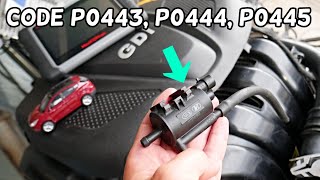
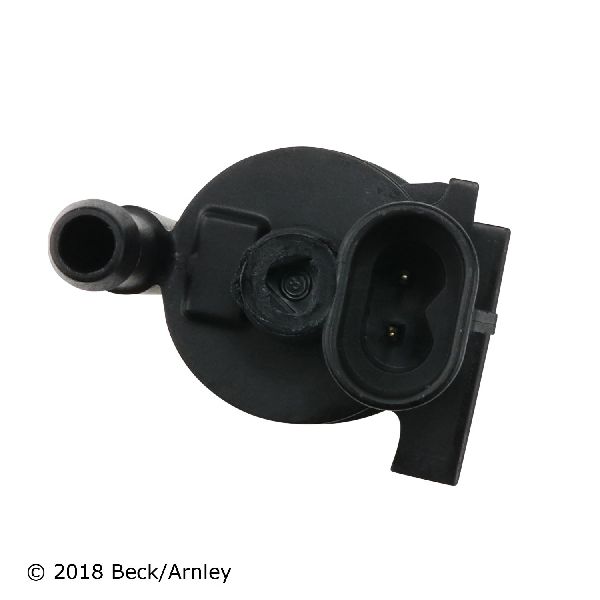
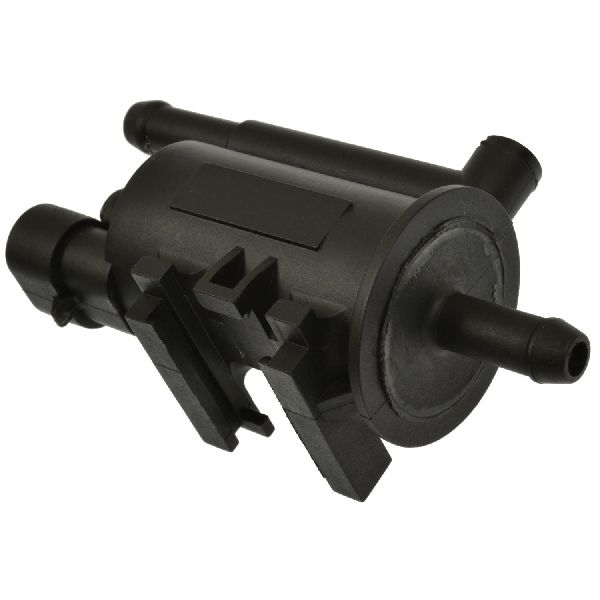
Typical fix: Replace the purge control valve. It is typically mounted on or near the intake manifold with two hoses and one electrical connector.
Est. part cost: $40-$120 - Damaged Wiring or Connector 🟡 Medium Probability The wiring harness in the engine bay is exposed to heat and vibration, which can cause wires to become brittle and crack or rub through their insulation over time.
How to confirm: Visually inspect the wiring harness leading to the purge valve for any signs of cracking, fraying, or rodent damage. Disconnect the connector and check for corrosion, bent pins, or water intrusion. Use a multimeter to check for 12V power on one wire and for continuity to the PCM on the other (ground-side control) wire with the key on.
Typical fix: Repair the damaged section of wire or clean/replace the electrical connector.
Est. part cost: $5-$25
Rare But Worth Checking
- Blown Fuse: The EVAP system is often on a shared fuse. While not common for this to be the only component affected, it's a quick and easy check in the fuse box before replacing parts.
- Faulty Powertrain Control Module (PCM): This is a very rare cause. The PCM's internal driver for the purge valve circuit can fail. This should only be considered after the valve and wiring have been definitively ruled out by testing.
Diagnosis Steps
- Scan for Codes: Use an OBD-II scanner to confirm P0443 is the active code. Note any other codes present, like P0444, P0445, or P0171.
- Inspect the Purge Valve Connector and Wiring: Locate the purge valve on the engine, near the intake manifold. Visually inspect the electrical connector and nearby wires for any obvious damage, corrosion, or loose connections.
- Test the Circuit for Power: Disconnect the connector. With the ignition on, use a multimeter to verify that one of the pins in the connector has battery voltage (approx. 12V).
- Test the Purge Valve Solenoid: With the connector still unplugged, set your multimeter to measure resistance (Ohms) and touch the probes to the two pins on the purge valve itself. A healthy valve should have a specific resistance value (typically 20-30 Ohms). An open circuit (infinite resistance) or a short (zero resistance) indicates a bad valve.
- Check for a Blown Fuse: Consult the owner's manual to locate the fuse for the EVAP system or emissions components and visually inspect it.
- Command the Valve On (Advanced): If you have a bidirectional scanner, you can command the purge valve to open and close. You should hear an audible click from the valve. If it doesn't click, and the wiring is confirmed to be good, the valve is faulty.
- Clear Codes and Test Drive: After performing repairs (like replacing the valve), clear the trouble codes with the scanner and perform a test drive to ensure the Check Engine Light does not return.
Parts You'll Likely Need
- EVAP Vapor Canister Purge Valve / Solenoid
(OEM #28910-2E000 or 28910-3C200 (verify by VIN))— This is the most frequent point of failure for a P0443 code, either due to an internal electrical failure of the solenoid coil or the valve becoming mechanically stuck.
Trusted brands: Hyundai (OEM), Dorman (911-676), Standard Motor Products (CP816), Beck Arnley
OEM price range: $60-$100
Aftermarket price range: $30-$75
Related Codes That Often Appear With This One
- P0444 — This code indicates an 'EVAP Purge Control Valve Circuit Open', which is a more specific version of the P0443 general circuit fault, often pointing directly to a broken wire or failed solenoid coil.
- P0445 — This code indicates an 'EVAP Purge Control Valve Circuit Shorted', another specific fault that falls under the general P0443 category, pointing to a short in the wiring or solenoid.
- P0171 — If the purge valve is stuck open, it can create a vacuum leak, allowing un-metered air (and fuel vapor) into the intake manifold. This can cause the engine to run lean and trigger a P0171 'System Too Lean' code.
Platform-Specific Known Issues
- Common Failure on Theta II Engines: The P0443 code is a well-documented and frequent issue across the Hyundai/Kia lineup for vehicles equipped with the 2.4L Theta II engine, including the Sonata, Optima, and Sportage. The cause is almost always the purge valve itself failing electrically.
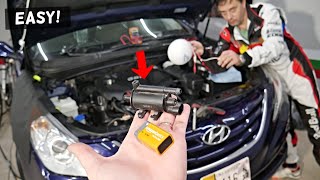
- Owner Experience: Simple DIY Fix: Multiple owners on forums like Reddit and Hyundai-Forums confirm that replacing the purge valve for a P0443 code is a beginner-friendly DIY repair that takes less than 30 minutes, requiring only basic tools to remove the engine cover and release the hose clamps and electrical connector. 🎬 Watch: A quick walkthrough of this common Hyundai Tucson fix.
Mechanic-Grade Diagnostic Values
- Purge Control Valve Solenoid Resistance — expected: 20-30 Ω (Ohms). Failure: A reading outside 15-35 Ω, infinite resistance (open), or near-zero resistance (short) indicates a faulty valve coil.
- Purge Valve Connector - Power Supply Pin — expected: Battery Voltage (~11-14 V) with Key On, Engine Off.. Failure: No voltage suggests a blown fuse or an open in the power supply wire.
- Purge Valve Connector - Control Pin (Back-probed) — expected: Near 0V when commanded ON by a scan tool; near battery voltage when commanded OFF.. Failure: Voltage does not change when commanded, indicating a wiring issue to the PCM or a faulty PCM driver.
Scan Tool Commands That Help
- Hyundai GDS (or equivalent bidirectional scanner): EVAP Purge Test / Actuation Test — This function allows the technician to command the purge valve solenoid to open and close manually. It's used to verify if the valve clicks audibly and if the control circuit is functioning correctly by observing voltage changes.
- Hyundai GDS (or equivalent bidirectional scanner): Resetting Adaptive Values — After replacing a component like the purge valve, it can be beneficial to reset the engine control module's adaptive learning values to ensure the system recalibrates with the new part immediately.
- Advanced Scan Tool: Monitor Fuel Tank Pressure (FTP) PID — To test for a mechanically stuck-open purge valve, command the vent valve closed and the purge valve closed (off). If the FTP sensor shows vacuum building in the tank with the engine running, it confirms the purge valve is leaking vacuum from the intake manifold into the EVAP system.
Wiring & Ground Locations
- Canister Purge Control Solenoid Valve — Located on the left side of the engine, near the top of the intake manifold runners on the 2.4L engine.. This is the component and connector that must be tested for the P0443 circuit code.
- Ghg01 (Ground) — Located on the left front of the engine compartment.. A poor ground at this location could potentially affect various engine sensor circuits, including the EVAP system, leading to intermittent electrical faults.
- PCM (Engine Control Module) — Located in the left rear of the engine compartment.. The control wire for the purge valve terminates at the PCM. A continuity check must be performed between the valve connector and the PCM connector if a wiring break is suspected.
OEM Part Supersession History
28910-25100→28910-2E000 (among others, depending on application)— Part consolidation and potential design updates across multiple Hyundai/Kia platforms.
Heads up: While many valves look physically similar, using the wrong part number can result in incorrect flow rates or electrical characteristics. The Pass 2 listed part numbers 28910-2E000 and 28910-3C200 are correct for this generation, while 28910-25100 is generally for earlier models. Always verify by VIN.
Model Year Variations Within This Range
- 2011-2013: Some parts catalogs show specific wiring harness options for SULEV (Super Ultra Low Emission Vehicle) vs. non-SULEV models, which could potentially affect EVAP component wiring or PCM logic. This is most relevant when diagnosing complex wiring issues.
Diagnostic Flowchart
Used vs. New Parts: Buying Guide for This Vehicle
When a used part is the smart pick: A used OEM purge valve from a low-mileage donor vehicle is a reasonable choice for this repair. The part is not a major wear item and is easy to access and replace, minimizing labor risk if the used part fails prematurely. Given the high failure rate, a used part is a cost-effective gamble.
Donor-vehicle mileage cap: roughly under 80000 miles for the part to have meaningful remaining life.
What to inspect on the donor part:
- Check for cracks or damage to the plastic housing and hose ports.
- Ensure the electrical connector pins are straight and free of corrosion.
- If possible, perform a resistance test on the spot with a multimeter (should be 20-30 ohms).
- Avoid parts from vehicles with obvious signs of engine fire or flood damage.
OEM-only on this vehicle (don't cheap out):
- Powertrain Control Module (PCM) - Due to programming requirements, a used PCM is not a simple plug-and-play solution and should be avoided unless you have access to specialized programming tools.
Aftermarket brands forum-validated for this vehicle:
- Dorman (specifically part 911-676) is a widely available and commonly used aftermarket replacement.
- Standard Motor Products (SMP)
- Beck/Arnley
Brands owners have reported issues with on this vehicle:
- No-name, unbranded parts from online marketplaces may have lower quality control and are a higher risk, though some may function correctly.
Real Owner Stories
Aggregated from forums and TSBs cited above. Mileages and costs reflect what owners reported in those sources.
2012 Hyundai Tucson 2.4L
Symptoms: The Check Engine Light came on for code P0443.
What fixed it: Replaced the EVAP purge control valve. The repair was a simple, beginner-friendly DIY job that took less than 30 minutes with basic tools.
Source hint: vehicle_specific_issues: Owner Experience: Simple DIY Fix
2011 Hyundai Tucson
Symptoms: The primary symptom was the Check Engine Light illuminating with code P0443 stored.
What fixed it: The problem was resolved by replacing the EVAP purge control valve, which is the most common failure point for this code on this vehicle.
Source hint: Hyundai-Forums thread 'p0443-code-on-2011-tucson'
Related OBD-II Codes
Frequently Asked Questions
Is the P0443 code a common problem on the 2010-2015 Hyundai Tucson?
Can I replace the purge valve myself to fix the P0443 code?
Where is the EVAP purge valve located on my Tucson?
How can I test the purge valve before buying a new one?
Are there any recommended aftermarket brands for the purge valve?
My Kia Sportage has a P0443 code. Is the problem the same as on the Tucson?
What symptoms, besides the Check Engine Light, are caused by P0443?
Helpful Videos
Used OEM Parts in Stock
New Aftermarket Parts Available


The information in this article is provided for general reference and educational purposes only. Vehicle specifications, procedures, and part compatibility can vary by production date, trim level, and region. Always consult your vehicle's factory service manual and verify part numbers before purchasing or performing repairs. Safety-critical components such as airbags, seat belts, and braking systems should be installed by a qualified professional.
- Hyundai Tucson:
- 🎬 Helpful Videos
- 🛍️ Shop This Part
- What's Unique About the 2010-2015 Hyundai Tucson
- Symptoms You May Notice
- Most Likely Causes
- Rare But Worth Checking
- Diagnosis Steps
- Parts You'll Likely Need
- Related Codes That Often Appear With This One
- Platform-Specific Known Issues
- Mechanic-Grade Diagnostic Values
- Scan Tool Commands That Help
- Wiring & Ground Locations
- OEM Part Supersession History
- Model Year Variations Within This Range
- Diagnostic Flowchart
- Used vs. New Parts: Buying Guide for This Vehicle
- Real Owner Stories
- 2012 Hyundai Tucson 2.4L
- 2011 Hyundai Tucson
- Related OBD-II Codes
- Frequently Asked Questions
- 🎟️ Get 5% Off