

P0443 on 2017-2019 Ford Escape 1.5L: EVAP Purge Valve Circuit Causes and Fixes
On a 2017-2019 Ford Escape with the 1.5L Turbo, code P0443 is almost always caused by a failed EVAP purge valve. It's a common issue, and replacing the valve assembly is a simple DIY fix, typically costing $40-$75 for an OEM part. The failure is so common that it is the first and most recommended fix in owner forums.
- P0443 on a 2017-2019 Escape 1.5L almost certainly means you need a new EVAP purge valve.
- This is an electrical circuit code, not a leak code. Don't waste money on a new gas cap.
- The replacement part is an assembly including the valve and hoses, with OEM part number GV6Z-9D289-E.
- This is a very easy and inexpensive DIY repair that can be done in under 30 minutes with basic tools.
- After replacing the valve, be sure to clear the code with a scanner.
What's Unique About the 2017-2019 Ford Escape

For this generation of Ford Escape with the 1.5L EcoBoost engine, the vapor canister purge valve is a known high-failure item. While the code technically means a circuit fault, the internal solenoid coil on the valve is the most common point of failure, leading to the code. The repair is straightforward and so common that many owners and technicians immediately suspect the valve itself once P0443 is confirmed. This issue is also prevalent on the Ford Fusion with the same 1.5L engine.
Symptoms You May Notice
- Check Engine Light is on.
- Slightly rough or unstable idle, especially if the valve is stuck open.
- Difficulty starting the engine immediately after refueling 🎬 Watch: How to get your engine started after refueling. (a very common symptom if the valve is stuck open).
- A minor decrease in fuel economy.
- Audible clicking or buzzing from the engine bay that stops when the valve is unplugged.
- Sudden loss of power while driving at highway speeds, as noted in some instances of EVAP system failure.
- Replacing the gas cap. A faulty gas cap typically causes EVAP leak codes (like P0455 or P0457), not a circuit code like P0443. This platform uses a capless system, where debris in the filler neck is the equivalent issue.
- Replacing the charcoal canister. The canister is a passive component and does not cause an electrical circuit fault code.
- Confusing it with a vacuum leak. While a stuck-open purge valve can cause symptoms similar to a vacuum leak, P0443 specifically points to an electrical fault, making the valve itself the primary suspect.
Most Likely Causes

- Failed Vapor Canister Purge Valve 🔴 High Probability The purge valve assembly is a widely documented common failure part on this and other Ford EcoBoost platforms, including the Ford Fusion. The internal solenoid winding fails, creating an open or short in the circuit.
How to confirm: With the engine running, use a scan tool to command the purge valve to open and close. Listen for a clicking sound from the valve. If there is no click, but voltage is present at the connector, the valve's internal solenoid has failed. You can also test the resistance between the two electrical pins on the valve with a multimeter; a good valve should read between 15 and 35 Ohms. An open circuit (infinite resistance) or short (near zero) confirms failure. You can also remove the valve and try to blow through it; it should be closed (no air passes) when de-energized. If you can blow through it, it's stuck open and faulty.
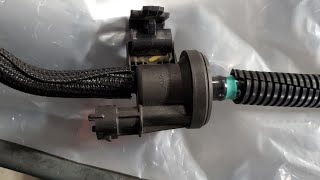
Typical fix: Replace the entire purge valve and hose assembly. It is sold as a single unit, part number GV6Z-9D289-E. 🎬 Watch: Complete step-by-step walkthrough for replacing the purge valve assembly.
Est. part cost: $40-$75 - Wiring or Connector Issue ⚪ Low Probability
How to confirm: Visually inspect the electrical connector and wiring harness leading to the purge valve for any signs of damage, corrosion, or loose pins. Use a multimeter to check for 12V power (VPWR wire) and a ground signal from the PCM (EVAPCP wire) at the connector when the valve is commanded on. A common power feed wire could be at fault if other components on the same circuit also have issues.
Typical fix: Repair the damaged section of wiring or clean/replace the electrical connector.
Est. part cost: $5-$20
Rare But Worth Checking
- Powertrain Control Module (PCM) Fault: This is extremely rare. The PCM driver for the purge valve circuit can fail, but all other possibilities should be exhausted before considering PCM replacement.
- Blown Fuse: A blown fuse for the EVAP system circuit can cause P0443. This can be overlooked because the fuse may be shared with other components and not be explicitly labeled for the EVAP system.
Diagnosis Steps

- Read the trouble codes with an OBD-II scanner to confirm P0443 is present. 🎬 See a professional diagnostic walkthrough for the P1450 and P0443 codes.
- Locate the vapor canister purge valve in the engine bay. On the 1.5L Escape, it is mounted near the top of the engine with hoses running to the intake manifold.
- Inspect the electrical connector and wiring harness attached to the purge valve for any visible damage, corrosion, or loose connections.
- If you have a capable scan tool (like FORScan or Ford's IDS), use its bidirectional controls to command the purge valve solenoid on and off. You should hear an audible clicking from the valve as it actuates.
- If no click is heard, disconnect the electrical connector. Use a multimeter to verify that there is battery voltage on the power supply pin (VPWR) with the key on.
- Check for a ground signal on the control pin (EVAPCP). This pin is grounded by the PCM to activate the valve. When the valve is commanded on, you should see the voltage drop to near zero. If voltage and ground signals are present but the valve does not click, the purge valve is faulty.
- As a secondary test, disconnect the valve and its electrical connector. Measure the resistance across the two pins of the valve itself. A reading between 15-35 Ohms is expected. Infinite resistance (open) or near-zero resistance (short) confirms a bad valve.
- If voltage or the ground signal is missing, there is a fault in the wiring harness, a blown fuse, or the PCM itself, which requires further circuit tracing.
- After replacing the part, clear the codes with the scanner and perform a drive cycle to ensure the fix is complete.
Parts You'll Likely Need
- Vapor Canister Purge Valve Assembly
(OEM #GV6Z-9D289-E)— This is the component that fails most frequently, causing code P0443. The internal solenoid coil burns out or shorts.
Trusted brands: Motorcraft (OEM), Dorman, Standard Motor Products
OEM price range: $40-$75
Aftermarket price range: $30-$60
Related Codes That Often Appear With This One
- P1450 — This code means 'Unable to Bleed Up Fuel Tank Vacuum'. A purge valve that is stuck open can cause this condition, so it frequently appears with P0443 if the valve has failed mechanically as well as electrically.
- P0456 — This code indicates a 'Very Small EVAP Leak'. While less common, a malfunctioning purge valve that isn't sealing properly can sometimes be interpreted by the PCM as a small leak, triggering this code alongside P0443.
- P0496 — Indicates 'EVAP Flow During a Non-Purge Condition'. This is another code that points directly to a purge valve stuck open, often seen with P0443 on these vehicles.
Platform-Specific Known Issues
- Owner Experience: Replaced Part, Code Returned: A user on a Ford Fusion forum reported replacing the purge valve for P0443, only to have the code return two weeks later. This suggests that while the valve is the most common cause, a wiring issue or a faulty replacement part can also occur. In some cases, both the purge valve and the canister vent valve are replaced to resolve persistent EVAP codes.
Mechanic-Grade Diagnostic Values
- Vapor Canister Purge Valve Solenoid Resistance — expected: 15 - 35 Ohms. Failure: A reading of infinite resistance (open circuit) or near-zero resistance (short circuit).
- Purge Valve Connector Power Pin (VPWR) Voltage — expected: Battery Voltage (~12V) with Key On, Engine Off.. Failure: 0V or significantly low voltage, indicating a break in the power supply wire or a blown fuse.
- Purge Valve Connector Control Pin (EVAPCP) Voltage — expected: Shows battery voltage when the valve is commanded OFF (inactive). Drops to near 0V or a pulsing ground signal when commanded ON by the PCM/scan tool.. Failure: Voltage does not change when the valve is commanded on, indicating a broken control wire or a failed PCM driver.
Scan Tool Commands That Help

- Ford IDS (Integrated Diagnostic System) or FORScan: Vapor Management Valve / Canister Purge Valve (CPV) Bidirectional Control — This command allows the technician to manually cycle the purge valve solenoid on and off while the engine is running. It is the definitive test to confirm if the valve is physically clicking and responding to electrical commands, which helps isolate the fault to either the valve itself or the wiring/PCM.
Wiring & Ground Locations
- Purge Valve Connector Pin 1 (VPWR) — At the electrical connector on the purge valve solenoid.. This is the power supply wire, typically receiving battery voltage from a fuse-protected circuit. A lack of voltage here points to a wiring issue upstream or a blown fuse, not a faulty valve.
- Purge Valve Connector Pin 2 (EVAPCP) — At the electrical connector on the purge valve solenoid.. This is the control wire that the PCM grounds to activate the solenoid. If power is present on the other pin but this wire never shows a ground signal when commanded, the fault lies in the wiring back to the PCM or the PCM driver itself.
Real Owner Repair Stories
- YouTube channel 'akjeeper' (2019 Ford Escape 1.5L EcoBoost) — Check engine light on, vehicle stumbles or is difficult to start after refueling.
❌ Tried (didn't work) Diagnosis went straight to the likely cause.
✅ What actually fixed it The vehicle had stored code P0496 ('EVAP Flow During a Non-Purge Condition'), which is functionally related to a stuck-open purge valve. The problem was resolved by replacing the entire vapor canister purge valve assembly with Ford Motorcraft part GV6Z-9D289-E. - Reddit user on r/fordescape (2016 Ford Escape 1.6L (similar part and issue)) — Needed to replace the canister purge valve.
✅ What actually fixed it The user noted that the OEM Ford part was on national backorder. A Ford technician advised them that the connectors/clips on aftermarket brands (like Duralast, Dorman, Standard Motor Products) often do not fit correctly, causing installation problems. This highlights a potential pitfall of using non-OEM parts for this specific repair. - NHTSA ODI #11633558 — An owner reported that after a diagnostic test showed multiple codes including P0443, P0456, and P1450, a dealership inspection identified an issue with the Evap system related line.
- NHTSA ODI #11099930 — In a cross-manufacturer reference, an owner described a vehicle suddenly losing power while driving at 55 mph or higher, with a check engine light displaying codes P2112 and P0443.
OEM Part Supersession History
GV6Z-9D289-A→GV6Z-9D289-E— Standard part revision and improvement by the manufacturer.
Diagnostic Flowchart
Other Known Issues on This Vehicle
Issues unrelated to this code that are worth knowing about as an owner of this generation:
- Engine Coolant Intrusion 🔴 High — A well-documented defect in 1.5L EcoBoost engines built before April 2019. Coolant leaks into cylinders due to a block design flaw, causing misfires, white smoke, and eventual engine failure. (Ref: TSB 19-2375 (later superseded by TSB 20-2100) describes the issue and repair, which involves replacing the engine short block.)
- 6F35 Transmission Failure 🔴 High — The 6F35 automatic transmission can experience premature failure, often before 100,000 miles. Symptoms include harsh shifting, slipping, shuddering, and complete loss of drive. (Ref: No specific recall, but the issue is the subject of numerous complaints and class-action lawsuits.)
- Panoramic Roof Panel Separation/Leak 🟠 Medium — Recalls have been issued for some model years due to improper bonding of the panoramic glass roof, which can lead to water leaks, wind noise, or, in rare cases, the panel detaching from the vehicle. (Ref: Recalls 14S22, 16V695 (for other model years, but demonstrates a recurring issue with Ford panoramic roofs).)
Used vs. New Parts: Buying Guide for This Vehicle
When a used part is the smart pick: For this specific part, a used part is strongly discouraged. The purge valve is a known high-failure item, and a used part from a salvage yard has a high probability of failing soon after installation, if it is not already faulty.
Donor-vehicle mileage cap: roughly under 20000 miles for the part to have meaningful remaining life.
What to inspect on the donor part:
- Inspect for any cracks in the plastic hoses or the valve body.
- Ensure all electrical connector tabs and hose clips are intact and not brittle.
- Verify it is a genuine Motorcraft part, not a previously replaced aftermarket one.
OEM-only on this vehicle (don't cheap out):
- While not strictly 'OEM-only', the Vapor Canister Purge Valve assembly is highly recommended to be purchased as an OEM Motorcraft part. Technicians and owners report that the quick-connect fittings on some aftermarket brands do not fit correctly, leading to installation issues or potential vacuum leaks.
Aftermarket brands forum-validated for this vehicle:
- Standard Motor Products is generally regarded as a reliable aftermarket alternative if an OEM part is unavailable.
Brands owners have reported issues with on this vehicle:
- Dorman has received mixed feedback. While some products are fine, others have been reported to fail prematurely or use inferior connectors compared to the OEM design, making Motorcraft a safer choice.
Real Owner Stories
Aggregated from forums and TSBs cited above. Mileages and costs reflect what owners reported in those sources.
Ford Escape
Symptoms: Check engine light with code P0443.
What fixed it: Installed a new purge solenoid; the fitment was exact and the installation took about 15–20 minutes.
Source hint: autozone.com - P0443 EVAP code on my Ford Escape. Serhii.
2018 Ford Escape SE 1.5L EcoBoost
Symptoms: Check engine light on (code P0496), hard start after fueling.
What fixed it: Replaced the purge valve with a Ford factory part after verifying the part with the VIN.
Source hint: YouTube - 2019 Ford Escape 1.5L EcoBoost: Replacing the Vapor Canister Purge Valve
2016 Ford Fusion
Symptoms: Classic symptoms of hard starting after fueling; replaced the purge valve but the code returned two weeks later.
What fixed it: The report suggests potential for wiring issues or a faulty replacement part when the code returns shortly after repair.
Source hint: Reddit r/fordfusion - Thread 'engine code p0443 for my 2016 ford fusion'
Ford Escape Owner Report
Symptoms: Multiple default codes including P1016, P0365, P0299, P164D, P0369, P0443, P0456, and P1450.
What fixed it: A diagnostic test at an auto place was followed by a dealership inspection, which identified an Evap system related issue on a specific line.
Source hint: NHTSA ODI #11633558
Related OBD-II Codes
Frequently Asked Questions
What is the specific part number I need for the purge valve on my 1.5L EcoBoost Escape?
I'm having trouble starting my Escape after I fill up at the gas station. Is this related to P0443?
Can I test the purge valve myself with a multimeter?
Is there a known engine defect I should be aware of while fixing this EVAP code on my 2017-2019 1.5L Escape?
Why does my engine make a clicking sound that stops when I unplug the purge valve?
Is this purge valve issue common to other Ford models?
Helpful Videos

Used OEM Parts in Stock

New Aftermarket Parts Available


The information in this article is provided for general reference and educational purposes only. Vehicle specifications, procedures, and part compatibility can vary by production date, trim level, and region. Always consult your vehicle's factory service manual and verify part numbers before purchasing or performing repairs. Safety-critical components such as airbags, seat belts, and braking systems should be installed by a qualified professional.
- Ford Escape:
- 🎬 Helpful Videos
- 🛍️ Shop This Part
- What's Unique About the 2017-2019 Ford Escape
- Symptoms You May Notice
- Most Likely Causes
- Rare But Worth Checking
- Diagnosis Steps
- Parts You'll Likely Need
- Related Codes That Often Appear With This One
- Platform-Specific Known Issues
- Mechanic-Grade Diagnostic Values
- Scan Tool Commands That Help
- Wiring & Ground Locations
- Real Owner Repair Stories
- OEM Part Supersession History
- Diagnostic Flowchart
- Other Known Issues on This Vehicle
- Used vs. New Parts: Buying Guide for This Vehicle
- Real Owner Stories
- Ford Escape
- 2018 Ford Escape SE 1.5L EcoBoost
- 2016 Ford Fusion
- Ford Escape Owner Report
- Related OBD-II Codes
- Frequently Asked Questions
- 🎟️ Get 5% Off