

P0443 on 2001-2010 Chrysler PT Cruiser: EVAP Purge Valve Circuit Malfunction Causes and Fixes
On a 2001-2010 PT Cruiser, code P0443 is most often caused by a failed EVAP purge solenoid. It's a straightforward replacement, typically costing $45-$85 for the part, with a DIY difficulty of 2/5.
- P0443 is an electrical circuit code, not a leak code. Do not replace your gas cap to fix it.
- The most likely culprit is the EVAP purge solenoid itself, which is a relatively inexpensive and accessible part.
- Before buying parts, check the fuse and inspect the wiring harness for obvious damage, especially near hot or vibrating components.
- Verify your engine type (Turbo or Non-Turbo) to correctly locate the purge solenoid before beginning work.
What's Unique About the 2001-2010 Chrysler PT Cruiser
The key challenge with this code on the PT Cruiser is the physical location of the purge solenoid, which differs between the naturally aspirated 2.4L engine and the 2.4L Turbo. On non-turbo models, the solenoid is often found low on the engine, sometimes accessed by removing the driver's side front wheel. On the 2.4L Turbo models, the solenoid is typically located higher in the engine bay, near the turbocharger itself. 🎬 Watch this video on locating and testing the solenoid on a PT Cruiser Turbo Knowing which engine you have is crucial before starting the repair.
Symptoms You May Notice
- Check Engine Light is on
- Rough or fluctuating idle if the valve is stuck open
- Slightly reduced fuel efficiency
- Possible fuel smell if vapors cannot be purged correctly
- Will cause an automatic failure of an emissions test
- Replacing the gas cap. A loose or faulty gas cap will typically cause an EVAP leak code (like P0455 or P0457), not a P0443 circuit code.
- Replacing the EVAP charcoal canister. The canister is a storage device and is not part of the electrical circuit monitored by the P0443 code.
Most Likely Causes
- Failed EVAP Purge Solenoid 🔴 High Probability The solenoid is an electromechanical part that can fail over time due to heat cycles and constant use. The internal coil can short out or develop an open circuit.
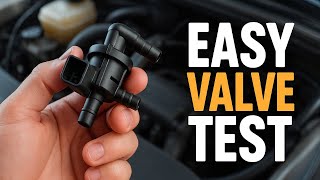
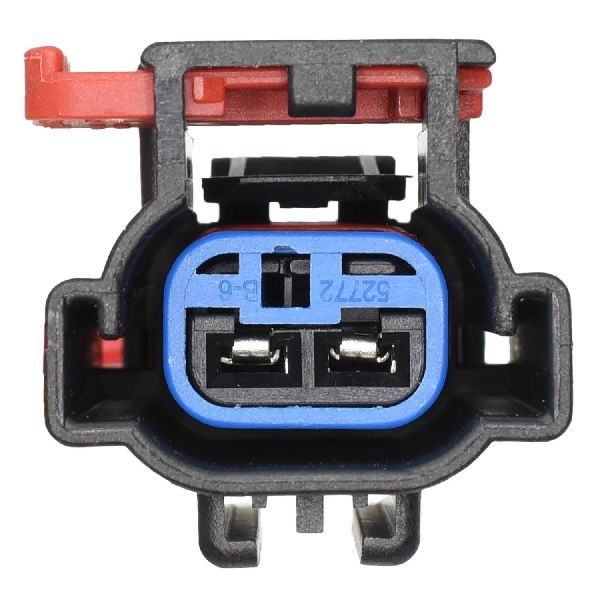
How to confirm: Disconnect the electrical connector and measure the resistance across the two pins 🎬 Watch a step-by-step DIY guide on testing an EVAP purge valve of the solenoid with a multimeter. With the engine cool, the resistance should be between 30 and 38 ohms. An open circuit (infinite resistance) or a short (zero resistance) indicates a bad solenoid. You can also try to apply 12V and ground to the pins to see if it clicks open and closed.
Typical fix: Replace the EVAP purge solenoid.
Est. part cost: $45-$85 - Damaged Wiring or Connector 🟡 Medium Probability The wiring harness in the engine bay is exposed to heat and vibration, which can lead to chafing, breaks, or corrosion over time. Rodent damage to wiring near the battery tray has also been reported by owners.
How to confirm: Visually inspect the wiring harness leading to the purge solenoid for any signs of damage, melting, or corrosion. With the key on, check for 12V power at one pin of the connector. The other wire is the control wire, which the PCM pulses to ground. Using a test light connected to battery positive, you should see it flash when the engine is running and the PCM is commanding the purge cycle.
Typical fix: Repair the damaged section of wire or replace the connector pigtail.
Est. part cost: $10-$30 - Blown Fuse ⚪ Low Probability An electrical short in the circuit can cause the related fuse to blow, cutting power to the solenoid.
How to confirm: Consult your owner's manual or the fuse box diagram to locate the fuse for the emissions system or EVAP components. Visually inspect the fuse and test for continuity.
Typical fix: Replace the blown fuse after identifying and fixing the underlying short circuit.
Est. part cost: $1-$5
Rare But Worth Checking
- Faulty Powertrain Control Module (PCM): This is very rare. The PCM's internal driver for the purge solenoid circuit can fail. This should only be considered after all other possibilities (solenoid, wiring, fuse) have been exhaustively tested and ruled out.
Diagnosis Steps
- Scan for codes to confirm P0443 is the primary code.
- Locate the EVAP purge solenoid. On non-turbo models, check the driver's side of the engine, possibly accessing it from the wheel well. On turbo models, look higher in the engine bay near the turbocharger.
- Visually inspect the solenoid, its connector, and the wiring harness for any obvious damage, corrosion, or loose connections. Pay attention to the harness area near the battery.
- Disconnect the electrical connector. With the ignition on (engine off), use a multimeter to verify that one pin has battery voltage (approx. 12V).
- With the connector still disconnected, measure the resistance of the solenoid itself across its two pins. A correct reading for a Chrysler of this era should be between 30 and 38 ohms. Infinite resistance (OL) or near-zero resistance indicates a faulty solenoid.
- If power and solenoid resistance are good, check the control wire. Connect a test light to the positive battery terminal and probe the control wire terminal in the connector. With the engine running, the test light should flash, indicating the PCM is attempting to ground the circuit. A steady light or no light suggests a wiring or PCM issue.
- If all wiring and the solenoid test good, the issue may be a rare failure of the PCM driver circuit.
Parts You'll Likely Need
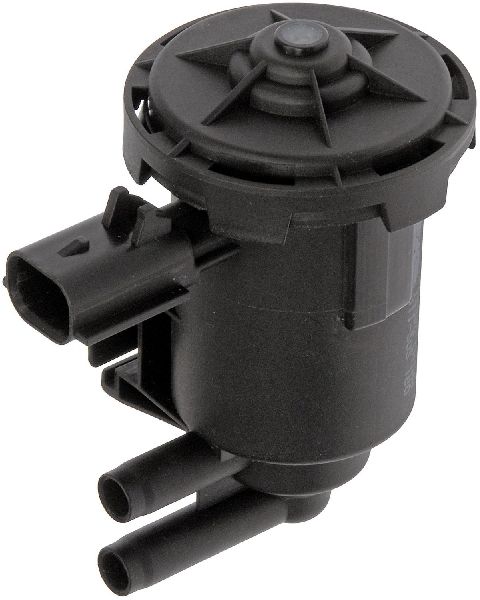
- EVAP Vapor Canister Purge Solenoid
(OEM #4669569)— This is the most common failure point for the P0443 code, as the internal coil winding fails electrically over time.
Trusted brands: Mopar, Standard Motor Products (CP428), Duralast, Bosch
OEM price range: $70-$90
Aftermarket price range: $45-$70
Related Codes That Often Appear With This One
- P0444 — P0444 indicates 'Purge Control Valve Circuit Open'. This is a more specific version of P0443 and often points directly to a broken wire or a failed-open solenoid coil.
- P0445 — P0445 indicates 'Purge Control Valve Circuit Shorted'. This points to a short circuit in the wiring or within the solenoid itself.
Platform-Specific Known Issues
- Wiring Damage Near Battery: An owner on a forum reported chasing a P0443 code after extensive parts replacement. The ultimate cause was found to be a wiring harness issue near the battery that had been previously damaged by a squirrel. This highlights the importance of thoroughly inspecting the entire circuit path for physical damage, especially in areas where rodents might nest.
Mechanic-Grade Diagnostic Values
- EVAP Purge Solenoid Control Circuit Resistance — expected: Below 5.0 ohms. Failure: Resistance above 5.0 ohms indicates excessive resistance or an open in the control wire between the PCM and the solenoid connector.
- Control Wire Voltage Drop (PCM Driver Test) — expected: Near 0V when commanded ON and grounded through the PCM.. Failure: A reading significantly above 0V (e.g., 1.5-2.0V) when commanded ON, which drops to near 0V when the test lead is grounded directly to the battery, points to high resistance inside the PCM driver circuit.
- Power Feed Wire Voltage (KOEO) — expected: Battery Voltage (Approx. 11-14V). Failure: No voltage indicates a blown fuse or an open in the power supply wire.
Scan Tool Commands That Help
- DRB III or equivalent professional scan tool: Actuate EVAP Purge Solenoid / EVAP Purge Test — Use this bidirectional control to command the solenoid ON (or by duty cycle from 0-100%) while testing for voltage at the connector. This confirms if the PCM is sending the signal and if the wiring is intact. It is also used while wiggling the harness to find intermittent opens or shorts.
Wiring & Ground Locations
- EVAP Purge Solenoid Control Wire — Runs from the purge solenoid connector to the Powertrain Control Module (PCM), which is located on the firewall behind the power distribution center. The wire is typically Dark Green with a White stripe.. This is the wire the PCM uses to ground-pulse the solenoid to open it. An open or short on this wire is a direct cause of P0443.
- G102 — Bolted to the left front strut tower in the engine compartment.. This is a primary chassis ground point. While the purge solenoid is controlled directly by the PCM, the PCM itself relies on clean grounds like G102 to function. A corroded or loose G102 can cause a wide range of bizarre electrical issues, including faulty driver circuits.
Real Owner Repair Stories
- YouTube user 'Cesar Chavez' (2005 Chrysler PT Cruiser) — Check Engine Light was on.
❌ Tried (didn't work) The user went straight to replacing the part based on the code.
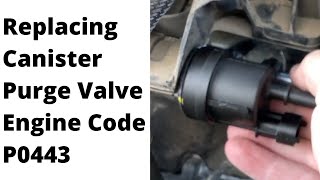
✅ What actually fixed it Replacing the EVAP purge solenoid resolved the Check Engine Light, which did not return after a 16+ mile test drive.
OEM Part Supersession History
4669569→No major supersession noted. This part number remains widely used.— N/A
Heads up: This part is used across a very wide range of Chrysler, Dodge, and Jeep vehicles. Aftermarket cross-references include 911-202, PV302, CP428, and CP518.
Model Year Variations Within This Range
- 2001-2010: The electrical circuit and part number for the purge solenoid are consistent across the entire model run. The only significant variation is the physical location of the solenoid, which is mounted low on the engine for naturally aspirated 2.4L models and higher in the engine bay near the turbocharger on 2.4L Turbo models.
Diagnostic Flowchart
Other Known Issues on This Vehicle
Issues unrelated to this code that are worth knowing about as an owner of this generation:
- Premature Front Control Arm Bushing Failure 🟠 Medium — Very common, often occurs between 60,000 and 100,000 miles. Results in clunking noises from the front suspension, uneven tire wear, and wandering steering.
- Cooling Fan Assembly Failure 🔴 High — A frequent point of failure, leading to engine overheating, especially in stop-and-go traffic. The fan motor can fail, or the wiring/connectors can burn out.
- Automatic Transmission Solenoid Pack Failure 🔴 High — Common on models with the 4-speed automatic. Symptoms include harsh shifting, getting stuck in 'limp mode' (2nd or 3rd gear), and setting transmission-specific fault codes. Often caused by internal solenoid failure or fluid leaking into the electrical connector.
- Engine Stalling / Camshaft Position Sensor Failure 🟠 Medium — Particularly noted on earlier models, a faulty camshaft position sensor can cause intermittent stalling or a no-start condition.
- TIPM (Totally Integrated Power Module) Electrical Problems 🔴 High — The TIPM, or fuse box, can develop internal faults causing a wide range of bizarre electrical issues, from fuel pump problems to starter malfunctions. This was a widespread issue across many Chrysler vehicles of this era.
Used vs. New Parts: Buying Guide for This Vehicle
When a used part is the smart pick: For this specific repair, a used part is generally not recommended. The failure is electronic (coil burnout) or mechanical (sticking), both of which are related to age and use. Given the low cost of a new aftermarket part ($45-$70), the risk of getting a used part that is near the end of its life outweighs the small potential savings.
Donor-vehicle mileage cap: roughly under 50000 miles for the part to have meaningful remaining life.
What to inspect on the donor part:
- Check for any cracks in the plastic housing.
- Ensure the electrical connector pins are clean, straight, and free of corrosion.
- If possible, test the resistance with a multimeter before purchase; it should be between 30-38 ohms.
- Avoid parts from vehicles that show signs of major engine bay damage or fire.
OEM-only on this vehicle (don't cheap out):
- For this P0443 code, no parts are strictly 'OEM-only'. The purge solenoid is a common part where quality aftermarket versions are acceptable.
Aftermarket brands forum-validated for this vehicle:
- Standard Motor Products (SMP)
- Bosch
- Duralast
Brands owners have reported issues with on this vehicle:
- No-name, unbranded parts from online marketplaces should be avoided, as their internal coil quality and durability can be highly inconsistent.
Real Owner Stories
Aggregated from forums and TSBs cited above. Mileages and costs reflect what owners reported in those sources.
2004 Chrysler PT Cruiser 2.4L Turbo
Symptoms: The owner needed to locate the purge valve for replacement and confirmed its specific position in the engine bay.
What fixed it: Replacement of the purge valve located high in the engine bay near the turbocharger.
Source hint: YouTube: '04 pt cruisers 2.4l turbo purge valve replacement and locations'
2001-2010 Chrysler PT Cruiser
Symptoms: Chasing a P0443 code even after replacing parts.
What fixed it: Repairing the wiring harness near the battery that had been damaged by a squirrel.
Source hint: vehicle_specific_issues: Wiring Damage Near Battery
2004 Chrysler Pacifica (Platform Mate)
Symptoms: Received a P0443 code indicating an EVAP purge flow fault.
What fixed it: Inspecting the wiring and connection to the EVAP purge solenoid as the primary diagnostic step.
Source hint: Chrysler Forum: 'Code P0443 EVAP purge flow fault'
Related OBD-II Codes
Frequently Asked Questions
Where is the EVAP purge solenoid located on my 2.4L Turbo PT Cruiser?
Can I use a used purge solenoid from a salvage yard to fix my P0443 code?
I replaced the solenoid but the P0443 code persists; could it be a wiring issue?
Will a P0443 code cause my PT Cruiser to fail an emissions test?
What should the resistance reading be for a healthy purge solenoid on a 2001-2010 PT Cruiser?
Is the P0443 code related to the common TIPM electrical problems in these vehicles?
Helpful Videos
![CHRYSLER PT CRUISER 2004 TURBO COMO PROBAR SOLENOIDE DE PURGA [EVAP] UBICACION DE LA VALVULA..](https://img.youtube.com/vi/nrTSLUtiT6w/mqdefault.jpg)
We Have This Part in Stock


The information in this article is provided for general reference and educational purposes only. Vehicle specifications, procedures, and part compatibility can vary by production date, trim level, and region. Always consult your vehicle's factory service manual and verify part numbers before purchasing or performing repairs. Safety-critical components such as airbags, seat belts, and braking systems should be installed by a qualified professional.
- Chrysler PT Cruiser:
- 🎬 Helpful Videos
- 🛍️ Shop This Part
- What's Unique About the 2001-2010 Chrysler PT Cruiser
- Symptoms You May Notice
- Most Likely Causes
- Rare But Worth Checking
- Diagnosis Steps
- Parts You'll Likely Need
- Related Codes That Often Appear With This One
- Platform-Specific Known Issues
- Mechanic-Grade Diagnostic Values
- Scan Tool Commands That Help
- Wiring & Ground Locations
- Real Owner Repair Stories
- OEM Part Supersession History
- Model Year Variations Within This Range
- Diagnostic Flowchart
- Other Known Issues on This Vehicle
- Used vs. New Parts: Buying Guide for This Vehicle
- Real Owner Stories
- 2004 Chrysler PT Cruiser 2.4L Turbo
- 2001-2010 Chrysler PT Cruiser
- 2004 Chrysler Pacifica (Platform Mate)
- Related OBD-II Codes
- Frequently Asked Questions
- 🎟️ Get 5% Off