

P0420 on 2011-2018 Honda Pilot: Injector, O2 Sensor, or Bad Cat?
On 2011-2018 Honda Pilots, P0420 often points to faulty fuel injectors (especially on 2016-2018 models) or a failing oxygen sensor, not always a bad catalytic converter. A full diagnosis is crucial before replacing the expensive converter, as the root cause is often an upstream component.
- For 2016-2018 Pilots, P0420 is very often caused by faulty fuel injectors covered under a warranty extension (TSB 20-100). Check your VIN first.
- Do not automatically replace the catalytic converter. It is an expensive part and often fails as a result of another problem.
- A proper diagnosis involves checking for other codes (misfires, air-fuel ratio) and analyzing live O2 sensor data with a scan tool.
- A failing downstream O2 sensor can mimic a bad converter and is a much cheaper initial repair.
- Bank 1 on a Honda Pilot V6 is the rear bank of cylinders, near the firewall.
What's Unique About the 2011-2018 Honda PILOT

For the third-generation Pilot (2016-2018), this code is very frequently caused by faulty fuel injectors, not the catalytic converter itself. Honda issued Technical Service Bulletins (TSBs 20-100, A21-010) and a warranty extension (10 years/150,000 miles) because debris from the manufacturing process could cause injectors to clog or leak. This dumps unburned fuel into the exhaust, which overwhelms and can eventually damage the catalytic converter, triggering the P0420 code. For the second-generation (2011-2015), while injectors can still be a cause, issues like oil consumption from the VCM (Variable Cylinder Management) system are a more common topic of discussion among owners for fouling sensors and the converter. Disabling the VCM system is a popular owner modification to prevent this.
Diagnostic Flowchart

Tap your situation to follow the diagnostic path that matches what you're seeing on this vehicle.
Generation note: This range covers two generations: the end of the second generation (2011-2015) and the start of the third generation (2016-2018). The third-gen models (2016-18) are particularly known for a fuel injector issue covered by Honda TSBs A21-010 and 20-100 that directly causes the P0420 code. The warranty extension covers these specific models for this issue. The second-gen models are more frequently discussed in forums in relation to oil consumption from the VCM system causing similar codes.
Symptoms You May Notice

- Check Engine Light is on
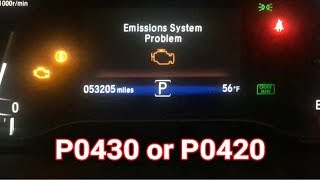
- Message on dash like "Emissions System Problem"
- Reduced fuel economy
- Possible decrease in engine power or sluggish acceleration
- Failed emissions test
- A rotten egg or sulfur smell from the exhaust (in some cases)
- Intermittent nature: The check engine light may turn on for a day or two and then turn off for weeks, making diagnosis tricky.
- Immediately replacing the catalytic converter without diagnosing the fuel injectors or oxygen sensors first. This is an expensive mistake, as a new converter can be quickly ruined by the same underlying problem.
- Replacing only the O2 sensor without checking for the underlying injector TSB on 2016-2018 models.
- Using a cheap, universal catalytic converter that may not meet the efficiency requirements of the Honda PCM, causing the code to return.
- Confusing the P0420 code's description with a faulty fuel injector. The code definition is for catalyst efficiency, but on these vehicles, the root cause is often the injectors.
Most Likely Causes

- Faulty Fuel Injectors 🔴 High Probability Specifically for 2016-2018 models, Honda TSBs A21-010 and 20-100 identify that debris from the manufacturing process can cause injectors to clog or leak, leading to an improper air-fuel ratio that triggers P0420. This was subject to a warranty extension of 10 years or 150,000 miles.
How to confirm: A mechanic can perform a cylinder A/F test using a Honda HDS diagnostic scan tool to identify failing injectors. A significant fuel pressure drop after the engine is turned off (e.g., from 500+ PSI to under 50 PSI in 15 minutes) can also indicate leaking injectors. The issue is often seen with companion codes like P0430, P219A/P219B, or misfire codes (P0300-P0306).
Typical fix: Replace all six fuel injectors with the updated kit and related fuel pipes. A PCM software update is also required as part of the TSB procedure.
Est. part cost: $250-$400 for a set of OEM injectors and pipes. - Failed Downstream Oxygen (O2) Sensor 🟡 Medium Probability Sensors have a finite lifespan and can fail or become 'lazy', sending incorrect data to the computer. The computer may think the converter is bad when it's just receiving bad information. It's a common wear item and a logical diagnostic step before replacing the converter.
How to confirm: Graph the voltage of the upstream and downstream O2 sensors on a scan tool. The upstream sensor (Air/Fuel sensor) should fluctuate rapidly around a baseline (approx. 2.8V for Honda). A good downstream sensor on a working converter should show a relatively steady, stable voltage (typically above 0.6V). If it's fluctuating wildly like the upstream sensor, or is flatlined, the sensor is likely bad.
Typical fix: Replace the Bank 1 downstream (Sensor 2) oxygen sensor. This is the rear, post-converter sensor.
Est. part cost: $50-$150 for a quality Denso or NGK/NTK sensor. - Failed Catalytic Converter 🟡 Medium Probability Often a symptom of another problem. The converter can be damaged by long-term exposure to unburned fuel from faulty injectors or oil burning from VCM issues. It can also fail from age and mileage. One owner reported a replacement cost of $2,200 at the dealer.
How to confirm: After confirming injectors and O2 sensors are good, this is the next logical step. A physical inspection might reveal rattling (from broken internal substrate) when tapped. A shop can use a borescope to visually inspect the converter's internal honeycomb structure through the O2 sensor port.
Typical fix: Replace the Bank 1 (rear) catalytic converter. This is a labor-intensive job.
Est. part cost: $400-$1200+ for an aftermarket part, with OEM parts costing significantly more. - Exhaust Leak ⚪ Low Probability
How to confirm: Visually inspect the exhaust manifold, gaskets, and pipes between the two Bank 1 oxygen sensors for cracks or black soot trails. A shop can perform a smoke test to find small leaks that allow oxygen to enter the exhaust stream, skewing sensor readings.
Typical fix: Replace the leaking gasket or repair/replace the cracked exhaust component.
Est. part cost: $20-$200
Rare But Worth Checking
- PCM Software Issue: Honda TSB 20-100 notes that the PCM software itself may misinterpret sensor inputs, thinking the cat is bad. The fix for the injector issue includes a mandatory software update to correct this logic.
- Excessive Oil Consumption (VCM): On the J35 engine, the Variable Cylinder Management (VCM) system can lead to oil consumption as piston rings get fouled. This oil burns in the exhaust, contaminating O2 sensors and the catalytic converter over time, contributing to a P0420 code. Many owners install a 'VCM muzzler' to disable the system and prevent this.
Diagnosis Steps
- Scan for other codes. If P0430, P219A/B, or P030x codes are present, suspect the fuel injector issue first, especially on a 2016-2018 model.
- Check for TSBs. Run your VIN with a Honda dealer to see if it's eligible for the warranty extension related to fuel injectors (TSB 20-100 or A21-010). Even if the VIN doesn't show up online, owners report it may still be covered.
- Analyze Oxygen Sensor Data. Use a scan tool to graph Bank 1 Sensor 1 (upstream A/F sensor) and Bank 1 Sensor 2 (downstream O2 sensor). The downstream sensor voltage should be relatively stable (e.g., >0.6V). If it mirrors the upstream sensor's rapid fluctuations or is stuck, investigate the sensor or an exhaust leak.
- Inspect for Exhaust Leaks. Visually and audibly check the exhaust system from the engine to the catalytic converter for any leaks, especially around gaskets and flex pipes.
- Perform Fuel System Tests (especially 2016-2018). If injectors are suspected, the official procedure is the Cylinder AF Test using a Honda HDS scan tool. A fuel pressure leak-down test can also point to leaking injectors.
- Check for Oil Consumption (especially 2011-2015). Check your oil level. If it is consuming oil, the P0420 may be a symptom of VCM-related issues fouling the catalytic converter.
- Inspect the Catalytic Converter. If all other components check out, the converter is the likely culprit. A borescope inspection is the best non-invasive method to check for a physically melted or broken substrate.
Parts You'll Likely Need
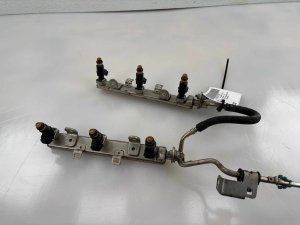
- Fuel Injector Kit
(OEM #16010-RLV-315)— The most probable root cause for 2016-2018 models, per Honda's own service bulletins. This kit includes all 6 injectors and required seals.
Trusted brands: Honda (OEM)
OEM price range: $250-$400 (kit)
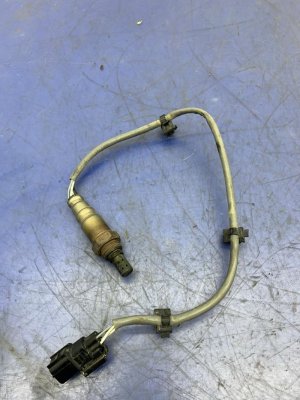
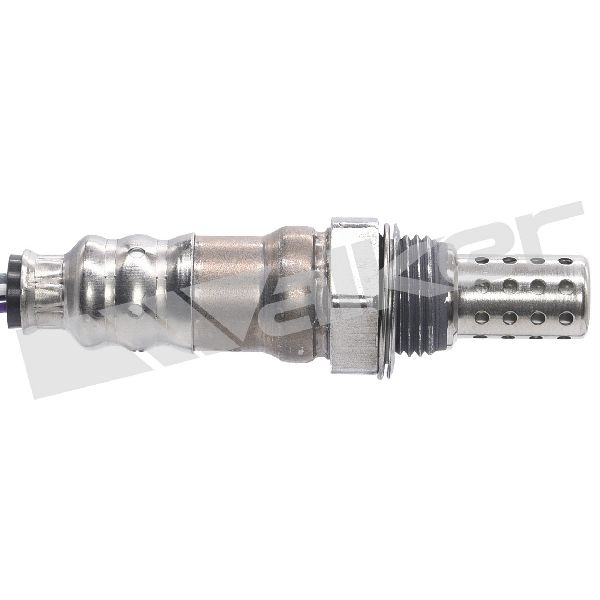
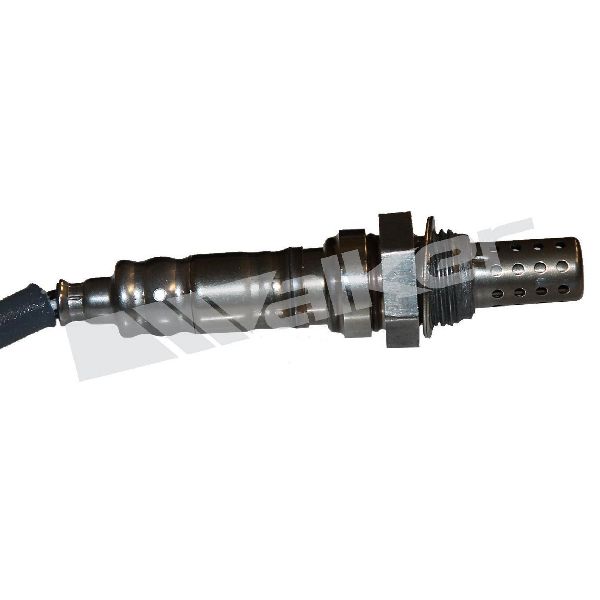
Aftermarket price range: $150-$300 (kit) - Bank 1 Downstream Oxygen Sensor
(OEM #36542-R70-A01 (for 2011-2015) or similar)— A common failure point that can incorrectly trigger a P0420 code. It's a logical part to test and replace before the much more expensive converter.
Trusted brands: Denso (e.g., 234-4351 for 2016-2018 rear), NGK/NTK
OEM price range: $120-$180
Aftermarket price range: $50-$100
Related Codes That Often Appear With This One
- P0430 — This is the same efficiency code but for Bank 2 (front). When both appear, it strongly points to a systemic issue like faulty fuel injectors affecting the entire engine, as described in TSB 20-100.
- P219A / P219B — These codes indicate an air-fuel ratio imbalance. They are specifically mentioned in the Honda TSBs about faulty fuel injectors and are a strong indicator that injectors are the root cause.
- P0300-P0306 — These are misfire codes. Misfires allow unburned fuel to enter the exhaust, which is a primary cause of catalytic converter damage and can be triggered by the same faulty injectors.
Technical Service Bulletins (TSBs) & Recalls
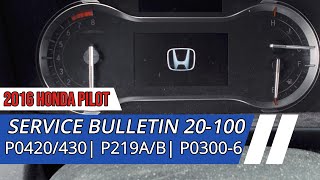
- A21-010: Warranty Extension: MIL Comes On with DTC P0420/P0430, P030x, and/or P219A/B (Without Software Update)
- 20-100: Warranty Extension: MIL Comes On with DTC P0420/P0430, P030x, and/or P219A/B (With Software Update)
- 18-025: MIL Comes On with DTC P0300-P0306 or P219A/B (Superseded by 20-100 for Pilot)
Platform-Specific Known Issues
- Warranty Extension for Fuel Injectors: Honda extended the warranty to 10 years or 150,000 miles for faulty fuel injectors causing P0420/P0430 on 2016-2017 Pilots (and other models). Check your VIN for eligibility.
- VCM-related Oil Consumption: The J35 engine's Variable Cylinder Management (VCM) system is known to sometimes cause increased oil consumption, which can foul sensors and catalytic converters over many miles.
Mechanic-Grade Diagnostic Values
- Upstream Air/Fuel (A/F) Sensor Voltage (Bank 1, Sensor 1) — expected: Approx. 2.8V at stoichiometric (14.7:1 air-fuel ratio). Unlike traditional O2 sensors, this is a wideband sensor.. Failure: Voltage significantly different from the 2.8V baseline, corresponding with rich/lean conditions indicated by fuel trims.
- Downstream Oxygen (O2) Sensor Voltage (Bank 1, Sensor 2) — expected: Relatively stable voltage, typically between 0.4V and 0.6V, or steady above 0.6V at idle when the catalytic converter is hot and working efficiently.. Failure: Voltage fluctuates rapidly, mimicking the upstream sensor's pattern, or is stuck at a very low voltage (e.g., <0.2V).
- Fuel Pressure Leak-Down Test (Key-On, Engine-Off) — expected: Fuel pressure should hold steady after the pump primes.. Failure: A rapid drop in fuel pressure after the engine is shut off. One diagnostic video showed a drop from over 500 PSI to 44.9 PSI in 15 minutes, indicating leaking fuel injectors.
- Total Fuel Trims (Short Term + Long Term) — expected: As close to 0% as possible, typically within +/- 8%.. Failure: Consistently high negative trims (e.g., -10% to -20%) indicate the PCM is pulling fuel to compensate for a rich condition, often caused by leaking injectors.
Hidden / Shadow Codes Worth Checking
- Mode $06, TID $20, PID $7F: A specific catalyst monitor test that can show a 'Fail' result on some scan tools, indicating the catalyst test has failed even if the MIL is intermittent. The exact definition of this Test ID is not widely published but points to a failure in the catalyst efficiency monitoring system. (see via A scan tool capable of reading Mode $06 data.)
Scan Tool Commands That Help
- Honda Diagnostic System (HDS): Cylinder Air Fuel Test — This is the specific diagnostic test called for in Honda's TSB 20-100 to definitively identify faulty fuel injectors causing an air-fuel imbalance.
- Honda Diagnostic System (HDS): Control Module Update / PGM-FI Update — This is a required step after replacing the fuel injectors per TSB 20-100. The software update adjusts the PCM's logic to work with the new injectors and may correct misinterpretations of sensor data.
- Honda Diagnostic System (HDS): CKP Pattern Clear/Learn — While not a direct fix for P0420, this function is used to relearn the crankshaft position sensor pattern after major engine work and can resolve related running issues that might contribute to emissions problems.
Wiring & Ground Locations
- G101 — Located at the left rear of the engine, often near the thermostat housing.. This is a primary engine ground. The PCM and sensor shields for the A/F and HO2S sensors rely on this ground. A poor connection here due to corrosion or a frayed wire can cause erratic sensor readings, potentially leading to a false P0420 code or other hard-to-diagnose electrical issues.
Real Owner Repair Stories
- Reddit user in /r/hondapilot (2016 Honda Pilot) — Intermittent P0420 code. Light would come on for a day or two, then turn off for weeks.
❌ Tried (didn't work) Replaced fuel injectors under Honda's service bulletin., Replaced the rear catalytic converter (by CarMax)., Dealer performed the PGM-FI software update under the TSB.
✅ What actually fixed it The issue was not fully resolved. After all the TSB-related repairs, the code continued to appear intermittently. The dealer's final diagnosis was that the (less than 3-year-old) replacement catalytic converter had failed again and needed to be replaced for $2,200, which was no longer covered by warranty. - YouTube channel macdaddypimpping (3rd Gen Honda Pilot (2016-2018)) — P0420 code and 'Emission System Problem' message on the dash.
❌ Tried (didn't work) The owner did not report trying other fixes first.
✅ What actually fixed it The owner took the vehicle to a Honda service center. The dealership diagnosed the problem and replaced all six fuel injectors, which resolved the code. - Reddit user in /r/Honda (2017 Honda Pilot, 115,000 miles) — Check engine light came on, then went off on its own. Stored code was P0420.
❌ Tried (didn't work) The owner was seeking advice before proceeding with repairs.
✅ What actually fixed it This story highlights a common diagnostic conflict. An auto parts store scan suggested 'Fuel Injector' for P0420. However, the Honda dealer diagnosed the stored P0420 code as 'bank one catalytic converter'. The dealer stated the software was up-to-date and that the catalytic converter was NOT covered under the fuel injector extended warranty, leaving the owner facing a potentially expensive repair not covered by the known TSB campaign.
"I Checked Everything" — The Actual Cause
- In one documented case, a 2016 Pilot had the TSB for faulty injectors performed (injectors replaced, software updated) and the catalytic converter was also replaced. Despite these common, high-probability fixes, the P0420 code returned intermittently. The final diagnosis pointed to a second failure of the catalytic converter itself, demonstrating that even after addressing the known root causes, the converter (which is supposed to be protected by these fixes) can still fail.
When the Usual Fixes Don't Work
- While the fuel injector TSB is the most common cause for P0420 on 2016-2018 Pilots, it is not a guaranteed fix. There are owner reports where the full TSB procedure (injector replacement and software update) was performed, yet the P0420 code returned. In one case, the catalytic converter itself was blamed and replaced, only for the code to return again, leading to a second diagnosis of a failed converter within a short period. This shows that the issue can be more complex than just the injectors, and a new converter can potentially be damaged again if a subtle, underlying issue persists, or the replacement part itself may be suspect.
OEM Part Supersession History
16010-RLV-305→16010-RLV-315— This is the updated fuel injector kit for the 2016-2018 models affected by the TSB. The new part is intended to resolve the manufacturing defect of the original injectors.
Heads up: Using the old part number (if even available) would re-introduce the original fault. It is critical to use the superseded part number 16010-RLV-315 for the repair.
Model Year Variations Within This Range
- 2011-2015: These 2nd generation Pilots use the J35Z engine family (e.g., J35Z4), which features port fuel injection and is more commonly associated with oil consumption issues due to the VCM (Variable Cylinder Management) system. P0420 on these models is often a secondary result of oil fouling the sensors or converter.
- 2016-2018: These 3rd generation Pilots use the J35Y engine family (e.g., J35Y6), which introduced direct injection. This engine is the subject of the TSB for faulty fuel injectors causing P0420, P0430, and other related codes. The root cause is fundamentally different from the earlier generation.
Real Owner Stories
Aggregated from forums and TSBs cited above. Mileages and costs reflect what owners reported in those sources.
2016 Honda Pilot
Symptoms: Check engine light with P0420 code would appear for a day or two, then turn off for weeks.
What fixed it: The issue was not fully resolved. After having the fuel injectors replaced under a TSB and the rear catalytic converter replaced by CarMax, the code continued to appear intermittently. The dealer's final diagnosis was that the replacement catalytic converter had failed again and needed to be replaced.
Cost: $2200
Source hint: reddit r/hondapilot
Related OBD-II Codes
Frequently Asked Questions
Does the fuel injector warranty extension apply to my Honda Pilot?
Why did my P0420 code come back after replacing the catalytic converter?
Can the VCM system cause a P0420 code on my 2011-2015 Pilot?
What companion codes should I look for to confirm bad fuel injectors?
How does a mechanic test the fuel injectors on a 2016-2018 Pilot?
Helpful Videos

Used OEM Parts in Stock

New Aftermarket Parts Available


The information in this article is provided for general reference and educational purposes only. Vehicle specifications, procedures, and part compatibility can vary by production date, trim level, and region. Always consult your vehicle's factory service manual and verify part numbers before purchasing or performing repairs. Safety-critical components such as airbags, seat belts, and braking systems should be installed by a qualified professional.
- Honda PILOT:
- 🎬 Helpful Videos
- 🛍️ Shop This Part
- What's Unique About the 2011-2018 Honda PILOT
- Diagnostic Flowchart
- Symptoms You May Notice
- Most Likely Causes
- Rare But Worth Checking
- Diagnosis Steps
- Parts You'll Likely Need
- Related Codes That Often Appear With This One
- Technical Service Bulletins (TSBs) & Recalls
- Platform-Specific Known Issues
- Mechanic-Grade Diagnostic Values
- Hidden / Shadow Codes Worth Checking
- Scan Tool Commands That Help
- Wiring & Ground Locations
- Real Owner Repair Stories
- "I Checked Everything" — The Actual Cause
- When the Usual Fixes Don't Work
- OEM Part Supersession History
- Model Year Variations Within This Range
- Real Owner Stories
- 2016 Honda Pilot
- Related OBD-II Codes
- Frequently Asked Questions
- 🎟️ Get 5% Off