

P0420 on 2015-2018 Honda FIT: Faulty Injectors (Warranty Extension) or Bad Catalytic Converter?
On a 2015-2016 Honda Fit, code P0420 is very often caused by faulty fuel injectors, which are covered by a Honda warranty extension (TSB 22-002) for 10 years or 150,000 miles. For 2017-2018 models, the cause is less clear, but can be the converter itself. Always diagnose injectors on 2015-16 models before replacing the expensive converter, as the repair may be free at a dealer.
- For a 2015-2016 Honda Fit, your first suspect for a P0420 code should be the fuel injectors, not the catalytic converter.
- Do not replace any parts without proper diagnosis. A scan tool that can read live data and fuel trims is essential.
- For 2017-2018 models, the cause is less certain. Diagnosis should include checking for misfires, exhaust leaks, and sensor function before condemning the converter.
- Ignoring a P0420 code can lead to the failure of an expensive catalytic converter, even if it wasn't the original problem.
- Always check for Technical Service Bulletins (TSBs) related to your vehicle's VIN before starting repairs.
What's Unique About the 2015-2018 Honda FIT

This generation of Honda Fit has a well-documented and unusual relationship with code P0420. For 2015-2016 models, Honda issued Technical Service Bulletin A18-027, and later superseded it with TSB 22-002, stating that faulty fuel injectors can cause a *false* P0420 code. Crucially, Honda also extended the warranty on these injectors to 10 years or 150,000 miles, making the most common fix free of charge at a dealership. Many owners have needlessly replaced catalytic converters when the injectors were the root cause. For 2017-2018 models, Honda has issued multiple bulletins indicating they are actively investigating the cause of P0420, suggesting a more complex problem. The 2018 model year, in particular, received a modified catalytic converter design as part of its mid-cycle refresh.
Diagnostic Flowchart

Tap your situation to follow the diagnostic path that matches what you're seeing on this vehicle.
Symptoms You May Notice

- Check Engine Light (CEL) is on
- Failure to pass an emissions inspection
- Reduced fuel economy
- Sluggish acceleration or lack of power
- Rough idle on cold starts
- Rotten egg (sulfur) smell from the exhaust
- Associated misfire codes (P0300-P0304) may be present
- Replacing the catalytic converter on a 2015-2016 model without first having a Honda dealer test the fuel injectors per TSB 22-002, potentially forgoing a free repair under the warranty extension.
- Replacing oxygen sensors when they are accurately reporting a failed catalytic converter.
Most Likely Causes

- Faulty Fuel Injectors Very High Probability Specifically affects 2015-2016 models, as documented in Honda TSB 22-002. An incorrectly installed or internally worn fuel injector can cause a rich fuel mixture that overwhelms the catalytic converter or simply tricks the sensors into reporting a false P0420 code. This is covered by a 10-year/150,000-mile warranty extension.
How to confirm: Take the vehicle to a Honda dealer. They will use a Honda-specific scan tool (I-HDS) to perform the "Cylinder AF Test" as described in TSB A18-027 and 22-002. If the test fails, the injectors are the cause. Monitoring long-term fuel trims for high negative numbers also suggests a rich condition.
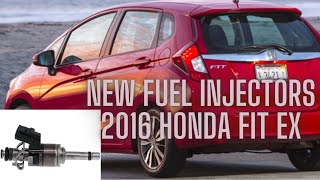
Typical fix: Replace the fuel injector set and the fuel joint pipe set under the warranty extension program at a Honda dealership. 🎬 Watch: One owner's experience getting their fuel injectors replaced.
Est. part cost: $0 (if covered by warranty), otherwise $1000+ for OEM parts. A dealer quote for the job out of warranty was reported to be $1,415. - Failed Catalytic Converter 🔴 High Probability Can be the primary failure, especially on 2017-2018 models where Honda is actively investigating the cause. It can also be a secondary failure caused by unaddressed issues like faulty injectors or ignition coils that contaminate the catalyst over time.
How to confirm: After ruling out injectors, use an infrared thermometer to check for a significant temperature increase (100°F+) from the converter's inlet to its outlet. A lack of temperature change indicates it is not working. A backpressure test can also check for a clog.
Typical fix: Replace the catalytic converter assembly. The Fit has two; a primary manifold converter and a secondary downstream converter.
Est. part cost: $800-$1500 for OEM, $300-$600 for aftermarket. - Faulty Ignition Coils 🟡 Medium Probability An owner complaint for a 2018 model cited faulty ignition coils as a concurrent issue with a P0420 code and a failed converter, suggesting misfires may be a contributing factor. Misfires allow unburnt fuel to enter the exhaust, damaging the converter.
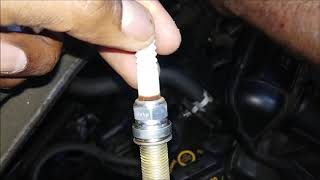
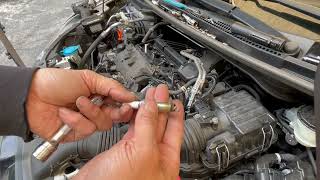
How to confirm: Check for corresponding misfire codes (P0300-P0304). Swap the suspected coil with one from another cylinder and see if the misfire code follows the coil. 🎬 Watch: How to remove the ignition coils and spark plugs.
Typical fix: Replace the faulty ignition coil(s) and spark plug(s).
Est. part cost: $40-$80 per coil - Exhaust Leak ⚪ Low Probability
How to confirm: Visually and audibly inspect the exhaust system from the engine to the downstream O2 sensor for any cracks, holes, or gasket leaks. A smoke machine is the most effective diagnostic tool. An unrepaired leak can allow oxygen to enter the exhaust, confusing the O2 sensors.
Typical fix: Repair the leak, which may involve replacing a gasket or welding a pipe.
Est. part cost: $10-$100 - Faulty Oxygen (O2) Sensor ⚪ Low Probability
How to confirm: Use a scan tool to graph the voltage of the upstream (A/F) and downstream (O2) sensors. A healthy upstream sensor will fluctuate rapidly, while the downstream sensor on a good converter should show a relatively steady, flat voltage. If the downstream sensor is lazy or mimics the upstream, it may be faulty, but this more often confirms a bad converter.
Typical fix: Replace the faulty oxygen sensor.
Est. part cost: $50-$150
Rare But Worth Checking
- Use of Fuel Additives or O2 Sensor Spacers:
Diagnosis Steps
- Read all stored diagnostic trouble codes. Pay close attention to any misfire (P030x) or fuel system (P017x, P219x) codes.
- For 2015-2016 models, immediately suspect fuel injectors. Contact a Honda dealer and reference TSB 22-002 and the associated warranty extension. They must perform the "Cylinder AF Test" to confirm.
- For all years, analyze live data from the upstream and downstream oxygen sensors. The downstream sensor's voltage should be stable on a healthy converter. If it fluctuates rapidly like the upstream sensor, the catalyst is not working.
- Check long-term fuel trims. Consistently high negative numbers (e.g., -10% or more) suggest a rich condition, pointing towards leaking injectors.
- As a low-cost initial step, some owners report temporary success using a quality fuel system cleaner (like Techron) or a catalytic converter cleaner, which can help determine if the issue is marginal.
- If misfire codes are present, diagnose the cause (spark plugs, ignition coils, injectors) before addressing the P0420 code.
- Inspect the exhaust system for leaks between the engine and the downstream O2 sensor.
- If all other tests are inconclusive, confirm catalytic converter failure with a temperature gun test or an exhaust backpressure test. 🎬 See this breakdown of P0420 causes and repair costs.
Parts You'll Likely Need
- Fuel Injector Set
(OEM #06160-5R1-000 (Kit per TSB 22-002))— The primary cause of P0420 on 2015-2016 models, covered by a 10yr/150k mile warranty extension. The original TSB A18-027 specified part 16010-5R1-315.
Trusted brands: Honda OE
OEM price range: $0 at dealer under warranty; $1000+ otherwise.
Aftermarket price range: $200-$400 - Catalytic Converter
(OEM #18160-5R7-A00 (Secondary/Lower Converter))— This is the part the code directly points to, and it can fail, especially if underlying issues like bad injectors are not addressed.
Trusted brands: Walker, MagnaFlow, AP Exhaust, Honda OE
OEM price range: $800-$1500
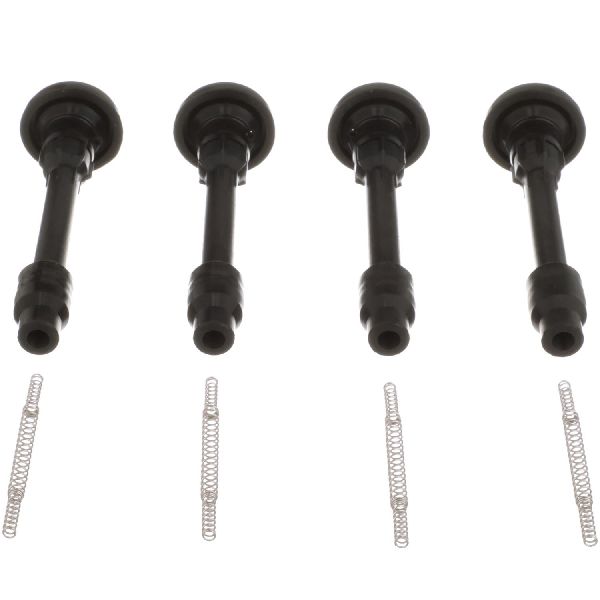
Aftermarket price range: $300-$600 - Ignition Coil — Can cause misfires that lead to catalytic converter damage and a P0420 code.
Trusted brands: NGK, Denso, Hitachi, Honda OE
OEM price range: $80-$120
Aftermarket price range: $40-$80
Related Codes That Often Appear With This One
- P0300, P0301, P0302, P0303, P0304 — These misfire codes can appear if faulty ignition coils or injectors are the root cause of the combustion issue that ultimately triggers the P0420 or damages the converter.
- P0171, P0172, P219A — These fuel system codes (System Too Lean, System Too Rich, Air-Fuel Ratio Imbalance) are also listed in the warranty extension TSB 22-002 as being related to the faulty fuel injectors.
Technical Service Bulletins (TSBs) & Recalls

- 22-002: Warranty Extension: MIL Comes On With DTC... P0420...
- A18-027: MIL Is On with DTC P0420 (for 2015-16 Fit) [Superseded by 22-002]
- 21-010: Warranty Extension: MIL Comes On with DTC P0420/P0430... (for Pilot, Ridgeline, Odyssey)
- ATI&05032024905: Searching for 2018 Fit with P0420
- ATI&03072025901: Searching for 2017 Fit with P0420
Platform-Specific Known Issues
- Warranty Extension for Fuel Injectors (TSB 22-002): For 2015-16 Fit models, Honda extended the warranty on the fuel injectors to 10 years or 150,000 miles. This TSB supersedes A18-027 and covers P0420 along with several misfire and fuel system codes (P0172, P219A, P0300-P0304). A dealer must perform the 'Cylinder AF Test' to confirm the failure and qualify for the free repair.
- Investigation into 2017-2018 Models: Honda has issued multiple Technical Service Bulletins (e.g., ATI&05032024905, ATI&03072025901) seeking specific 2017-2018 Fit vehicles that are logging the P0420 code. This indicates the manufacturer is actively investigating a root cause that is distinct from the known 2015-2016 injector issue, and the 2018 model year received a modified catalytic converter design.
Mechanic-Grade Diagnostic Values
- Low-Pressure Fuel System — expected: 47-54 psi (320-370 kPa) at idle.. Failure: Pressure outside of this range indicates a problem with the fuel pump or pressure regulator.
- Fuel Injector Resistance — expected: ~2.2 Ohms. Failure: A reading significantly different from this suggests an electrical failure of the injector coil. However, the common issue with these injectors is mechanical/internal leakage, not electrical failure.
- Fuel Factor Study Value (via Honda i-HDS) — expected: 0.83 to 1.15. Failure: A value below 0.83 indicates a rich-leaning (likely leaking) injector. A value above 1.15 indicates a lean-leaning injector.
- Long-Term Fuel Trim (LTFT) — expected: Close to 0%, typically within +/- 5%. Failure: Consistently high negative values (e.g., -15% or more) strongly suggest a rich condition, often caused by leaking fuel injectors.
Scan Tool Commands That Help
- Honda i-HDS (or compatible high-level scanner like Autel): Cylinder AF Test — This is the definitive, dealer-mandated test to confirm faulty fuel injectors as the cause of P0420 on 2015-2016 models per TSB A18-027. The test individually modulates each injector and measures the air-fuel ratio response to pinpoint a leaking or underperforming injector. A 'fail' result on one or more cylinders confirms the need for injector replacement.
- Honda i-HDS: CMK Relearn (Crank Pattern / Learned Value Clear) — This is a critical step *after* replacing fuel injectors. It clears the long-term fuel trim memory. Failing to do this can cause the ECU to apply old, incorrect fuel adjustments (like a -17% LTFT) to the new injectors, potentially causing a new lean code (P0171) or other drivability issues.
Wiring & Ground Locations
- G101 — On the engine, typically at the thermostat housing, connecting the engine wiring harness to the engine block.. This is a primary ground for the ECM/PCM and multiple critical sensors, including the Primary HO2S (Upstream A/F Sensor) and CKP sensor. A poor connection here can cause erratic sensor readings, leading to incorrect fuel calculations and potentially triggering false P0420 or other engine codes.
- G201 / G202 — In the main engine compartment wiring harness.. These are general grounds for the engine compartment harness. While not directly tied to the O2 sensors in diagrams, corrosion or damage to these points can introduce electrical noise and unpredictable issues throughout the powertrain management system.
- ECM/PCM Connector A & B — Located behind the passenger side glovebox.. This is where all sensor inputs are processed. When diagnosing a persistent P0420 with no obvious cause, checking for voltage and continuity at the specific pins for the upstream and downstream O2 sensors can rule out a wiring break between the sensor and the computer.
Real Owner Repair Stories
- Unofficial Honda FIT Forums user (2016 Fit LX) — P0420, occasional P0171 (System Too Lean)
❌ Tried (didn't work) Replaced fuel injectors and fuel pipe, Replaced catalytic converter, Replaced MAF sensor, Replaced engine wiring harness due to damage, Replaced MAF sensor again (under warranty), Replaced catalytic converter again (under warranty)
✅ What actually fixed it The user's engine was ultimately replaced because the lean condition (P0171) had apparently caused valves in cylinder 1 to stop sealing properly. The P0420 was a symptom of a much larger mechanical engine problem that developed over time. - Unofficial Honda FIT Forums user (2015 Fit) — Check engine light with P0420, followed by a misfire less than a year later.
❌ Tried (didn't work) Initial dealer diagnosis led to replacing the catalytic converter under warranty.
✅ What actually fixed it When the code and a misfire returned less than a year later, a new TSB pointed to the fuel injectors. The owner discovered the original catalytic converter failure was likely a *symptom* of the bad injectors, which should have been the primary diagnosis. The final fix was replacing the fuel injectors.
"I Checked Everything" — The Actual Cause
- The most common scenario for this vehicle where a smoke test would pass, but a P0420 code exists, is the faulty fuel injector issue on 2015-2016 models. An exhaust smoke test will not detect an internal fuel injector leak that is causing a rich fuel mixture. The rich mixture overwhelms the catalytic converter, causing it to perform inefficiently and trigger the P0420 code, even with no exhaust leaks present.
OEM Part Supersession History
16010-5R1-315 (Individual Injector)→06160-5R1-000 (Injector Kit)— Honda TSB 22-002 and A18-027 mandate replacing the injectors as a matched set, along with the fuel joint pipe. The kit was created to facilitate this complete repair.
Heads up: The kit (06160-5R1-000) includes four injectors, the fuel feed pipe, and a throttle body gasket, and is the required service part for the warranty extension.
Model Year Variations Within This Range
- 2015-2016: These years are explicitly covered by TSB 22-002 and a warranty extension for faulty fuel injectors causing a false P0420. The primary cause is almost always the injectors.
- 2017-2018: These years are not covered by the injector TSB. Honda has issued separate bulletins seeking vehicles from these years with P0420, indicating an ongoing investigation into a different root cause.
- 2018: The 2018 model year marked a mid-cycle refresh which included a "modified catalytic converter design" to meet SULEV-30 emission standards. This suggests the part itself may differ from earlier years.
Real Owner Stories
Aggregated from forums and TSBs cited above. Mileages and costs reflect what owners reported in those sources.
2015 Honda Fit — 95000 miles
Symptoms: Check engine light with P0420 code, sometimes idles rough on cold start.
What fixed it: Other users suggested the cause is likely failed fuel injectors covered under a TSB, advising against replacing the O2 sensor or catalytic converter.
Source hint: Unofficial Honda FIT Forums
2018 Honda Fit
Symptoms: P0420 code and a failed catalytic converter with concurrent misfire issues.
What fixed it: Replacing the faulty ignition coils, which were identified as the root cause of the misfires that damaged the converter.
Source hint: Owner complaint cited in Faulty Ignition Coils section
Related OBD-II Codes
Frequently Asked Questions
Does the fuel injector warranty extension (TSB 22-002) apply to my 2018 Honda Fit?
My 2015 Fit has a P0420 code and rough idle. Should I replace the catalytic converter first?
What is the 'Cylinder AF Test' mentioned for the Honda Fit?
Are there any specific TSBs for the 2017-2018 Honda Fit regarding the P0420 code?
Can a bad ignition coil cause a P0420 on my Fit?
Helpful Videos
Used OEM Parts in Stock

New Aftermarket Parts Available


The information in this article is provided for general reference and educational purposes only. Vehicle specifications, procedures, and part compatibility can vary by production date, trim level, and region. Always consult your vehicle's factory service manual and verify part numbers before purchasing or performing repairs. Safety-critical components such as airbags, seat belts, and braking systems should be installed by a qualified professional.
- Honda FIT:
- 🎬 Helpful Videos
- 🛍️ Shop This Part
- What's Unique About the 2015-2018 Honda FIT
- Diagnostic Flowchart
- Symptoms You May Notice
- Most Likely Causes
- Rare But Worth Checking
- Diagnosis Steps
- Parts You'll Likely Need
- Related Codes That Often Appear With This One
- Technical Service Bulletins (TSBs) & Recalls
- Platform-Specific Known Issues
- Mechanic-Grade Diagnostic Values
- Scan Tool Commands That Help
- Wiring & Ground Locations
- Real Owner Repair Stories
- "I Checked Everything" — The Actual Cause
- OEM Part Supersession History
- Model Year Variations Within This Range
- Real Owner Stories
- 2015 Honda Fit — 95000 miles
- 2018 Honda Fit
- Related OBD-II Codes
- Frequently Asked Questions
- 🎟️ Get 5% Off