

P0420 on 2006-2013 BMW 3-Series (N54): Catalyst Efficiency Causes and Fixes
On the N54-powered BMW 335i, code P0420 often points to a failing catalytic converter, but the root cause is frequently a deeper engine issue like leaky fuel injectors or failing O2 sensors. Always diagnose underlying engine problems like misfires, fuel system faults, or sensor issues before replacing the expensive catalytic converters to avoid repeat failure.
- Do not automatically replace the catalytic converter. P0420 on an N54 is often a symptom of another problem.
- Always investigate for leaky fuel injectors, failing O2 sensors, misfires, and exhaust leaks as the primary root cause.
- Use a scan tool to analyze live O2 sensor data. This is the most effective non-invasive step to determine if the converter or a sensor is at fault.
- The N54 engine has two catalytic converters. P0420 refers to Bank 1, which serves cylinders 1-3.
- Ignoring this code can lead to a clogged converter, which can cause severe engine backpressure and potential damage.
What's Unique About the 2006-2013 BMW 3-Series
The BMW N54 engine is a high-performance, twin-turbocharged, direct-injection engine with several well-documented failure points that can directly lead to a P0420 code. Unlike many cars where a P0420 simply means an old, worn-out catalytic converter, on the N54 it is frequently a symptom of another problem. Leaky fuel injectors, failing high-pressure fuel pumps (HPFP), and bad ignition components can cause a rich fuel mixture, which rapidly destroys the catalytic converters by dousing them in unburnt fuel. Therefore, replacing the catalytic converter without addressing these potential underlying issues often results in the new converter failing prematurely.
Generation note: The 2006-2013 3-Series range covers the E90/E91/E92/E93 generation. However, the N54 engine specified was primarily used in 335i models from 2006 to 2010. From 2011 onwards, the 335i used the newer N55 single-turbo engine. This guide is specific to the N54-equipped models.
Symptoms You May Notice
- Check Engine Light (Service Engine Soon) is on.
- Reduced engine power and sluggish acceleration.
- A smell of sulfur or rotten eggs from the exhaust.
- Rattling noises from the exhaust if the internal structure of the converter has broken apart.
- Failing an emissions test.
- Rough idle and misfires, especially if the code is accompanied by P0430 (both banks failing).
- Immediately replacing the catalytic converter without checking for underlying causes like bad O2 sensors, leaky fuel injectors, or misfires. The new converter will likely fail again if the root problem isn't fixed.
Most Likely Causes
- Failing Catalytic Converter 🔴 High Probability Often a secondary failure caused by other N54-specific issues like leaky injectors or misfires flooding the converter with unburnt fuel, leading to overheating and substrate meltdown. Age and mileage also contribute to natural wear.
How to confirm: Use an infrared thermometer to check the converter's temperature. The outlet should be at least 100°F hotter than the inlet on a fully warmed-up engine. If temperatures are similar or the inlet is hotter, the converter is likely clogged or inactive. A definitive test involves comparing upstream and downstream O2 sensor graphs; if they mirror each other, the cat has failed.
Typical fix: Replacement of the Bank 1 downpipe, which contains the catalytic converter. This is a costly repair.
Est. part cost: $700-$2500 - Failing Oxygen (O2) Sensors 🟡 Medium Probability O2 sensors have a finite lifespan (approx. 100,000-120,000 miles) and can send false readings. A lazy or faulty post-catalyst (downstream) sensor is a common misdiagnosis for a bad converter.
How to confirm: Use a scan tool to graph O2 sensor voltage. The upstream (Sensor 1) should fluctuate rapidly between ~0.1V and ~0.9V. The downstream (Sensor 2) should hold a relatively steady, smooth voltage. If the downstream sensor's graph mirrors the upstream sensor, the converter is likely bad. If the downstream sensor is flatlined, slow to respond, or shows erratic behavior inconsistent with the upstream sensor, the sensor itself is likely faulty.
Typical fix: Replace the faulty oxygen sensor. Bank 1 Sensor 2 is the primary sensor for this code.
Est. part cost: $80-$200 - Leaky Fuel Injectors 🟡 Medium Probability The N54 engine is notorious for fuel injector failures. The Piezo-style injectors are prone to leaking, creating a rich running condition that sends unburnt fuel into the exhaust, quickly contaminating and destroying the catalytic converter.
How to confirm: Look for other codes related to fuel trim or misfires. A simple method is to remove the spark plugs after the car has sat overnight; a plug that is wet with fuel indicates a leak in that cylinder. A more definitive test involves removing the injectors, keeping them connected to the fuel rail, and cranking the engine to see if any injectors drip fuel.
Typical fix: Replace the faulty fuel injector(s). It is highly recommended to replace them as a full set with the latest 'Index 12' version and code them to the DME.
Est. part cost: $400-$1500 for a set - Exhaust Leaks ⚪ Low Probability Flex pipes, gaskets, and welds in the exhaust system can crack or fail over time, allowing oxygen to enter the exhaust stream. This can skew O2 sensor readings and trick the DME into setting a P0420 code.
How to confirm: Visually inspect the exhaust system from the engine to the post-cat O2 sensor for cracks or loose connections. Listen for ticking or hissing sounds, especially on a cold start. A smoke test is the most definitive way to find small leaks.
Typical fix: Replace the leaking gasket or repair/replace the cracked pipe section.
Est. part cost: $20-$150
Rare But Worth Checking
- Engine Misfires: Caused by bad spark plugs or ignition coils. A consistent misfire allows unburnt fuel to enter the exhaust, which will damage the catalytic converter over time. BMW codes will often specify a 'catalyst damaging misfire'.
- Failing High-Pressure Fuel Pump (HPFP): Another well-known N54 issue. While it more often causes lean conditions, erratic fuel pressure can contribute to conditions that harm the catalytic converters. Symptoms include long cranks and power loss under acceleration.
- Engine Not Reaching Operating Temperature: A thermostat stuck open can prevent the engine from getting hot enough for the catalytic converter to operate efficiently, triggering P0420 and P0430 codes. This can be checked by monitoring coolant temperature with a scan tool.
Diagnosis Steps
- Read all fault codes from the DME. Pay close attention to any misfire, fuel trim, or fuel system codes, as they are crucial clues.
- Analyze Freeze Frame data to see the engine conditions (coolant temp, RPM, etc.) when the code was set.
- Inspect the exhaust system for any audible leaks between the cylinder head and the rear oxygen sensor. A smoke test is the most reliable method.
- Using a capable scan tool, graph the voltage of the Bank 1 oxygen sensors (both pre-cat and post-cat).
- Observe the pre-cat (Sensor 1) voltage. It should fluctuate rapidly between approximately 0.1V and 0.9V.
- Observe the post-cat (Sensor 2) voltage. On a healthy converter, this should be relatively stable and smooth (typically above 0.5V).
- If the post-cat sensor's voltage graph mimics the pre-cat sensor's graph, the catalytic converter has lost its efficiency.
- If the post-cat sensor shows a flat, unchanging voltage or is very slow to respond, the sensor itself is likely defective.
- Before replacing a converter, rule out engine issues. Check spark plugs for fuel fouling (indicating leaky injectors), test ignition coils, and test fuel injectors for leaks, especially on the N54 engine.
- As a final check, use an infrared thermometer to measure the inlet and outlet pipe temperatures of the catalytic converter after a 20-minute drive. The outlet should be at least 100°F hotter than the inlet.
Parts You'll Likely Need
- Catalytic Converter / Downpipe (Bank 1)
(OEM #18307592437)— This is the direct cause indicated by the code, though it's often damaged by another failure. The converter is integrated into the downpipe for cylinders 1-3.
Trusted brands: Bosal, Walker Exhaust, MagnaFlow, VEGAZ
OEM price range: $1500-$2500
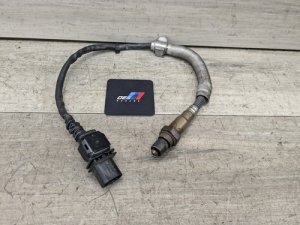
Aftermarket price range: $700-$1200 - Downstream Oxygen Sensor (Bank 1, Sensor 2) — This sensor measures catalyst efficiency. It can fail and provide false readings, leading to a misdiagnosis of the converter. It's a common wear item and a frequent cause of the code.
Trusted brands: Bosch, NTK
OEM price range: $150-$250
Aftermarket price range: $80-$150 - Fuel Injector (Index 12)
(OEM #13538616079)— A primary root cause on the N54. Leaky injectors foul spark plugs and destroy catalytic converters with raw fuel. Replacing with the latest index is critical for reliability.
Trusted brands: Genuine BMW, VDO
OEM price range: $250-$450 per injector
Aftermarket price range: $200-$300 per injector
Related Codes That Often Appear With This One
- P0430 — This is the identical code for Bank 2 (cylinders 4-6). If both appear together, it points towards a systemic issue affecting both banks, such as a faulty engine coolant thermostat, bad fuel, or a failing mass airflow sensor.
- P030x (e.g., P0301, P0302) — These are cylinder-specific misfire codes. A misfire is a primary cause of catalytic converter damage due to unburnt fuel entering the exhaust.
- 29DC, 29E2, 2FBF — These are BMW-specific codes related to the fuel injection system and high-pressure fuel pump, pointing to root causes that can lead to P0420.
Technical Service Bulletins (TSBs) & Recalls
- SIB 01 02 12: Extended warranty coverage for turbocharger wastegate issues to 8 years/82,000 miles.
Platform-Specific Known Issues
- A complaint filed with the NHTSA for a BMW with a P0420 code mentioned a loss of power while driving, which can be a symptom of a clogged catalytic converter. [ODI #11579138]
Mechanic-Grade Diagnostic Values
- High-Pressure Fuel Pump (HPFP) Pressure — expected: Around 700-750 psi at idle, ramping up to 1500-2200+ psi under load.. Failure: Pressure dropping below 900 psi at full throttle, or erratic readings. A drop to 600 psi or below when coasting can be a sign of a pending failure.
- Low-Pressure Fuel Pump (LPFP) Pressure — expected: Typically ranges from 55-75 psi.. Failure: Dropping below 50 psi under load indicates a problem with the pump. Some failed low-pressure sensors can get stuck reading a constant 55.7 psi.
- Upstream (Pre-Cat) O2 Sensor Voltage (Narrowband) — expected: Rapidly fluctuating between approximately 0.1V and 0.9V as the DME adjusts the air-fuel mixture.. Failure: A slow, lazy, or flat-lined signal.
- Upstream (Pre-Cat) O2 Sensor Voltage (Wideband - used on N54) — expected: On ISTA, a reading of 1.99V - 2.01V indicates a perfect (Lambda 1.0) mixture in homogeneous mode.. Failure: A steady voltage of 2.00V on some scanners can indicate a problem being investigated, not necessarily a failed sensor. Values deviating significantly from the expected range for a given engine mode point to an issue.
- Downstream (Post-Cat) O2 Sensor Voltage — expected: A relatively steady voltage, typically between 0.7V and 0.9V, indicating the catalyst is working.. Failure: Fluctuating in a similar pattern to the upstream sensor, which indicates the catalyst is not cleaning the exhaust.
- Piezo Fuel Injector Resistance — expected: Approximately 190-200 ohms, with BMW's specification being around 200 +/- 40 ohms.. Failure: An open circuit (infinite resistance) or a reading significantly outside the specified range.
Hidden / Shadow Codes Worth Checking
- 2AAF - DME: Fuel pump, plausibility: This shadow code indicates the DME has detected an issue with the fuel pump, often the low-pressure fuel pump or its sensor. It can be a precursor to fuel delivery problems that eventually lead to catalyst-damaging conditions. (see via BMW-specific scan tools like ISTA, INPA, or high-end aftermarket scanners (Foxwell, etc.) capable of reading shadow/history faults.)
- 29F2 - DME: High-pressure fuel system, fuel pressure: This code directly points to a problem with the high-pressure side of the fuel system, often a failing HPFP. This can cause lean or rich conditions that damage the catalytic converters. (see via BMW-specific scan tools.)
Scan Tool Commands That Help
- ISTA/D: Call up ECU functions -> DME -> Diagnostics scan -> Oxygen sensor control — This function allows viewing live data for both upstream and downstream oxygen sensors to evaluate their performance and, by extension, the performance of the catalytic converter.
- ISTA/D: Service function -> Powertrain -> Engine Electronics -> Code injector data — This is a mandatory step after replacing any fuel injectors. Each new injector has a calibration value printed on it that must be entered into the DME to ensure correct fuel delivery. Failure to do so will cause rough running and potential fuel mixture issues.
- ISTA/D: Service function -> Powertrain -> Engine Electronics -> Delete adaptations — After replacing major components like fuel injectors, O2 sensors, or the HPFP, it is crucial to reset the engine's learned fuel and air adaptations to allow it to re-learn based on the new components.
Wiring & Ground Locations
- Engine Ground Strap (Lower) — On the driver's side (LHD) of the vehicle, connecting the engine mount bracket to the chassis, located under the car.. A corroded or broken main engine ground strap can cause a myriad of electrical issues, including incorrect sensor readings. O2 sensors rely on a stable ground reference to provide accurate voltage signals to the DME. A poor ground can skew these readings, potentially leading to a false P0420 code.
- Upper Engine Grounds — There are multiple grounding points in the engine bay, including one near the water pump with an aluminum bolt and two smaller grounds for the ignition coils.. While less likely to be the primary cause than the main strap, poor grounds for the ignition system can lead to weak spark, incomplete combustion, and misfires, which directly contribute to catalytic converter damage.
Real Owner Repair Stories
- Bimmerpost user 'jrabbit' (2008 BMW 335i @ 90k miles) — Service Engine Soon light with codes P0420 and P0430.
❌ Tried (didn't work) Initial diagnosis pointed to catalytic converters or a systemic issue like a bad MAF sensor or vacuum leak.
✅ What actually fixed it Replacement of three faulty oxygen sensors resolved the issue and the check engine light turned off.
OEM Part Supersession History
Various older part numbers ending in index -01 through -10→13538616079 (marked with index 11 or, most recently, 12)— Early N54 injectors were highly prone to leaking and failure. BMW has revised the design multiple times to improve reliability and performance.
Heads up: Injectors with an index of 10 or lower cannot be mixed in the same engine bank (cylinders 1-3 or 4-6) with injectors of index 11 or higher. It is best practice to replace all six injectors with the latest index (12) to ensure balanced and reliable operation.
Diagnostic Flowchart
Other Known Issues on This Vehicle
Issues unrelated to this code that are worth knowing about as an owner of this generation:
- High-Pressure Fuel Pump (HPFP) Failure 🔴 High — Very common. Can fail at any mileage. Symptoms include long crank times, engine sputtering, and sudden loss of power. (Ref: BMW extended the warranty on the HPFP to 10 years or 120,000 miles for many vehicles.)
- Electric Water Pump & Thermostat Failure 🔴 High — Common failure item, typically between 50,000 and 80,000 miles. Failure is often sudden and can cause rapid overheating.
- Turbocharger Wastegate Rattle 🟠 Medium — Extremely common. Caused by wear in the wastegate actuator rod/bushing. Creates a distinct rattling noise on deceleration or startup. (Ref: BMW extended the warranty for wastegate-related turbo failure to 8 years or 82,000 miles. (SIB 01 02 12))
- Intake Valve Carbon Buildup 🟠 Medium — Inevitable due to direct injection. Requires cleaning (walnut blasting) every 40,000-60,000 miles to prevent rough idle, misfires, and power loss.
- Valve Cover and Gasket Oil Leaks 🟠 Medium — The plastic valve cover can crack and the gasket can become brittle, leading to oil leaks. An oil filter housing gasket (OFHG) leak is also common and can cause the serpentine belt to fail if oil drips on it.
Used vs. New Parts: Buying Guide for This Vehicle
When a used part is the smart pick: For this repair, used parts are generally not recommended for the core components. However, if sourcing a complete used engine or cylinder head, those would come with their own components. Individual electronic sensors and injectors should be purchased new.
Donor-vehicle mileage cap: roughly under 60000 miles for the part to have meaningful remaining life.
What to inspect on the donor part:
- For catalytic converters, ensure the donor car did not have codes for misfires or fuel system faults.
- Check for physical damage, cracks, or signs of extreme heat on the converter body.
- When buying used injectors, only consider Index 11 or 12, and ensure they come from a reputable source with a known history if possible.
OEM-only on this vehicle (don't cheap out):
- Fuel Injectors: Due to the high failure rate of early versions and the need for precise calibration, only Genuine BMW or OEM VDO Index 12 injectors should be used.
- High-Pressure Fuel Pump (HPFP): Given the history of failures and multiple revisions, using a Genuine BMW or OEM pump is critical for reliability.
Aftermarket brands forum-validated for this vehicle:
- Bosch or NTK for Oxygen Sensors.
- MagnaFlow or Bosal for aftermarket catalytic converters (ensure they are CARB compliant if required by your state).
- Walbro for upgraded Low-Pressure Fuel Pumps (LPFP) if modifying the vehicle.
Brands owners have reported issues with on this vehicle:
- Unbranded, no-name fuel injectors or oxygen sensors from online marketplaces. These often fail quickly or are dead on arrival.
Real Owner Stories
Aggregated from forums and TSBs cited above. Mileages and costs reflect what owners reported in those sources.
2008 BMW 335i N54
Symptoms: A modified N54 experiencing both P0420 and P0430 codes simultaneously, accompanied by a rough idle and engine misfires.
What fixed it: The discussion suggests addressing systemic issues and potential misfires, though the specific thread focuses on the presence of both bank codes (P0420/P0430) on a modified platform.
Source hint: e90post.com thread titled 'P0420 and P0430 codes, along with rough idle and misfires'
2010 BMW 135i N54
Symptoms: Leaky injectors leading to fouled spark plugs, resulting in misfires and rough running.
What fixed it: Replacing leaky fuel injectors to prevent further catalyst damage.
Source hint: 1addicts.com thread titled 'leaky injectors can foul spark plugs, leading to misfires and rough running'
BMW 3-Series (N54)
Symptoms: A sudden loss of power while driving.
What fixed it: This symptom is associated with a clogged catalytic converter, as noted in a formal complaint regarding catalyst efficiency.
Source hint: NHTSA complaint [ODI #11579138]
Related OBD-II Codes
Frequently Asked Questions
Does SIB 01 02 12 cover my catalytic converter failure on my 2009 335i?
I have a P0420 and a rough idle; could my N54 fuel injectors be the cause?
Is there an extended warranty for the High-Pressure Fuel Pump (HPFP) if it's causing my P0420?
Can a bad thermostat cause a P0420 code on the E90 3-Series?
What is the recommended replacement for the leaky injectors causing my catalyst efficiency code?
How can I tell if my Bank 1 downpipe is actually bad or if it's just a sensor?
Used OEM Parts in Stock




New Aftermarket Parts Available


The information in this article is provided for general reference and educational purposes only. Vehicle specifications, procedures, and part compatibility can vary by production date, trim level, and region. Always consult your vehicle's factory service manual and verify part numbers before purchasing or performing repairs. Safety-critical components such as airbags, seat belts, and braking systems should be installed by a qualified professional.
- BMW 3-Series:
- 🛍️ Shop This Part
- What's Unique About the 2006-2013 BMW 3-Series
- Symptoms You May Notice
- Most Likely Causes
- Rare But Worth Checking
- Diagnosis Steps
- Parts You'll Likely Need
- Related Codes That Often Appear With This One
- Technical Service Bulletins (TSBs) & Recalls
- Platform-Specific Known Issues
- Mechanic-Grade Diagnostic Values
- Hidden / Shadow Codes Worth Checking
- Scan Tool Commands That Help
- Wiring & Ground Locations
- Real Owner Repair Stories
- OEM Part Supersession History
- Diagnostic Flowchart
- Other Known Issues on This Vehicle
- Used vs. New Parts: Buying Guide for This Vehicle
- Real Owner Stories
- 2008 BMW 335i N54
- 2010 BMW 135i N54
- BMW 3-Series (N54)
- Related OBD-II Codes
- Frequently Asked Questions
- 🎟️ Get 5% Off