

OBD-II Code P0175: System Too Rich (Bank 2)
The Ultimate 2026 Guide to Causes, Diagnosis, and Repair Costs for P0175
- Code P0175 indicates Bank 2 of your engine is running too rich, meaning long-term fuel trims have hit their maximum negative limit (typically -25%).
- If P0175 appears alone, the most likely culprits are a leaking fuel injector on Bank 2 or a faulty Bank 2 upstream oxygen sensor.
- If P0175 is paired with P0172 (Bank 1 Rich), the issue affects the entire engine, pointing directly to a dirty MAF sensor or a failing fuel pressure regulator.
- Do not drive more than 50 miles with an active P0175 code, as unburned fuel will melt your catalytic converter and cause a $1,500+ repair.
What Does P0175 Mean?

Code P0175 means your engine's computer, the Powertrain Control Module (PCM), detects too much fuel and not enough air on 'Bank 2'. Bank 2 is the side of a V-shaped engine that does not contain cylinder #1. The PCM constantly strives to maintain a perfect 14.7:1 air-to-fuel ratio. This code signifies the PCM has reached its maximum limit trying to reduce fuel and can no longer correct the excessively rich mixture.
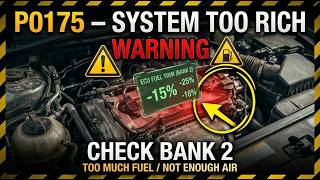
Technical definition: The official SAE definition for P0175 is "System Too Rich (Bank 2) 🎬 Watch: Why you shouldn't replace O2 sensors immediately for P0175.". This indicates the Powertrain Control Module (PCM) detects the long-term fuel trim (LTFT) for Bank 2 has reached its maximum negative compensation limit (typically -25% to -30%), yet the air-fuel ratio remains richer than the optimal 14.7:1 stoichiometric ratio.
Can I Drive With P0175?
Yes, But With Caution. You can drive short distances, but doing so risks severe damage. Continuing to drive with a P0175 code causes poor fuel economy, engine hesitation, and fouled spark plugs. Most critically, unburned fuel destroys the catalytic converter, a repair costing between $800 and $2,500. Do not drive more than 50 miles before repairing the issue.
Common Causes

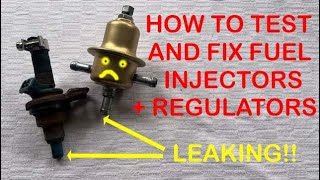
- Leaking or Stuck-Open Fuel Injector(s) on Bank 2 (Very Common) — A fuel injector on Bank 2 is stuck partially open or leaking, continuously dumping excess fuel into the cylinder. 🎬 Watch: How to test for leaking fuel injectors using simple tools. This is the most frequent cause of a rich condition isolated to a single engine bank.
- Faulty Upstream Oxygen (O2) Sensor on Bank 2 (Common) — The Bank 2 O2 sensor fails and sends an incorrect 'stuck rich' voltage reading to the computer. The PCM mistakenly reduces the fuel supply, but the false sensor data triggers the code.
- Dirty or Faulty Mass Airflow (MAF) Sensor (Common) — A contaminated MAF sensor under-reports the air entering the engine. The computer calculates a fuel injection amount too high for the actual airflow. This causes a rich condition across all cylinders and almost always triggers a P0172 code simultaneously.
- Faulty Fuel Pressure Regulator (Less Common) — A failed fuel pressure regulator creates excessive pressure in the fuel rail. This forces too much fuel through the injectors with every pulse, affecting all cylinders and triggering both P0172 and P0175.
- Exhaust Leak (Before the O2 Sensor) (Rare) — A crack in the exhaust manifold before the upstream O2 sensor pulls outside air into the exhaust stream. This oxygen tricks the O2 sensor into reporting a lean condition, causing the PCM to dump excessive fuel and create a genuinely rich mixture.
- Stuck-Open EVAP Purge Valve (Rare) — The EVAP purge valve controls fuel vapors from the charcoal canister. A stuck-open valve allows unmetered fuel vapors into the intake manifold, creating a rich condition affecting both banks.
Symptoms

- Check Engine Light is On — The PCM illuminates the malfunction indicator lamp as soon as fuel trims exceed the -25% threshold.
- Poor Fuel Economy — The vehicle consumes 10% to 20% more fuel than usual because the engine continuously dumps unneeded gasoline into the cylinders.
- Rough Idle and Engine Hesitation — The engine shakes at a stop, feels sluggish, or misfires when accelerating due to spark plugs fouling from excess fuel.
- Black Smoke and Raw Fuel Smell — A strong gasoline odor from the tailpipe or visible black smoke confirms unburned fuel is passing through the exhaust system.
- Fuel Dilution of Engine Oil (also visible on scanner) — Excess fuel washes past the piston rings and contaminates the engine oil. The oil level rises and smells strongly of gasoline, severely reducing lubrication.
Diagnostic Flowchart

Tap your situation to follow the diagnostic path that matches what you're seeing on this code.
Common Fixes & Costs
- Replace Bank 2 Upstream Oxygen (O2) Sensor
— Parts: $50-$150, Labor: $100-$150, ~1.0 hr book time
(Intermediate)
: OEM - Replace Leaking Fuel Injector(s) on Bank 2
— Parts: $60-$200 (per injector), Labor: $200-$450, ~2.5 hr book time
(Professional)
: OEM - Clean or Replace Mass Airflow (MAF) Sensor
— Parts: $10 (cleaner) or $150-$300 (new sensor), Labor: $50-$100, ~0.5 hr book time
(DIY)
: OEM - Replace Fuel Pressure Regulator — Parts: $100-$250, Labor: $100-$200, ~1.5 hr book time (Intermediate)
DIY vs Professional
- Replace Bank 2 Upstream Oxygen (O2) Sensor — Beginner:
- Replace Leaking Fuel Injector(s) on Bank 2 — Beginner:
- Clean or Replace Mass Airflow (MAF) Sensor — Beginner:
Used vs. New Parts: Buying Guide
When a used part is worth it: Never buy used O2 or MAF sensors. They are wear items with finite lifespans. Used fuel rails or intake manifolds are acceptable if undamaged.
Donor-vehicle mileage cap: roughly under 40000 miles for the part to have meaningful remaining life.
Donor quality checklist:
- Match part numbers exactly; visually identical sensors have different calibrations.
- Avoid parts from vehicles scrapped due to engine fires or emissions failures.
Decision logic:
- If Part is an electronic sensor (O2, MAF) or fuel injector → Buy new from an OEM or reputable aftermarket brand (Denso, Bosch). The risk of repeat labor costs is too high.
- If Part is a mechanical component like a fuel rail → A used part from a low-mileage donor is cost-effective.
Warranty tradeoff: Used parts offer 30-day warranties but exclude electrical components. New aftermarket parts offer 1-3 year warranties.
Worst-case if a used part fails: 300-500 if a used sensor fails, requiring repeat diagnostic time and a second part purchase.
What Happens If You Wait — Timeline
- 0-2 weeks: Check Engine Light illuminates. The PCM compensates at its maximum limit. No drivability symptoms are noticeable. (MPG impact: 0-5%% · Added cost: $0)
- 2 weeks - 3 months: Fuel economy drops noticeably. A raw fuel smell emits from the exhaust at idle. The engine idles roughly on cold starts. (MPG impact: 10-15%% · Added cost: $50-150 in wasted fuel)
- 3-6 months: Bank 2 spark plugs foul with carbon, causing intermittent misfires (P030x codes). The catalytic converter overheats as unburned fuel ignites inside it. (MPG impact: 15-25%% · Added cost: $200-400 (spark plug replacement))
- 6+ months: The catalytic converter substrate melts and collapses. The engine loses severe power and stalls due to exhaust backpressure. P0430 sets permanently. (MPG impact: 30%+% · Added cost: $1,200-2,500 (catalytic converter replacement))
Cost of Not Fixing It
- 0-1 month: Reduced fuel economy (10-15% drop), strong fuel smell, and automatic emissions test failure. (Added cost: 50-150 in wasted fuel)
- 1-6 months: Spark plugs foul and cause misfires. The catalytic converter overheats and degrades. (Added cost: 200-400 (spark plugs and diagnostics))
- 6+ months: Complete catalytic converter meltdown, causing severe power loss and potential engine damage from backpressure. (Added cost: 1200-2500 (catalytic converter replacement))
Diagnosis Steps
- Scan Codes and Review Fuel Trims
Use an OBD-II scanner to confirm P0175 and check for P0172. Review Long-Term Fuel Trim (LTFT) for both banks. If Bank 2 LTFT is -25% but Bank 1 is normal, the issue is isolated to Bank 2 (likely an injector or O2 sensor). If both banks are highly negative, suspect the MAF sensor or fuel pressure.
Tools: OBD-II Scanner with Live Data (Beginner) - Analyze Live O2 Sensor Data
Watch the Bank 2, Sensor 1 (upstream) O2 sensor voltage on your scanner. A healthy sensor fluctuates rapidly between 0.1V and 0.9V. If it is stuck high (above 0.8V) while short-term fuel trims are negative, it confirms a rich condition. Compare it to Bank 1 to isolate the fault.
Tools: OBD-II Scanner with Live Data (Intermediate) - Clean the Mass Airflow (MAF) Sensor
If P0172 is also present, remove the MAF sensor and spray the delicate wires with dedicated MAF cleaner. Do not touch the wires or use brake cleaner. Reinstall once completely dry and recheck fuel trims.
Tools: Screwdriver, MAF Sensor Cleaner (Beginner) - Perform a Fuel Injector Leak-Down Test
Connect a fuel pressure gauge to the fuel rail. Turn the key ON (engine off) to pressurize the system, then turn it OFF. The pressure should hold steady. If it drops rapidly, an injector is leaking. Pull the Bank 2 spark plugs; a wet, fuel-soaked plug pinpoints the exact leaking injector.
Tools: Fuel Pressure Gauge, Spark Plug Socket (Advanced) - Test Running Fuel Pressure
With the engine idling, check the fuel pressure gauge. Compare the reading to manufacturer specs (typically 40-60 PSI). Pressure exceeding the maximum limit indicates a faulty fuel pressure regulator or a restricted return line.
Tools: Fuel Pressure Gauge (Intermediate) - Conduct a Smoke Test for Exhaust Leaks
Introduce smoke into the exhaust system with the engine off. Look for smoke escaping from the exhaust manifold or pipes before the upstream O2 sensor. Even a pinhole leak pulls in oxygen and causes a false rich command.
Tools: Automotive Smoke Machine (Advanced)
When This Code Triggers (Freeze-Frame Conditions)
- Engine Coolant Temp: 180-205°F (Fully warmed up, in closed-loop operation)
- RPM: 1500-2500 (Cruise or steady throttle, not idle or heavy acceleration)
- Engine Load: 25-60% (Light to moderate load, maintaining speed)
- Vehicle Speed: 40-65 mph (Steady highway or arterial road driving)
Related Codes
- P0172 — System Too Rich (Bank 1). If both P0172 and P0175 are present, the problem affects the entire engine. Stop looking at Bank 2 specifically and test the MAF sensor, fuel pressure, and EVAP system.
- P0300-P0308 — Misfire codes. A severe rich condition fouls spark plugs and causes misfires. If fuel trims were highly negative before the misfire logged, the rich condition caused the misfire. Fix P0175 first.
- P0430 — Catalyst Efficiency Below Threshold (Bank 2). P0175 directly causes P0430 by dumping raw fuel into the exhaust and melting the converter. Fix the P0175 fuel issue before replacing the expensive converter.
Climate & Environmental Factors
- Cold Weather: The PCM intentionally runs a rich mixture during cold starts. A faulty Engine Coolant Temperature (ECT) sensor stuck reading 'cold' causes this rich condition to persist indefinitely, triggering P0175. This failure is highly noticeable in winter.
- High Altitude: Air is less dense at high altitudes. A lazy O2 sensor or slightly dirty MAF sensor fails to adjust quickly enough to the thin air, pushing fuel trims past their negative limit and triggering the code.
How to Talk to a Mechanic About This Code
Say this: "I have a P0175 code. I'd like you to check the live data for fuel trims and the Bank 2 O2 sensor, and perform a fuel pressure leak-down test before recommending parts."
This proves you understand the diagnostic process. It forces the technician to look at data and test for leaking injectors rather than blindly replacing the O2 sensor.
Avoid saying:
- 'Just replace the O2 sensor.'
- 'My check engine light is on, can you look at it?' (invites upsell)
- 'Whatever you recommend.'
Questions to ask before authorizing the repair:
- Can you show me the fuel trim data for both banks?
- Did you perform a fuel pressure leak-down test? What were the results?
- If you recommend an O2 sensor, did you confirm it failed, or is it just reporting a rich condition from a leaking injector?
Where to Take It: Dealer vs Independent vs Chain
- Dealer:
Only recommended if your vehicle has a known software TSB for P0175 or is under warranty. Otherwise, it is unnecessarily expensive.
Best for: Vehicles under powertrain or emissions warranty., Known manufacturer software glitches (e.g., Ford PCM updates).
Downsides: Labor rates are 30-40% higher than independent shops., Tendency to replace entire assemblies rather than individual components. (Typical cost: +35% vs. baseline) - Independent Shop:
The best choice. An experienced independent technician can diagnose O2 sensors, MAF sensors, and leaking injectors effectively for a fair price.
Best for: Out-of-warranty vehicles., Accurate, data-driven diagnostics for common codes like P0175.
Downsides: Quality varies; vet shops based on ASE certifications and reviews. (Typical cost: +0% vs. baseline) - Chain Shop:
Avoid for repairs. P0175 requires live data analysis and fuel pressure testing, which chain shops rarely perform accurately.
Best for: Free initial code scans.
Downsides: Technicians lack advanced diagnostic training., High pressure to upsell unnecessary parts. (Typical cost: -10% vs. baseline)
When to Walk Away From the Repair
If the estimated repair cost exceeds 40% of the car's private-party value, consider selling it.
- Car worth $4000, fix is $2000: Borderline. The repair is 50% of the car's value. Get a second opinion and assess if the catalytic converter is already damaged.
- Car worth $12000, fix is $800: Fix it. The repair is less than 10% of the car's value.
- Car worth $2500, fix is $1500: Walk away. The repair is 60% of the car's value. It is not a sound financial decision.
What Scan Tool You Need for This Code
Minimum: An OBD-II scanner that displays live data for O2 sensor voltage and short/long-term fuel trims.
A $20 code reader only shows 'P0175'. It cannot display the live fuel trim data required to determine if the cause is a bad O2 sensor, a leaking injector, or high fuel pressure.
Budget: BlueDriver Pro (~$100) — Pairs with a smartphone to graph live O2 sensor data and view fuel trims. Provides repair reports based on your specific VIN.
Mid-range: Innova 5610 (~$350) — Offers bidirectional controls to test fuel pumps and EVAP solenoids. Graphs live data to pinpoint faults without swapping parts.
Professional: Autel MaxiCOM MK808S (~$450) — Provides OE-level diagnostics, full bidirectional control, and advanced functions like injector balance tests to isolate leaking injectors.
Rent vs buy: Auto parts stores offer 'Loan-A-Tool' programs to borrow OBD-II scanners for free (with a refundable deposit). This is ideal for a one-time diagnosis.
How to Clear the Code After You Fix It
- Use an OBD-II scan tool to clear the P0175 code.
- Perform a complete OBD-II drive cycle to reset readiness monitors.
- Do not disconnect the battery to clear codes; it erases all readiness monitors and guarantees an emissions failure.
Drive cycle (~30 minutes): Start cold and idle for 3 minutes. Drive in stop-and-go traffic for 15 minutes. Drive at a steady 55-60 mph for 10 minutes. Let the vehicle cool down completely.
Readiness monitors affected: Catalyst Monitor, O2 Sensor Monitor, O2 Sensor Heater Monitor, Fuel System Monitor
Before emissions retest: drive at least 50 miles to fully set monitors.
Watch out for:
- Clearing the code without fixing the root cause guarantees the code returns within 50 miles.
- Disconnecting the battery resets all monitors to 'Not Ready', failing the emissions test automatically.
Will This Fail Emissions / State Inspection?
Yes — this code typically fails an OBD-II emissions inspection.
- California: An active P0175 is an automatic failure. All OBD-II readiness monitors must be 'Ready' to pass; no exceptions allowed. Drive 50-100 miles after repair before re-testing.
- New York: An illuminated Check Engine Light or stored P0175 code results in an immediate test failure.
- Texas: An active P0175 fails the test. After clearing codes, Texas allows one readiness monitor to be 'Not Ready' (two for 1996-2000 models) and still pass.
Most Commonly Affected Vehicles
- Ford F-150 (5.0L V8) (2018-2021) — Frequently caused by a PCM software glitch requiring a dealer reflash (TSB 22-2393). If software is updated, check the 'flex fuel learning' parameter or test for a stuck-open EVAP purge valve.
- Chevrolet / GMC Silverado, Sierra, Tahoe (5.3L V8) (2007-2018) — Often points to a faulty Bank 2 upstream O2 sensor. On Flex Fuel models, a skewed alcohol content sensor falsely commands a rich mixture, triggering both P0172 and P0175.
- Toyota Sienna, Camry (3.5L V6) (2011-2017) — Highly sensitive to aftermarket MAF sensors. Non-OEM sensors over-report air at idle, causing a persistent rich condition. Always use an OEM Denso MAF sensor.
- Dodge / Ram 1500 (5.7L HEMI V8) (2009-2018) — Leaking fuel injectors are the primary suspect. However, cracked exhaust manifolds (a known HEMI defect) pull unmetered air into the exhaust, causing a false rich code.
Manufacturer-Specific Notes
- Ford: On 2018-2021 5.0L V8s, check for TSBs before replacing parts. TSB 22-2393 notes PCM software causes false rich codes and requires a reflash. Refueling habits also skew the 'flex fuel learning' parameter.
- General Motors (Chevy/GMC): On Flex Fuel V8s, technicians immediately check the alcohol content reading with a scan tool. A skewed virtual sensor falsely commands a rich mixture, triggering P0172 and P0175 without any mechanical failure.
- Toyota/Lexus: Never use aftermarket MAF sensors. Their physical design differs slightly from OEM, leading to incorrect airflow readings and persistent rich codes that baffle mechanics. Stick to OEM Denso parts.
Real Owner Stories
2013 Chevrolet Tahoe with aftermarket intake
Vehicle consistently showed P0172 and P0175 codes. The dealership replaced the MAF sensor and had the owner reinstall the stock air intake, resolving P0172, but P0175 remained.
What they tried:
- Replaced MAF sensor.
- Swapped aftermarket cold air intake for the OEM unit.
Outcome: Because the code isolated to Bank 2 after reverting to stock parts, the owner performed a leak-down test. They found a single leaking fuel injector on Bank 2. Replacing the injector solved the P0175.
Lesson: Over-oiled aftermarket filters contaminate MAF sensors, causing dual-bank rich codes. If a code persists on only one bank after fixing the intake, the remaining issue is localized (like a single injector).
2003 Ford E-350 with new injectors
Immediately after a shop replaced four fuel injectors on Bank 2, the van set a P0175 code on the drive home.
What they tried:
- Owner questioned the imbalance between new injectors on one side and old ones on the other.
Outcome: The shop installed cheap aftermarket injectors that flowed 15% more fuel than the OEM parts. The PCM could not dial back the fuel enough. Replacing them with OEM Motorcraft injectors fixed the code.
Lesson: A P0175 code immediately after a repair points directly to the new parts. Always use OEM or high-quality equivalent fuel injectors to ensure correct flow rates.
How to Prevent This Code From Triggering
- Use Top Tier certified gasoline (Every fill-up) — Top Tier fuels contain high detergent concentrations that prevent carbon deposits on fuel injectors. This ensures a proper spray pattern and prevents the leaking injectors that cause P0175.
- Clean the Mass Airflow (MAF) sensor (Every 30,000 miles) — Dirt and oil residue cause the MAF sensor to under-report airflow, leading to a rich mixture. Cleaning it with dedicated spray is a $10 preventive measure that saves hundreds in diagnostics.
- Replace upstream oxygen sensors (Every 100,000 miles) — O2 sensors degrade and slow down over time. A lazy sensor sends inaccurate signals, causing incorrect fuel adjustments that damage the catalytic converter.
Frequently Asked Questions
What does 'Bank 2' mean?
On a V-style engine (V6 or V8), Bank 1 is the side containing cylinder #1. Bank 2 is the opposite side. Inline 4-cylinder engines only have Bank 1 and cannot trigger a P0175 code.
What is the most common misdiagnosis for P0175?
The most common mistake is immediately replacing the Bank 2 oxygen sensor. The O2 sensor is usually just the messenger accurately reporting a rich condition caused by a leaking fuel injector. Always test fuel pressure before replacing sensors.
My fuel trims are negative, what does that mean?
Fuel trim is the percentage of fuel the computer adds or subtracts. A negative trim (e.g., -15%) means the computer detects a rich condition and is pulling fuel out. P0175 sets when the trim hits its maximum negative limit (usually -25%) and cannot correct the mixture.
Can a dirty air filter cause a P0175 code?
Yes, a severely clogged air filter restricts airflow enough to cause a rich condition. However, it affects the entire engine and triggers both P0172 and P0175 simultaneously.
Can an exhaust leak cause a rich code?
Yes, if the leak is before the upstream O2 sensor. The leak pulls outside oxygen into the exhaust, fooling the sensor into thinking the engine is lean. The computer adds fuel, making the engine run rich and triggering P0175.
Will P0175 clear itself?
No, P0175 indicates a hard fault that requires repair. After fixing the issue, clear the code with a scan tool. The vehicle must be driven to allow fuel trims to relearn and confirm the fix.
What happens if I ignore P0175?
Ignoring P0175 destroys your catalytic converter. Unburned fuel enters the exhaust and superheats the converter, melting its internal structure. This causes a P0430 code and requires a $1,500+ replacement.
Key Takeaways
- Code P0175 indicates Bank 2 of your engine is running too rich, meaning long-term fuel trims have hit their maximum negative limit (typically -25%).
- If P0175 appears alone, the most likely culprits are a leaking fuel injector on Bank 2 or a faulty Bank 2 upstream oxygen sensor.
- If P0175 is paired with P0172 (Bank 1 Rich), the issue affects the entire engine, pointing directly to a dirty MAF sensor or a failing fuel pressure regulator.
- Do not drive more than 50 miles with an active P0175 code, as unburned fuel will melt your catalytic converter and cause a $1,500+ repair.
Helpful Videos


The information in this article is provided for general reference and educational purposes only. Vehicle specifications, procedures, and part compatibility can vary by production date, trim level, and region. Always consult your vehicle's factory service manual and verify part numbers before purchasing or performing repairs. Safety-critical components such as airbags, seat belts, and braking systems should be installed by a qualified professional.
- 🎬 Helpful Videos
- What Does P0175 Mean?
- Can I Drive With P0175?
- Common Causes
- Symptoms
- Diagnostic Flowchart
- Common Fixes & Costs
- DIY vs Professional
- Used vs. New Parts: Buying Guide
- What Happens If You Wait — Timeline
- Cost of Not Fixing It
- Diagnosis Steps
- When This Code Triggers (Freeze-Frame Conditions)
- Related Codes
- Climate & Environmental Factors
- How to Talk to a Mechanic About This Code
- Where to Take It: Dealer vs Independent vs Chain
- When to Walk Away From the Repair
- What Scan Tool You Need for This Code
- How to Clear the Code After You Fix It
- Will This Fail Emissions / State Inspection?
- Most Commonly Affected Vehicles
- Manufacturer-Specific Notes
- Real Owner Stories
- 2013 Chevrolet Tahoe with aftermarket intake
- 2003 Ford E-350 with new injectors
- How to Prevent This Code From Triggering
- Frequently Asked Questions
- What does 'Bank 2' mean?
- What is the most common misdiagnosis for P0175?
- My fuel trims are negative, what does that mean?
- Can a dirty air filter cause a P0175 code?
- Can an exhaust leak cause a rich code?
- Will P0175 clear itself?
- What happens if I ignore P0175?
- Key Takeaways
- 🎟️ Get 5% Off