

P0335 on 2007-2018 Lexus ES350: Crankshaft Sensor Circuit Malfunction Causes and Fixes
P0335 on a Lexus ES350 almost always means the crankshaft position sensor has failed. While the part is not expensive, it is very difficult to access, requiring the A/C compressor to be moved. Expect a repair shop to charge between $400 and $650 for parts and labor. Always use an OEM Denso sensor to avoid repeat failures.
- P0335 on a 2007-2018 ES350 indicates a critical failure of the crankshaft position sensor circuit, which can cause a no-start or dangerous stalling condition, even at highway speeds.
- The most likely fix is replacing the crankshaft position sensor itself.
- This is not a simple DIY job. The sensor is located behind the A/C compressor, making the repair labor-intensive and best left to a professional unless you have advanced experience.
- Always use a high-quality OEM Denso replacement part (90919-A5003) to avoid repeating this difficult repair in the near future.
- Before starting expensive repairs, check the simple things: ensure the main car battery is healthy and try replacing the key fob battery, as both have been documented to cause this code.
What's Unique About the 2007-2018 Lexus ES350
While P0335 is a generic code, the repair on the ES350 with the 2GR-FE engine is notably difficult. The crankshaft position sensor is buried low on the front of the engine, behind the A/C compressor and near the crankshaft pulley. Unlike many vehicles where this is a quick fix, on the ES350, mechanics must unbolt and move the A/C compressor to gain access, making the labor a significant portion of the repair cost.
Generation note: This guide covers the Lexus ES350 from 2007-2018, which includes the XV40 (2007-2012) and XV60 (2013-2018) generations. Both generations use the 2GR-FE 3.5L V6 engine, and the location of the crankshaft position sensor and the associated repair procedure are consistent across this entire year range.
Symptoms You May Notice
- Engine will not start, or has a single 'click' sound when trying to start.
- Engine stalls unexpectedly, sometimes while driving at highway speeds.
- Extended cranking time before the engine starts.
- Rough or unstable idle, sometimes right before stalling.
- Noticeable loss of engine power and poor acceleration.
- Check Engine Light is on.
- VSC (Vehicle Stability Control) light may illuminate along with the Check Engine Light.
- A starter motor may be suspected due to a no-crank or no-start symptom, but the presence of code P0335 points specifically to the crankshaft position sensor circuit.
- Replacing the sensor without thoroughly checking the wiring harness can lead to a misdiagnosis. A ClubLexus forum member reported a case where a new OEM sensor did not fix the stalling problem, suggesting the actual fault was in the wiring or elsewhere in the circuit.
Most Likely Causes
- Failed Crankshaft Position Sensor 🔴 High Probability Heat and vibration from the engine cause the sensor's internal electronics to fail over time, with failures becoming more common after 100,000 miles. This is the most common reason for a P0335 code.
How to confirm: After confirming the wiring is intact, testing the sensor with a multimeter for resistance is a key step. However, due to the sensor's location, it's often replaced based on the code and symptoms after a wiring check.
Typical fix: Replace the crankshaft position sensor with a high-quality OEM part.
Est. part cost: $70-$150 - Wiring or Connector Issue 🟡 Medium Probability The sensor's wiring is located low in the engine bay and can be susceptible to damage from road debris, oil leaks, or heat, causing frayed wires, a corroded connector, or a loose connection.
How to confirm: Visually inspect the wiring harness for damage. Unplug the connector and check for corrosion on the pins. Perform a continuity test on the wires from the sensor connector (B9) to the corresponding pins (NE+ and NE-) at the ECM to rule out a break in the harness.
Typical fix: Repair the damaged section of wiring or replace the connector pigtail.
Est. part cost: $15-$40 - Damaged Reluctor Ring ⚪ Low Probability This is uncommon, but the 34-tooth ring on the crankshaft that the sensor reads can become damaged, bent, or accumulate metallic debris, preventing an accurate signal.
How to confirm: This requires visual inspection of the reluctor ring for cracks or deformation, which is a major job involving the removal of the crankshaft pulley and timing cover.
Typical fix: Clean or replace the reluctor ring/crankshaft.
Est. part cost: $50-$1000+
Rare But Worth Checking
- Faulty Engine Control Module (ECM): This is very rare. The ECM should only be considered after all other possibilities, including the sensor, wiring, and reluctor ring, have been definitively ruled out.
- Weak Vehicle Battery: A failing car battery can cause low voltage conditions that trigger a variety of erroneous trouble codes. In one documented case, a P0335 was accompanied by a C1241 (Low Battery Positive Voltage) code, and the issue was the main battery. Manufacturer service bulletins such as TSB Bulletin #L-TT-0007-10 and TSB Bulletin #LSB000710 confirm that low battery voltage can contribute to a P0335 MIL "ON" condition due to inconsistent rotational speed of the engine's crankshaft.
- Weak Key Fob Battery: In at least two separate instances on ClubLexus forums, a no-start condition accompanied by code P0335 was resolved by simply replacing the battery in the key fob. The weak fob battery appears to cause a fault in the car's immobilizer system, which can erroneously log a crank sensor code.
Diagnosis Steps
- Scan the ECM for P0335 and any other stored trouble codes. Note any other codes, like C1241, as they can provide clues.
- Using a scan tool with live data capability (like Toyota Techstream), monitor the 'Engine Speed' parameter while cranking the engine. If the reading is 0 RPM while the engine is physically turning over, it strongly confirms a fault in the crank sensor circuit.
- If the car will not start, try replacing the key fob battery. This is a simple, low-cost step that has been documented to resolve the issue.
- Perform a thorough visual inspection of the crankshaft position sensor's wiring harness and connector. Look for any signs of breaks, fraying, melting, or corrosion on the pins.
- If wiring appears intact, test the sensor. Disconnect the sensor and measure the resistance between its terminals. Per Toyota service data for similar engines, the resistance should be 1,630-2,740 Ohms when cold and 2,065-3,225 Ohms when hot.
- If the sensor tests bad or is inconclusive, the next step is replacement. Due to the difficult access, many technicians will proceed with replacement if steps 2 and 4 point to a sensor issue.
- If a new sensor does not resolve the code, perform a continuity check on the harness between the sensor connector (B9) and the ECM connector (often B12 or E11) pins NE+ (Pin 110) and NE- (Pin 111) to rule out an open or short in the wiring.
- If the sensor, wiring, and connector are all confirmed to be good, the final and least likely possibilities are a damaged reluctor ring or a faulty ECM.
Parts You'll Likely Need
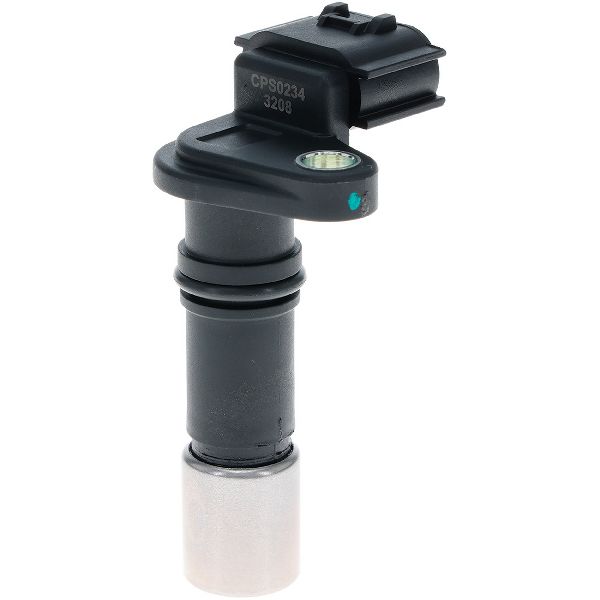
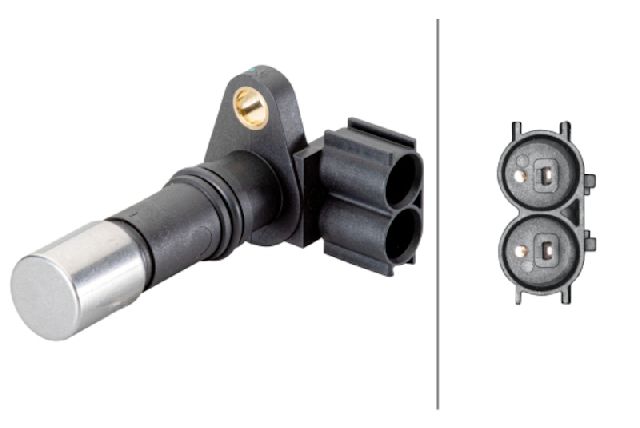
- Crankshaft Position Sensor
(OEM #90919-A5003 (replaces 90919-05057))— This sensor is the most common point of failure for code P0335. It is highly recommended to use a genuine OEM Denso part to avoid premature failure and having to repeat the difficult labor.
Trusted brands: Denso (OEM), NTK/NGK, Hitachi
OEM price range: $100-$150
Aftermarket price range: $20-$80
Related Codes That Often Appear With This One
- C1241 - Low Battery Positive Voltage: This code can appear alongside P0335 if a weak or failing vehicle battery is the underlying cause of the electrical issues.
- P1603, P1604, P1605: As noted in NHTSA ODI #11620473, these engine stall and startability codes can appear concurrently with P0335 during a failure event.
Technical Service Bulletins (TSBs) & Recalls
- TSB Bulletin #L-TT-0007-10: Notes that low battery voltage can contribute to a MIL "ON" condition for P0335 because it causes inconsistent rotational speed of the engine's crankshaft.
- TSB Bulletin #LSB000710: Applies to 1994 and later models, stating that low battery voltage can trigger a P0335 code due to inconsistent crankshaft rotational speed.
- No specific Technical Service Bulletins (TSBs) directly addressing code P0335 for the 2007-2018 Lexus ES350 were found in public databases during the research for this article. Diagnosis relies on standard workshop manual procedures.
Platform-Specific Known Issues
- A documented case on ClubLexus shows that even after replacing the crankshaft sensor with a genuine Toyota part, the P0335 code and sudden stalling can return. In this instance, the car stalled again after 185 miles, indicating a more complex intermittent issue, possibly with the wiring harness or reluctor wheel, that was not solved by the sensor replacement alone.
Mechanic-Grade Diagnostic Values
- Crankshaft Position Sensor Resistance (Cold) — expected: 1,630 - 2,740 Ω. Failure: A reading outside this range, or an open/infinite reading, indicates a failed sensor.
- Crankshaft Position Sensor Resistance (Hot) — expected: 2,065 - 3,225 Ω. Failure: A reading outside this range indicates a failed sensor, especially if the issue only occurs when the engine is warm.
- Scan Tool 'Engine Speed' PID while cranking — expected: Should display a value greater than 0 RPM (typically a few hundred RPM).. Failure: A steady reading of 0 RPM while the engine is physically cranking is a strong indicator of a complete failure in the crankshaft position sensor circuit (sensor, wiring, or ECM).
Scan Tool Commands That Help
- Toyota Techstream: Data List -> Engine Speed — This is the primary live data parameter to monitor when diagnosing a P0335. If it reads 0 RPM during cranking, it confirms the ECM is not receiving a signal.
- Toyota Techstream: Utility -> All Readiness -> P0335 — After a repair, this function can be used to check the DTC judgment result. An 'ABNORMAL' result indicates the fault persists, while 'NORMAL' confirms the fix. 'INCOMPLETE' means the required driving conditions have not been met to re-run the monitor.
Wiring & Ground Locations
- B9 — The electrical connector for the crankshaft position sensor itself, located on the lower front of the engine, behind the A/C compressor.. This is the starting point for any circuit testing (resistance or continuity).
- B12 / E11 — The main Engine Control Module (ECM) connector. The specific identifier may vary by year, but it's the primary computer connection.. This is the termination point for the crankshaft sensor circuit. Continuity must be checked between connector B9 and this connector.
- ECM Pins 110 (NE+) & 111 (NE-) — Within the main ECM connector (B12/E11), these are the specific pins for the crankshaft position sensor signal.. A technician must probe these exact pins to perform a continuity or short-to-ground test on the wiring harness between the sensor and the ECM.
Real Owner Repair Stories
- Reddit user, r/mechanic (2016 Lexus RX350 (2GR-FE family)) — Engine running very poorly, misfiring, surging, and setting multiple timing-related codes including P0335 immediately after a major service.
❌ Tried (didn't work) Initial diagnosis was confusing due to multiple codes.
✅ What actually fixed it The technician discovered that during a rear main seal replacement, the reluctor ring on the flywheel had been slightly bent ('cockeyed') during reassembly. This caused an incorrect signal from the crank sensor. The fix required removing the transmission again to correct the reluctor ring. - NHTSA ODI #11620473 — An owner reported their vehicle had to be towed after a technician found codes P0335, P1603, P1604, and P1605. After bore-scoping the cylinders, the technician found they were unable to turn the motor by hand, indicating a severe mechanical failure coinciding with the sensor code.
When the Usual Fixes Don't Work
- While a failed sensor is the most common cause, it is not the only cause. A recurring P0335 after one or even two OEM sensor replacements strongly points to an intermittent wiring issue (a wire that loses connection when hot or vibrated), a problem with the ECM connector pins, or, in rare cases, a damaged reluctor ring. In these cases, simply replacing the sensor again will not fix the root cause.
OEM Part Supersession History
90919-05057→90919-A5003— Standard part number update/revision by Toyota.
Model Year Variations Within This Range
- 2007-2018: While the engine is consistently a 2GR-FE, the specific ECM connector identifiers may vary (e.g., B12 vs E11). However, the physical location of the crankshaft position sensor on the front of the engine and the diagnostic procedure remain the same for this entire generation range.
Diagnostic Flowchart
Real Owner Stories
Aggregated from forums and TSBs cited above. Mileages and costs reflect what owners reported in those sources.
2007 Lexus ES350 — 150000 miles
Symptoms: Sudden, complete stalling at any time. OBDII code P0335. Disconnecting the battery temporarily resolves the issue.
What fixed it: The owner replaced the sensor with a genuine Toyota part, but the car stalled again after 185 miles. The dealer suspected the reluctor wheel and quoted around $1200 to inspect it.
Source hint: ClubLexus.com - 'Sudden stalling - Crankshaft position sensor code'
2007-2017 Lexus LS
Symptoms: No-start condition with a P0335 code.
What fixed it: Resolved by replacing a weak key fob battery, which prevented the immobilizer system from properly authorizing the start.
Source hint: ClubLexus.com - 'Error Code P0335 and Solution'
2007-2017 Lexus LS
Symptoms: Engine completely shut down while driving on the freeway, but restarted immediately.
What fixed it: Diagnosed as an intermittent electrical fault in the crankshaft position sensor circuit A.
Source hint: ClubLexus.com - 'P0335 crankshaft position sensor circuit A issue'
Related OBD-II Codes
Frequently Asked Questions
Are there any Technical Service Bulletins (TSBs) for the P0335 code on my 2007-2018 Lexus ES350?
My ES350 won't start and has a P0335 code. Could it just be the key fob battery?
I replaced the crankshaft position sensor on my 2GR-FE engine, but the car still stalls and throws P0335. What else could it be?
How do I test the crankshaft position sensor wiring on my ES350?
What should the resistance be on a good 2GR-FE crankshaft position sensor?
Why is the labor cost so high to replace the crankshaft position sensor on the ES350?
We Have This Part in Stock



The information in this article is provided for general reference and educational purposes only. Vehicle specifications, procedures, and part compatibility can vary by production date, trim level, and region. Always consult your vehicle's factory service manual and verify part numbers before purchasing or performing repairs. Safety-critical components such as airbags, seat belts, and braking systems should be installed by a qualified professional.
- Lexus ES350:
- 🛍️ Shop This Part
- What's Unique About the 2007-2018 Lexus ES350
- Symptoms You May Notice
- Most Likely Causes
- Rare But Worth Checking
- Diagnosis Steps
- Parts You'll Likely Need
- Related Codes That Often Appear With This One
- Technical Service Bulletins (TSBs) & Recalls
- Platform-Specific Known Issues
- Mechanic-Grade Diagnostic Values
- Scan Tool Commands That Help
- Wiring & Ground Locations
- Real Owner Repair Stories
- When the Usual Fixes Don't Work
- OEM Part Supersession History
- Model Year Variations Within This Range
- Diagnostic Flowchart
- Real Owner Stories
- 2007 Lexus ES350 — 150000 miles
- 2007-2017 Lexus LS
- 2007-2017 Lexus LS
- Related OBD-II Codes
- Frequently Asked Questions
- 🎟️ Get 5% Off