

OBD-II Code P0336: Crankshaft Position Sensor Performance Problem
What P0336 means, why it triggers, and how to fix it
- Replacing a faulty crankshaft position sensor resolves P0336 in over 70% of cases, typically costing $150 to $350 at a repair shop.
- Stop driving immediately if you experience sudden engine stalling, as P0336 causes the engine to shut off unpredictably in traffic.
- Always perform a 'Crankshaft Variation Relearn' with a bidirectional scan tool after replacing the sensor on GM, Chrysler, and Honda vehicles to prevent the code from returning.
- Install only genuine OEM sensors on Hyundai and Kia vehicles, as aftermarket sensors frequently fail to meet the PCM's strict 5.0-volt reference signal requirements.
What Does P0336 Mean?

P0336 means the Powertrain Control Module (PCM) is receiving an erratic, noisy, or incorrect signal from Crankshaft Position Sensor 'A'. This sensor reports the exact rotational speed and position of the engine's crankshaft. The PCM uses this data to time ignition spark and fuel injector pulses. When the signal pattern deviates from expected parameters or fails to correlate with the camshaft sensor, the PCM triggers P0336.
Technical definition: The official SAE/OBD-II definition is "Crankshaft Position Sensor 'A' Circuit Range/Performance". This indicates the PCM detects the crankshaft position sensor signal is missing pulses, has extra pulses, or performs erratically compared to normal parameters. For example, General Motors vehicles set this code if the PCM detects more than 10 crankshaft resynchronizations within 10 seconds.
Can I Drive With P0336?
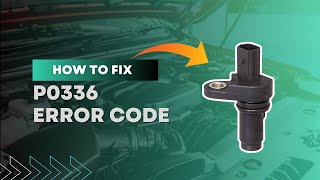
No — Do Not Drive. Do not drive. Sudden engine stalling happens unpredictably at any speed, creating a severe safety hazard in traffic. Driving with the associated misfires dumps unburnt fuel into the exhaust, destroying the catalytic converter and adding $800 to $2,500 in repair costs. 🎬 Watch: A quick overview of P0336 symptoms and fixes. The engine frequently fails to restart when hot, leaving you stranded.
Common Causes

- Faulty Crankshaft Position Sensor (CKP) (Very Common) — The sensor fails internally from heat cycles, vibration, or age, sending a weak, intermittent, or noisy signal to the PCM.
- Wiring or Connector Issues (Common) — The wiring harness degrades from engine heat, or connector pins corrode and loosen, creating high resistance and an unreliable signal.
- Damaged or Dirty Reluctor Wheel (Less Common) — The sensor reads a toothed ring (reluctor wheel) on the crankshaft. Broken teeth, heavy metallic debris, or a loose wheel prevent accurate magnetic readings.
- Mechanical Engine Timing Issues (Less Common) — A stretched timing chain or jumped timing belt alters the physical relationship between the crankshaft and camshafts, causing a signal mismatch that triggers the code.
- Incorrect Sensor Air Gap (Rare) — The distance between the sensor tip and reluctor wheel (typically 0.5mm - 1.5mm) is too large due to improper mounting, missing shims, or aftermarket part variances.
- Electromagnetic Interference (EMI) (Rare) — Faulty spark plug wires, a failing alternator, or improperly routed wiring create electrical noise that corrupts the sensitive sensor signal.
Symptoms

- Check Engine Light is On — The PCM illuminates the Check Engine Light immediately upon detecting the performance problem.
- Engine Stalling — The engine suddenly shuts off, especially when decelerating or at low speeds, posing a major safety risk.
- Hard Start or No Start — The engine requires long cranking times or refuses to start. A classic symptom is a vehicle that won't restart when hot but starts normally after cooling down.
- Erratic Tachometer Behavior — The tachometer needle bounces erratically or drops to zero while the engine is running.
- Reduced Fuel Economy — The PCM enriches the fuel mixture to compensate for uncertain timing, dropping gas mileage by 10-15%.
- Rough Idle and Engine Misfires (also visible on scanner) — Incorrect ignition timing causes a shaky, vibrating idle and noticeable engine stumbling during acceleration.
Diagnostic Flowchart

Tap your situation to follow the diagnostic path that matches what you're seeing on this code.
Common Fixes & Costs
- Replace Crankshaft Position Sensor
— Parts: $40-$100, Labor: $110-$250, ~1.5 hr book time
(DIY)
Chevrolet Silverado 1500 (2014, 5.3L): OEM {'part_number': '12669636', 'price': '$45'} (Alt: {"brand": "ACDelco", "part_number": "12669636", "price": "$40"})
Hyundai Sonata (2017, 2.4L): OEM {'part_number': '39180-2G000', 'price': '$85'} (Alt: {"brand": "Walker Products", "part_number": "235-1121", "price": "$35"}) - Perform Crankshaft Variation Relearn — Parts: $0, Labor: $50-$150, ~0.5 hr book time (Professional)
- Repair Wiring or Replace Connector — Parts: $10-$50, Labor: $50-$200, ~1.0 hr book time (Intermediate)
- Clean Sensor Tip and Reluctor Ring — Parts: $5-$15, Labor: $50-$150, ~0.5 hr book time (DIY)
- Replace Damaged Reluctor Wheel
— Parts: $50-$200, Labor: $800-$2500, ~8.0 hr book time
(Professional)
Ram 1500 (2015, 3.0L EcoDiesel): OEM {'part_number': '68222751AA', 'price': '$125'}
Used vs. New Parts: Buying Guide
When a used part is worth it: Never buy a used crankshaft position sensor. It is a sensitive electronic component with an unknown lifespan. The labor to replace it far outweighs the minimal savings of a used part.
Donor quality checklist:
- Purchase new OEM parts for sensitive makes like Hyundai, Kia, and Nissan.
- If choosing aftermarket, select reputable electronics brands like Bosch, Denso, or NTK.
- Avoid ultra-cheap online sensors; they use weak magnets that provide noisy signals.
Decision logic:
- If Vehicle is a Hyundai or Kia → Buy a new OEM sensor from the dealer. These vehicles reject aftermarket sensors.
- If The sensor requires removing major engine components to access → Buy a new OEM sensor to guarantee you do not have to pay the massive labor cost twice.
- If The sensor is easily accessible and budget is tight → A new, premium aftermarket part (Bosch/Denso) is acceptable.
Warranty tradeoff: Used parts offer 30 days at best. New OEM parts carry a 1-year warranty. Premium aftermarket parts often include limited lifetime warranties.
Worst-case if a used part fails: $300-$500 if a cheap part fails, requiring repeat labor and a second sensor purchase.
What Happens If You Wait — Timeline
- 0-1 month: Check Engine Light illuminates. Occasional hard starting or brief hesitation during acceleration. (MPG impact: 0-5%% · Added cost: $0-$30 in wasted fuel.)
- 1-3 months: Engine stalling at low speeds begins. Noticeable rough idle and consistent drop in fuel economy. (MPG impact: 5-15%% · Added cost: $100-$300 for a tow after stalling.)
- 3-6 months: Constant misfires dump unburnt fuel into the exhaust, overheating the catalytic converter. (MPG impact: 15-25%% · Added cost: $300-$800 in early-stage catalytic converter damage.)
- 6+ months: Catastrophic failure of the catalytic converter. The internal substrate melts, creating a major exhaust blockage. (MPG impact: 25%+% · Added cost: $1500-$3000 for catalytic converter replacement.)
Cost of Not Fixing It
- Immediate: Sudden engine stalling creates a severe safety hazard. The vehicle frequently fails to restart, leaving you stranded. (Added cost: $100-$300 for an emergency tow.)
- 0-1 Month: Fuel economy drops by 10-15% due to inefficient engine timing and the PCM running a rich fuel mixture. (Added cost: $20-$60 per month in wasted fuel.)
- 1-6+ Months: Persistent misfires dump unburnt fuel into the exhaust, melting the catalytic converter's internal substrate. (Added cost: $800-$2500 for catalytic converter replacement.)
Diagnosis Steps

- Scan for Codes & Review Live Data
Use an OBD-II scanner to confirm P0336. Check for related codes like P0340 (Camshaft Sensor). Monitor the engine RPM signal (PID: ENG_RPM) while cranking or running. An RPM signal that drops to zero, freezes, or jumps erratically confirms a performance issue.
Tools: OBD-II Scanner with Live Data (Beginner) - Check for Technical Service Bulletins (TSBs)
Check for TSBs or recalls before replacing parts. For example, Ram EcoDiesels have a W58 recall for tone wheel failures, and GM vehicles have bulletins requiring a crankshaft variation relearn.
Tools: Internet access or repair database (Beginner) - Visually Inspect Wiring and Connector
Locate the crankshaft position sensor. Inspect the wiring harness for melting, chafing, or oil contamination. Unplug the connector and check for bent or corroded pins.
Tools: Flashlight (Beginner) - Perform a Harness 'Wiggle Test'
With the engine running or while monitoring live data, carefully wiggle the wiring harness between the sensor and the PCM. If the engine stumbles or the RPM signal drops out, you have located a break or short in the wiring.
Tools: OBD-II Scanner with Live Data (Intermediate) - Test Sensor Voltage and Ground
With the key on, engine off, and sensor unplugged: Test the 3-wire sensor reference voltage (typically 5.0V). Next, test the ground circuit voltage drop with the engine running by back-probing the ground wire. A reading higher than 100mV (0.1V) indicates excessive resistance.
Tools: Digital Multimeter, Wiring Diagram, Back-probe pins (Advanced) - Test Signal with an Oscilloscope
Connect an oscilloscope to the sensor's signal wire. While running, look for a clean digital square wave or AC sine wave. P0336 is confirmed by missing peaks, random voltage spikes, or low amplitude.
Tools: Oscilloscope, Wiring Diagram (Advanced) - Inspect the Reluctor Wheel
Remove the sensor and use a borescope to look inside the mounting hole. Rotate the engine by hand and look for broken teeth, wobble, or heavy metallic debris on the wheel.
Tools: Borescope, Socket/wrench to turn crankshaft (Advanced) - Perform Crankshaft Position Sensor Relearn
After replacing the sensor on GM, Chrysler, and Honda vehicles, perform a 'variation learn' procedure with a bidirectional scan tool to calibrate the PCM. Skipping this causes the code to return.
Tools: Bidirectional Scan Tool (Advanced)
When This Code Triggers (Freeze-Frame Conditions)
- Engine Coolant Temp: 175-210°F (Engine is fully warmed up, exposing heat-sensitive internal sensor failures.)
- RPM: 1500-3000 RPM (During steady throttle or light acceleration, when the PCM expects a clean, predictable signal pattern.)
- Engine Load: 25-60% (The engine is under moderate load, exposing signal integrity issues not present at idle.)
- Vehicle Speed: 30-60 mph (Occurs during city or highway driving rather than at a standstill.)
Related Codes
- P0335 — Indicates a complete loss of signal (Circuit Malfunction), resulting in a crank-no-start. P0336 means the signal is present but erratic.
- P0339 — Indicates the signal drops out completely and returns (Intermittent). Strongly points to a loose connection or a heat-sensitive sensor.
- P0340 — Camshaft Position Sensor code. If present with P0336, the PCM sees a timing mismatch, indicating a stretched timing chain or jumped belt.
- P1336 — GM-specific code meaning 'Crankshaft Position System Variation Not Learned'. Sets when a sensor is replaced but the relearn procedure is skipped.
Climate & Environmental Factors
- High Engine Temperature: Aging sensor electronics break down under heat. The sensor works perfectly when cold but fails at operating temperature, causing stalling and a no-start condition until the engine cools.
- Extreme Cold: Plastic wiring insulation becomes brittle. Engine vibration cracks the insulation, leading to shorts or open circuits.
- Oil and Fluid Leaks: Oil leaking from valve covers seeps into the sensor connector, degrading the electrical connection and corrupting the signal.
How to Talk to a Mechanic About This Code
Say this: "I have a P0336 code with intermittent stalling. Please test the crank sensor signal, inspect the wiring harness, and let me know if my vehicle requires a crankshaft variation relearn procedure."
This proves you understand the common causes and specific software requirements, steering the mechanic toward a complete diagnosis rather than a blind parts swap.
Avoid saying:
- 'Just fix whatever's wrong'
- 'My check engine light is on, can you look at it?'
- 'Just throw a new sensor in it'
Questions to ask before authorizing the repair:
- Did you test the sensor's signal with an oscilloscope?
- Did you perform a wiggle test on the wiring harness?
- Are you installing an OEM sensor or aftermarket?
- Does this quote include the crankshaft variation relearn procedure?
Where to Take It: Dealer vs Independent vs Chain
- Dealer:
Recommended only if your vehicle has a known complex issue (like the Ram tone wheel) or is under warranty.
Best for: Vehicles under powertrain warranty, Known manufacturer defects like the Ram EcoDiesel tone wheel, Complex diagnostics involving PCM software updates
Downsides: Highest labor rates, Defaults to expensive part assemblies (Typical cost: +50% vs. baseline) - Independent Shop:
Best overall fit. A qualified independent shop provides the best balance of expertise and value for sensor and wiring repairs.
Best for: Standard sensor replacement, Wiring diagnostics and repair, Out-of-warranty vehicles
Downsides: May lack the specific bidirectional tool for a mandatory relearn procedure on niche makes (Typical cost: +0% vs. baseline) - Chain Shop:
Avoid for any complex diagnosis involving wiring, reluctor wheels, or relearn procedures.
Best for: Simple, easily accessible sensor replacements
Downsides: Technician skill varies dramatically, Incapable of diagnosing intermittent wiring faults or performing relearn procedures (Typical cost: -10% vs. baseline)
When to Walk Away From the Repair
If the estimated repair cost exceeds 50% of the car's private-party value, consider selling the vehicle instead of repairing it.
- Car worth $4000, fix is $300: Fix it. This is a standard sensor replacement cost.
- Car worth $8000, fix is $2500: Borderline. This repair involves major engine disassembly for a reluctor wheel. Get a second opinion.
- Car worth $3000, fix is $2200: Walk away. The repair cost is over 70% of the car's value.
What Scan Tool You Need for This Code
Minimum: A code reader that displays live data, specifically the engine RPM PID.
A basic $20 reader cannot display the live RPM signal, which is essential for spotting signal dropouts. It also cannot perform a crankshaft variation relearn.
Budget: BlueDriver Pro Scan Tool (~$100) — Connects via Bluetooth to graph the live engine RPM signal, allowing you to watch for dropouts or glitches.
Mid-range: Innova 5610 (~$350) — A handheld scanner with bidirectional controls capable of performing the mandatory crankshaft variation relearn procedure.
Professional: Autel MaxiCOM MK808S (~$450) — A full-featured diagnostic tablet that performs relearn procedures on all makes and provides OEM-level active tests.
Rent vs buy: Buy a midrange scanner if you own a GM vehicle and plan to replace the sensor yourself, as the relearn procedure is mandatory.
How to Clear the Code After You Fix It
- Use an OBD-II scan tool to clear the P0336 code.
- Ensure the fuel tank is between 30% and 70% full.
- Perform a complete OBD-II drive cycle to run the system's readiness monitors.
Drive cycle (~30 minutes): Cold start the engine and idle for 3 minutes with the A/C on. Drive in city traffic with several slow stops. Accelerate to 55-60 mph and maintain steady speed for 5 minutes. Coast down to 20 mph without braking.
Readiness monitors affected: Misfire Monitor, Fuel System Monitor, Catalyst Monitor
Watch out for:
- Clearing the code resets all readiness monitors to 'Not Ready', causing an automatic emissions test failure.
- The code returns immediately if a required relearn procedure was skipped.
- Disconnecting the battery clears the code but resets learned memory in all modules, causing rough shifting or idle issues.
Will This Fail Emissions / State Inspection?
Yes — this code typically fails an OBD-II emissions inspection.
- California: An active P0336 code results in an automatic smog check failure. A complete drive cycle must be performed after repair to set readiness monitors.
- New York: The NYS DMV inspection includes an OBD-II scan. The illuminated Check Engine Light guarantees failure.
- Texas: In emissions-testing counties, an active P0336 fails the vehicle. Monitors must be reset via a drive cycle before retesting.
Most Commonly Affected Vehicles
- Ram / Jeep 1500 / Grand Cherokee (3.0L EcoDiesel) (2014-2018) — P0336 strongly indicates a delaminating crankshaft tone wheel. Recall W58 updates software to prevent stalling, but the physical wheel often requires expensive replacement.
- Chevrolet / GMC Silverado, Tahoe, Equinox (2005-2016) — Requires a mandatory 'Crankshaft Variation Relearn' procedure with a scan tool after replacing the sensor. Skipping this sets code P1336 or returns P0336.
- Hyundai / Kia Sonata, Optima, Sorento (2011-2023) — Highly sensitive to aftermarket sensors. Using an OEM sensor is mandatory to prevent the code from returning immediately.
- Nissan Altima, Maxima (2004-2017) — Sensor failure is common. On V6 models, the sensor is located in a tight spot on the transmission bell housing, increasing labor time.
- Subaru Forester, Outback (2005-2015) — The sensor is conveniently located on the top front of the engine block, making DIY replacement exceptionally easy.
- Honda Accord, Civic (2001-2013) — Code frequently appears after a timing belt change if the sensor air gap is incorrect or the connector wasn't fully seated.
Manufacturer-Specific Notes
- General Motors: Requires a 'Crankshaft Variation Relearn' (CASE learn) using a bidirectional scan tool after sensor replacement. Failure to do this returns P0336 or sets P1336.
- Ram / Jeep (EcoDiesel): P0336 is the primary warning sign of a failing magnetic tone wheel on the crankshaft, a known defect covered under extended warranties.
- Hyundai / Kia: PCMs reject aftermarket crankshaft sensors due to strict voltage reference requirements. OEM dealer parts are mandatory for a lasting repair.
Real Owner Stories
2010 Kia Rondo with intermittent stalling
The engine cut out frequently during hard acceleration. The check engine light flashed briefly but didn't stay on until the stalling worsened.
What they tried:
- Scanned the code, revealing P0336.
Outcome: The owner replaced the sensor with an OEM Kia part, resolving the stalling completely.
Lesson: Intermittent issues may not store a permanent code immediately. Scan the vehicle as soon as the light stays on, and always use OEM sensors for Kia/Hyundai.
1996 Chevrolet LT4 with persistent P0336 after repair
Immediately after a water pump replacement, the car threw a P0336 code. A shop replaced the crank sensor, but the code returned.
What they tried:
- Replaced the sensor a second time.
- Considered replacing the ECM.
Outcome: The owner found coolant had dripped into the upward-facing sensor connector during the water pump job. Cleaning and drying the connector fixed the issue.
Lesson: If a code appears immediately after unrelated engine work, inspect the connectors for fluid contamination or physical damage.
LS1-swapped car with P0336 after engine build
A newly built engine cranked but wouldn't start, immediately setting P0336.
What they tried:
- Verified spark and injector pulse.
- Checked sensor wiring for power and ground.
Outcome: The root cause was a bent reluctor wheel on the new crankshaft, likely damaged during shipping. The sensor and wiring were perfectly fine.
Lesson: On new engine builds, P0336 points directly to mechanical damage or improper installation of the reluctor wheel.
How to Prevent This Code From Triggering
- Fix engine oil leaks promptly (As soon as detected) — Oil leaking from valve covers seeps into the sensor connector, degrading the connection and causing signal errors.
- Inspect and secure wiring harnesses (During every oil change) — Securing the harness away from hot exhaust manifolds prevents melting and chafing that lead to electrical shorts.
- Clean engine grounds (Every 30,000 miles) — Corrosion on ground straps adds resistance to the circuit, corrupting the sensor's low-voltage signal.
Frequently Asked Questions
I replaced the crank sensor and the P0336 code came back. What did I miss?
You likely skipped the mandatory 'crankshaft variation relearn' procedure required by your vehicle's computer. Alternatively, if you drive a Hyundai or Kia, the computer is rejecting the aftermarket sensor. Finally, the issue may be a damaged wiring harness rather than the sensor itself.
What is the difference between P0335 and P0336?
P0335 means the crankshaft signal is completely dead, resulting in an engine that cranks but won't start. P0336 means the signal is present but erratic or noisy. The engine runs with P0336, but it stalls unpredictably and misfires.
Should I use an OEM or Aftermarket crankshaft sensor?
Always use an OEM sensor for Hyundai, Kia, and Nissan vehicles to prevent immediate part rejection. For other makes, premium aftermarket brands like Bosch or Denso are acceptable. Avoid cheap online sensors, as they use weak magnets that trigger performance codes.
Can a bad ground cause a P0336 code?
Yes. A poor ground connection creates high resistance, altering the sensor's signal voltage. The PCM interprets this voltage drop as an erratic signal and triggers P0336.
How much does it cost to fix code P0336?
Replacing the sensor costs between $150 and $350 at a repair shop. If the issue is a damaged reluctor wheel inside the engine, costs escalate to $1,500-$2,500.
Can a bad battery cause a P0336 code?
Yes. A weak battery causes low system voltage during cranking. This voltage drop starves the sensor, causing it to send an erratic signal that triggers the code.
Will my car pass an emissions test with a P0336 code?
No. The active Check Engine Light results in an automatic emissions test failure.
Key Takeaways
- Replacing a faulty crankshaft position sensor resolves P0336 in over 70% of cases, typically costing $150 to $350 at a repair shop.
- Stop driving immediately if you experience sudden engine stalling, as P0336 causes the engine to shut off unpredictably in traffic.
- Always perform a 'Crankshaft Variation Relearn' with a bidirectional scan tool after replacing the sensor on GM, Chrysler, and Honda vehicles to prevent the code from returning.
- Install only genuine OEM sensors on Hyundai and Kia vehicles, as aftermarket sensors frequently fail to meet the PCM's strict 5.0-volt reference signal requirements.
Helpful Videos

The information in this article is provided for general reference and educational purposes only. Vehicle specifications, procedures, and part compatibility can vary by production date, trim level, and region. Always consult your vehicle's factory service manual and verify part numbers before purchasing or performing repairs. Safety-critical components such as airbags, seat belts, and braking systems should be installed by a qualified professional.
- 🎬 Helpful Videos
- What Does P0336 Mean?
- Can I Drive With P0336?
- Common Causes
- Symptoms
- Diagnostic Flowchart
- Common Fixes & Costs
- Used vs. New Parts: Buying Guide
- What Happens If You Wait — Timeline
- Cost of Not Fixing It
- Diagnosis Steps
- When This Code Triggers (Freeze-Frame Conditions)
- Related Codes
- Climate & Environmental Factors
- How to Talk to a Mechanic About This Code
- Where to Take It: Dealer vs Independent vs Chain
- When to Walk Away From the Repair
- What Scan Tool You Need for This Code
- How to Clear the Code After You Fix It
- Will This Fail Emissions / State Inspection?
- Most Commonly Affected Vehicles
- Manufacturer-Specific Notes
- Real Owner Stories
- 2010 Kia Rondo with intermittent stalling
- 1996 Chevrolet LT4 with persistent P0336 after repair
- LS1-swapped car with P0336 after engine build
- How to Prevent This Code From Triggering
- Frequently Asked Questions
- I replaced the crank sensor and the P0336 code came back. What did I miss?
- What is the difference between P0335 and P0336?
- Should I use an OEM or Aftermarket crankshaft sensor?
- Can a bad ground cause a P0336 code?
- How much does it cost to fix code P0336?
- Can a bad battery cause a P0336 code?
- Will my car pass an emissions test with a P0336 code?
- Key Takeaways
- 🎟️ Get 5% Off