

P0335 on 2012-2017 Kia Rio 1.6L: Crankshaft Sensor Failure Causes and Fixes
On a 2012-2017 Kia Rio with the 1.6L engine, code P0335 is almost always caused by a failed crankshaft position sensor. This is a very common failure point that leads to stalling or a no-start condition, often happening when the engine is hot. Expect to pay $25-$80 for an aftermarket sensor or $70-$120 for an OEM part; it's a relatively easy DIY fix.
- P0335 on a 2012-2017 Kia Rio almost always points to a bad crankshaft position sensor.
- Key symptoms are sudden engine stalling (especially when hot), a crank-no-start condition, and an extended cranking time.
- Do not continue to drive the vehicle, as the engine can shut off at any moment, creating a serious safety risk.
- Replacing the sensor is a straightforward and common DIY repair that requires basic tools and access from underneath the car, near the oil filter.
- Always inspect the wiring and connector for damage before assuming the sensor is the only problem, and consider using an OEM part for best results.
What's Unique About the 2012-2017 Kia Rio

The 1.6L Gamma GDI engine in the Kia Rio, like many other Hyundai/Kia engines of this era, is known for frequent crankshaft position sensor failures. The sensor's location on the engine block, near the transmission bellhousing and below the exhaust manifold, exposes it to significant heat and vibration, causing the internal electronics to fail over time. This results in intermittent stalling that can occur without warning, often when the engine is hot, and can eventually lead to a crank-no-start condition.
Symptoms You May Notice
- Engine stalls unexpectedly, especially when coming to a stop or at idle after the engine has warmed up.
- Engine cranks but will not start (crank-no-start).
- Extended cranking time required to start the engine.
- Check Engine Light is on.
- Tachometer (RPM gauge) drops to zero or behaves erratically while the engine is stalling or cranking.
- Rough running or engine hesitation.
- Car enters 'limp mode' with reduced power and acceleration.
- Replacing the camshaft position sensor. A cam sensor fault will typically set a different code, like P0340.
- Replacing the fuel pump. A no-start or stalling condition can mimic fuel delivery issues, but P0335 points specifically to the crank sensor circuit.
Most Likely Causes

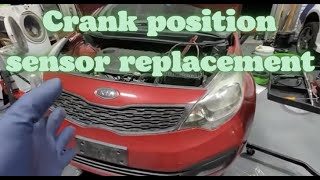
- Failed Crankshaft Position Sensor 🔴 High Probability The sensor is a known high-failure part on Hyundai/Kia GDI engines 🎬 Watch: How to swap the sensor on a 1.6L engine due to its location, which exposes it to constant heat cycles and vibration, leading to internal failure. Many owners report failure after the vehicle is fully warmed up.
How to confirm: Scan for code P0335. Test the sensor's signal with an oscilloscope; a complete lack of signal or an erratic, dropping signal during cranking or running confirms failure. Due to the high failure rate and low cost of the part, many owners and mechanics opt for replacement as the primary diagnostic step after checking wiring. A multimeter can be used to check the sensor's internal resistance; the OEM part (39180-2B000) should measure approximately 900 Ω.
Typical fix: Replace the crankshaft position sensor. It is held in by a single 10mm bolt and is accessible from underneath the vehicle, near the oil filter and where the engine meets the transmission.
Est. part cost: $25-$120 - Damaged Wiring or Connector 🟡 Medium Probability The wiring harness runs near hot engine and exhaust components, making it susceptible to melting, chafing, or corrosion at the connector. The connector itself can become brittle from heat.
How to confirm: Visually inspect the wiring harness from the sensor to the main engine loom for any signs of melting, breaks, or frayed wires. Check the connector pins for corrosion, moisture, or damage. Wiggle the connector while the engine is running (if possible) to see if it induces a stall. Check for correct voltage at the ECM connector pins; the CKP signal is at pin 56 and sensor ground is at pin 63.
Typical fix: Repair the damaged section of wiring or replace the connector pigtail.
Est. part cost: $10-$30
Rare But Worth Checking
- Damaged Reluctor Ring: The reluctor ring (or tone wheel) is what the sensor reads. If it's damaged, bent, or has debris on it, the signal will be disrupted. This is rare but can happen if other engine work was performed or if there is excessive crankshaft play.
- Faulty Powertrain Control Module (PCM): This is extremely rare. The PCM should only be considered after all other possibilities, including the sensor and wiring, have been thoroughly ruled out by a professional.
Diagnosis Steps

- Scan the vehicle's computer for trouble codes to confirm P0335 is present. Note any other codes that may be stored.
- Visually inspect the crankshaft position sensor's wiring harness and connector. Look for any signs of melting, chafing, corrosion, or loose pins.
- Mechanic's Check: Test the sensor's internal resistance using a multimeter. Disconnect the sensor and measure between its two pins. A reading near 900 Ohms indicates a likely good sensor for the standard part (39180-2B000). An open circuit (infinite resistance) or a reading far from spec confirms failure.
- If the wiring appears okay and the sensor tests bad or is inconclusive, the most common and cost-effective next step is to replace the crankshaft position sensor due to its extremely high failure rate on this platform.
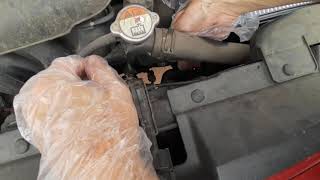
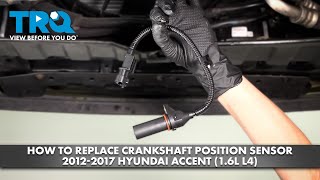
- The sensor is located on the front of the engine block, near the transmission bellhousing and just above the oil filter. It is held in by a single 10mm bolt and is best accessed from underneath the car. 🎬 See this step-by-step guide to replacing the sensor
- After replacing the sensor, clear the trouble codes with a scan tool. No special relearn procedure is required.
- Start the engine and perform a test drive. The engine should start more quickly and run smoothly. Re-scan for codes to ensure the fix was successful.
- Pro-Tip: Many owners in forums recommend using an OEM or OE-supplier (like Mando) sensor, as some aftermarket sensors have been reported to fail quickly or be dead-on-arrival. Also, apply a thin coat of clean engine oil to the new sensor's O-ring before installation to ensure a proper seal and prevent damage.
Parts You'll Likely Need
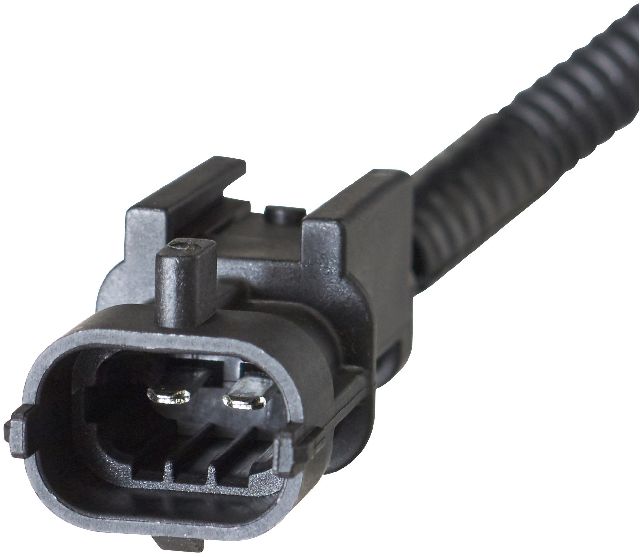
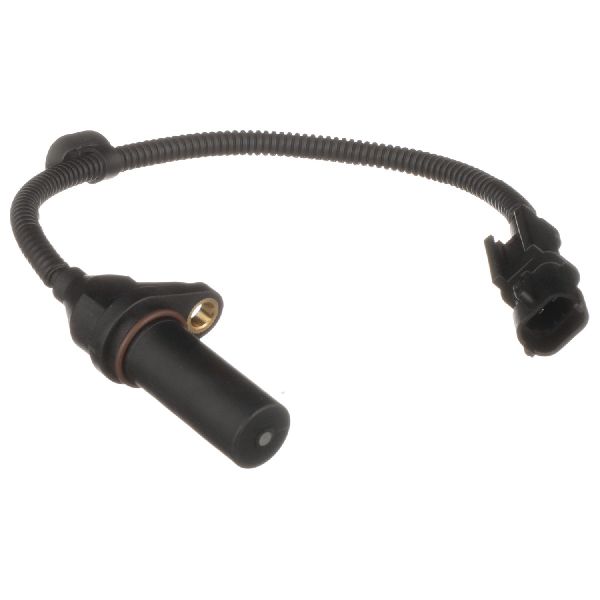
- Crankshaft Position Sensor
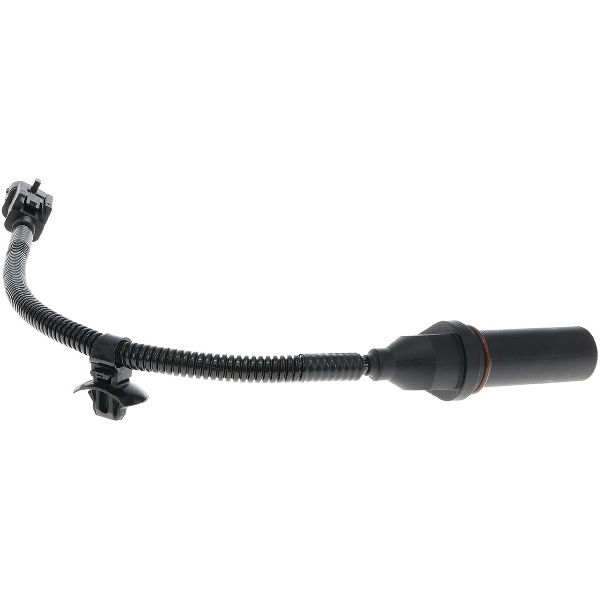
(OEM #39180-2B000)— This is the primary failure point for code P0335 on the 1.6L Gamma engine due to heat and vibration causing internal failure.
Trusted brands: Hyundai/Kia (OEM), Mando (OE Supplier), NGK/NTK, Delphi, Walker Products
OEM price range: $70-$120
Aftermarket price range: $25-$80
Related Codes That Often Appear With This One
- P0336 — This code indicates a 'Crankshaft Position Sensor 'A' Circuit Range/Performance' issue, meaning the signal is erratic but not completely gone. It often appears as the sensor is beginning to fail, before it fails completely and triggers P0335.
- P0016 / P0017 — These codes indicate a 'Crankshaft/Camshaft Position Correlation' error. If the PCM loses the crankshaft signal (P0335), it cannot verify the timing relationship with the camshafts, which can trigger these codes as a secondary fault.
Platform-Specific Known Issues
- Intermittent stalling, particularly when the engine is hot or coming to a stop, is a hallmark symptom of a failing crankshaft position sensor on these vehicles, often occurring long before the sensor fails completely and sets a code.
- Some owners report that after replacing the sensor, the car still won't start. This can be due to using a faulty aftermarket sensor or not properly clearing the codes from the PCM. In rare cases, the wiring harness connector may have been damaged during the replacement.
Mechanic-Grade Diagnostic Values
- Crankshaft Position Sensor (CKP) Internal Resistance — expected: Approx. 900 Ω (for OEM part 39180-2B000). Failure: An open circuit (OL or infinite resistance) or a value significantly different from 900 Ω.
- Crankshaft Position Sensor (CKP) Internal Resistance (for Start-Stop models) — expected: Approx. 1035 Ω (for OEM part 39180-2B100). Failure: Using this part on a non-start-stop vehicle may cause issues, even if it fits physically.
- CKP Sensor Circuit Bias Voltage — expected: 1.0V to 2.0V. Failure: Voltage outside this range with the key on and engine off can indicate a wiring fault or PCM issue.
Wiring & Ground Locations

- ECM Pin 56 — At the main Engine Control Module (ECM/PCM) connector.. This is the CKP sensor signal input pin. A technician can back-probe this pin to verify with an oscilloscope if the signal from the sensor is reaching the computer, which helps isolate a wiring break from a failed sensor.
- ECM Pin 63 — At the main Engine Control Module (ECM/PCM) connector.. This is the sensor ground pin for the CKP sensor. Verifying continuity to ground from this pin can rule out a bad ground path, which would cause the sensor to read incorrectly.
Real Owner Repair Stories
- Reddit user on r/MechanicAdvice (2012 Kia Rio) — P0335 code present.
❌ Tried (didn't work) The owner replaced the crankshaft position sensor with the battery still connected.
✅ What actually fixed it The car would not start after the replacement. While the final fix isn't posted, the story serves as a critical cautionary tale that an improper procedure or a dead-on-arrival aftermarket part can lead to a worse condition (no-start vs. stalling). - Techn' Moto YouTube Channel (2010 Kia Rio (similar platform)) — Vehicle would stall intermittently over a two-month period with no check engine light or stored codes.
❌ Tried (didn't work) Initial diagnosis was difficult as no codes were present.
✅ What actually fixed it Based on research into common stalling issues for this platform, the owner proactively replaced the crankshaft position sensor with an OEM part. This completely resolved the stalling issue, confirming the sensor can fail intermittently long before it fails completely and sets a P0335 code. - NHTSA ODI #11183623 (Kia Sorento - Cross-Manufacturer Reference) — An owner reported that the vehicle had trouble starting and the tachometer would fall to zero as the engine operated, with an OBD reader confirming code P0335.
When the Usual Fixes Don't Work
- While replacing the crankshaft position sensor is the most common fix, it is not a silver bullet. A 2012 Kia Rio owner on Reddit reported a P0335 code, replaced the sensor, and the vehicle subsequently would not start at all. This highlights the possibility of receiving a defective aftermarket part (dead-on-arrival) or an installation error causing the new problem. It underscores the importance of using high-quality parts and verifying all connections before assuming the initial diagnosis was wrong.
- In some cases, the issue may persist even after sensor replacement. NHTSA ODI #11459982 describes a situation where, after replacing the crankshaft sensor due to code P0335, the car continued to stall and struggle to start up.
OEM Part Supersession History
39180-2B000→N/A, but has a variant: 39180-2B100— Part variant for different vehicle options.
Heads up: Part number 39180-2B000 is for models WITHOUT a start-stop system and has a resistance of ~900 Ohms and a 280mm cable. Part 39180-2B100 is for models WITH a start-stop system, has a resistance of ~1035 Ohms and a 350mm cable. While they may physically interchange, using the wrong sensor can cause performance issues due to the different electrical characteristics. Always use the part number specified for the vehicle's VIN.
Model Year Variations Within This Range
- 2012-2017: The 1.6L Gamma GDI engine and its core components, including the crankshaft position sensor system, remained consistent throughout this generation. No significant variations affecting P0335 diagnosis are noted.
Diagnostic Flowchart
Other Known Issues on This Vehicle
Issues unrelated to this code that are worth knowing about as an owner of this generation:
- Excessive Oil Consumption 🔴 High — Widespread issue, often starting around 60,000-100,000 miles. Can consume over 1 quart per 1,000 miles. (Ref: No specific recall, but related to engine defect class-action lawsuits.)
- Engine Knocking and Premature Failure 🔴 High — Common in 2012-2014 models, often around 100,000 miles. Caused by connecting rod bearing failure or carbon buildup on piston rings. (Ref: Part of a major class-action lawsuit settlement for Hyundai/Kia engines (Theta II, Nu, Gamma).)
- Hydraulic Electronic Control Unit (HECU) Fire Risk 🔴 High — Affects all 2012-2017 Kia Rio models. An electrical short can occur in the HECU, potentially causing a fire while parked or driving. (Ref: NHTSA Recall 23V-177 / Kia Recall SC266.)
- Failing High-Pressure Fuel Pump (HPFP) 🟠 Medium — A known weak point on the 1.6L GDI engine, can lead to hesitation, power loss, and codes like P0191 or P0087.
Used vs. New Parts: Buying Guide for This Vehicle
When a used part is the smart pick: For this specific repair, a used part is NOT recommended. The crankshaft position sensor is a known high-failure item due to its location and exposure to heat cycles. A used sensor from a junkyard has an unknown history and is likely to have a very short remaining service life, making the labor of installing it a poor investment.
What to inspect on the donor part:
- Not applicable as used parts are not recommended.
OEM-only on this vehicle (don't cheap out):
- Crankshaft Position Sensor: While not strictly 'OEM-only', using a genuine Hyundai/Kia part or one from the Original Equipment (OE) supplier (Mando) is very strongly recommended by mechanics and experienced owners to avoid premature failure or dead-on-arrival parts.
Aftermarket brands forum-validated for this vehicle:
- Mando (OE Supplier)
- NGK/NTK
- Delphi
Brands owners have reported issues with on this vehicle:
- Unbranded, low-cost sensors from online marketplaces are frequently reported as being defective out of the box or failing within a few months. Be wary of counterfeit parts. Genuine parts have distinct packaging, printing quality, and wire lengths; fakes often have poor quality printing, spelling errors on the packaging, and incorrect wire lengths.
Real Owner Stories
Aggregated from forums and TSBs cited above. Mileages and costs reflect what owners reported in those sources.
2012 Kia Rio 1.6L
Symptoms: The owner replaced the sensor for a P0335 code, but the car then refused to start entirely.
What fixed it: The source emphasizes the importance of troubleshooting steps beyond just part replacement, such as checking for damaged wiring connectors or faulty aftermarket parts.
Source hint: Reddit r/MechanicAdvice: 'Crankshaft position sensor replaced'
2016 Kia Rio 1.6L
Symptoms: Owner experienced a no-start condition and weird noises after replacing the sensor for P0335.
What fixed it: The report highlights potential pitfalls with aftermarket parts or installation issues.
Source hint: Reddit r/MechanicAdvice: 'Engine making weird noises after replaceing crankshaft position sensor'
Kia Rio 1.6L GDI
Symptoms: Stalling, erratic tachometer (RPM gauge), and a weak or rough start.
What fixed it: Replacement of the crankshaft position sensor after confirming the P0335 code.
Source hint: Reddit r/MechanicAdvice: 'Kia rio crankshaft position sensor help'
Related OBD-II Codes
Frequently Asked Questions
Where is the crankshaft position sensor located on the 2012-2017 Kia Rio 1.6L?
Is there a specific part number I should use for the replacement sensor?
My 2012 Rio is stalling when I come to a stop but hasn't thrown a code yet. Could it still be the crank sensor?
Does my Kia Rio require a special relearn procedure after replacing the sensor?
Are there any recalls for the 2012-2017 Kia Rio that I should be aware of while fixing this?
What should the resistance reading be for a healthy Kia Rio crank sensor?
Helpful Videos
We Have This Part in Stock


The information in this article is provided for general reference and educational purposes only. Vehicle specifications, procedures, and part compatibility can vary by production date, trim level, and region. Always consult your vehicle's factory service manual and verify part numbers before purchasing or performing repairs. Safety-critical components such as airbags, seat belts, and braking systems should be installed by a qualified professional.
- Kia Rio:
- 🎬 Helpful Videos
- 🛍️ Shop This Part
- What's Unique About the 2012-2017 Kia Rio
- Symptoms You May Notice
- Most Likely Causes
- Rare But Worth Checking
- Diagnosis Steps
- Parts You'll Likely Need
- Related Codes That Often Appear With This One
- Platform-Specific Known Issues
- Mechanic-Grade Diagnostic Values
- Wiring & Ground Locations
- Real Owner Repair Stories
- When the Usual Fixes Don't Work
- OEM Part Supersession History
- Model Year Variations Within This Range
- Diagnostic Flowchart
- Other Known Issues on This Vehicle
- Used vs. New Parts: Buying Guide for This Vehicle
- Real Owner Stories
- 2012 Kia Rio 1.6L
- 2016 Kia Rio 1.6L
- Kia Rio 1.6L GDI
- Related OBD-II Codes
- Frequently Asked Questions
- 🎟️ Get 5% Off