

P0322 on 2004-2011 Chevrolet Aveo: Crank Sensor Failure Causes and Fixes
This code almost always means the crankshaft position sensor has failed. The engine will likely crank but not start, or stall while driving. Expect to pay $20-$60 for a new sensor and plan for a moderately difficult DIY replacement due to its location, which is often behind the starter motor. A 'Crankshaft Variation Relearn' procedure with a professional scan tool is required after replacement to avoid future issues.
- P0322 on a Chevy Aveo means the crankshaft position sensor or its circuit has failed.
- The most common symptom is the engine cranking but failing to start, with the tachometer showing 0 RPM.
- Do not drive the vehicle, as it can stall at any time, creating a dangerous situation.
- The most likely fix is replacing the crankshaft position sensor, but first confirm its location on your specific vehicle.
- After replacement, a 'Crankshaft Variation Relearn' procedure must be performed with a professional scan tool to prevent other codes and running issues.
What's Unique About the 2004-2011 Chevrolet Aveo
On the 1.6L E-TEC II engine in the Aveo, the P0322 code is a straightforward but critical issue. The primary point of confusion for this platform is the physical location of the crankshaft position sensor, which can vary. Some early models may have it on the front of the engine block below the oil filter, a location shown in several popular but potentially misleading repair videos. However, most 1.6L E-TEC II engines, particularly in later years, have it buried on the back of the engine behind the starter motor, making replacement significantly more difficult. It is crucial to visually confirm the location before starting the repair. Additionally, after replacing the sensor, this vehicle requires a 'Crankshaft Variation Relearn' procedure using a bidirectional scan tool to ensure the PCM accurately reads the new sensor's signal and to prevent misfire codes like P0300.
Generation note: This range covers the first generation (T200, 2004-2006) and the second generation (T250, 2007-2011) of the Aveo. While the engine remained the 1.6L E-TEC II, the location of the crankshaft position sensor may differ. It is crucial to visually confirm the sensor's location on your specific vehicle before purchasing parts or beginning repairs. Early models are more likely to have the front-mounted sensor below the oil filter, while later models commonly have it behind the starter. All model years within this range require a scan tool relearn procedure after sensor replacement.
Symptoms You May Notice
- Engine cranks but will not start
- Engine stalls intermittently while driving, often without warning
- Rough idling or engine hesitation
- Check Engine Light is on
- Tachometer may not work or shows 0 RPM during cranking
- Jerky acceleration or loss of power before stalling
- Replacing the camshaft position sensor (While it can cause similar issues, P0322 specifically points to a loss of the primary engine speed signal, which is the crankshaft sensor.)
- Replacing ignition coils or spark plugs (These would typically be accompanied by misfire codes like P0300-P0304, though misfires can be a symptom of an intermittent CKP failure).
- Faulty Fuel Pump (A no-start can be blamed on fuel, but a quick check of the RPM gauge during cranking can point to the CKP sensor instead.)
Most Likely Causes
- Failed Crankshaft Position Sensor (CKP) 🔴 High Probability The sensor is a common failure point due to age and constant exposure to high heat cycles from the engine and exhaust. Oil leaks from other common failure points (like the valve cover gasket) can also saturate and damage the sensor.
How to confirm: Use a scan tool to monitor engine RPM (PID: RPM) while cranking. If it reads 0 or is erratic, the CKP sensor or its circuit is not sending a signal. You can also test the sensor's signal output with an oscilloscope for a definitive diagnosis; a healthy sensor should produce a clean square wave while the engine is cranked.
Typical fix: Replace the crankshaft position sensor. Given the labor involved if it's behind the starter, using a high-quality OEM or reputable aftermarket part (e.g., ACDelco, Delphi) is strongly recommended to avoid repeat failures. A 'Crankshaft Variation Relearn' procedure must be performed with a compatible scan tool after replacement.
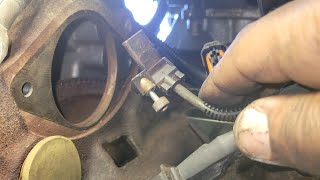
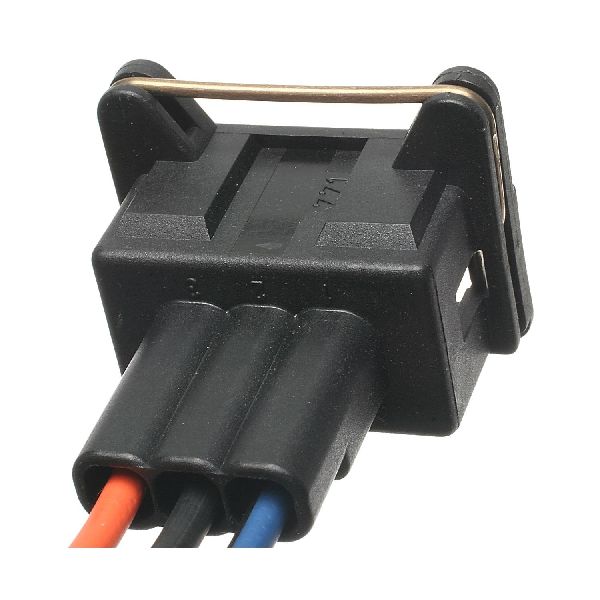
Est. part cost: $20-$60 - Damaged Wiring or Connector 🟡 Medium Probability The wiring harness to the sensor runs close to hot engine and exhaust components, making it susceptible to becoming brittle, melted, or frayed. A common chafe point is where the harness can touch the hot EGR valve. The connector itself can also suffer from corrosion or broken locking tabs.
How to confirm: Visually inspect the entire length of the wiring from the sensor to the main harness. Check for frayed wires, melted insulation, or loose connections, paying close attention to the area near the EGR valve. Wiggle the connector and harness (with the engine off) while checking for continuity with a multimeter. Check for reference voltage (typically 5V) and ground at the connector with the key on.
Typical fix: Repair the damaged section of wire or replace the connector pigtail. Use heat-shrink butt connectors for a durable, moisture-resistant repair.
Est. part cost: $10-$30
Rare But Worth Checking
- Skipped Timing Belt: While this would typically set other codes like P0016, a severely out-of-time engine may fail to start and could potentially cause a P0322 if the crank and cam signals are so out of sync that the PCM rejects the crank signal. This is a critical issue on this interference engine, often caused by a failed plastic idler or tensioner pulley.
- Faulty Powertrain Control Module (PCM): This is extremely rare. The PCM should only be considered after all other possibilities, including the sensor and its entire circuit, have been thoroughly tested and ruled out. A short in the CKP sensor wiring (e.g., melting on the EGR valve) can potentially damage the PCM's internal driver circuit.
Diagnosis Steps
- Connect an OBD-II scanner and confirm the P0322 code is present. Check for any other codes, especially P1336.
- Monitor the live data on the scanner. Watch the 'Engine RPM' PID while cranking the engine. If it stays at 0, the PCM is not seeing a signal from the CKP sensor.
- Disconnect the battery.
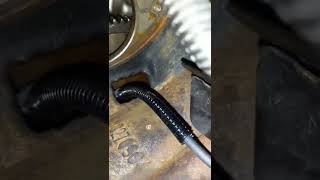
- Locate the crankshaft position sensor. First, check the front of the engine, below the oil filter housing. If it's not there, it is almost certainly located on the back of the engine, inserted into the bellhousing, which requires removing the starter motor for access.
- Once located, inspect the sensor's connector and wiring for any signs of physical damage, melting (especially near the EGR valve), corrosion, or oil contamination.
- If wiring looks good, test the circuit. With the key on, check for a 5-volt reference signal and a good ground at the sensor's connector using a multimeter. The signal wire may show a static voltage (one user reported 2.5V) with the key on, but should produce a fluctuating 0-5V square wave when cranking (best seen with an oscilloscope).
- If the wiring and power/ground are confirmed good, the next step is to replace the crankshaft position sensor, as it is the most common failure point.
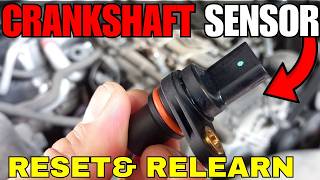
- After replacing the sensor, a 'Crankshaft Variation Relearn' (CASE Relearn) procedure MUST be performed using a compatible bidirectional scan tool (e.g., GM Tech2 or equivalent). Failure to do so will likely result in a P1336 code and persistent misfire issues. 🎬 Watch: How to perform a crankshaft position sensor relearn procedure
- If a new sensor and relearn procedure do not fix the issue, perform a continuity test on the signal wire (Yellow/Black) between the sensor connector and the PCM connector (Pin 5) to rule out an open or short in the harness.
- As a last resort, if the sensor, wiring, and reluctor wheel are confirmed to be good, the issue may be with the PCM's input driver, but this is highly unlikely.
Parts You'll Likely Need
- Crankshaft Position Sensor
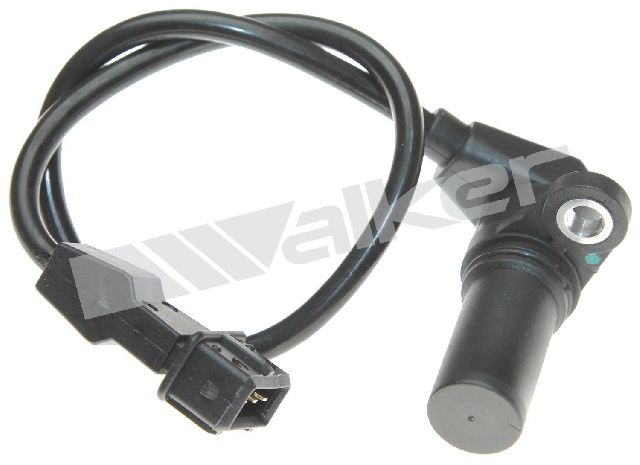
(OEM #25198942)— This sensor is the most common cause of a P0322 code, failing from heat and age and causing a no-start or stalling condition.
Trusted brands: ACDelco (GM Genuine), Delphi, Standard Motor Products (SMP), NTK
OEM price range: $40-$70
Aftermarket price range: $20-$60
Related Codes That Often Appear With This One
- P1336 —
- P0300 —
Platform-Specific Known Issues
- The location of the crankshaft position sensor on the 1.6L E-TEC II engine is often behind the starter motor, requiring the starter to be removed for access. 🎬 Watch: 2009 Chevy Aveo crankshaft sensor replacement video guide This significantly increases the labor time and difficulty compared to sensors located on the front of the engine.
- A popular YouTube video by user 'richpin06a' shows the sensor in the easy-to-access front location, which has caused confusion for many owners who later discover their vehicle has the sensor in the difficult rear location. It's critical to visually confirm before starting.
- A 'Crankshaft Variation Relearn' (CASE Relearn) is mandatory after replacing the CKP sensor. This requires a bidirectional scan tool and if skipped, will often cause a P1336 code and persistent misfire detection issues.
Mechanic-Grade Diagnostic Values
- CKP Sensor Signal Voltage (while cranking) — expected: Fluctuating 0V to 5V square wave (requires oscilloscope). Failure: No signal, or a flat line at 0V or another voltage, indicates a failed sensor or circuit issue.
- CKP Sensor Connector Voltage (Key On, Engine Off) — expected: One pin should have a 5V reference, one should have a good ground (<0.1V to chassis ground).. Failure: Missing 5V reference or high resistance on the ground pin points to a wiring or PCM issue, not a bad sensor.
- Live Data 'Engine RPM' (while cranking) — expected: Should read approximately 200-300 RPM.. Failure: A reading of 0 RPM indicates the PCM is receiving no signal from the CKP sensor.
Scan Tool Commands That Help
- GM Tech2 / GDS2 or equivalent bidirectional scanner: Crankshaft Position Variation Learn (CASE Relearn) — This is a mandatory procedure after replacing the crankshaft position sensor, the PCM, or the engine. It synchronizes the PCM with the physical variations of the reluctor wheel and new sensor. Skipping this step will often set a P1336 code and cause the PCM's misfire detection to be inaccurate.
Wiring & Ground Locations
- CKP Sensor Signal Wire — Yellow/Black wire running from the CKP sensor to Pin 5 on the ECM connector.. This is the specific wire that carries the engine speed signal to the PCM. An open or short on this wire will directly cause a P0322. It is known to be susceptible to melting if it contacts the EGR valve.
- G103 — An engine ground, sometimes cited as being on the starter motor mounting bolt or next to the #4 injector.. This is a critical ground point for the engine block and can affect the electrical return path for various sensors, including the CKP sensor. A poor connection can cause erratic or missing signals.
- G104 — A chassis ground point often located behind the right-side headlamp.. This is a major ground for the ECM and various sensors. Corrosion or looseness can cause a wide range of difficult-to-diagnose electrical issues, including a P0322.
Real Owner Repair Stories
- ChevroletForum.com user (2004 Chevrolet Aveo) — Died while driving, crank no start, no spark, fuel pump not running during crank, 0 RPM on scan tool.
❌ Tried (didn't work) Replacing the crankshaft position sensor
✅ What actually fixed it The user discovered the CKP sensor wiring harness had melted through on the EGR valve. Repairing the bare signal wire was the necessary fix. This highlights a wiring failure perfectly mimicking a sensor failure. - AveoForum.com user 'crtrett' (Chevrolet Aveo (year not specified)) — Died in a parking lot, crank but no start, no trouble codes stored.
❌ Tried (didn't work) Replacing fuel pump, Replacing spark plugs, wires, and ignition coil, Replacing oil pressure sending unit
✅ What actually fixed it The final fix was replacing the oil pump. The user concluded that the ECU was not enabling the fuel pump because it detected zero oil pressure during cranking, a safety feature that did not set a code. - AveoForum.com user 'Adicah07' (2007 Chevrolet Aveo) — Overheated on highway, resulted in crank but no start. Had numerous previous codes including P0016 (Crank/Cam correlation) and P0340 (Cam sensor).
❌ Tried (didn't work) Replacing alternator, battery, ECM, camshaft sensor, crankshaft sensor, fuel injectors, fuel pump, MAP sensor, O2 sensor, spark plugs, coil, and wires.
✅ What actually fixed it The thread concluded with a mechanic diagnosing a probable timing belt issue. Given the overheat and previous correlation codes, a jumped or broken timing belt is the most logical root cause that would not be fixed by replacing sensors.
OEM Part Supersession History
96253542, 96434780, 25182450→25198942— Part consolidation and potential design updates by the manufacturer.
Heads up: After installing the new sensor (25198942), a 'Crankshaft Variation Relearn' procedure is required. Some GM parts sources explicitly state that the part requires 'programming and/or special setup procedures'. Failure to perform the relearn can lead to other codes (P1336) and poor performance.
Model Year Variations Within This Range
- 2004-2008 (approx.): Some early models, particularly those with a canister-style oil filter, may have the CKP sensor located on the front of the engine block below the oil filter. This is an easy-access location.
- 2007-2011 (approx.): Later models, particularly those with a cartridge-style oil filter, most commonly have the CKP sensor located on the rear of the engine block, behind the starter motor. This location requires significantly more labor to access.
Diagnostic Flowchart
Other Known Issues on This Vehicle
Issues unrelated to this code that are worth knowing about as an owner of this generation:
- Premature Timing Belt & Pulley Failure 🔴 High — Very common. The original plastic tensioner and idler pulleys are known to fail before the recommended service interval. While intervals vary (60k miles for early models, 100k for later), replacement every 60,000 miles with a kit containing metal pulleys is strongly advised by the community to prevent catastrophic engine damage. (Ref: GM issued TSB 06-06-01-021 in 2006 regarding a 'goodwill' replacement program to examine belts for defects, but no full recall was issued.)
- Cracked Plastic Thermostat Housing 🟠 Medium — Extremely common across all model years. The plastic housing becomes brittle from heat cycles and can crack suddenly, causing a major coolant leak. Aftermarket aluminum housings are a popular and recommended upgrade.
- Leaking Valve Cover Gasket 🟠 Medium — A very common oil leak. The gasket hardens over time, allowing oil to leak externally and, more critically, into the spark plug tubes, which causes engine misfires (P0300-P0304).
Used vs. New Parts: Buying Guide for This Vehicle
When a used part is the smart pick: For this specific repair, using a used crankshaft position sensor is NOT recommended. The part is a low-cost electronic wear item, and the labor cost (especially if the sensor is behind the starter) is too high to risk installing a part with an unknown history. A used wiring pigtail or connector from a junkyard is a viable option if only the connector is damaged.
Donor-vehicle mileage cap: roughly under 50000 miles for the part to have meaningful remaining life.
What to inspect on the donor part:
- If sourcing a connector pigtail, inspect for any signs of melting, brittleness in the wires, or corrosion on the pins.
- Ensure the locking tab on the connector is intact and functional.
- Select a donor vehicle that shows no signs of major oil leaks or front-end damage.
OEM-only on this vehicle (don't cheap out):
- Crankshaft Position Sensor
Aftermarket brands forum-validated for this vehicle:
- ACDelco (GM Genuine)
- Delphi
- NTK
- Standard Motor Products (SMP)
Brands owners have reported issues with on this vehicle:
- No-name, unbranded sensors from online marketplaces should be avoided due to high failure rates and the significant labor involved in replacement.
Real Owner Stories
Aggregated from forums and TSBs cited above. Mileages and costs reflect what owners reported in those sources.
2004 Chevrolet Aveo 1.6L
Symptoms: The car was stalling and misfiring. The owner was getting a crankshaft position sensor code.
What fixed it: Replacing the crankshaft sensor did not work; the ultimate fix was replacing a faulty coil pack.
Source hint: ChevroletForum.com: NOTICE!!!!! ALL AVEO OWNERS - STALLING OR SPUDERING?
2004-2011 Chevrolet Aveo 1.6L
Symptoms: Intermittent jerkiness while driving, engine stalling without warning, and a no-start condition where the engine cranks but won't fire.
What fixed it: Replacing the crankshaft position sensor.
Source hint: Ross-Tech Forums: Car randomly gets jerky and stalls while driving (P0322)
2004-2011 Chevrolet Aveo 1.6L
Symptoms: Crank but no start condition following an engine overheat.
What fixed it: While the user replaced the crank sensor, the community suggested checking the timing belt as the root cause for the signal loss.
Source hint: AveoForum.com: Crank but no start - tried everything!
Related OBD-II Codes
Frequently Asked Questions
I saw a video by richpin06a showing the sensor on the front of the engine, but I can't find it on my Aveo. Where is it?
I replaced my CKP sensor but now I have a P1336 code. Did I get a bad part?
Can an oil leak cause my P0322 code on this vehicle?
Is there a specific wiring area I should check for damage on my 1.6L Aveo?
Is there a TSB for the timing belt issues that might be related to my no-start?
What brand of sensor should I use for the replacement?
Helpful Videos
We Have This Part in Stock


The information in this article is provided for general reference and educational purposes only. Vehicle specifications, procedures, and part compatibility can vary by production date, trim level, and region. Always consult your vehicle's factory service manual and verify part numbers before purchasing or performing repairs. Safety-critical components such as airbags, seat belts, and braking systems should be installed by a qualified professional.
- Chevrolet Aveo:
- 🎬 Helpful Videos
- 🛍️ Shop This Part
- What's Unique About the 2004-2011 Chevrolet Aveo
- Symptoms You May Notice
- Most Likely Causes
- Rare But Worth Checking
- Diagnosis Steps
- Parts You'll Likely Need
- Related Codes That Often Appear With This One
- Platform-Specific Known Issues
- Mechanic-Grade Diagnostic Values
- Scan Tool Commands That Help
- Wiring & Ground Locations
- Real Owner Repair Stories
- OEM Part Supersession History
- Model Year Variations Within This Range
- Diagnostic Flowchart
- Other Known Issues on This Vehicle
- Used vs. New Parts: Buying Guide for This Vehicle
- Real Owner Stories
- 2004 Chevrolet Aveo 1.6L
- 2004-2011 Chevrolet Aveo 1.6L
- 2004-2011 Chevrolet Aveo 1.6L
- Related OBD-II Codes
- Frequently Asked Questions
- 🎟️ Get 5% Off