

P0322 on 2011-2018 Audi Q3 2.0TDI: Crank Sensor Failure Causes and Fixes
P0322 on an Audi Q3 2.0TDI almost always means the Crankshaft Position Sensor (G28) has failed or its wiring is compromised. This can cause the engine to crank but not start, stall unexpectedly when hot, or take a long time to fire up. Replacing the sensor with a genuine OEM part is the most common fix, with parts costing between $20 for a questionable aftermarket brand and $150+ for a genuine OEM part.
- P0322 on your Audi Q3 means the engine computer isn't getting a signal from the Crankshaft Position Sensor.
- The most common symptoms are the engine cranking but not starting, or stalling when hot.
- The most likely fix is replacing the Crankshaft Position Sensor (G28) with a genuine OEM part.
- Before replacing the sensor, always inspect the wiring harness for visible damage, as chafing is a known issue.
- Do not drive the vehicle, as a sudden stall could be dangerous.
What's Unique About the 2011-2018 Audi Q3
On the 2.0TDI engine in the Q3 and its platform mates (like the VW Tiguan and Audi A3), the P0322 code is a very common fault pointing directly to the Crankshaft Position Sensor (G28). The sensor is known to fail due to heat soak, leading to an intermittent crank-no-start or stalling condition that worsens as the engine warms up. While the sensor itself is the usual culprit, there are documented cases on this platform where wiring issues—such as chafing near the oil filter housing or breaks further up the loom—can mimic a sensor failure, making a thorough diagnosis important before replacing parts.
Symptoms You May Notice
- Engine cranks but does not start
- Long crank before starting
- Engine stalls unexpectedly, especially when warm
- Check Engine Light is on
- EPC (Electronic Power Control) light may be on 🎬 See a mechanic explain the common causes and symptoms of P0322.
- Glow plug indicator light may flash (on TDI models)
- Tachometer (RPM gauge) does not move during cranking or shows 0 RPM while the engine is running
- Rough idling or engine hesitation
- Loss of power during acceleration
- Car is jerky or feels like it loses power intermittently while driving
- Activation of a rev limiter or limp mode, as noted in some manufacturer-related reports
- Replacing the Camshaft Position Sensor. While related to engine timing, a camshaft sensor fault will typically set a different code (e.g., P0341). P0322 is specific to the engine speed/crankshaft sensor input.
- Replacing the fuel pump. A no-start condition can be mistaken for a fuel issue. However, if the ECM does not see an engine speed signal from the crank sensor, it will not command the fuel pump to run after the initial prime.
Most Likely Causes
- Faulty Crankshaft Position Sensor (G28) 🔴 High Probability These sensors are exposed to high heat cycles at the back of the engine block and are a common failure item across many VAG models. The internal electronics can break down over time, causing a loss of signal, particularly when the engine reaches operating temperature. Using non-OEM (aftermarket) sensors is a frequent cause of repeat failures or unresolved codes; it is highly recommended to use a genuine or OEM-equivalent part (e.g., Bosch).
How to confirm: Scan the vehicle for codes. Observe the tachometer while cranking; if it does not register any RPM, the sensor is very likely bad. You can also monitor live data with an advanced scan tool (like VCDS) to see if the ECM is receiving an engine speed signal. A definitive test is to unplug the camshaft position sensor (G40); if the engine then refuses to start at all, the G28 crank sensor or its circuit is confirmed to be faulty.
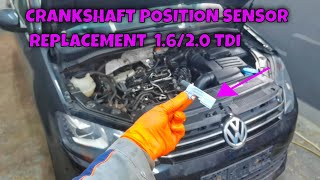
Typical fix: Replace the Crankshaft Position Sensor. It is held in by a single bolt (typically 10mm) and is located on the engine block, often underneath or near the oil filter housing. Removing the oil filter first provides significantly better access. 🎬 Watch this step-by-step guide to locating and replacing the TDI sensor. Be sure to clean the area before removing the old sensor to prevent debris from falling into the block.
Est. part cost: $20-$190 - Damaged Wiring or Connector 🟡 Medium Probability The sensor's wiring harness is routed near hot engine and exhaust components. Over time, the protective loom can become brittle and crack, exposing the wires to heat damage, oil, and vibration. Common chafe points are near the oil filter housing and where the harness rubs against the engine block or other components. In some cases, the break can be further up the loom, closer to the ECU.
How to confirm: Visually inspect the wiring harness from the sensor back to the main engine harness. Check the connector at the sensor for corrosion, pushed-out pins, or damage. Perform a continuity test on the three wires between the sensor connector and the ECM connector. With the ignition on, you should measure approximately 5V on pin 1 (power), 0V on pin 3 (ground), and 5V on pin 2 (signal).
Typical fix: Repair the damaged section of wiring using solder and heat-shrink tubing or replace the connector pigtail. Ensure the repaired harness is routed securely away from heat sources and sharp edges.
Est. part cost: $10-$40
Rare But Worth Checking
- Faulty Engine Control Module (ECM): This is very uncommon, but it's a possibility if a new OEM sensor and verified wiring do not resolve the code. The driver circuit for the sensor within the ECM can fail. On a 2012 Tiguan, a similar issue was traced to coolant leaking into the ECM and causing damage.
- Damaged Reluctor Ring: The crankshaft position sensor reads a toothed wheel (reluctor ring). While rare, if this ring is damaged or has debris/metal particulates stuck to it, the sensor cannot get a clean signal. This typically requires more significant engine work to inspect or replace.
Diagnosis Steps
- Connect an OBD-II scanner and confirm P0322 is the primary code. Note any other codes present, such as P0321.
- With the scanner connected, monitor live data for 'Engine Speed' (RPM) while cranking the engine. If the reading is 0 or erratic, the issue is likely the sensor or its circuit. Be aware the ECU may substitute the cam sensor signal, so a non-zero reading doesn't rule out a G28 fault.
- Turn the ignition off and locate the Crankshaft Position Sensor (G28). On the 2.0TDI, it is typically found on the engine block below the oil filter housing.
- Inspect the sensor's connector for corrosion, moisture, or loose pins. Thoroughly inspect the wiring harness for any signs of melting, chafing, or breaks, especially around the oil filter housing.
- For a more advanced check, disconnect the sensor and test the harness connector with the ignition on. Using a multimeter, verify ~5V power on pin 1 and ~0V ground on pin 3.
- If wiring and voltages appear correct, replace the Crankshaft Position Sensor. It is strongly recommended to use a genuine OEM or OEM-equivalent (e.g., Bosch) part. Removing the oil filter will make access much easier. A DIYer on a forum reported success using an endoscope camera to guide their tools without removing other components.
- After replacing the sensor, clear the trouble codes with the scanner.
- Start the engine and confirm the tachometer is working and the Check Engine Light does not return. Take the vehicle for a test drive, allowing it to reach full operating temperature to ensure the fix is complete.
Parts You'll Likely Need
- Crankshaft Position Sensor / Engine Speed Sensor (G28)
(OEM #04L906433B (or 03L906433))— This sensor is the most common failure point for code P0322. It provides the essential engine speed signal to the ECM, and its failure results in a no-start or stalling condition. Note: Several part numbers exist for the 2.0TDI engine family. Always verify the correct part number for your specific vehicle using its VIN.
Trusted brands: Bosch (Often the OEM), Febi Bilstein, Delphi, Meyle, Hitachi
OEM price range: $120-$190
Aftermarket price range: $20-$70
Related Codes That Often Appear With This One
- P0321 — P0321 indicates 'Ignition/Distributor Engine Speed Input Circuit Range/Performance'. It often appears with P0322 as the sensor begins to fail intermittently before failing completely.
Technical Service Bulletins (TSBs) & Recalls
- No specific Technical Service Bulletins (TSBs) directly addressing the P0322 code on the Audi Q3 2.0TDI were found during research. The issue is commonly handled as a standard diagnostic procedure.
Platform-Specific Known Issues
- There are owner reports on 2.0TDI models where replacing the sensor does not fix the issue, and the problem is traced to a wiring fault between the Engine Control Unit (ECU) and the Transmission Control Unit (TCU), which can also cause a G28 no-signal fault.
- A documented case on a Skoda Octavia with the same engine family found a broken signal wire in the main harness under the windscreen wipers, far from the sensor itself, causing an identical P0322 fault. The owner posted a detailed repair video on YouTube.
Mechanic-Grade Diagnostic Values
- Crankshaft Position Sensor (G28) internal resistance — expected: 480 - 1000 Ω (Ohms) between terminals 2 and 3 of the sensor connector.. Failure: A reading outside this range, or any resistance value between pins 1+2 or 1+3 (should be infinite/open circuit).
- Voltage at the G28 sensor harness connector (Key On, Engine Off) — expected: Pin 1 (Power): ~5V, Pin 2 (Signal): ~5V, Pin 3 (Ground): ~0V.. Failure: Missing voltage on Pin 1 or Pin 2, or voltage present on Pin 3, indicates a wiring fault between the connector and the ECM.
- Live Data Engine Speed (VCDS/VAG-COM Measuring Blocks) — expected: A steady RPM reading during cranking and at idle.. Failure: A reading of 0 RPM during cranking is a strong indicator of a failed G28 sensor or circuit. However, a 'No Signal' P0322 code can still be present even if RPM is displayed, as the ECM may substitute the camshaft sensor's signal. This is a common diagnostic trap.
Hidden / Shadow Codes Worth Checking
- 16706 / 000802: This is the VAG-specific fault code number for P0322, 'Engine Speed Sensor (G28): No Signal'. It is not a hidden code but is what will be displayed on VAG-specific diagnostic tools like VCDS. (see via VCDS (VAG-COM) or ODIS (dealer software).)
Wiring & Ground Locations
- G28 Sensor to ECM Pins — The G28 sensor wiring runs from the lower rear of the engine block up to one of the main ECM connectors.. For continuity testing, the G28 sensor pins connect to specific pins on the ECM. One wiring diagram shows the G28 signal wire going to pin 82 of the ECM connector. Another shows pins 48 and 49 on the T55 connector. Verifying the correct diagram for the specific engine (EA189 vs EA288) is crucial.
- Engine Block / Gearbox Ground — A primary ground strap is typically located between the engine/gearbox and the chassis. A specific ground point is designated on the gearbox.. A poor engine ground can cause all manner of erratic sensor behavior and electrical noise, potentially triggering a P0322 code.
- Ground Point 602 — In the front left footwell, near the A-pillar.. This is a major interior ground point. While less likely to be the direct cause, issues here can affect the ECM or other control modules that process the G28 signal.
- Main Harness Ground (375) — A ground connection designated as '375' is located within the main wiring harness itself.. A fault at an internal harness ground point can be very difficult to trace and can cause intermittent signal loss for sensors sharing that ground path.
Real Owner Repair Stories
- Ross-Tech Forums user (2013 Passat TDI (CKRA engine)) — Flashing glow plug light and P0322 code.
❌ Tried (didn't work) Initial diagnosis pointed towards replacing the sensor.
✅ What actually fixed it The owner found the main engine harness had melted against a metal coolant tube on the front of the engine, causing an intermittent short in the sensor circuit. Repairing the wiring and securing the harness away from the pipe resolved the issue. - YouTube user 'Modrix' (2005 Skoda Octavia 2.0 TDI (BKD engine)) — Crank but no start, or very long crank time. P0322 code present.
❌ Tried (didn't work) The owner noted many online reports where replacing the sensor did not fix the problem, so they investigated wiring first.
✅ What actually fixed it A broken signal wire was found in the main wiring loom, located far from the sensor under the windscreen scuttle panel near the ECU. Splicing in a new wire to bypass the break fixed the problem completely. - Ross-Tech Forums user (2015 Golf Sportwagen TDI (~157k miles)) — Jerky power delivery, feeling like the transmission was slipping, stalling at idle, and intermittent long crank times.
❌ Tried (didn't work) Transmission fluid flush., Resetting transmission adaptations., Wiggling the sensor wire harness (which actually made it worse, causing a stall).
✅ What actually fixed it Replacing the crankshaft position sensor with a genuine part from a VW dealer solved all symptoms.
Documented NHTSA Reports
- NHTSA ODI #11325248 — An owner reported that their vehicle encountered a rev limiter and threw codes P0322 and P0421. The report noted the P0322 code was for the "engine ignition distributor no signal" and occurred even though the engine bay had not been exposed to water.
When the Usual Fixes Don't Work
- In multiple documented cases, replacing the G28 sensor—even with a new OEM part—did not fix the P0322 code. The ultimate solution was found in the wiring harness. One owner of a Passat TDI discovered the harness had melted against a coolant pipe, causing a short. Another owner of a Skoda with the same engine family traced the fault to a single broken signal wire far from the sensor, under the windscreen scuttle panel. These cases prove that a thorough wiring inspection, including continuity tests from the sensor plug to the ECM, is essential before condemning a second sensor or assuming an ECU fault.
OEM Part Supersession History
03L906433→04L906433, 04L906433B, etc.— Standard part evolution for different engine updates (e.g., EA189 to EA288) and supplier changes.
Heads up: While multiple part numbers exist, the most critical factor is using a Genuine OEM or OEM-equivalent (Bosch) part. Forum and video evidence shows that even reputable aftermarket brands like Febi Bilstein can be incompatible or fail prematurely, causing the P0322 code to persist or return.
Model Year Variations Within This Range
- 2011-~2014: Vehicles in this range are typically equipped with the EA189 2.0TDI engine. This engine was central to the 'Dieselgate' emissions scandal and has a DPF system. Diagnostic procedures and wiring may differ slightly from later models.
- ~2015-2018: Later models in this range are typically equipped with the updated EA288 2.0TDI engine. This engine was designed to meet stricter emissions standards (Euro 6) and often includes an SCR (AdBlue) system in addition to the DPF. While the function of the G28 sensor is the same, its part number, wiring harness, and ECM software may be different from the EA189.
Diagnostic Flowchart
Used vs. New Parts: Buying Guide for This Vehicle
When a used part is the smart pick: For this specific repair, a used part is almost never a smart choice. The crankshaft position sensor is a known high-failure item due to heat and vibration. The labor required to access it is significant enough that installing a used sensor with unknown history is a major gamble that often results in having to do the job twice.
What to inspect on the donor part:
- Not applicable as used sensors are not recommended.
OEM-only on this vehicle (don't cheap out):
- Crankshaft Position Sensor (G28). Multiple forum and video sources confirm that non-OEM sensors, even from reputable aftermarket brands, frequently fail to work correctly or have a very short service life for this application.
Aftermarket brands forum-validated for this vehicle:
- Bosch (Often the original equipment manufacturer for VAG). Ensure it is sourced from a reputable vendor to avoid counterfeits.
Brands owners have reported issues with on this vehicle:
- Febi Bilstein (A specific case on a VAG vehicle showed a new Febi sensor did not resolve the P0322 code while a genuine OE sensor did).
- Generic, unbranded sensors from online marketplaces like eBay or Amazon.
Real Owner Stories
Aggregated from forums and TSBs cited above. Mileages and costs reflect what owners reported in those sources.
2014 Audi Q3 2.0TDI
Symptoms: The car starts after a few seconds and drives okay, but live data shows 0 RPM for both engine and cam speed until the engine fires up. The P0322 code is present.
What fixed it: Replacing the crank sensor with a genuine part did not fix the problem; the error remained, suggesting a more complex wiring or ECU issue.
Source hint: MHH AUTO
2015 VW Golf TDI
Symptoms: The car would randomly get jerky and stall while driving.
What fixed it: The issue was resolved by replacing the crankshaft position sensor with a part from the dealer. The owner mentioned using an endoscope camera to help with the installation without removing other components.
Source hint: Ross-Tech Forums: 'Resolved - Car randomly gets jerky and stalls while driving (P0322)'
Skoda Octavia 2.0TDI
Symptoms: Vehicle presented with an identical P0322 fault code.
What fixed it: The problem was traced to a broken signal wire in the main wiring harness located under the windscreen wipers, far away from the sensor itself. Repairing the wire resolved the fault.
Source hint: A documented case on a Skoda Octavia with the same engine family
Audi (model not specified)
Symptoms: Vehicle had a crank-no-start condition with codes P0321 and P0322.
What fixed it: The owner replaced both the crank and cam sensors, but the P0322 code returned, indicating the root cause was likely in the wiring harness, not the sensors themselves.
Source hint: AudiWorld Forums: 'EPC and P0322 won't start'
Related OBD-II Codes
Frequently Asked Questions
I'm getting a P0322 code on my Q3 TDI. Should I use a cheap aftermarket crankshaft sensor?
My tachometer shows 0 RPM while cranking my 2014 Q3. Is this related to the P0322 code?
I replaced the crankshaft sensor on my Q3, but P0322 came back. What's the next step?
Where is the crankshaft position sensor (G28) located on the 2.0TDI engine?
My Q3 TDI is jerky, stalls when warm, and the glow plug light is flashing. Is P0322 a likely cause?
Are there any official recalls or TSBs for the P0322 code on the Audi Q3 2.0TDI?
Helpful Videos

We Have This Part in Stock

The information in this article is provided for general reference and educational purposes only. Vehicle specifications, procedures, and part compatibility can vary by production date, trim level, and region. Always consult your vehicle's factory service manual and verify part numbers before purchasing or performing repairs. Safety-critical components such as airbags, seat belts, and braking systems should be installed by a qualified professional.
- Audi Q3:
- 🎬 Helpful Videos
- 🛍️ Shop This Part
- What's Unique About the 2011-2018 Audi Q3
- Symptoms You May Notice
- Most Likely Causes
- Rare But Worth Checking
- Diagnosis Steps
- Parts You'll Likely Need
- Related Codes That Often Appear With This One
- Technical Service Bulletins (TSBs) & Recalls
- Platform-Specific Known Issues
- Mechanic-Grade Diagnostic Values
- Hidden / Shadow Codes Worth Checking
- Wiring & Ground Locations
- Real Owner Repair Stories
- Documented NHTSA Reports
- When the Usual Fixes Don't Work
- OEM Part Supersession History
- Model Year Variations Within This Range
- Diagnostic Flowchart
- Used vs. New Parts: Buying Guide for This Vehicle
- Real Owner Stories
- 2014 Audi Q3 2.0TDI
- 2015 VW Golf TDI
- Skoda Octavia 2.0TDI
- Audi (model not specified)
- Related OBD-II Codes
- Frequently Asked Questions
- 🎟️ Get 5% Off