

P0302 on 2006-2011 Kia Rio 1.6L: Cylinder 2 Misfire Causes and Fixes
P0302 on a 2006-2011 Kia Rio indicates a misfire in cylinder 2. The most common causes are a worn spark plug, a bad spark plug wire, or a faulty ignition coil. A full ignition system tune-up is a frequent and effective solution, with DIY parts costing between $75 and $150. Diagnosis is straightforward by swapping components between cylinders.
- P0302 on a 2006-2011 Kia Rio is a misfire on cylinder 2, the second from the belt side.
- The most likely causes are bad spark plugs, wires, or an ignition coil. Start your diagnosis there.
- A simple 'swap test' is the best way to diagnose: swap the spark plug from cylinder 2 to cylinder 1. If the code follows the part (becomes P0301), you've found the problem.
- If the Check Engine Light is flashing, pull over immediately to prevent expensive damage to your catalytic converter.
- Replacing all four spark plugs and the full set of wires at the same time is recommended for long-term reliability.
What's Unique About the 2006-2011 Kia Rio
The 2006-2011 Kia Rio with the 1.6L G4ED engine uses a conventional ignition system with two ignition coils and a set of four spark plug wires. This is different from newer 'coil-on-plug' systems where each spark plug has its own coil. This 'wasted spark' system means one coil fires the spark plugs for two cylinders at once (cylinders 1 & 4, and 2 & 3). This design makes diagnosing a P0302 slightly different, as the issue could be the spark plug, the specific wire for cylinder 2, or the coil pack shared with cylinder 3.
Symptoms You May Notice
- Check Engine Light is on or flashing
- Rough or shaky idle
- Engine hesitation or stumbling during acceleration
- Noticeable loss of power
- Reduced fuel economy
- Engine stalling
- Unusual odor from the exhaust due to unburned fuel.
- Replacing a fuel injector before thoroughly testing the ignition system (spark plugs, wires, and coil), which are more common and easier to diagnose.
- Replacing only one spark plug instead of the full set, which can lead to uneven performance and future misfires in other cylinders.
- Replacing the wrong ignition coil due to misunderstanding the wasted-spark system pairing (1&4, 2&3).
Most Likely Causes
- Worn or Faulty Spark Plug 🔴 High Probability Spark plugs are a routine maintenance item with a service life of around 30,000 miles on this engine. They are the most common failure point for any ignition system. An excessively large spark plug gap from wear forces the ignition coil to work harder, which can cause a misfire.
How to confirm: Inspect the spark plug for cylinder 2. Look for wear, fouling, or damage. In some cases, oil on the spark plug can cause the misfire, as noted in NHTSA ODI #11438984, where oil contamination led to a P0302 code and eventual engine backfire. The easiest test is to swap the spark plug from cylinder 2 with another cylinder (e.g., cylinder 1). Clear the codes and run the engine. If the code changes to P0301, the spark plug is the culprit.
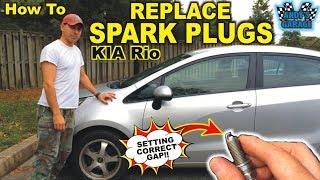
Typical fix: Replace the spark plug. It is highly recommended to replace all four spark plugs at the same time to ensure even performance. The standard NGK plugs are a common and effective replacement.
Est. part cost: $20-$50 for a set of 4 - Bad Spark Plug Wire 🔴 High Probability The G4ED engine uses spark plug wires which can degrade over time due to high heat and age, causing resistance to increase or the insulation to fail, allowing the spark to arc to the engine block instead of the plug.
How to confirm: After confirming the spark plug is good, swap the spark plug wire from cylinder 2 with the wire from cylinder 3 (since they are similar lengths). Clear the codes and drive. If the code changes to P0303, the wire is bad. You can also visually inspect the wire for cracks or carbon tracking and test its resistance with a multimeter. Resistance should not exceed 25 kOhm/m.
Typical fix: Replace the spark plug wire set. Wires should always be replaced as a complete set to ensure uniform resistance and prevent future misfires.
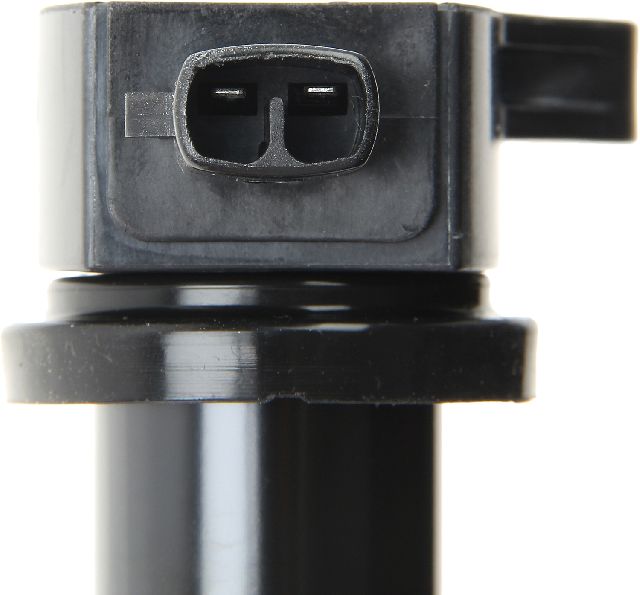
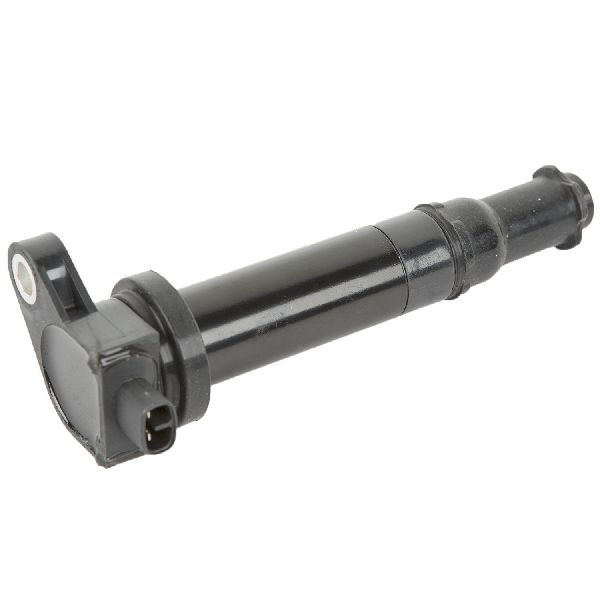
Est. part cost: $25-$60 for a set - Faulty Ignition Coil 🟡 Medium Probability This engine has two coils, each firing two cylinders. The coil for cylinders 2 and 3 can fail, causing a misfire. While durable, they are a common failure point after many years and miles, sometimes developing cracks in the housing that allow spark to escape.
How to confirm: If new plugs and wires do not solve the issue, the coil is the next likely suspect. Since one coil fires both cylinders 2 and 3, a failing coil might also throw a P0303 code. The definitive test is to swap the ignition coil for cylinders 2&3 with the coil for cylinders 1&4. Clear the codes and drive. If the code changes to P0301 or P0304, the coil is bad.
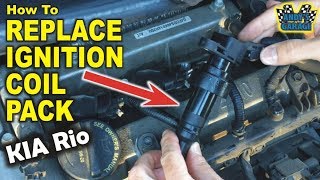
Typical fix: Replace the faulty ignition coil. There are two coils; ensure you replace the correct one. Many owners choose to replace both coils and the wire set at the same time 🎬 See this walkthrough on how to replace the ignition coil pack. for peace of mind.
Est. part cost: $30-$80 per coil - Clogged or Defective Fuel Injector ⚪ Low Probability Less common than ignition issues, but fuel injectors can become clogged with deposits over time or fail electronically, preventing the correct amount of fuel from entering cylinder 2.
How to confirm: Listen to the injector with a mechanic's stethoscope; it should make a consistent clicking sound. A more involved test is to swap the fuel injector from cylinder 2 with another cylinder. If the misfire code follows the injector (e.g., moves to P0301 after swapping with cylinder 1), it needs to be cleaned or replaced.
Typical fix: Clean or replace the fuel injector for cylinder 2. Professional cleaning is sometimes an option, but replacement is more common.
Est. part cost: $50-$150
Rare But Worth Checking
- Low Engine Compression: If all ignition and fuel delivery checks pass, a mechanical issue could be the cause. This could be due to a burnt valve, worn piston rings, or a leaking head gasket. A compression test is needed to diagnose this. The nominal compression for the G4ED engine is 1422 kPa (approx. 206 PSI). If compression is low, a leak-down test can pinpoint the source of the leak. Reports such as NHTSA ODI #11582922 and NHTSA ODI #11725093 describe instances where a P0302 was present alongside a total loss of compression in cylinder 2, leading to engine stalling.
- Vacuum Leak: A vacuum leak, such as a cracked hose or a bad intake manifold gasket near the cylinder 2 runner, can lean out the air/fuel mixture and cause a misfire. This often causes other codes (like lean codes P0171/P0174) or a random misfire (P0300) but can be isolated to a single cylinder if the leak is localized.
Diagnosis Steps
- Read the code from the OBD-II port using a scanner. Confirm P0302 is present and note any other codes.
- Check if the Check Engine Light is flashing. If so, avoid driving the vehicle to prevent catalytic converter damage.
- Locate cylinder 2, which is the second cylinder from the timing belt side of the engine.
- Start with the ignition system. Swap the spark plug from cylinder 2 with the one from cylinder 1. Clear the codes and test drive. If the code changes to P0301, you have a bad spark plug.
- If the code remains P0302, swap the spark plug wire from cylinder 2 with the one from cylinder 3. Clear codes and test drive. If the code moves to P0303, the wire is faulty.
- If the code is still P0302, swap the ignition coil for cylinders 2 & 3 with the coil for 1 & 4. Clear codes and test drive. If the code moves to P0301 or P0304, the ignition coil is the culprit.
- If ignition components (plugs, wires, coil) are all confirmed good, investigate the fuel system. Listen for the click of the fuel injector on cylinder 2. If it's silent, it may have failed. Consider swapping injectors to confirm the fault.
- If all else fails, perform an engine compression test to check for mechanical issues like a bad valve or piston rings. Nominal pressure should be around 1422 kPa (206 PSI).
Parts You'll Likely Need
- Spark Plugs (Set of 4)
(OEM #1881411051)— This is the most common cause of a single-cylinder misfire and is a standard maintenance item.
Trusted brands: NGK (BKR5E-11 / Part No. 6953 or BKR5ES-11 / Part No. 2382), Denso, Champion
OEM price range: $25-$40
Aftermarket price range: $15-$30 - Ignition Coil
(OEM #27301-26640)— The second most likely failure point in the ignition system after plugs and wires.
Trusted brands: Delphi (GN10330), Denso (673-8308), NGK (U5073)
OEM price range: $60-$90
Aftermarket price range: $30-$60 - Spark Plug Wire Set
(OEM #27400-2X140)— Wires degrade over time and are a common cause of misfires on engines with this type of ignition system.
Trusted brands: NGK, Denso
OEM price range: $50-$80
Aftermarket price range: $25-$50
Related Codes That Often Appear With This One
- P0300 — If the misfire is intermittent or begins to affect other cylinders, a P0300 (Random/Multiple Cylinder Misfire) code may appear.
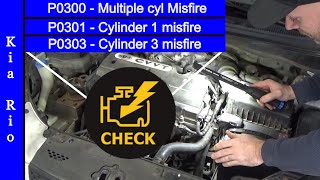
- P0303 — Because cylinders 2 and 3 share an ignition coil in a wasted-spark system, a failing coil can sometimes cause misfires and codes for both cylinders. 🎬 Watch: Diagnosing flashing engine lights and multiple cylinder misfire codes.
Technical Service Bulletins (TSBs) & Recalls
- No specific TSBs directly addressing P0302 on this platform were found. Misfire diagnosis for this model follows standard procedures. Later Kia models have TSBs for misfire logic updates and coil issues, but they do not apply to the 2006-2011 Rio. For example, TSB Bulletin #TSBENG181_R1 provides procedures for replacing ignition coils or coil RFI springs for codes P0300 through P0304 on other Kia models.
Platform-Specific Known Issues
- The simple, sequential diagnostic process of swapping plugs, then wires, then coils between cylinders is extremely effective on this platform and will identify the root cause of a P0302 misfire in the vast majority of cases. Owners consistently solve the problem with this method before needing to investigate the fuel system or mechanical issues.
Mechanic-Grade Diagnostic Values
- Ignition Coil Primary Resistance — expected: 0.752 Ohms ± 15%. Failure: A reading outside of this range indicates a faulty coil.
- Spark Plug Wire Resistance — expected: Should not exceed 25 kOhm per meter.. Failure: Significantly higher resistance means the wire needs replacement.
- Fuel Pressure — expected: 49-52 PSI. Failure: Pressure below this range can indicate a weak fuel pump, potentially causing a lean misfire.
- Fuel Injector Resistance — expected: Approximately 13.8 - 15.2 Ohms (General spec for similar Hyundai/Kia injectors, specific G4ED value not found). Failure: A reading far outside this range, or an open/short circuit, indicates a failed injector coil.
Hidden / Shadow Codes Worth Checking
- Mode $06 Data: While not a hidden code, a professional scan tool can access Mode $06 data, which contains misfire counts for each cylinder. This can be used to see if cylinder 2 is accumulating misfires even before the PCM sets the P0302 code, which is useful for diagnosing intermittent issues. (see via Professional OBD-II scan tool with Mode $06 functionality.)
Wiring & Ground Locations
- ECM Pin 2 — At the Engine Control Module (ECM) connector.. This is the ignition control signal wire for the coil serving cylinders 2 and 3. A wiring issue between this pin and the ignition coil could prevent the coil from firing, causing a P0302 (and potentially P0303).
- Main Engine Ground — Typically a thick black cable from the engine block or cylinder head to the chassis/frame rail near the battery.. A poor engine ground can cause a weak spark across all cylinders, leading to random misfires. While less likely to cause a single-cylinder misfire, it's a foundational check for any ignition problem.
Real Owner Repair Stories
- NHTSA ODI #11570707 — An owner reported that the vehicle began to hesitate, sputtered, and failed to accelerate. A code reader retrieved DTC P0302 (Cylinder Misfire) at approximately 95,000 miles.
- Car Talk Community Forum (2009 Kia Rio) — Sudden misfire with codes P0300, P0301, and P0302. After replacing spark plugs, the misfire continued and the check engine light started flashing.
❌ Tried (didn't work) Replacing all four spark plugs.
✅ What actually fixed it The owner discovered that the metal contact pin inside the spring of one of the ignition coils was completely missing. Replacing the faulty ignition coil resolved the issue. - YouTube channel badass1g (Kia/Hyundai with 1.6L engine) — Hard misfire and bucking during low acceleration, especially below 2,000 RPM. Crucially, there was NO check engine light.
❌ Tried (didn't work) Replacing spark plugs (which were suspected to be counterfeit NGK plugs from an online retailer).
✅ What actually fixed it After extensive part swapping, the problem was traced to a single bad ignition coil pack. The owner bought four used coils from a junkyard to diagnose the issue, and replacing the faulty original coil with a used one fixed the hard misfire.
When the Usual Fixes Don't Work
- While a P0302 code is almost always accompanied by a solid or flashing Check Engine Light, there are owner-reported cases of a noticeable, hard misfire occurring intermittently with no code being stored and no light illuminating. In one such case, the cause was a failing ignition coil. This indicates the misfire may not have been frequent enough to meet the PCM's threshold for setting a code, but was still severe enough to be felt by the driver.
OEM Part Supersession History
27301-26640→No official supersession found, but this part is cross-referenced by many aftermarket numbers.— N/A
Heads up: Common aftermarket cross-reference part numbers include UF499, C1543, 673-8308, and GN10330. Ensure the replacement coil is specified for the 2006-2011 Rio 1.6L.
Model Year Variations Within This Range
- 2010-2011: The Kia Rio received a cosmetic facelift for the 2010 model year, which included the 'Tiger Nose' grille and a revised steering wheel. However, the Alpha II G4ED 1.6L engine and its wasted-spark ignition system remained unchanged, so the causes and diagnostic procedures for a P0302 are identical across the entire 2006-2011 model range.
Diagnostic Flowchart
Other Known Issues on This Vehicle
Issues unrelated to this code that are worth knowing about as an owner of this generation:
- Timing Belt Replacement 🔴 High — Critical maintenance item. Replacement is recommended every 60,000 miles (96,000 km) under severe service or 90,000 miles (145,000 km) under normal service. Failure can cause significant engine damage as it is an interference engine.
- Knock Sensor Failure 🟠 Medium — The knock sensor, located under the intake manifold, can fail over time, causing a check engine light and potentially poor performance. It's a relatively common and accessible repair from underneath the vehicle.
- Minor Electrical Problems 🟡 Low — Some owners report occasional issues with interior electrical components, though widespread, systemic failures are not common.
- Airbag System Recall (2006-2008) 🔴 High — A recall was issued for the Occupant Classification System (OCS) sensor in the front passenger seat, which could fail to detect a small-statured adult, preventing the airbag from deploying in a crash. Ensure this recall has been performed. (Ref: NHTSA Campaign ID: 08V161000)
Used vs. New Parts: Buying Guide for This Vehicle
When a used part is the smart pick: For this repair, using a used part is generally only recommended for diagnosis, not as a permanent fix. A used ignition coil or fuel injector from a junkyard can be a cheap way to confirm if a component is bad by swapping it in and seeing if the problem resolves. If it does, a new part should be purchased for the final repair.
Donor-vehicle mileage cap: roughly under 80000 miles for the part to have meaningful remaining life.
What to inspect on the donor part:
- For an ignition coil, check the plastic housing for any cracks, melting, or signs of arcing (white or black residue).
- For a fuel injector, look for a clean nozzle and intact O-rings. Avoid parts that are heavily corroded or caked in grime.
- Check the donor vehicle's mileage if possible; lower is always better.
OEM-only on this vehicle (don't cheap out):
- No parts for this specific repair are strictly 'OEM-only', as high-quality aftermarket options are widely available and effective.
Aftermarket brands forum-validated for this vehicle:
- NGK (for spark plugs, wires, and coils)
- Denso (for spark plugs, wires, and coils)
- Bosch (for spark plugs and wires)
- Delphi (for ignition coils)
Brands owners have reported issues with on this vehicle:
- Unbranded, deeply discounted ignition components (especially spark plugs and coils) from online marketplaces like Amazon or eBay. There are documented cases of counterfeit parts that look legitimate but fail quickly or cause performance issues.
Real Owner Stories
Aggregated from forums and TSBs cited above. Mileages and costs reflect what owners reported in those sources.
2006 Kia Rio 1.6L
Symptoms: Rough idling and blinking check engine light; a fault log discovered a cylinder 2 misfire.
What fixed it: Replacement of the Ignition Coil Packs.
Source hint: youtube_comment from Pinoy Padyakero
2006 Kia Rio 1.6L
Symptoms: Engine code P0302 and P0116.
What fixed it: Replacing spark plugs was identified as the first step for resolution.
Source hint: Reddit r/MechanicAdvice thread '2006 Kia Rio engine code P0302 and P0116'
Related OBD-II Codes
Frequently Asked Questions
Is there a specific TSB for the P0302 misfire on my 2006-2011 Kia Rio?
Which cylinder do I need to check for a P0302 code on the 1.6L G4ED engine?
Can I swap parts between cylinders to find the problem on this car?
Does the 2006-2011 Kia Rio have individual coil packs for each cylinder?
Are there any safety recalls I should be aware of for my 2006-2008 Rio?
How often should I change the spark plugs to prevent misfires on this engine?
Helpful Videos
We Have This Part in Stock


The information in this article is provided for general reference and educational purposes only. Vehicle specifications, procedures, and part compatibility can vary by production date, trim level, and region. Always consult your vehicle's factory service manual and verify part numbers before purchasing or performing repairs. Safety-critical components such as airbags, seat belts, and braking systems should be installed by a qualified professional.
- Kia Rio:
- 🎬 Helpful Videos
- 🛍️ Shop This Part
- What's Unique About the 2006-2011 Kia Rio
- Symptoms You May Notice
- Most Likely Causes
- Rare But Worth Checking
- Diagnosis Steps
- Parts You'll Likely Need
- Related Codes That Often Appear With This One
- Technical Service Bulletins (TSBs) & Recalls
- Platform-Specific Known Issues
- Mechanic-Grade Diagnostic Values
- Hidden / Shadow Codes Worth Checking
- Wiring & Ground Locations
- Real Owner Repair Stories
- When the Usual Fixes Don't Work
- OEM Part Supersession History
- Model Year Variations Within This Range
- Diagnostic Flowchart
- Other Known Issues on This Vehicle
- Used vs. New Parts: Buying Guide for This Vehicle
- Real Owner Stories
- 2006 Kia Rio 1.6L
- 2006 Kia Rio 1.6L
- Related OBD-II Codes
- Frequently Asked Questions
- 🎟️ Get 5% Off