

P0301 on 2010-2017 Volkswagen Golf: Cylinder 1 Misfire Causes & Fixes
On a 2010-2017 VW Golf, code P0301 is most often caused by a failed ignition coil on cylinder 1. This is a very common and easy DIY fix, with the part costing between $30 and $75. Swapping the coil from cylinder 1 to cylinder 2 is the standard diagnostic procedure to confirm the failure.
- P0301 on a VW Golf indicates a misfire in cylinder 1, which is the cylinder closest to the belts on the passenger side.
- The most likely cause is a bad ignition coil. The easiest way to diagnose this is to swap the coil with another cylinder's and see if the fault code moves.
- If the coil and spark plug are good, the next most common causes are a failed PCV valve or (on TSI engines) carbon buildup on the intake valves.
- Do not ignore a flashing check engine light, as driving with a misfire can quickly damage the expensive catalytic converter.
What's Unique About the 2010-2017 Volkswagen GOLF

This era of Volkswagen Golf is known for a high failure rate of ignition coils, making them the primary suspect for a P0301 code. Additionally, the direct-injected TSI engines (1.8T and 2.0T) are highly susceptible to carbon buildup on the intake valves, which can cause persistent misfires that won't be fixed by new plugs or coils. This happens because fuel is injected directly into the cylinder, so it never washes over the intake valves to clean them. The port-injected 2.5L engine does not suffer from this specific carbon buildup issue.
Diagnostic Flowchart

Tap your situation to follow the diagnostic path that matches what you're seeing on this vehicle.
Generation note: This range covers the Mk6 (2010-2014) and Mk7 (2015-2017) Golf generations. The Mk6 used the 2.5L 5-cylinder and 2.0T TSI 4-cylinder engines, while the Mk7 primarily used the 1.8T TSI 4-cylinder. While ignition coil failure is common across all engines, significant carbon buildup on intake valves is a major concern for the direct-injected TSI engines (1.8T/2.0T) but not the port-injected 2.5L. Carbon cleaning is often required on TSI engines between 60,000 and 100,000 miles.
Symptoms You May Notice

- Flashing Check Engine Light (indicates a severe, catalyst-damaging misfire)
- Rough or shaking idle
- Engine hesitation or stumbling during acceleration
- Noticeable loss of power
- Reduced fuel economy
- Smell of gasoline or sulfur from the exhaust
- White smoke from the tailpipe (can indicate a stuck-open fuel injector)
- Replacing oxygen (O2) sensors. A misfire will often cause O2 sensor codes, but the sensor is usually just reporting the problem, it is not the cause.
- Replacing the catalytic converter. A misfire can destroy a catalytic converter, but the misfire itself must be fixed first.
Most Likely Causes

- Faulty Ignition Coil 🔴 High Probability Ignition coils are a well-documented, high-failure-rate item on this generation of Volkswagen engines.
How to confirm: Swap the ignition coil from cylinder 1 with the coil from cylinder 2. Clear the codes and run the engine. If the code changes to P0302 (Cylinder 2 Misfire), the ignition coil is confirmed to be faulty.
Typical fix: Replace the faulty ignition coil. Many owners choose to replace all coils at the same time as a preventative measure, often using OEM supplier brands like Bosch or NGK, or upgrading to the popular red-topped coils from the Audi R8.
Est. part cost: $30-$75 per coil - Worn or Fouled Spark Plug 🔴 High Probability Spark plugs are a regular maintenance item. If they are past their service life (typically 40,000-60,000 miles), they are a likely cause. A fouled plug (covered in fuel, oil, or carbon) can also cause a misfire.
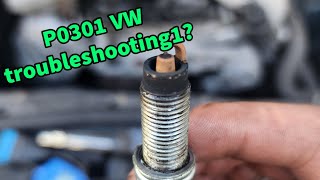
How to confirm: After confirming the coil is good, remove the spark plug from cylinder 1. Inspect it for wear (worn electrode), carbon fouling, or oil contamination. You can also swap it with another cylinder's plug to see if the fault follows. For tuned vehicles, ensuring the correct heat range and plug gap (e.g., 0.024 inches) is critical.
Typical fix: Replace the spark plug. It is best practice to replace all spark plugs as a set to ensure even performance.
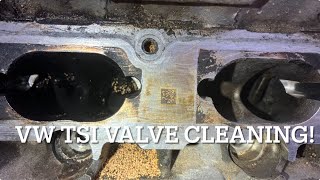
Est. part cost: $10-$25 per plug - Carbon Buildup on Intake Valves (1.8T/2.0T engines only) 🟡 Medium Probability Direct injection (TSI) engines spray fuel directly into the cylinder, so fuel detergents don't wash over the intake valves. Over time, oil vapor from the PCV system bakes onto the hot valves, restricting airflow and causing misfires, especially at idle or low RPM. This service is often needed every 70,000-100,000 miles.
How to confirm: This requires a borescope to visually inspect the intake valves through the intake manifold ports. A shop can perform this inspection, or it can be confirmed when the intake manifold is removed for cleaning.
Typical fix: The intake manifold must be removed and the valves cleaned, typically through a process called walnut blasting. This is an intensive labor job with costs ranging from $600 to $1200.
Est. part cost: $0 (cleaning service) - Failed Fuel Injector ⚪ Low Probability While less common than coils or plugs, fuel injectors can become clogged or fail electronically, sometimes getting stuck open or closed, especially on higher mileage vehicles. A user on the r/GolfGTI subreddit confirmed a bad injector was the cause of their P0301 after replacing plugs and coils.
How to confirm: This is a more advanced diagnostic. It can involve checking the injector's electrical resistance or swapping the injector with one from another cylinder, which is labor-intensive. A stuck-open injector may also produce white smoke from the exhaust.
Typical fix: Replace the faulty fuel injector. On TSI engines, this is an involved job that requires removing the intake manifold, making it a good time to also perform a carbon cleaning service.
Est. part cost: $50-$200 per injector - Failed PCV Valve ⚪ Low Probability The PCV (Positive Crankcase Ventilation) valve, or oil separator, can fail and create a significant vacuum leak. This throws off the air-fuel mixture and can cause misfires across multiple cylinders.
How to confirm: Symptoms include a whistling noise from the engine, high oil consumption, or a strong vacuum at the oil cap when the engine is running. A failed PCV often triggers lean codes (like P0171) alongside misfire codes.
Typical fix: Replace the PCV valve assembly. The OEM part number for many 2.0T TSI engines is 06H103495AH or a later revision.
Est. part cost: $100-$200
Rare But Worth Checking
- Low Engine Compression: This indicates a serious mechanical engine problem, such as worn piston rings, a bad valve, or a failed head gasket. A compression test is needed to confirm. A user on the Ross-Tech forums reported a P0301 with only 60 PSI in cylinder 1 compared to 90 PSI in others, indicating a mechanical fault.
- Vacuum Leak: A crack in an intake hose or a bad gasket can allow unmetered air into the engine, causing a lean condition and misfires. A loose air intake hose after other repairs has been reported as a cause.
- Crankshaft Position Sensor Adaptation: A VW Technical Tip (01-17-03TT) notes that after an actual misfire repair has been performed, the ECM may not automatically relearn the crankshaft sensor profile, causing false misfire codes. The fix involves clearing all OBD DTCs three times in a row with the ignition on and engine off to force a relearn.
Diagnosis Steps
- Read the fault codes with an OBD-II scanner and note any other codes present. A flashing check engine light indicates a severe misfire that could damage the catalytic converter.
- Identify cylinder 1 (the cylinder on the passenger side of the engine, closest to the accessory belt).
- Swap the ignition coil from cylinder 1 to cylinder 2. This is the most common failure point. Clear the codes, start the engine, and see if the misfire code changes to P0302. If it does, the ignition coil is bad.
- If the code remains P0301, move the spark plug from cylinder 1 to cylinder 3. Clear codes and re-test. If the code moves to P0303, the spark plug is bad. Inspect the old plug for fouling or wear.
- If the code is still P0301, inspect the ignition coil's electrical connector and wiring for damage or looseness.
- Check for vacuum leaks. Listen for whistling noises or check vacuum hoses for cracks. A common source is the PCV valve/oil separator.
- For TSI engines (1.8T/2.0T), if the misfire persists and is most noticeable at idle or low RPM, the next step is to inspect the intake valves for carbon buildup using a borescope.
- If all else fails, more advanced diagnostics like a fuel injector resistance test, swapping injectors between cylinders, or an engine compression test are needed to check for fueling or mechanical issues.
Parts You'll Likely Need
- Ignition Coil
(OEM #06H905115B, 07K905715G, 06E905115G (revisions exist))— This is the
Related Codes That Often Appear With This One
- P0300 — If the cause of the misfire (like a bad PCV valve, widespread carbon buildup, or low fuel pressure) affects multiple cylinders, a P0300 (Random/Multiple Cylinder Misfire) code will often accompany P0301.
- P0302, P0303, P0304 — These codes indicate misfires in other cylinders and point towards a systemic issue rather than a single bad coil or plug.
- P0087 — As noted in TSB #VIN4APIN20220118, this code for 'Fuel Rail/System Pressure - Too Low' can appear with misfire codes, suggesting a fuel delivery problem could be the root cause.
- P0171 — This code for 'System Too Lean (Bank 1)' often appears with a failed PCV valve or other vacuum leak, as the unmetered air disrupts the air-fuel ratio.
- P0351 — This code for 'Ignition Coil 'A' Primary/Secondary Circuit Malfunction' points directly to an electrical fault with the ignition coil for cylinder 1, rather than just a misfire event. When seen with P0301, a bad coil is almost certain.
Technical Service Bulletins (TSBs) & Recalls
- VIN4APIN20220118 - Notes that misfire codes (P0301-P0304) can appear alongside fuel pressure codes like P0087, indicating a potential fuel delivery issue.
- 01-17-03TT - A Technical Tip explaining that false misfire codes can appear after a repair because the crankshaft sensor adaptation profile has not been relearned. Recommends clearing DTCs three consecutive times to force a relearn.
Platform-Specific Known Issues
- Carbon Buildup (TSI Engines): Direct injection engines like the 1.8T and 2.0T are prone to heavy carbon deposits on the intake valves, which requires a manual cleaning (walnut blasting) service, typically every 60,000-80,000 miles, to resolve related misfires.
- Ignition Coil Failure: Ignition coils on this platform are known to fail frequently. It is a common practice for owners to keep a spare coil in the car for emergencies.
- False Misfire Detection: TSB 01-17-03TT describes a condition where the ECM can report false misfires after a repair has been made. The fix involves a specific procedure to clear the codes multiple times to force the crankshaft sensor to relearn.
Mechanic-Grade Diagnostic Values
- High-Pressure Fuel Rail (HPFP) Pressure vs. Requested Pressure — expected: Actual pressure should closely track requested pressure under all load conditions.. Failure: If actual pressure falls significantly below specified, especially at high RPM, it indicates a fuel deficiency (e.g., failing LPFP or HPFP). A lambda regulator value pegged at +25% simultaneously confirms this.
- Spark Plug Gap (Tuned Vehicles) — expected: 0.024 inches. Failure: An incorrect gap on a tuned engine can cause misfires under high boost. Stock plugs may not be suitable.
- Low-Pressure Fuel Pump (LPFP) Duty Cycle — expected: Varies with demand, but should not be maxed out continuously.. Failure: If the duty cycle is climbing to its maximum while actual pressure is falling, the low-pressure fuel system is struggling to keep up.
Hidden / Shadow Codes Worth Checking
- Misfire Counter (Live Data): The ECU tracks misfire events per cylinder in real-time, even before they are frequent enough to set a P030x trouble code. This allows a technician to see which cylinder is having intermittent issues. (see via Using a tool like VCDS (VAG-COM), navigate to Engine (01) -> Advanced Measuring Values and search for 'misfire'. On older controllers, check Measuring Block Groups 014, 015, and 016.)
Scan Tool Commands That Help
- VCDS (VAG-COM): Advanced Measuring Values — To simultaneously log multiple parameters like misfire counts per cylinder, requested vs. actual fuel rail pressure, and lambda values. This is critical for diagnosing misfires that only occur under specific load or RPM conditions.
- VCDS (VAG-COM): Output Tests — Can be used to activate certain components like the fuel pump to verify its operation without the engine running. This helps isolate electrical from mechanical issues.
Wiring & Ground Locations
- Ground connection on the engine block (18) — On the engine block itself, crucial for the engine's electrical systems.. A poor engine ground can cause a weak or inconsistent spark, leading to misfires. The ignition coils rely on a solid ground path to function correctly.
- Ground connection in plenum chamber, left (607) — Located in the plenum chamber area, near the firewall on the driver's side (LHD).. This ground point is in the vicinity of the Engine Control Module (J623) and other critical sensors. Corrosion or looseness here can cause a wide range of erratic engine management issues, including false misfire detection.
- Ground strap, battery to body (1) — The main ground strap from the battery negative terminal to the vehicle's chassis.. This is the primary ground for the entire vehicle's electrical system. Degradation of this strap can lead to system-wide low voltage issues, affecting ignition performance and potentially causing misfires.
- Main earth point with brown wires (Mk7) — Located above the battery at the back of the engine bay.. This is a central grounding point for numerous engine bay components. On the Mk7 platform, ensuring this connection is clean and tight is a key step in troubleshooting electrical faults.
Real Owner Repair Stories
- Reddit user r/GolfGTI (2012 GTI 6-speed, 56k miles) — Flashing check engine light, engine misfiring, P0301 code.
❌ Tried (didn't work) Replaced all four spark plugs., Replaced all four ignition coils with OEM parts.
✅ What actually fixed it The problem was a faulty #1 cylinder fuel injector that was stuck open. This was confirmed by the presence of white smoke from the tailpipe. The user noted that replacing the injector also meant it was a good time for a carbon cleaning service. - Reddit user r/GolfGTI (2017 GTI Sport, 114k miles) — P0301 misfire code appeared shortly after having the cylinder 1 fuel injector replaced by the dealer for a P0201 code. Car felt down on power and ran rough.
❌ Tried (didn't work) Swapping spark plugs to see if the misfire moved.
✅ What actually fixed it Performing a carbon cleaning service resolved the misfire and power loss issues. This suggests the new injector was functioning, but the underlying carbon buildup on the intake valves was the remaining cause of the misfire. - Reddit user r/MechanicAdvice (2000 VW Jetta 2.0L) — P0301, engine vibration, intermittent loss of power, blinking CEL.
❌ Tried (didn't work) Replaced spark plugs and wires., Replaced ignition coil., Replaced Mass Airflow Sensor.
✅ What actually fixed it The new spark plug wire for cylinder 1 was faulty out of the box. Replacing the brand new, but defective, wire with another new one solved the problem.
When the Usual Fixes Don't Work
- In one documented case on a 2012 GTI, the owner replaced both the spark plugs and all four ignition coils in response to a P0301, which are the most common fixes. The misfire persisted. The ultimate cause was a failed fuel injector stuck open in cylinder 1, which required removing the intake manifold to replace. This highlights that while coils and plugs are primary suspects, they are not the only cause, and symptoms like white smoke can point towards a fuel system issue.
OEM Part Supersession History
06H905115A→06H905115B (and later revisions)— The 'A' revision of the 2.0T TSI ignition coil had known quality and longevity issues, leading to frequent misfires. The 'B' revision is a more robust and reliable design.
Heads up: While physically interchangeable, it is highly recommended to replace any 'A' revision coils with the newer 'B' revision or equivalent OEM part if a misfire occurs.06H103495A / 06H103495E→06H103495AC / 06H103495AH (and later revisions)— Early versions of the 2.0T TSI PCV valve assembly were prone to diaphragm failure, causing significant vacuum leaks and misfires. Later revisions offered improved durability.
Model Year Variations Within This Range
- Approx. 2015+: The introduction of the EA888 Gen 3 engine in the Mk7 Golf (and later Mk6 models) included a dual-injection system (both port and direct injection). This significantly reduces the rate of carbon buildup on intake valves compared to the direct-injection-only earlier Gen 1 and Gen 2 EA888 engines. While carbon buildup can still occur, it is a much less frequent cause of misfires on these later models.
Helpful Videos
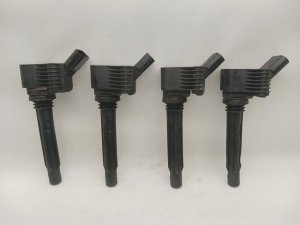
Used OEM Parts in Stock



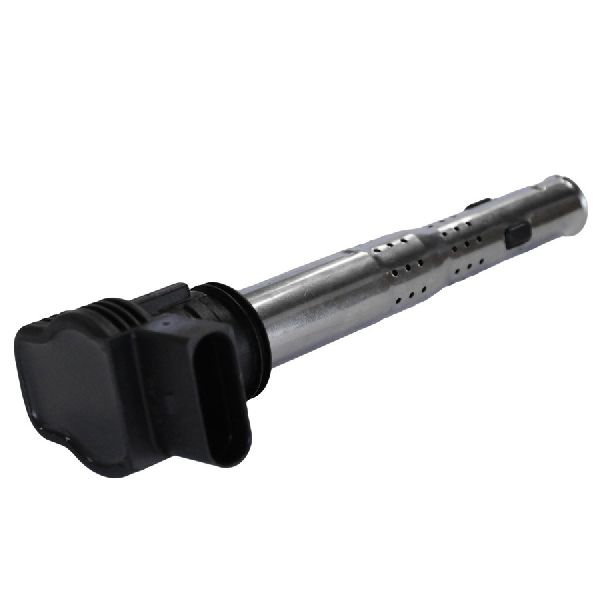
New Aftermarket Parts Available

The information in this article is provided for general reference and educational purposes only. Vehicle specifications, procedures, and part compatibility can vary by production date, trim level, and region. Always consult your vehicle's factory service manual and verify part numbers before purchasing or performing repairs. Safety-critical components such as airbags, seat belts, and braking systems should be installed by a qualified professional.
- Volkswagen GOLF:
- 🎬 Helpful Videos
- 🛍️ Shop This Part
- What's Unique About the 2010-2017 Volkswagen GOLF
- Diagnostic Flowchart
- Symptoms You May Notice
- Most Likely Causes
- Rare But Worth Checking
- Diagnosis Steps
- Parts You'll Likely Need
- Related Codes That Often Appear With This One
- Technical Service Bulletins (TSBs) & Recalls
- Platform-Specific Known Issues
- Mechanic-Grade Diagnostic Values
- Hidden / Shadow Codes Worth Checking
- Scan Tool Commands That Help
- Wiring & Ground Locations
- Real Owner Repair Stories
- When the Usual Fixes Don't Work
- OEM Part Supersession History
- Model Year Variations Within This Range
- 🎟️ Get 5% Off