

P0301 on 2007-2013 Mini Cooper: Cylinder 1 Misfire Causes and Fixes
P0301 means cylinder 1 is misfiring. On the 2007-2013 Mini Cooper, this is most often caused by a failed ignition coil or a worn spark plug. A simple diagnostic is to swap the coil from cylinder 1 with another cylinder to see if the code changes (e.g., to P0302). Other common causes on this platform include carbon buildup on intake valves and high-pressure fuel pump (HPFP) failure.
- P0301 on a 2007-2013 Mini Cooper indicates a misfire in the first cylinder, located on the passenger side of the engine.
- Start your diagnosis with the easiest and most common fixes: swap the ignition coil from cylinder 1 to another cylinder to see if the misfire follows it.
- If the coil is good, inspect and likely replace the spark plugs, especially if they are old.
- Be aware of platform-specific issues like carbon buildup (especially on N14 engines) and high-pressure fuel pump (HPFP) failure, which are common secondary causes for misfires.
- Do not ignore a flashing check engine light, as it signals a severe misfire that can quickly damage your catalytic converter.
What's Unique About the 2007-2013 Mini Cooper

The 2007-2013 Mini Cooper (R56 generation) uses two different direct-injection turbo engines: the N14 (2007-2010) and the N18 (2011-2013). While both can suffer from common misfire causes like bad coils, they are also known for specific issues. The N14 engine, in particular, is highly susceptible to severe carbon buildup on the intake valves, which can disrupt airflow and cause misfires. Both engines have also been plagued by high-pressure fuel pump (HPFP) failures, which can lead to misfires, often during cold starts. Additionally, the N14 engine is known for timing chain tensioner issues, often called the 'death rattle', which can cause the timing to jump and lead to misfires.
Generation note: This guide covers the second-generation Mini Cooper Hardtop (R56), which includes two different engines. The 2007-2010 models use the N14 engine, while the 2011-2013 models use the updated N18 engine. The N14 is particularly known for heavy carbon buildup on intake valves and timing chain issues. The N18 has an improved PCV system to reduce carbon buildup, but it can still occur. Both engines are known for high-pressure fuel pump (HPFP) failures, and MINI has issued warranty extensions for this part on both N14 and N18 engines.
Symptoms You May Notice
- Rough or shaking idle.
- Hesitation or stumbling during acceleration.
- Noticeable loss of engine power.
- Flashing or solid Check Engine Light.
- Difficulty starting the engine, especially when cold (long crank times).
- Smell of raw fuel from the exhaust.
- Engine goes into reduced power 'limp mode'.
- Loud 'rattling' or 'diesel tractor' noise from passenger side of engine on cold starts (indicative of timing chain issues).
- Replacing only the spark plugs when the ignition coil is the actual point of failure.
- Replacing the low-pressure fuel pump in the tank when the high-pressure fuel pump (HPFP) is the real issue.
- Repeatedly replacing plugs and coils when the root cause is severe carbon buildup on the intake valves.
Most Likely Causes

- Faulty Ignition Coil 🔴 High Probability Ignition coils are a very common failure item on this Mini platform. Heat and vibration lead to internal coil failure over time. Many owners on forums recommend using OEM-branded coils like Bosch or Delphi over cheaper aftermarket options to avoid premature failure.
How to confirm: Swap the ignition coil from cylinder 1 with another cylinder (e.g., cylinder 2). Clear the codes and drive the car. If the code changes to P0302 (Cylinder 2 Misfire), the coil is bad. This is the most common first diagnostic step recommended on owner forums.
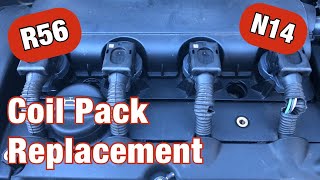
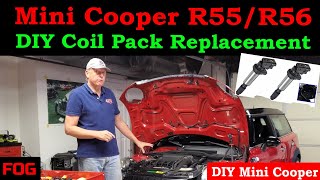
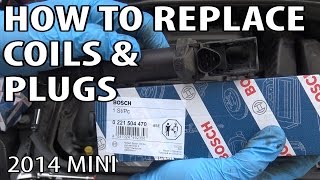
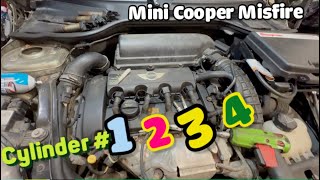
Typical fix: Replace the faulty ignition coil. It is often recommended to replace all four coils at the same time as a preventative measure, along with the spark plugs if they are due. 🎬 Watch this DIY guide to replacing your coils and plugs.
Est. part cost: $40-$80 per coil - Worn or Fouled Spark Plug 🔴 High Probability
How to confirm: After ruling out the coil, remove the spark plug from cylinder 1. Inspect it for wear (worn electrode), carbon fouling (dry, black soot), or oil/fuel contamination (wet). A plug fouled with fuel could indicate a leaking injector. Compare it to the other plugs.
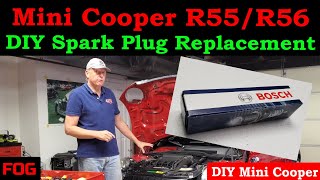
Typical fix: Replace the spark plugs. Plugs should be replaced as a set of four. Ensure they are gapped correctly before installation, although many modern iridium plugs come pre-gapped. The correct spark plug for the N14 engine is NGK PLZKBR7A.
Est. part cost: $15-$25 per plug - Carbon Buildup on Intake Valves 🔴 High Probability As direct-injection engines, the N14 and N18 do not have fuel washing over the intake valves. Oil vapor from the PCV system bakes onto the hot valves, forming hard carbon deposits that restrict airflow. This is especially severe on the N14 engine and is often required every 40,000-60,000 miles.
How to confirm: This requires visual inspection using a borescope inserted into the intake ports with the intake manifold removed. This is a very common cause of persistent, otherwise unexplained misfires on this platform.
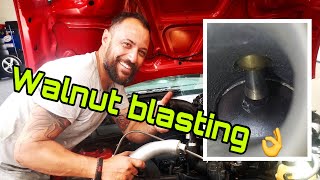
Typical fix: The intake valves must be cleaned. The most effective and manufacturer-recommended method is walnut shell blasting, which uses crushed walnut shells and compressed air to safely remove the deposits without damaging the valves or cylinder head. 🎬 See how to perform a walnut blast carbon cleaning.
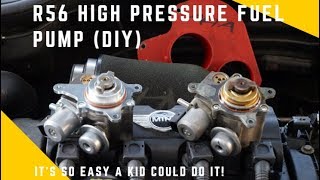
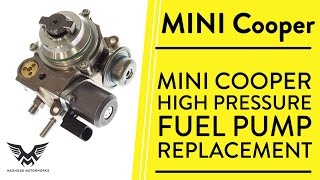
Est. part cost: $50-$100 for walnut media and port adapter (DIY) - Failing High-Pressure Fuel Pump (HPFP) 🟡 Medium Probability The HPFP is a well-documented weak point on both N14 and N18 engines, often failing prematurely, sometimes as early as 40,000 miles. MINI has issued warranty extensions for this part to 10 years/120,000 miles under TSBs M01 04 19 (N14) and M01 01 16 (N18).
How to confirm: Diagnosis requires a scan tool capable of reading fuel rail pressure. Compare the requested fuel pressure to the actual fuel pressure during a cold start and under load. A significant discrepancy (e.g., actual pressure is far below requested pressure) points to a failing HPFP. This often appears with code P2880.
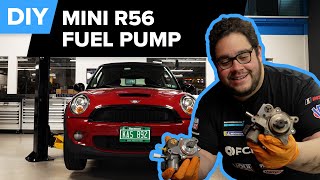
Typical fix: Replace the high-pressure fuel pump. Some owners opt for the equivalent Peugeot/Citroën part, which can be cheaper than the MINI-branded part.
Est. part cost: $300-$1000+ - Leaking or Clogged Fuel Injector ⚪ Low Probability
How to confirm: A leaking injector may cause a fuel smell, a wet, black spark plug, or misfires after a hot soak restart. A clogged injector will lean out the cylinder. Swapping the injector between cylinders (similar to a coil swap) can confirm the fault, but this is more labor-intensive. A professional injector cleaning and flow testing service is another option.
Typical fix: Replace the faulty fuel injector. It's recommended to replace the Teflon seal and decoupling element whenever an injector is removed and reinstalled.
Est. part cost: $100-$250 per injector
Rare But Worth Checking
- Timing Chain and Tensioner Issues (N14): Primarily affecting the N14 engine, the timing chain tensioner can fail, causing the chain to become slack. This creates a 'death rattle' noise on cold starts. If left unaddressed, the chain can stretch or skip a tooth on the camshaft sprocket, altering valve timing and causing misfires, often on multiple cylinders. In severe cases, this leads to catastrophic engine damage. NHTSA ODI #10608012 describes a case where an upper guide rail for the timing chain shattered, resulting in P0301 and P0303 misfire codes.
- Low Cylinder Compression: If ignition and fuel system checks don't reveal the cause, a mechanical issue could be the culprit. This can be caused by a burnt valve, damaged piston, or worn piston rings. A compression test and a cylinder leak-down test will identify this. One forum user reported a P0301 but the dealer found low compression on a different cylinder, highlighting the need for thorough testing.
- Faulty DME (ECU): In rare cases, the driver circuit for the ignition coil within the engine computer (DME) can fail. This usually happens after an ignition coil shorts out. If a new coil and plug do not produce spark on cylinder 1, this should be investigated. A Reddit user reported this exact failure, which required a new DME to resolve the P0301.
Diagnosis Steps

- Read the fault codes with an OBD-II scanner to confirm P0301 and check for any other codes, especially P0300 or P2880.
- Swap the ignition coil from cylinder 1 to cylinder 2. Clear the codes and test drive. If the code changes to P0302, the ignition coil is faulty.
- If the misfire remains on cylinder 1, inspect the spark plug. Look for signs of wear, damage, or fouling (black/sooty, wet with fuel, or oily). Replace if necessary. It's best practice to replace all four.
- If ignition components are good, the issue is likely fuel, air, or mechanical. Check for vacuum leaks around the intake manifold and PCV hoses.
- Use a scan tool to monitor the high-pressure fuel pump's actual vs. requested pressure, especially during a cold start, to check for HPFP failure.
- For N14 engines especially, inspect intake valves for carbon buildup using a borescope. This is a very common cause of persistent misfires.
- Listen for a 'death rattle' on cold starts (N14 engine), which would indicate a timing chain issue requiring immediate attention.
- If other tests are inconclusive, perform a cylinder compression test, followed by a leak-down test if compression is low, to check for mechanical engine problems like a burnt valve or bad piston rings.
Parts You'll Likely Need

- Ignition Coil
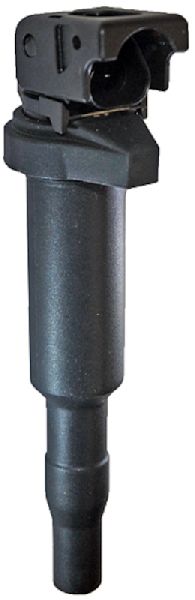
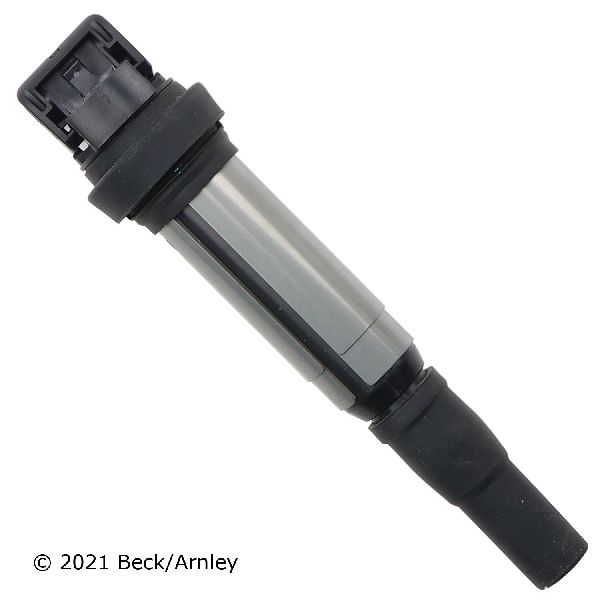
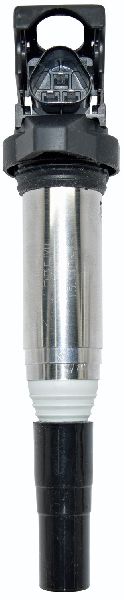
(OEM #12138616153 (supersedes 12137575010))— This is the most frequent cause of a single-cylinder misfire on this platform.
Trusted brands: Bosch, Delphi, Eldor
OEM price range: $70-$100
Aftermarket price range: $40-$80 - Spark Plug
(OEM #12122158253 (NGK PLZKBR7A for N14))— Spark plugs are a regular maintenance item and can cause misfires when worn or fouled.
Trusted brands: NGK, Bosch
OEM price range: $25-$35
Aftermarket price range: $15-$25 - High-Pressure Fuel Pump (HPFP)
(OEM #13517588879 (for N14))— A very common failure point on N14/N18 engines that leads to various misfire and starting issues. Subject to a warranty extension.
Trusted brands: MINI (OEM), PSA (Peugeot/Citroen OEM)
OEM price range: $600-$1200
Aftermarket price range: $300-$700
Related Codes That Often Appear With This One
- P0300 — This is a 'Random/Multiple Cylinder Misfire' code. If the cause (like a bad HPFP, large vacuum leak, or jumped timing) affects all cylinders, P0300 may appear alongside P0301 and other cylinder-specific codes.
- P0302, P0303, P0304 — These codes indicate misfires on cylinders 2, 3, and 4, respectively. Seeing multiple misfire codes often points to a systemic issue like fuel delivery (HPFP), severe carbon buildup, or timing problems.
- P2880 — This code specifically relates to 'High Pressure Fuel System Plausibility'. It often appears when the HPFP is failing and cannot provide the pressure requested by the DME, leading to misfires.
Technical Service Bulletins (TSBs) & Recalls
- M01 04 19: Class action settlement extending the warranty on the N14 High-Pressure Fuel Pump (HDP) to 10 years/120,000 miles.
- M01 01 16: Extends the limited warranty for the N18 engine's High-Pressure Fuel Pump (HDP) to 10 years/120,000 miles.
- M12 02 10 (superseded by M12 02 12): Discusses diagnosis for misfire faults on the N14, pointing to fuel quality, carbon deposits, and recommending walnut shell blasting.
Platform-Specific Known Issues
- The 'Death Rattle' and Misfires: On N14 engines, a loud rattling noise from the passenger side of the engine upon cold start is a classic symptom of a failing timing chain tensioner. This isn't just a noise issue; a loose chain can cause incorrect valve timing, leading to misfires (P0301, P0300, etc.) and eventual engine damage if not addressed.
- Carbon Buildup Diagnosis Story: A common story on North American Motoring involves an owner chasing a persistent P0301 code. They replace plugs and coils with no success. The misfire remains on cylinder 1. Finally, after removing the intake manifold, they discover the intake ports are severely choked with carbon. After a walnut blasting service, the misfire is completely resolved. This is a rite of passage for many N14 owners.
- HPFP Cold Start Woes: Owners with a failing HPFP often report a specific symptom pattern: the car struggles to start and runs very rough for the first 30-60 seconds when cold. It may even stall. Once warmed up, the car may run perfectly fine. This intermittent, temperature-dependent behavior, often accompanied by P2880, is a strong indicator of HPFP failure.
Mechanic-Grade Diagnostic Values
- High-Pressure Fuel Rail Pressure (N14 Engine, at idle) — expected: ~5 MPa or ~725 PSI. Failure: Significantly lower pressure, especially during cold starts or under load. A failing pump may only show ~110 PSI while cranking.
- High-Pressure Fuel Rail Pressure (N18 Engine, at idle) — expected: ~725 PSI, or up to ~1100 PSI on vehicles with a specific DME software update.. Failure: Pressure that is significantly below the target setpoint shown on a capable scan tool.
- Low-Pressure Fuel Pump Pressure (in-tank) — expected: ~5 bar or ~70-90 PSI, measured at the feed line to the HPFP.. Failure: Pressure significantly below 70 PSI. A completely failed pump may show as low as 5 PSI.
- Fuel Injector Resistance (General) — expected: These are high-impedance injectors, typically measuring between 10-16 ohms. All injectors should have very similar readings.. Failure: A reading that is significantly different from the other injectors, or an open/infinite resistance reading, indicates a faulty injector. However, swapping the injector to another cylinder is the most definitive test.
Hidden / Shadow Codes Worth Checking
- 2EE0: Combustion Misfire & Fuel Injection fault. This is a BMW-specific code that may accompany a generic P030x code. (see via BMW/MINI specific scan tools like ISTA or Foxwell scanners.)
- 140010, 140110, 140210, etc.: Hexadecimal codes for 'Misfire, Multiple Cylinders Detected' or specific cylinders (e.g., 140110 for Cylinder 1). (see via Advanced BMW/MINI diagnostic software (ISTA).)
- 2D7F: Injector open circuit fault. For cylinder 1, this would point directly to an issue with the injector or its wiring/DME driver. (see via BMW/MINI specific scan tools.)
Scan Tool Commands That Help
- ISTA (Dealer Software): Service Functions > Drive > Digital Motor Electronics (DME) > Misfire Detection — To view detailed misfire counters and roughness data for each cylinder, which can help diagnose intermittent misfires that don't always set a code. You can also access test plans for specific fault codes.
- Generic OBD-II Scanner with Mode 6: On-Board Monitor Test (Mode $06) > Misfire Data — To view the raw misfire count for each cylinder during the current and last driving cycles. This is extremely useful for confirming a bad coil after swapping it, as you can see if the high misfire count moves to the new cylinder even before the Check Engine Light comes back on.
- Foxwell NT510 / similar: Control Modules > Drive > DME > Live Data > High Pressure Fuel System — To monitor the 'Rail Pressure Setpoint' versus the 'Actual Rail Pressure' in real-time. This is the primary method for diagnosing a failing HPFP.
Wiring & Ground Locations
- Engine Ground Strap — A braided strap running from the engine block (often near the passenger side engine mount) to the chassis frame rail.. This is the main ground for the engine. Corrosion or breakage is common and can cause weak spark, stalling, and random electrical issues, including misfires. A bad ground can also cause battery drain issues.
- Ignition Coil Grounds — Small ground wires bolted directly to the front of the valve cover, providing a ground path for the ignition coils.. A loose or corroded ground here can directly affect the performance of the ignition coils, leading to weak spark and misfires.
- DME Main Grounds — Located on the driver's side, in front of the firewall. Access requires removing the DME/ECU and unfastening the fuse box.. These are the primary ground points for the engine computer. A poor connection here can cause a wide range of unpredictable engine management faults, including false misfire detection or failure of DME coil drivers.
- Cylinder 1 Injector Wiring (N14) — At the DME connector X60232 (the small 32-pin connector), power supply is on Pin 4 and the DME control signal is on Pin 29.. When diagnosing a persistent P0301 after swapping parts, a technician can test for continuity and signal from these specific pins to rule out a wiring or DME driver issue.
Real Owner Repair Stories
- North American Motoring forum user (2013 MINI Countryman S ALL4 (R60, N18 engine)) — Car went into limp mode, loss of power, Check Engine Light on. Started with P0301, then P0300, P0301, P0302.
❌ Tried (didn't work) Replaced all 4 ignition coils., Replaced all 4 spark plugs., Replaced the High-Pressure Fuel Pump (HPFP).
✅ What actually fixed it The DME (ECU) had failed. A diagnostic check showed no 5v signal coming from the coil plug on cylinder 1. The owner sourced a used DME on eBay and had it cloned with the information from the original, which resolved all misfire codes. - North American Motoring forum user (MINI Cooper S (R56)) — Persistent P0301 misfire code and the DSC (Dynamic Stability Control) light would illuminate and stay on.
❌ Tried (didn't work) Swapping spark plugs between cylinders.
✅ What actually fixed it The T-MAP sensor on the intake manifold was missing its rubber gasket on the electrical plug. This allowed water to enter and corrode the connector pins and the sensor itself. Cleaning the connector and replacing the MAP sensors fixed the P0301 and the DSC light issue. - NHTSA ODI #10608012 — An owner reported that after further inspection of misfire codes P0300, P0301, and P0303, it was discovered that the upper guide rail for the timing chain had shattered.
"I Checked Everything" — The Actual Cause
- A cracked valve cover can cause misfires. The N14/N18 valve cover has an integrated PCV (crankcase ventilation) system. If the internal diaphragm fails or the cover develops a hairline crack, it creates an unmetered air leak (vacuum leak). This may not be found with a smoke test if the leak is internal to the PCV passages, but it will lean out the mixture and can cause misfires, sometimes isolated to a single cylinder depending on intake manifold airflow dynamics.
OEM Part Supersession History
13517592429 (N18 HPFP)→13517630644, then 13518605102— Revisions to improve reliability of the high-pressure fuel pump.
Heads up: The N18 HPFP changed around 03/2012. The early 'Continental' style pump is different from the later 'round style' pump. They are not interchangeable.13537528351 (N14 Fuel Injector)→13-64-7-598-785, then 13-53-7-591-623, then 13-53-8-682-350— Multiple revisions to improve injector performance and reliability.
Heads up: When replacing injectors, it is highly recommended to replace them as a full set to ensure matched flow rates and characteristics.Genuine MINI HPFP (N14)→Genuine PSA (Peugeot/Citroën) HPFP (Part # 1920LL or 9819938480)— Cost savings. The N14 is a joint BMW/PSA engine, and the PSA-branded pump is identical to the MINI part but often significantly cheaper.
Heads up: This is a direct, genuine-to-genuine alternative for the N14 engine only.
Model Year Variations Within This Range
- 2011-2013 (N18 Engine): A DME software update was released by MINI that increased the target fuel rail pressure at idle from ~750 PSI to ~1100 PSI. A technician diagnosing low fuel pressure must be aware of which software version is on the car to know the correct target pressure.
- 2011-2012 (N18 Engine): The design of the High-Pressure Fuel Pump (HPFP) changed around March 2012. Early N18 engines use a 'Continental' branded pump (e.g., PN 13517592429), while later models use a different design. The parts are not interchangeable.
Diagnostic Flowchart
Real Owner Stories
Aggregated from forums and TSBs cited above. Mileages and costs reflect what owners reported in those sources.
Mini Cooper N14 — ~50000 miles
Symptoms: Chased a persistent P0301 code. Replaced plugs and coils with no success, and the misfire remained isolated to cylinder 1.
What fixed it: Removed the intake manifold, discovered the intake ports were severely choked with carbon, and performed a walnut blasting service.
Source hint: North American Motoring forum story on Carbon Buildup Diagnosis
Mini Cooper N14/N18 — ~40000 miles
Symptoms: Experienced long cranks, the engine going into limp mode, and struggling to start when cold, accompanied by code P2880.
What fixed it: Replaced the failing High-Pressure Fuel Pump (HPFP).
Source hint: North American Motoring thread 264593: high-pressure-fuel-pump-failure-symptoms
Mini Cooper R53
Symptoms: Experienced a P0301 cylinder 1 misfire code that standard ignition troubleshooting could not resolve.
What fixed it: Dealer performed a cylinder compression test which revealed an underlying mechanical engine issue.
Source hint: North American Motoring thread 247188: r53-w-p0301-code-help
Mini Cooper
Symptoms: Triggered a Code P0301 misfire detected in 1 cylinder.
What fixed it: Started the DIY diagnostic journey by replacing the spark plugs.
Source hint: Reddit r/MINI thread: Code P0301 misfire detected in 1 cylinder
Mini Cooper Clubman S
Symptoms: An owner reported a random misfire (P0300) along with specific cylinder misfires P0301 and P0303, and a downstream throttle air leak (P1492).
What fixed it: Further inspection revealed that the upper guide rail for the timing chain had shattered (NHTSA ODI #10608012).
Related OBD-II Codes
Frequently Asked Questions
Is the High-Pressure Fuel Pump (HPFP) covered under warranty for my N14 or N18 engine?
I have a P0301 code and hear a loud rattling noise on cold starts. What does this mean?
What spark plugs should I use for my N14 engine to fix a cylinder 1 misfire?
I replaced the ignition coils and spark plugs, but P0301 keeps coming back. What is the next step?
Are there specific ignition coil brands recommended for the 2007-2013 Mini Cooper?
My Mini struggles to start and runs rough for the first minute when cold, then runs fine. Is this related to P0301?
Helpful Videos
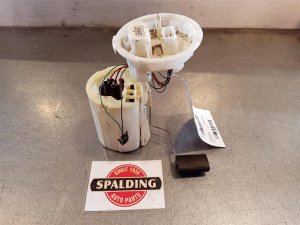
Used OEM Parts in Stock


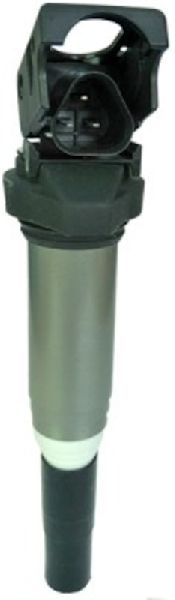
New Aftermarket Parts Available



The information in this article is provided for general reference and educational purposes only. Vehicle specifications, procedures, and part compatibility can vary by production date, trim level, and region. Always consult your vehicle's factory service manual and verify part numbers before purchasing or performing repairs. Safety-critical components such as airbags, seat belts, and braking systems should be installed by a qualified professional.
- Mini Cooper:
- 🎬 Helpful Videos
- 🛍️ Shop This Part
- What's Unique About the 2007-2013 Mini Cooper
- Symptoms You May Notice
- Most Likely Causes
- Rare But Worth Checking
- Diagnosis Steps
- Parts You'll Likely Need
- Related Codes That Often Appear With This One
- Technical Service Bulletins (TSBs) & Recalls
- Platform-Specific Known Issues
- Mechanic-Grade Diagnostic Values
- Hidden / Shadow Codes Worth Checking
- Scan Tool Commands That Help
- Wiring & Ground Locations
- Real Owner Repair Stories
- "I Checked Everything" — The Actual Cause
- OEM Part Supersession History
- Model Year Variations Within This Range
- Diagnostic Flowchart
- Real Owner Stories
- Mini Cooper N14 — ~50000 miles
- Mini Cooper N14/N18 — ~40000 miles
- Mini Cooper R53
- Mini Cooper
- Mini Cooper Clubman S
- Related OBD-II Codes
- Frequently Asked Questions
- 🎟️ Get 5% Off