

P0300 on 2015-2019 Subaru Outback 2.5L: Random Misfire Causes and Fixes
Code P0300 on a 2015-2019 Subaru Outback most often points to worn spark plugs or a failing ignition coil. Replacing all four spark plugs is a common first step and costs around $40-$80 for parts. If that doesn't solve it, an ignition coil or the front Air/Fuel ratio sensor are the next likely culprits.
- P0300 on a 2015-2019 Outback is most likely caused by worn-out spark plugs or a bad ignition coil.
- Do not ignore a flashing check engine light, as it signals a severe misfire that can quickly damage your expensive catalytic converter.
- Due to the boxer engine design, changing spark plugs and coils is more difficult than on many other cars, requiring wobble extensions and a specific 14mm thin-wall socket.
- Always replace spark plugs as a complete set of four.
- If you experience a shudder without a check engine light, consider investigating the transmission's torque converter as a possible cause.
What's Unique About the 2015-2019 Subaru Outback
On the 2015-2019 Outback with the FB25 engine, a P0300 code is very frequently a straightforward ignition or air/fuel system issue. These engines use a coil-on-plug system, where each spark plug has its own ignition coil. While the boxer engine design makes accessing the spark plugs and coils notoriously tight against the frame rails, it's a common maintenance job. Another issue sometimes seen on Subarus is a transmission torque converter shudder that can be misidentified by the driver as an engine misfire, though this typically won't set a P0300 code on its own.
Symptoms You May Notice
- Rough or vibrating idle
- Hesitation or stumbling during acceleration
- Flashing or solid Check Engine Light
- Noticeable loss of engine power
- Reduced fuel economy
- Engine is hard to start
- Shuddering sensation, sometimes described as driving over rumble strips, often occurring between 35-45 mph (can be confused with torque converter lock-up issues).
- Replacing only one spark plug or coil when others are near the end of their service life.
- Mistaking a transmission torque converter shudder for an engine misfire. The shudder feels like a vibration under light throttle at 35-45 mph and is a known transmission issue, whereas a misfire is typically a more erratic stumble.
Most Likely Causes
- Worn or Fouled Spark Plugs 🔴 High Probability Spark plugs are a regular maintenance item with a 60,000-mile replacement interval. The FB25 engine can also have oil consumption issues, which may lead to oil fouling the spark plugs, causing a misfire.
How to confirm: Remove and inspect the spark plugs. Look for a worn-down center electrode, an excessively wide gap, or black/oily deposits on the tip. The specified gap is typically 0.039 to 0.043 inches.
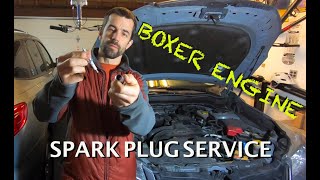
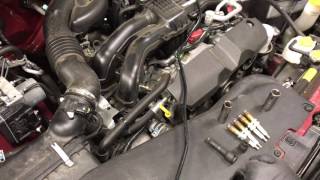
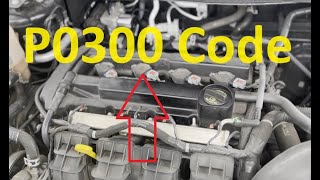
Typical fix: Replace all four spark plugs as a set. It is critical to use the correct 14mm thin-wall spark plug socket 🎬 Watch: Step-by-step spark plug replacement for 2019 Outback models. and be prepared for a difficult job due to tight access. Use of OEM-spec NGK plugs is highly recommended by enthusiasts.
Est. part cost: $40-$80 - Defective Ignition Coil(s) 🔴 High Probability Ignition coils are a common failure point on modern engines. Heat and vibration cause the internal windings to fail over time, resulting in a weak or non-existent spark. A loose coil hold-down bolt can also cause a poor connection and misfires.
How to confirm: The best way is to swap the suspected bad coil with a coil from a known good cylinder. If the misfire code changes to that specific cylinder (e.g., P0301, P0302), the coil is bad. A loose coil can be confirmed by checking the 10mm hold-down bolt; one owner found their coil was 'dangling off the side of the engine'.
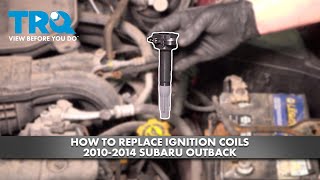
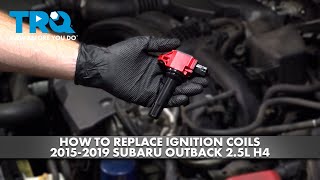
Typical fix: Replace the faulty ignition coil. While you can replace just one, if the vehicle has high mileage, it may be wise to replace all four as a preventative measure. The spark plug boot/cap is also available as a separate service part per TSB 07-153-19. 🎬 See this walkthrough on replacing ignition coils on your Outback.
Est. part cost: $50-$100 per coil - Failing Front Air/Fuel Ratio (O2) Sensor 🟡 Medium Probability The front A/F sensor (Bank 1, Sensor 1) provides critical data for fuel mixture adjustments. When it becomes slow or fails, it can send incorrect information to the ECM, leading to a lean or rich condition that causes random misfires across all cylinders. A manufacturer service bulletin, TSB Bulletin #11-193-19, notes that slight differences in the air-fuel ratio between cylinders can cause P0300 to set.
How to confirm: A failing A/F sensor will often cause poor fuel economy, a rough idle, and hesitation in addition to the P0300 code. A scan tool with live data can monitor the sensor's response time and voltage to confirm failure. A specific forum member fixed their P0300 and P0304 codes by replacing this sensor.
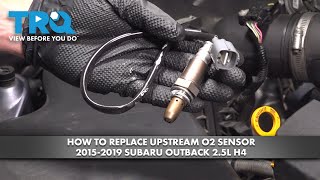
Typical fix: Replace the front A/F sensor, located on the passenger side exhaust manifold. A special 22mm slotted oxygen sensor socket is required for removal. The Denso 234-9109 is a commonly cited OEM-quality 🎬 Watch: How to replace the upstream air/fuel ratio sensor. replacement part.
Est. part cost: $100-$180 - Vacuum Leak 🟡 Medium Probability Vacuum leaks from sources like a cracked intake air snorkel, a disconnected PCV hose, or a leaking intake manifold gasket allow unmetered air into the engine. This leans out the air-fuel mixture and can cause random misfires.
How to confirm: A mechanic can perform a smoke test, which involves feeding pressurized smoke into the intake system and watching for where it escapes. Visually inspecting all vacuum hoses, especially the PCV hose and the large intake snorkel, for cracks or breaks is also a good first step.
Typical fix: Replace the leaking hose or gasket. Intake manifold gaskets are more labor-intensive than a simple hose.
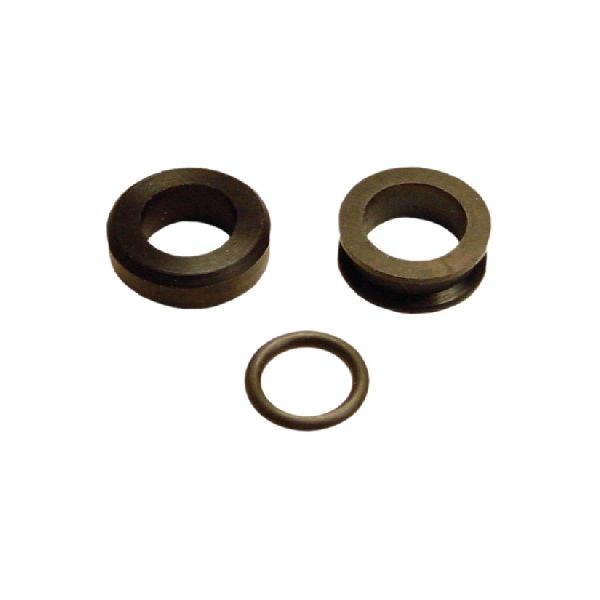
Est. part cost: $10-$150 - Dirty or Clogged Fuel Injectors ⚪ Low Probability Carbon buildup can restrict fuel flow, leading to a lean condition in one or more cylinders. While less common than ignition issues, a failing injector can cause a persistent misfire that starts randomly. One owner on subaruoutback.org ultimately traced their P0300, P0302, and P0304 codes to a bad fuel injector after replacing plugs and coils did not work.
How to confirm: Requires a fuel injector balance test to measure the flow rate of each injector. This is typically done by a professional.
Typical fix: Professional fuel system cleaning or replacement of the clogged injector(s).
Est. part cost: $100-$300 per injector
Rare But Worth Checking
- Weak Fuel Pump: A failing fuel pump may not supply enough pressure to the entire fuel rail, causing lean conditions and random misfires, especially under high load. Some 2018-2019 models were part of a recall for failing Denso fuel pumps.
- Clogged Catalytic Converter: A restricted catalytic converter can create excessive exhaust backpressure, leading to misfires across all cylinders. This is usually a consequence of long-term misfires dumping unburned fuel, not the initial cause.
- Internal Engine Mechanical Failure: Though uncommon, issues like a loose valve guide or low compression on multiple cylinders can cause a P0300 code. On older Subaru engines, loose exhaust valve guides were a known issue causing misfires. A compression or cylinder leak-down test is required for diagnosis.
Diagnosis Steps
- Check for other stored DTCs. Specific cylinder misfire codes (P0301-P0304) can help narrow the search.
- Inspect the ignition system. Remove and examine all four spark plugs for signs of wear, fouling, or damage. Check that ignition coil bolts are tight.
- If plugs are old or fouled, replace all four with high-quality replacements (e.g., NGK, Denso) and re-test.
- If plugs look good, swap ignition coils between cylinders to see if the misfire follows the coil (e.g., swap coil from cylinder 1 to cylinder 2 and see if a P0301 becomes a P0302).
- Check the front Air/Fuel ratio sensor. If you have a scan tool, monitor its live data for slow response. This is a common culprit if ignition components are good.
- Inspect the air intake system for obvious cracks or loose connections between the air filter box and the engine, paying close attention to the PCV hose.
- Check for vacuum leaks. Listen for hissing sounds at idle. For a definitive diagnosis, a professional smoke test is recommended.
- If the above steps do not resolve the issue, more advanced diagnostics are needed, such as testing fuel pressure, checking fuel injector function, and performing an engine compression test.
Parts You'll Likely Need
- Spark Plugs (Set of 4)
(OEM #22401AA830)— These are a standard maintenance item with a 60,000-mile service life and are the most common fix for random misfires.
Trusted brands: NGK (OEM supplier, Part: SILZK7B11), Denso
OEM price range: $80-$100 (set of 4)
Aftermarket price range: $40-$70 (set of 4) - Ignition Coil
(OEM #22433AA682)— Ignition coils are the second most common failure point for a P0300 code after spark plugs.
Trusted brands: Denso (OEM quality, Part: 673-6018), Bosch, NGK
OEM price range: $100-$130 (per coil)
Aftermarket price range: $50-$100 (per coil) - Front Air/Fuel Ratio Sensor
(OEM #22641AA61A)— A failing upstream O2 sensor is a common cause of incorrect fuel mixtures leading to random misfires.
Trusted brands: Denso (OEM supplier, Part: 234-9109)
OEM price range: $180-$250
Aftermarket price range: $100-$180
Related Codes That Often Appear With This One
- P0301, P0302, P0303, P0304 — These codes indicate a misfire on a specific cylinder (1, 2, 3, or 4). They often accompany P0300 when the misfire is frequent enough for the ECM to identify the problem cylinder(s).
- P0171 — This code for "System Too Lean (Bank 1)" can be caused by a large vacuum leak or a faulty front A/F sensor, which are also common causes for P0300.
Technical Service Bulletins (TSBs) & Recalls
- 09-101-23: ECM reprogramming to improve misfire detection logic on newer models.
- WRE-20: Voluntary emissions recall for some 2020 models due to incorrect ignition coils causing potential misfires.
- 07-153-19: Announcing availability of the ignition coil cap as a separate service part for 2015-19 Legacy/Outback.
- 02-157-14R: Addresses oil consumption on earlier FB engines by replacing the short block; relevant context for oil-fouled spark plugs.
- TSB Bulletin #07-112-16R: Provides a procedure for diagnosis and repair of DTC P0300 which may result from fluctuation of the alternator's current output outside of specified limits.
- TSB Bulletin #11-188-19: Notes that P0300 may set during frequent accelerator pedal on and off at highway speed; includes files to enhance misfire diagnosis.
- TSB Bulletin #11-186-18: Announces reprogramming files to enhance detection of P0300, particularly if a customer presents with rough idle or hesitation after a cold start in winter conditions.
- TSB Bulletin #11-193-19: Addresses P0300 caused by slight differences in the air-fuel ratio between cylinders during warm-up.
Platform-Specific Known Issues
- A recall/service campaign (WRE-20) was issued for a small number of 2020 Outback models for incorrect ignition coils installed from the factory, which could lead to misfires. While this doesn't cover the 2015-2019 range, it highlights the sensitivity of the ignition system.
- A Technical Service Bulletin (TSB 09-101-23) was released for 2020-22 models to update ECM logic for better misfire detection. This suggests Subaru has actively worked to refine how the system identifies misfires.
- TSB 07-153-19 announces that the ignition coil cap (spark plug boot) is available as a separate service part for 2015-2019 models, which can save money if only the boot is damaged and not the entire coil.
Mechanic-Grade Diagnostic Values
- Ignition Coil Primary Winding Resistance — expected: 0.4 to 2.0 ohms. Failure: A reading of 0 ohms (short) or OL/infinity (open).
- Ignition Coil Secondary Winding Resistance — expected: 6,000 to 10,000 ohms (6kΩ - 10kΩ). Failure: A reading significantly outside the expected range, or OL/infinity.
- Engine Compression (FB25) — expected: A healthy engine should show around 180 PSI per cylinder, with minimal variation between cylinders.. Failure: Low compression in one or more cylinders, or significant variation (more than 10-15%) between cylinders.
- Mode 6 Misfire Counts — expected: Zero or very low counts on all cylinders during normal operation.. Failure: Significantly high misfire counts logged for one or more cylinders, even without a specific P030x code being set.
Hidden / Shadow Codes Worth Checking
- Mode 6 / Mode $06 Data: This is not a proprietary 'shadow code' but a standard OBD-II diagnostic mode. It provides access to non-continuous monitor test results, including raw misfire counts per cylinder for the current and last 10 driving cycles. This allows a technician to see which cylinders are misfiring the most, even if the count isn't high enough to trigger a specific P0301-P0304 code. (see via Requires a professional-grade scan tool or an advanced consumer OBD-II scanner with Mode 6 capability.)
Scan Tool Commands That Help
- Subaru Select Monitor (SSM) or equivalent pro-level scanner: Misfire Count Data (Live & Historical) — This is one of the first data points to check for a P0300. Viewing the historical misfire data can instantly reveal if the 'random' misfire is actually heavily biased towards one or two cylinders, pointing the diagnosis toward components specific to those cylinders.
Wiring & Ground Locations
- Main Engine Grounding System — Subarus have a critical grounding system. Key points include: 1) The main negative battery cable to the chassis. 2) A ground strap from the block to the chassis. 3) A ground on the alternator housing. 4) A critical ground point on the top of the intake manifold.. The ECU and many engine sensors get their ground reference from the bolts on top of the plastic intake manifold. A poor connection here can cause erratic sensor readings and unexplained electrical issues, including random misfires. Ensuring all these grounds are clean and tight is a crucial, often overlooked, diagnostic step.
Real Owner Repair Stories
- YouTube channel 'd brand' (2016 Subaru Outback) — Engine misfire code P0300.
❌ Tried (didn't work) The video does not detail other failed attempts, focusing on the successful diagnosis.
✅ What actually fixed it The owner identified visible arcing/burn marks on one of the ignition coils. Replacing the faulty ignition coil resolved the misfire code. - YouTube channel 'MrSubaru1387' (Older Subaru Legacy 2.2L (demonstrates a common Subaru issue)) — Returning P0303 misfire code after tune-up (new coil, plugs, wires).
❌ Tried (didn't work) New ignition coil, New spark plugs and wires, Compression test (was good), Injector tests (resistance and signature were good)
✅ What actually fixed it The root cause was a loose exhaust valve guide in the cylinder head for cylinder #3. This was diagnosed by removing the exhaust Y-pipe and visually inspecting the distance between the valve guide and the back of the valve, comparing it to other cylinders.
"I Checked Everything" — The Actual Cause
- A Subaru Technical Service Bulletin (07-112-16R) for the 2014-16 Forester with the same FB25 engine family identifies a potential cause for P0300 that would not be found by a smoke test or standard ignition checks. Fluctuations in the alternator's current output can trigger a random misfire code. The fix is to replace the alternator with an updated part number.
When the Usual Fixes Don't Work
- While the most common causes are spark plugs and ignition coils, a significant number of owners chase the P0300 code by replacing these parts with no success. In these cases, the root cause is often something less obvious that affects the overall engine operation, such as a faulty front A/F sensor providing bad data to the ECU, a poor engine ground connection on the intake manifold causing electrical gremlins, or, in rare mechanical cases, an issue within the valvetrain like a loose valve guide or broken spring.
OEM Part Supersession History
22433AA680, 22433AA681→22433AA682— Standard part revision and consolidation by the manufacturer.Varies (e.g., 13217AA540, 13217AA580, 13217AA590)→Varies (e.g., 13217AA521, 13217AA581, 13217AA591)— Subaru issued a TSB (02-134-12R) announcing a change to the valve springs for the FB engine. New springs are identified by different color paint marks.
Heads up: When a failed valve spring is found, all sixteen springs must be replaced as a set with the new, corresponding part numbers. The end with the paint mark must face upwards.
Model Year Variations Within This Range
- 2015-2016 (Potentially): Models in the early part of this generation may be more susceptible to P0300 caused by a faulty alternator, as TSB Bulletin #07-112-16R for the same engine in the 2014-2016 Forester identified this issue. The fix was a redesigned alternator.
- 2015-2019: The FB25 engine used in this generation (a continuation from 2014) features a higher 10.3:1 compression ratio and redesigned pistons compared to the first-generation FB25 (2011-2013), which was known for more significant oil consumption issues. While improved, some oil consumption can still occur and foul plugs.
Diagnostic Flowchart
Other Known Issues on This Vehicle
Issues unrelated to this code that are worth knowing about as an owner of this generation:
- Cracked Windshields 🔴 High — Extremely common. Many owners report spontaneous cracking without impact, leading to class-action lawsuits.
- Parasitic Battery Drain 🔴 High — Widespread issue where the battery dies prematurely, often within 1-2 years. A class-action lawsuit alleges a fault in the CAN system causing the drain.
- Excessive Oil Consumption 🟠 Medium — While improved from early FB25 engines, some 2015-2019 models still consume oil, potentially fouling spark plugs and causing misfires. Subaru considers up to 1 quart per 1,200 miles 'normal'. (Ref: 02-157-14R (for earlier models, but issue can persist))
- Starlink Infotainment System Failures 🟠 Medium — The head unit is known to freeze, become unresponsive to touch, and have persistent Bluetooth connectivity issues.
- Torque Converter Shudder 🟠 Medium — A noticeable shudder or vibration, often described as driving over rumble strips, occurs under light acceleration around 35-45 mph. This is a transmission issue, not an engine misfire.
Used vs. New Parts: Buying Guide for This Vehicle
When a used part is the smart pick: For high-cost components like a complete engine assembly (in case of catastrophic internal failure) or a transmission assembly, a verified low-mileage used part from a reputable salvage yard is a cost-effective strategy. Body panels and other non-wear items are also excellent candidates for used parts.
Donor-vehicle mileage cap: roughly under 75000 miles for the part to have meaningful remaining life.
What to inspect on the donor part:
- For engines, ask for compression test numbers. A healthy FB25 should be near 180 PSI per cylinder with little variance.
- Visually inspect for significant oil leaks, especially around cam carriers and head gaskets.
- Check the vehicle history of the donor car for regular maintenance if possible.
- Ensure the part comes with a warranty (e.g., 90 days) from the seller.
OEM-only on this vehicle (don't cheap out):
- Front Air/Fuel Ratio Sensor: The ECU is calibrated for the specific response rate of the OEM Denso sensor. Aftermarket sensors can cause persistent fuel trim and performance issues.
- PCV Valve: This is an inexpensive but critical emissions component. An OEM part ensures correct flow rates.
- Camshaft/Crankshaft Position Sensors: These are vital for engine timing. Given the potential for difficult-to-diagnose issues, OEM is the safest choice.
Aftermarket brands forum-validated for this vehicle:
- NGK (Spark Plugs, Ignition Coils)
- Denso (A/F Sensors, Ignition Coils, Fuel Pumps) - Often the OEM supplier.
- Bosch (Ignition Coils)
Brands owners have reported issues with on this vehicle:
- Unnamed, 'white box' or exceptionally cheap ignition coils and sensors from online marketplaces. Owners frequently report premature failure or out-of-spec performance leading to a repeat of the original problem.
Real Owner Stories
Aggregated from forums and TSBs cited above. Mileages and costs reflect what owners reported in those sources.
2019 Subaru Outback 3.6R — 54000 miles
Symptoms: Knocking sound and a blinking Check Engine Light.
What fixed it: Tightening a loose ignition coil on cylinder 4 that was dangling off the side of the engine.
Source hint: Reddit r/subaruoutback post titled '19' Outback 3.6R 54k miles, knocking sound/Blinking EL - Codes: P0300, P0304, P219B'
Subaru Outback FB25
Symptoms: P0300, P0302, and P0304 codes. Replacing spark plugs and ignition coils did not resolve the issue.
What fixed it: Replacing a faulty fuel injector on cylinder 4.
Source hint: subaruoutback.org thread titled 'P0300 random misfire'
Subaru Outback FB25
Symptoms: Chasing P0300 and P0304 codes.
What fixed it: Replacing the front O2 sensor (Air/Fuel sensor).
Source hint: subaruoutback.org thread titled 'P0300 and P0304 Misfire Mystery'
Related OBD-II Codes
Frequently Asked Questions
I have a 2015-2019 Outback; do I have to replace the entire ignition coil if only the rubber boot is torn?
Could my P0300 code be related to the oil consumption issues common in the FB25 engine?
Is there a specific spark plug recommended for the 2.5L FB25 engine to prevent misfires?
My Outback feels like it's driving over rumble strips at 40 mph; is this a transmission problem or a P0300 misfire?
Does the ECM reprogramming TSB 09-101-23 apply to my 2017 Outback?
Can a loose bolt really cause a P0300 code on this car?
Helpful Videos
Used OEM Parts in Stock


New Aftermarket Parts Available


The information in this article is provided for general reference and educational purposes only. Vehicle specifications, procedures, and part compatibility can vary by production date, trim level, and region. Always consult your vehicle's factory service manual and verify part numbers before purchasing or performing repairs. Safety-critical components such as airbags, seat belts, and braking systems should be installed by a qualified professional.
- Subaru Outback:
- 🎬 Helpful Videos
- 🛍️ Shop This Part
- What's Unique About the 2015-2019 Subaru Outback
- Symptoms You May Notice
- Most Likely Causes
- Rare But Worth Checking
- Diagnosis Steps
- Parts You'll Likely Need
- Related Codes That Often Appear With This One
- Technical Service Bulletins (TSBs) & Recalls
- Platform-Specific Known Issues
- Mechanic-Grade Diagnostic Values
- Hidden / Shadow Codes Worth Checking
- Scan Tool Commands That Help
- Wiring & Ground Locations
- Real Owner Repair Stories
- "I Checked Everything" — The Actual Cause
- When the Usual Fixes Don't Work
- OEM Part Supersession History
- Model Year Variations Within This Range
- Diagnostic Flowchart
- Other Known Issues on This Vehicle
- Used vs. New Parts: Buying Guide for This Vehicle
- Real Owner Stories
- 2019 Subaru Outback 3.6R — 54000 miles
- Subaru Outback FB25
- Subaru Outback FB25
- Related OBD-II Codes
- Frequently Asked Questions
- 🎟️ Get 5% Off